


By Alexis O. Kaya, MD, PhD, Neuroscientist.
Article type: Narrative review with conceptual analysis (non-systematic; no meta-analysis)
Keywords: adult hippocampal neurogenesis; memory continuity; dentate gyrus; neural plasticity; systems consolidation
From Adult Neurogenesis to the Problem of Memory Continuity
Scientific discoveries do not always end debates. Sometimes, their greatest contribution is to make an older question sufficiently clear that a deeper one can finally emerge. The recent evidence for adult human hippocampal neurogenesis belongs to this category.
For decades, one of the most persistent controversies in neuroscience concerned a seemingly straightforward question: can the adult human brain generate new neurons? The question carried consequences far beyond developmental biology. It touched the nature of neural plasticity, the limits of biological renewal, the mechanisms of learning, and ultimately the possibility that the adult brain might remain capable of forms of cellular transformation once thought to belong primarily to early life.
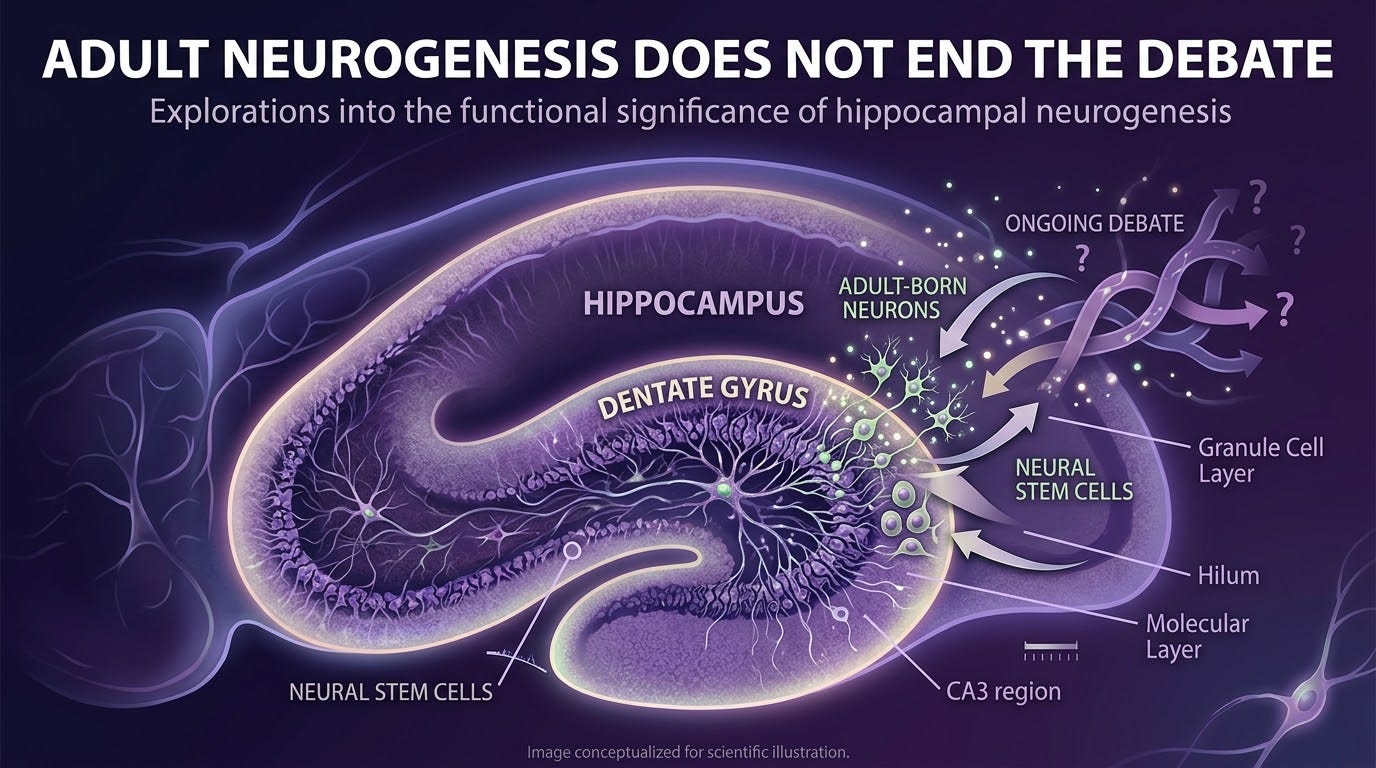
In 2025, Ionut Dumitru, Marta Paterlini, and their colleagues provided compelling evidence for proliferating neural progenitor cells in the adult human hippocampus. Using single-nucleus transcriptomic analyses together with immunohistochemical identification of proliferating cells and computational approaches, the authors identified proliferating neural progenitors in adult human hippocampal tissue and showed that these progenitor populations were localised within the dentate gyrus. Their findings made an important contribution to a debate that had remained unresolved for years: adult human hippocampal tissue can contain cellular populations that retain proliferative and neurogenic characteristics.
The following year, Ahmed Disouky and colleagues extended the landscape considerably further. Using multiomic single-cell approaches to analyse 355,997 nuclei isolated from human hippocampal samples, they identified neural stem cells, neuroblasts, and immature granule neurons across cohorts representing young adulthood, healthy ageing, exceptional cognitive ageing, preclinical pathology, and Alzheimer’s disease. Their work did not merely revisit the question of whether neurogenesis exists. It began to investigate the molecular and regulatory architecture through which neurogenesis changes across ageing, cognitive resilience, and neurodegeneration.
Taken together, these studies represent a substantial advance. They strengthen the evidence that the adult human hippocampus is not simply a biologically static structure. At least within the specialised environment of the dentate gyrus, cellular populations associated with neurogenesis can persist into adulthood, and the molecular organisation of this neurogenic system can change with age, cognitive status, and disease. The question that dominated the controversy for decades is therefore no longer the only question that matters.
But this is precisely where the scientific problem becomes more interesting. A discovery can settle one question while bringing another into sharper focus. The confirmation of proliferating neural progenitors and neurogenic trajectories does not mean that all questions about the adult brain have now been resolved. It means that the nature of the problem has changed.
If the adult human hippocampus can selectively generate new neuronal elements, then neuroscience should also ask how such biological renewal remains compatible with the persistence of function. This question becomes particularly important when the hippocampus is considered in relation to memory.
The hippocampus occupies a central position in contemporary theories of memory formation, contextual representation, indexing, consolidation, and the organisation of distributed mnemonic systems. Yet memory is not merely the capacity to acquire new information. A memory system must also preserve enough continuity for information acquired at one point in time to remain functionally available after the biological system that participated in its acquisition has undergone further experience, plasticity, molecular change, synaptic remodelling, ageing, and, in some regions, the selective generation and integration of new cellular elements.
The problem is therefore no longer simply whether new neurons can appear. It is what their appearance requires us to ask about the organisation of the system into which they appear. How can a biological system preserve functional continuity while selectively generating new cellular elements within an architecture that would need to remain sufficiently stable to support memory?
This is not a question that contradicts adult neurogenesis. On the contrary, it is a question made more salient by the accumulating evidence.
A biological system can be dynamic without being disorganised. It can change without losing its functional identity. It can learn without becoming unrecognisable to itself. Neuroscience already possesses an extensive vocabulary for describing many of the mechanisms through which these transformations occur: synaptic plasticity, structural remodelling, systems consolidation, neural ensembles, engrams, pattern separation, pattern completion, and adult neurogenesis. Each describes an important aspect of how neural systems change, adapt, encode, reorganise, or recover function. Yet the coexistence of these processes raises a broader problem. What, exactly, must remain sufficiently preserved for change not to become fragmentation?
This question is particularly striking in the hippocampus. The dentate gyrus is associated with mechanisms that support learning and the differentiation of related experiences, while also constituting the principal adult neurogenic niche currently supported by evidence in the human brain. Disouky and colleagues themselves emphasize that the relevance of adult hippocampal neurogenesis for human cognition remains unknown. Their work therefore extends the biological description of neurogenesis while leaving open a fundamental functional question: what role does the selective renewal of cellular populations play within a system that must simultaneously participate in the organisation of memory across time?
The apparent paradox should not be exaggerated. The generation of new neurons does not imply that an entire mature neural network is continuously replaced. Neural progenitor proliferation is not synonymous with the continuous substitution of mature neurons, and neither proposition is equivalent to the continuous replacement of the neural architecture supporting memory. These are distinct biological claims, and confusing them would obscure rather than clarify the significance of adult neurogenesis.
But once these distinctions are made, a further question remains. A memory can survive changes in synaptic strength. It can survive changes in molecular composition. It can survive the addition of new experiences and the continuous adaptation of the organism. In some neural systems, it must also coexist with the selective appearance and integration of new cellular elements. What allows continuity to survive this transformation?
The question leads us beyond the historical debate over whether adult neurogenesis exists. It directs attention toward a more general problem of biological organisation: how can a living system remain functionally continuous while parts of its own substrate continue to change?
The distinction is consequential because the neuroscience of memory has largely been organised around questions of encoding, storage, retrieval, consolidation, representation, and transformation. These questions have produced an extraordinary body of experimental knowledge. We increasingly understand that memory is not a single object stored in a single place, and that the biological processes supporting it are distributed across cells, synapses, neural populations, circuits, and systems.
However, another question should be distinguished from these: where are memories encoded, organised, indexed, or initially stabilised, and what preserves their functional continuity as the biological substrate changes?
The two questions are related, but they are not identical. The first concerns the formation and organisation of memory. The second concerns persistence. The confirmation of adult hippocampal neurogenesis therefore does not close the scientific debate surrounding memory and the adult brain. It moves that debate to a deeper level.
The question now extends beyond whether the adult brain can change. We already know that it can. The question is how much change a biological architecture can undergo while preserving sufficient structural and organisational continuity to remain functionally continuous across time. That is the problem to which adult neurogenesis now directs us. Its significance relative to the original controversy remains to be established.
What the Recent Studies Established
The scientific significance of a discovery depends, first, on describing it accurately. This principle is particularly important in the study of adult human neurogenesis, where decades of controversy have often produced a curious scientific situation: the same evidence has sometimes been interpreted as proof, absence of proof, indirect support, methodological artefact, or evidence for an entirely different biological process. The difficulty has not merely been determining whether the adult human hippocampus changes. No serious account of the adult brain can deny that it changes. The difficulty has been identifying, with sufficient cellular specificity, whether populations capable of generating new neurons persist within the adult human hippocampus.
It is within this historical context that the 2025 study by Ionut Dumitru, Marta Paterlini, Margherita Zamboni, and their collaborators assumes its importance. The study emerged from the research environment of Jonas Frisén and colleagues at the Karolinska Institutet in Stockholm, bringing together expertise in cellular and molecular biology, transcriptomics, bioinformatics, computational analysis, pathology, and human brain research. Dumitru and Paterlini contributed equally to the work, which also included Christoph Ziegenhain, Sarantis Giatrellis, Rasool Saghaleyni, Åsa Björklund, Kanar Alkass, Mathew Tata, Henrik Druid, and Rickard Sandberg. The collaboration reflects the nature of the problem itself: demonstrating neurogenesis in the adult human brain requires evidence that cannot easily be obtained through a single experimental technique.
The title of their publication is therefore important: Identification of proliferating neural progenitors in the adult human hippocampus.
It is a deliberately precise title. The authors do not claim to have demonstrated the continuous replacement of the adult hippocampal neuronal population. They do not claim that the adult hippocampus continuously reconstructs its mature neural architecture. Nor do they present their study as a complete explanation of the functional consequences of adult neurogenesis for memory. Their central achievement is both more specific and scientifically more powerful: they identified proliferating neural progenitor cells in the adult human hippocampus.
This distinction should guide any interpretation of their work. The question addressed by Dumitru and colleagues was rooted in a long-standing methodological problem. Adult neurogenesis is comparatively accessible to experimental investigation in laboratory animals, but the human brain presents obvious limitations. Human tissue cannot ordinarily be examined longitudinally under controlled experimental conditions, the identification of rare cellular populations is technically difficult, and post-mortem material introduces additional biological and methodological challenges. Most importantly, the failure to identify a proliferating progenitor cell cannot automatically be interpreted as evidence that such cells do not exist. A rare, transient, spatially restricted, or molecularly heterogeneous cellular population can remain difficult to detect even when the biological process itself is present.
Dumitru and colleagues approached this problem by analysing human hippocampal tissue across the lifespan, from birth through adulthood. Their experimental framework was designed around a central principle: before asking whether proliferating progenitors persist in adulthood, one must first understand how the relevant cellular populations can be identified and distinguished.
The study used single-nucleus RNA sequencing to analyse the transcriptional profiles of cells within the human hippocampus. This approach allowed the investigators to classify cellular populations according to patterns of gene expression rather than relying exclusively on a small number of predetermined markers. In early childhood, the authors identified the expected stages of the neural progenitor population, establishing a developmental transcriptional framework against which later hippocampal samples could be examined.
This was methodologically significant.
The study was not based simply on asking whether one marker associated with neurogenesis could be detected in an adult brain. Instead, it approached the problem through the identification of cellular populations and transcriptional states. The relevant question became whether adult hippocampal cells could be identified whose molecular profiles were consistent with neural progenitor populations and whether evidence could then be obtained that some of these cells were actively proliferating.
To address the second part of this problem, the authors used antibodies against Ki67, a widely used marker associated with cellular proliferation. Ki67 does not identify a neuron, nor does it independently establish the complete developmental fate of a cell. Its importance in this context is more precise: it provides evidence that a cell is engaged in the cell cycle and is therefore proliferative. The identification of Ki67-positive cells was consequently integrated into a broader analytical framework rather than being treated as an isolated demonstration of adult neurogenesis.
The investigators then combined this cellular evidence with machine-learning approaches designed to identify and classify proliferating neural progenitor populations within the adult human hippocampus. This computational component was particularly relevant to the biological difficulty of the problem. Cellular populations do not always separate cleanly into simple categories. Developmental states can overlap. Molecular signatures can change gradually. Rare populations may be obscured within much larger datasets dominated by mature neuronal and non-neuronal cell types. Machine-learning approaches can therefore help detect patterns that would be difficult to identify through a limited set of manually selected markers alone.
According to the authors’ reported findings, this combined approach identified proliferating neural progenitor cells in adolescent and adult human hippocampal tissue. The transcriptomic analyses further supported the localisation of neural progenitors within the dentate gyrus.
This anatomical localisation matters. The finding is not that the adult human brain, considered as a homogeneous organ, has been shown to generate new neurons indiscriminately throughout its entire structure. The evidence described by Dumitru and colleagues concerns a specific neurogenic cellular population within a specific anatomical environment: the adult human hippocampus, with neural progenitor populations localised within the dentate gyrus. That precision is not a limitation of the discovery. It is part of its scientific strength.
Biological systems are rarely uniform. Cellular renewal, plasticity, and developmental capacity are distributed unevenly across tissues and anatomical regions. A specialised neurogenic niche should therefore not be interpreted as evidence that all neuronal populations throughout the adult brain possess the same capacity for proliferation or renewal. The dentate gyrus is precisely the kind of anatomical specificity that makes the finding biologically meaningful.
The question, therefore, is not whether the study demonstrated that every mature neuron in the adult brain can divide. It did not. Nor is the relevant conclusion that the adult brain is continuously replacing its neuronal population. That is not what the study set out to demonstrate.
The direct conclusion is more precise: Proliferating neural progenitor cells can be identified in the adult human hippocampus, and transcriptomic evidence localises neural progenitor populations within the dentate gyrus. This represents an important contribution to the scientific evidence concerning adult human hippocampal neurogenesis. The importance of this conclusion should not be diminished by precision. On the contrary, precision is what gives the discovery its value.
For many years, one of the central difficulties in the field was the challenge of finding proliferating progenitor cells in adult human hippocampal tissue. Dumitru and colleagues directly addressed that difficulty through the integration of transcriptomic analysis, proliferation markers, computational classification, and anatomical localisation. Their findings therefore move the discussion beyond a purely inferential argument about whether adult neurogenesis might theoretically occur in humans. They provide cellular evidence that proliferating neural progenitor populations persist in the adult human hippocampus.
The available evidence supports this interpretation. The discovery deserves to be taken seriously. This point requires substantiation before any deeper question can be asked. Our purpose is not to minimize the achievement of Dumitru and colleagues, nor to suggest that their findings are somehow weakened because they do not answer every question raised by adult neurogenesis. No scientific study is required to answer questions it was not designed to investigate.
The more productive response is the opposite. Once proliferating neural progenitors have been convincingly identified, the scientific discussion can move forward. The question is no longer whether the evidence should be dismissed. The question is what follows from taking that evidence seriously. And this requires an equally precise distinction between several propositions that are often treated as though they meant the same thing. They do not.
The proliferation of a neural progenitor, the generation of a new neuron, the replacement of a mature neuron, and the preservation or transformation of the neural architecture supporting memory are not equivalent biological processes. Confusing them would obscure the significance of the discovery. Distinguishing them allows the discovery to reveal its full implications.
Four Distinct Claims About Adult Neurogenesis
Scientific debates often become confused not because the available evidence is necessarily contradictory, but because different biological propositions are allowed to merge into a single conclusion.
This risk is particularly important in the discussion of adult neurogenesis. The statement that proliferating neural progenitor cells exist in the adult human hippocampus is not identical to the statement that new neurons are generated and integrated into adult neural circuits. Neither statement is equivalent to the proposition that mature neurons are continuously replaced. And neither of these propositions, even if established, would by itself demonstrate that the neural architecture supporting memory undergoes continuous replacement.
These are four different biological claims. They operate at different levels of organisation. They therefore require different forms of evidence. Failing to distinguish them risks producing conclusions that extend beyond what a particular experiment was designed to establish. Conversely, distinguishing them does not weaken the evidence for any one of them. It allows each finding to retain its proper scientific meaning.
Neural Progenitor Proliferation
The first claim concerns the most immediate level of cellular evidence. A neural progenitor cell enters the cell cycle and undergoes proliferation. In its most precise form, this establishes cellular proliferation within a neurogenic lineage.
This is the level at which the findings of Dumitru and colleagues are particularly important. Using antibodies against the proliferation marker Ki67, together with machine-learning algorithms and transcriptomic analyses, the authors identified proliferating neural progenitor cells in the adult human hippocampus. Their transcriptomic data further localised neural progenitor populations within the dentate gyrus. This is already an important finding. But its meaning must remain precise.
A proliferating progenitor is not, by definition, a newly generated mature neuron. Ki67 indicates that a cell is associated with active proliferation. It does not, by itself, establish the complete developmental trajectory of that cell, its ultimate fate, its long-term survival, its synaptic integration, or its functional contribution to a particular neural computation. Those questions require additional evidence. Thus, the identification of proliferating neural progenitors establishes an important biological fact: the adult human hippocampus contains cells within a neural progenitor lineage that retain proliferative activity. It does not automatically establish the continuous replacement of mature neurons.
This distinction is not semantic. It separates the observation of cellular proliferation from the much stronger claim of neuronal substitution.
A biological system may generate progenitor cells without every proliferative event leading to the production of a surviving, mature, and functionally integrated neuron. The trajectory between proliferation and mature functional integration contains multiple developmental and biological stages.
The first claim therefore concerns proliferative potential and activity. It tells us that the system retains a capacity for cellular renewal within a neurogenic lineage. It does not yet tell us the full functional destiny of every newly generated cellular element.
Adult Neurogenesis
The second claim concerns not simply cellular proliferation but the existence of an identifiable neurogenic trajectory. Adult neurogenesis implies that cells progress through developmental states associated with neuronal generation and maturation. Conceptually, the relevant sequence can include:
neural stem-cell or progenitor state, neuroblast, immature neuron, and mature neuron.
The strength of this second level lies not in the identification of a single marker but in the demonstration of a biologically coherent developmental trajectory. This is precisely where the work of Disouky and colleagues substantially extends the molecular framework.
Using multiomic single-cell analyses of human post-mortem hippocampal samples, the authors identified neural stem cells, neuroblasts, immature granule neurons, and mature granule neurons. Their RNA velocity analyses supported a directional developmental trajectory from neural stem cells through intermediate developmental states toward mature granule neurons. Complementary chromatin-accessibility analyses provided an additional molecular framework for distinguishing stemness-associated and neuronal maturation states.
This is a distinct level of evidence from the identification of cellular proliferation alone.
The question is no longer merely: Is a cell dividing? It becomes: Does the cellular population occupy a recognisable position within a neurogenic developmental trajectory?
The two questions are related, but they are not interchangeable. Together, the findings of Dumitru and colleagues and the multiomic framework developed by Disouky and colleagues strengthen the evidence that the adult human hippocampus contains cellular populations associated with a continuing neurogenic process. Dumitru and colleagues identified proliferating neural progenitors, whereas Disouky and colleagues described a molecular trajectory encompassing neural stem cells, neuroblasts, immature neurons, and mature granule neurons.
Yet even here, precision remains essential. Adult neurogenesis does not necessarily imply that newly generated neurons are produced for the purpose of replacing neurons that have already matured and disappeared. Generation and replacement are not the same biological process.
A new neuron may be added to an existing architecture. It may integrate selectively. It may survive or fail to survive. Its contribution may depend on developmental timing, local circuit organisation, experience, and the physiological state of the surrounding network.
Therefore, the second claim establishes something more extensive than progenitor proliferation: the existence of a neurogenic developmental trajectory within the adult human hippocampus. However, it still does not establish the continuous replacement of the mature neuronal population.
Continuous Replacement of Mature Neurons
The third claim is substantially stronger. It would imply the continuous replacement of already mature neurons by newly generated neurons.
This proposition introduces a different biological question. It is no longer concerned simply with whether a neural progenitor divides or whether a developmental neurogenic trajectory can be identified.
It concerns whether mature neurons already participating in an established neural architecture are continuously lost and replaced by newly generated neurons in a manner that constitutes an ongoing turnover of the mature neuronal population.
The distinction matters because a system can contain neurogenesis without operating according to a model of complete or continuous neuronal replacement. The addition of new cellular elements and the substitution of old ones are different organisational processes.
Consider the difference between two biological possibilities. In the first, new neurons are generated and progressively incorporated into an existing neural population while much of the pre-existing mature architecture remains present. In the second, mature neurons are continuously removed and replaced by newly generated neurons such that the cellular composition of the network is progressively substituted over time.
These are not equivalent forms of biological renewal. The first describes selective cellular addition and integration. The second describes continuous mature neuronal replacement. The identification of proliferating neural progenitors should therefore not automatically be assimilated to the latter proposition.
Dumitru and colleagues did not frame their central finding as a demonstration that the mature neuronal population of the adult hippocampus is continuously replaced. Their study established the presence of proliferating neural progenitors in the adult human hippocampus and localised neural progenitor populations within the dentate gyrus.
Similarly, the neurogenic trajectory described by Disouky and colleagues establishes molecular evidence consistent with progression through developmental neuronal states. It does not, by itself, answer the distinct quantitative question of whether the mature neuronal population supporting adult hippocampal function undergoes continuous cellular substitution.
This is not a limitation of either study. It is simply a different question. And it would require experiments specifically designed to answer it. The distinction becomes particularly important when neurogenesis is discussed in relation to memory. If newly generated neurons are incorporated into an existing circuit, the fundamental question is not merely whether the circuit contains new cells. It is: How does their integration alter, preserve, or reorganise the pre-existing functional architecture? That question leads directly to the fourth level.
Continuous Replacement of the Neural Architecture Supporting Memory
The fourth claim concerns a broader level of organisation. It also moves from the level of individual cells to the level of biological organisation. Even if new neurons are generated within the adult human hippocampus, a further question remains: Does the neural architecture supporting a given memory undergo continuous replacement?
This question cannot be answered merely by counting cells. Nor can it be answered simply by demonstrating the existence of progenitor proliferation or even a complete neurogenic developmental trajectory. The reason is straightforward. A memory is not identical to a neuron. A neural architecture supporting a memory is not reducible to the number of cells contained within a particular anatomical structure.
Memory depends on relationships. It depends on patterns of connectivity, functional organisation, synaptic efficacy, population dynamics, and interactions among distributed neural systems. A change in cellular composition may therefore have profoundly different consequences depending on whether the organisational relationships that support function are disrupted, transformed, compensated for, or preserved.
The introduction of a new neuron into a neural system is thus not equivalent to the replacement of the functional architecture of that system. A newly generated neuron may become incorporated into an existing organisational framework. It may contribute to the modification of that framework. It may participate in the encoding of new information. It may alter the dynamics through which existing information is discriminated, generalised, or retrieved. But none of these possibilities automatically implies that the entire architecture supporting a previously established memory has been replaced.
This distinction is where the problem of adult neurogenesis becomes substantially more interesting. The question now extends beyond: Can the biological substrate change? The evidence for plasticity makes that question increasingly uncontroversial. The question becomes: What level of organisation must remain sufficiently preserved for functional continuity to survive biological change?
The studies by Dumitru and colleagues and Disouky and colleagues do not directly answer this question. But this should not be interpreted as a weakness in their work. It was not the question these studies were designed to answer.
Dumitru and colleagues investigated whether proliferating neural progenitor cells could be identified in the adult human hippocampus. Disouky and colleagues investigated the molecular, transcriptomic, and epigenomic architecture of human hippocampal neurogenesis across adulthood, ageing, cognitive resilience, and Alzheimer’s disease. Both studies make important contributions within the scientific frameworks they established.
The problem of functional continuity belongs to another level of analysis. It asks what happens when biological components change within a system whose function depends on organised relationships extending across time. This does not contradict neurogenesis. It follows from taking neurogenesis seriously.
If new cellular elements can be generated and integrated within a neural system that participates in learning and memory, then the problem of continuity becomes more, not less, important. How can the system change without losing the functional consequences of its previous organisation? How can new elements be integrated without reducing the system to a succession of disconnected biological states?
How can memory remain functionally available while the biological substrate participating in its formation continues to undergo plasticity, molecular change, structural remodelling, and, in specialised regions, cellular renewal?
These questions move the debate from the existence of neurogenesis toward the organisation of persistence. This transition depends on keeping the four claims distinct. Progenitor proliferation is not identical to neurogenesis. Neurogenesis is not identical to mature neuronal replacement. Mature neuronal replacement is not identical to the replacement of a functional neural architecture. The scientific importance of adult hippocampal neurogenesis is not reduced by these distinctions. It is clarified by them.
Only once these levels are separated can we begin to ask what the evidence from the human hippocampus actually means for the larger question of the adult brain—and why a discovery about the generation of new neurons may ultimately lead to a deeper problem about the persistence of organised function.
From Dentate-Gyrus Evidence to Claims About the Adult Brain
Scientific discoveries do not enter public culture in the same form in which they leave the laboratory.
Between a scientific paper and a public headline, evidence must be translated. Technical language must become accessible. Cellular classifications must become understandable. Statistical and anatomical precision must often be compressed into a few sentences capable of capturing attention. This process is necessary.
Without scientific communication, discoveries remain confined to specialised communities and technical literature. But translation always introduces a risk: as scientific language becomes broader and more accessible, the boundaries of the original evidence can gradually become less visible.
The recent coverage of adult human neurogenesis provides a particularly useful example. The Futura article discussing the findings of Dumitru and colleagues was published under the headline: “Scientists confirm adult human brains continue to produce new neurons.”
The article itself then describes research conducted in the hippocampus and explains that the investigators identified proliferating neural progenitor cells within adult human hippocampal tissue. It further describes the dentate gyrus as the anatomical region in which the relevant progenitor populations were localised.
The problem is therefore not that the article is unrelated to the underlying science. Nor is the problem that its central message is entirely fabricated. The difficulty lies elsewhere. The anatomical scope of the scientific evidence is narrower than the linguistic scope of the headline. This distinction is subtle, but scientifically important.
The study by Dumitru and colleagues concerns the adult human hippocampus. More specifically, their transcriptomic data showed that neural progenitor populations were localised within the dentate gyrus. Their central experimental achievement was the identification of proliferating neural progenitor cells within this specialised anatomical environment.
The headline, however, shifts the grammatical subject from a specific neurogenic niche to the organ as a whole: adult human brains. This change is understandable from the perspective of popular communication. “The adult human brain” is immediately intelligible. “The dentate gyrus of the adult human hippocampus contains proliferating neural progenitor populations” is scientifically more precise but considerably less likely to function as a public headline.
Yet these two formulations do not carry exactly the same scientific implications. The first can easily be understood as a statement about the adult brain in general. The second identifies a specific anatomical location in which a particular biological process has been demonstrated. The distinction matters because the brain is not a homogeneous biological structure. It is not one tissue with one uniform capacity for renewal.
Different regions contain different neuronal populations, developmental histories, cellular environments, molecular programs, vascular structures, glial interactions, patterns of connectivity, and capacities for structural change. A biological property demonstrated in one specialised neural environment cannot automatically be generalised to the entire organ.
The adult human hippocampus is therefore not simply a representative fragment of the brain from which the biological properties of all other regions can be inferred. And the dentate gyrus is even more specific.
The dentate gyrus is not merely one small portion of the brain in which researchers happened to find new cells. Its anatomical and cellular identity is central to the interpretation of the evidence. It is a specialised component of the hippocampal formation with a distinctive cellular organisation and a long-standing association with adult neurogenesis research. The localisation of proliferating neural progenitor populations within this region is therefore biologically meaningful. It suggests not a generalised capacity of every mature neural population to proliferate, but the persistence of a specialised neurogenic environment within a particular anatomical niche.
This distinction becomes even more important when the recent work of Ahmed Disouky and colleagues is considered alongside that of Dumitru and colleagues. Disouky and colleagues examined human hippocampal neurogenesis through a large multiomic analysis of post-mortem human hippocampi obtained from individuals across different cognitive and pathological conditions. Their work identified neural stem cells, neuroblasts, and immature granule neurons within the hippocampal neurogenic system and examined the molecular regulation of these populations across adulthood, ageing, Alzheimer’s disease, and exceptional cognitive ageing. The significance of this work lies partly in its anatomical specificity.
The question under investigation is not whether the adult human brain is uniformly capable of generating new neurons across all of its structures. It concerns the molecular architecture of a particular neurogenic system within the hippocampus.
Indeed, the broader research framework associated with Disouky and colleagues is explicitly organised around human hippocampal neurogenesis and the cellular interactions of specialised neurogenic niches. The available project description emphasizes the need to understand the mechanisms regulating neurogenesis within the adult human hippocampus and the interactions of neurogenic populations with their local cellular environment.
This matters because neurogenesis is not simply a property of an isolated cell. A cell does not generate, mature, and integrate into a functional neural system in anatomical emptiness. Neurogenesis depends on an environment. It depends on local molecular signals, cellular interactions, developmental programs, vascular and metabolic conditions, glial regulation, extracellular organisation, and circuit-specific constraints. A neurogenic cell population must therefore be understood within the niche that makes its existence possible.
The dentate gyrus should consequently be interpreted not merely as the place where new cells have been found, but as part of the biological context that makes the process itself possible. This has an important consequence for scientific interpretation. The existence of adult neurogenesis within a specialised neurogenic niche does not imply that the adult cortex, the thalamus, the basal ganglia, or every other mature neural structure possesses the same degree of proliferative capacity. Nor does it imply that mature neurons throughout the adult brain are continuously replaced.
These are additional propositions. They require their own evidence. The scientific discovery becomes no less important once this distinction is made. On the contrary, its biological significance becomes more precise.
The remarkable finding is not necessarily that the adult brain has retained a universal developmental program capable of regenerating neurons everywhere. The more interesting possibility is that evolution has preserved specialised forms of cellular renewal within particular neural architectures while maintaining relative stability in others. Such specialisation would itself demand explanation. Why should one neural system retain a detectable neurogenic lineage while another appears to preserve its mature cellular population more conservatively? What computational or biological demands distinguish a renewable neural niche from a relatively stable neural architecture? What functions can be supported by the selective generation and integration of new neurons that might not be compatible with indiscriminate neuronal renewal throughout the brain?
These questions are more scientifically interesting than a generalised statement that “the adult brain makes new neurons.” They transform the discovery from a simple binary proposition into a problem of regional biological specialisation.
From Organ-Level Language to Niche-Level Evidence
The linguistic difference between brain and dentate gyrus may appear minor to a non-specialist reader.
Scientifically, it is not. The phrase ‘the adult human brain produces new neurons’ suggests an organ-level property. The evidence from Dumitru and colleagues establishes a much more anatomically specific finding: Proliferating neural progenitor cells can be identified in the adult human hippocampus, with neural progenitor populations localised within the dentate gyrus.
The second formulation is not less remarkable. It is simply more faithful to the scale at which the evidence was obtained. This is an important principle of scientific communication. The scope of a conclusion should remain proportionate to the scope of the observation.
When a process is demonstrated within a particular cell type, the conclusion should not automatically become a statement about all cells. When it is demonstrated within a particular anatomical region, the conclusion should not automatically become a statement about the entire organ. And when it is demonstrated in one biological context, the conclusion should not automatically be generalised to every physiological function associated with that organ. The same principle applies to the interpretation of adult neurogenesis.
Dumitru and colleagues demonstrate proliferating neural progenitor cells within the adult human hippocampus. Disouky and colleagues provide a much broader molecular characterization of hippocampal neurogenesis across adulthood, ageing, cognitive resilience, and Alzheimer’s disease. Neither finding requires us to conclude that the adult brain is uniformly neurogenic. Nor do these findings require us to conclude that the adult nervous system continuously renews its mature neuronal population as a whole.
The scientific evidence points instead toward something potentially more complex: biological renewal may be selectively preserved within specialised neural niches. This possibility should not be regarded as a restriction on the significance of adult neurogenesis. It may be one of its most important implications.
A selectively renewable neural structure suggests that renewal itself may be regulated according to the biological requirements of particular systems. Some neural architectures may benefit from maintaining highly stable cellular populations over long periods. Others may preserve a capacity for selective cellular addition, remodelling, or developmental renewal.
The central scientific problem is therefore not whether one model of the brain must be universally correct. It is to understand why different forms of biological persistence and biological change coexist within the same organ. The brain may be plastic without being uniformly renewable. It may contain regions capable of cellular renewal without implying that all neural systems operate according to the same biological logic. It may preserve stable neuronal populations in some contexts while maintaining specialised developmental niches in others.
This interpretation is not more conservative than the popular claim. It is more biologically specific. And specificity is particularly important when scientific discoveries are communicated to the public.
The Futura article correctly identifies the historical importance of the debate over adult human neurogenesis. It correctly links the recent findings to research from the Karolinska Institutet and describes the use of advanced single-cell and computational methods to investigate human hippocampal tissue. It also identifies the hippocampus as the anatomical focus of the study.
The difficulty emerges when the language of the article progressively moves from the evidence obtained in a specialised hippocampal region toward more general claims about the adult brain. The phrase ‘the adult brain continues to grow new neurons’ is broader than the direct anatomical scope of the evidence discussed in the study.
This does not necessarily make the statement false in the ordinary language of public communication. The hippocampus is, of course, part of the brain. A process occurring within the hippocampus is therefore occurring within the brain. But this logical relationship should not obscure the scientific distinction between: a process occurring somewhere within the brain and a process that characterises the brain generally. These are different propositions.
The first is supported by the anatomical evidence. The second would require evidence across a substantially broader range of neural regions. Scientific communication becomes problematic when the reader is not given enough linguistic information to distinguish between them. The issue, therefore, is not one of accusation. It is one of scale. The scale of the biological evidence is regional and niche-specific. The scale of the headline is organ-wide. And when these two scales are not explicitly distinguished, a reader can easily infer a stronger biological generalisation than the original study directly establishes.
This is particularly important because the public implications of the discovery can then expand as well. A statement about proliferating progenitors in the dentate gyrus can become a statement about lifelong neuronal renewal. Lifelong neuronal renewal can become a statement about widespread regeneration. And widespread regeneration can then be interpreted as evidence for new possibilities in brain repair, recovery from injury, ageing, education, or cognitive enhancement. Each of these transitions may be scientifically interesting. But each represents an additional inferential step. The evidence supporting one level does not automatically establish the next.
The most accurate interpretation of the present evidence is therefore not that the adult brain has been revealed to be uniformly regenerative. The evidence is more specific. It supports the existence of specialised neurogenic processes within the adult human hippocampus. The dentate gyrus should consequently be understood as an anatomically and functionally distinctive environment in which cellular renewal can coexist with a mature neural system. That coexistence is itself one of the most interesting features of the discovery.
A specialised neurogenic niche represents a biological solution to a difficult organisational problem. A neural system must preserve enough stability to maintain its functional operations. At the same time, under particular biological conditions, it may retain the capacity to generate and integrate new cellular elements.
The existence of such a niche suggests that stability and renewal are not mutually exclusive biological principles. But neither are they necessarily distributed uniformly. They may coexist through specialisation. The question that follows is therefore not: Can the adult brain change? Nor even simply: Can the adult brain generate new neurons?
The evidence from the adult human hippocampus has made the answer to that question increasingly clear within a specific neurogenic context. The more interesting question is: Why is biological renewal preserved here? Why does the dentate gyrus retain a cellular capacity that appears to be highly restricted anatomically? What functional demands might make selective renewal compatible with this particular architecture? And how does a system containing a renewable cellular component preserve the continuity of the functions in which it participates?
These questions do not reduce the importance of adult human neurogenesis. They arise because the evidence for it is now sufficiently compelling to require a more precise biological interpretation. The conclusion, therefore, is not that the adult human brain is either regenerative or non-regenerative. Such a binary description is too crude for the biology now emerging.
The more accurate conclusion is: The evidence supports specialised neurogenic niches, not a uniformly neurogenic adult brain. And this distinction changes how the discovery should be understood. Adult neurogenesis is not necessarily evidence that the mature brain has retained everywhere the biological logic of development. It may instead reveal something more selective: that the adult brain preserves different strategies of persistence in different neural architectures. Some systems may depend primarily on the long-term preservation of existing cellular substrates. Others may retain specialised capacities for controlled cellular renewal.
The coexistence of these strategies raises a deeper question about the organisation of the adult brain.
How can selective renewal occur in one part of a system whose broader function depends on continuity?
It is here that the anatomical specificity of the dentate gyrus becomes more than a methodological detail. It becomes the beginning of the biological problem we should now investigate.
The Molecular Architecture of Human Hippocampal Neurogenesis
Disouky et al. and the Molecular Architecture of Human Neurogenesis
If the study by Dumitru and colleagues helped move the debate toward direct cellular evidence for proliferating neural progenitors in the adult human hippocampus, the publication by Ahmed Disouky and colleagues substantially changes the scale of the scientific landscape.
Published in Nature in February 2026 under the title Human hippocampal neurogenesis in adulthood, ageing and Alzheimer’s disease, the study does not simply return to the question of whether neurogenesis exists. It asks a more ambitious set of questions. What cellular states constitute the neurogenic system of the adult human hippocampus? What molecular and regulatory networks distinguish these states? How do these networks change with ageing? How are they altered during the transition toward Alzheimer’s disease? And what distinguishes the hippocampus of individuals who retain exceptional memory performance into advanced age?
The study therefore moves the scientific discussion from the problem of existence toward the problem of regulation. This is an important transition.
The existence of a biological process is only the beginning of its scientific investigation. Once a process has been identified, the next questions concern its organisation, regulation, variability, vulnerability, and functional significance.
Disouky and colleagues approached these questions through an unusually large multiomic analysis of the human hippocampus. Using single-nucleus RNA sequencing together with single-nuclei assay for transposase-accessible chromatin sequencing, the investigators analysed 355,997 nuclei isolated from post-mortem human hippocampal samples. Their approach combined information about gene expression with information about chromatin accessibility, allowing cellular identity and regulatory state to be investigated simultaneously. The significance of this approach should not be underestimated.
Transcriptomic analysis can reveal which genes are being expressed by a particular cell population. Chromatin-accessibility profiling adds another dimension by examining which regions of the genome are accessible to the regulatory machinery that controls transcription. Together, these approaches make it possible to move beyond the identification of cell types toward the analysis of the molecular regulatory architecture through which those cells maintain their identity or progress toward another developmental state. The result is not merely a list of cells. It is an attempt to reconstruct the biological organisation of a neurogenic system.
The Neurogenic Trajectory
At the centre of the study is the identification of a developmental trajectory within the adult human hippocampus. Disouky and colleagues identified cellular populations corresponding to neural stem cells, neuroblasts, and immature granule neurons and examined their relationship to mature granule neurons. Using transcriptomic data, machine-learning-assisted cell annotation, RNA velocity, chromatin-accessibility analyses, and gene-regulatory-network approaches, they reconstructed evidence for a directional developmental organisation rather than treating these populations as isolated cellular categories. Conceptually, the trajectory can be represented as follows: neural stem cell → progenitor and transitional developmental states → neuroblast → immature granule neuron → mature granule neuron.
The actual biological trajectory described in the study is more complex than a simple linear diagram. The investigators identified subclusters and used RNA-velocity analyses to infer directional relationships among neural stem cells, astrocyte-associated transitional states, neuroblasts, immature neurons, and mature granule neurons. Nevertheless, the central implication is clear.
The adult human hippocampus contains molecularly distinguishable cellular states that can be organised into a developmental neurogenic trajectory. This matters because it addresses a problem that cannot be resolved through proliferation markers alone. A proliferating cell tells us that a cellular population is active. A developmental trajectory asks something more: What is the biological direction of that activity?
The RNA-velocity analyses provided evidence consistent with directional progression from neural stem-cell-associated states toward neuronal developmental states and ultimately mature granule neurons. The investigators further supported this interpretation through orthogonal chromatin-accessibility analyses.
Neural stem cells exhibited chromatin-accessibility patterns associated with stemness and multilineage potential, whereas neuroblasts and immature neurons showed increasing accessibility of genomic regions associated with neuronal development and maturation. The molecular transition was therefore accompanied by a regulatory transition.
The transcription factors and gene-regulatory networks associated with neural stem-cell maintenance differed from those associated with neuronal differentiation and maturation. This is an important contribution of the study.
Disouky and colleagues do not merely describe a population of cells that appear immature. They investigate the molecular networks through which distinct neurogenic states are maintained and transformed. The study therefore adds a regulatory dimension to the debate over human neurogenesis.
The question becomes not simply whether immature neurons exist, but what molecular architecture organises the transition from stemness to neuronal maturation.
From Cell Identity to Regulatory Architecture
The multiomic design of the study makes this transition possible. Gene expression alone provides a snapshot of cellular identity. But a cell’s identity is not determined only by the genes currently detected within its transcriptome. It also depends on the regulatory landscape that determines which genomic regions are available for transcriptional activity and which regulatory networks can maintain or transform the cell’s biological state.
Disouky and colleagues therefore analysed both transcriptional signatures and chromatin accessibility.
This revealed a progressive reorganisation of molecular programs across the neurogenic trajectory.
Neural stem-cell-associated regulatory interactions diminished as cells progressed toward neuroblast and immature neuronal states. Conversely, regulatory interactions associated with neuronal differentiation and maturation became increasingly prominent.
The study also identified distinct transcription-factor networks associated with different stages of the trajectory. Together, these findings support a model in which adult human hippocampal neurogenesis is not simply a matter of cell proliferation followed by an unspecified developmental fate. It is governed by changing regulatory networks.
This point is particularly important for the broader argument developed in this article. The existence of new cells is not, by itself, the entire biological phenomenon. Cells emerge within an organised regulatory environment. They acquire identities through developmental transitions. Their biological trajectory is constrained by molecular networks. And their eventual contribution to the mature tissue must occur within an already existing anatomical and cellular architecture. The study therefore shifts attention from cellular production toward organised biological transformation.
Ageing, Alzheimer’s Disease, and Preclinical Change
The second major contribution of Disouky and colleagues is that they do not study adult neurogenesis as a single biological condition. They investigate it across different trajectories of ageing and cognitive health. The human hippocampal samples were obtained from five distinct cohorts: young adults with intact cognition; aged adults with normal-for-age cognition; individuals with preclinical intermediate pathology, representing a possible transition from healthy ageing toward Alzheimer’s disease; individuals with Alzheimer’s disease; and SuperAgers, defined as older individuals with exceptional episodic-memory performance.
The young adult cohort included eight cognitively intact individuals between 20 and 40 years of age. Additional cohorts represented healthy ageing, preclinical pathological change, Alzheimer’s disease, and exceptional cognitive ageing. This design changes the scientific question substantially. Neurogenesis is no longer treated as something that either exists or does not exist. It becomes a biological process that can itself change. It can be regulated differently across individuals. It can be altered during ageing. It can become dysregulated during disease. And it may display a distinct molecular profile in individuals who maintain exceptional cognitive function. This is a much richer scientific landscape.
The investigators found that dysregulated neurogenesis was associated largely with alterations in chromatin accessibility. This finding is particularly important because it suggests that pathological change may not first appear simply as the disappearance of a cell population. The regulatory environment of neurogenic cells can change before the full biological consequences of those changes become apparent at the level of cellular composition. In individuals with preclinical intermediate pathology, Disouky and colleagues identified early alterations in chromatin accessibility within neurogenic cells.
These alterations were more pronounced in the samples obtained from individuals with Alzheimer’s disease. The study therefore points toward a potentially important principle: The dysregulation of a biological process may begin at the level of molecular accessibility and regulation before it becomes fully visible at the level of cellular populations.
This distinction between cellular identity and regulatory state is scientifically important. A tissue can contain cells that remain recognisable as belonging to a particular lineage while the molecular networks regulating those cells are already changing.
The architecture of a biological process may therefore begin to transform before the cells themselves disappear. In Alzheimer’s disease, Disouky and colleagues also reported a significant reduction in the average number of neuroblasts and immature neurons compared with younger and healthy ageing cohorts, while neural stem-cell numbers were increased in the preclinical and Alzheimer’s disease groups relative to healthy ageing.
This pattern itself resists simplistic interpretation. It does not support a crude model in which disease merely eliminates every component of the neurogenic system simultaneously. Different stages of the neurogenic trajectory can be affected differently. The problem is therefore one of dysregulation, not merely presence or absence.
The SuperAger Question
Perhaps one of the most intriguing aspects of the study concerns the SuperAger cohort. SuperAgers are individuals aged 80 years or older whose episodic-memory performance is equal to or better than that of individuals decades younger. Disouky and colleagues identified a distinct profile of neurogenesis in this group, which they interpreted as potentially representing a resilience signature. This finding warrants careful interpretation.
The study does not establish that a particular pattern of neurogenesis causes exceptional memory. Nor does it demonstrate that enhanced neurogenesis is, by itself, the explanation for cognitive resilience. The authors themselves frame the finding as a distinct profile that may reflect a resilience signature. That restraint is important. But the observation nevertheless changes the scientific question.
If the neurogenic system displays distinguishable molecular profiles in individuals with different cognitive trajectories, then neurogenesis may be related not only to the generation of cells but also to the broader biological capacity of the hippocampus to respond differently to ageing.
The comparison between healthy ageing, pathological change, Alzheimer’s disease, and SuperAgers therefore introduces an important new dimension: individual variability. Two individuals of similar chronological age do not necessarily possess the same molecular architecture of cognitive ageing. The hippocampus is not simply a biological clock that declines identically in every individual. Its cellular and regulatory systems can follow different trajectories. Some may show pathological dysregulation. Others may retain patterns associated with cognitive resilience.
This observation raises an important scientific question. What distinguishes biological ageing from pathological ageing? And what biological organisation allows some neural systems to maintain functional capacity despite the accumulation of decades of molecular, cellular, and systemic change?
The work of Disouky and colleagues does not provide a final answer. But it gives the question a molecular architecture.
Beyond the Existence of Neurogenesis
Taken together, the findings of Disouky and colleagues change the nature of the debate. The question now extends beyond: Does adult human hippocampal neurogenesis exist? The evidence now directs attention toward a series of more sophisticated questions: How is neurogenesis regulated? How does the neurogenic system change across ageing? What molecular alterations emerge before the clinical expression of neurodegenerative disease? Why are neuroblasts and immature neurons altered differently from neural stem cells in Alzheimer’s disease? Why do some individuals maintain exceptional memory into advanced age? What distinguishes molecular deterioration from molecular resilience?
These questions are scientifically richer than the original binary controversy. They also reveal something important about the meaning of a scientific discovery. The confirmation of a biological phenomenon does not necessarily end a field of investigation. Often, it allows the field to begin.
The evidence for human hippocampal neurogenesis now opens the possibility of investigating its regulatory architecture, its developmental trajectories, its vulnerability to disease, and its relationship to individual differences in cognitive ageing. But one question remains outside the direct scope of both the Dumitru and Disouky studies. It is the question that concerns this article.
Even if the adult human hippocampus contains proliferating progenitors, neural stem cells, neuroblasts, immature neurons, and developmental trajectories toward mature granule neurons, how does the larger functional system preserve continuity across biological change?
The answer cannot be obtained simply by establishing that neurogenesis exists. Nor can it be inferred merely from demonstrating that a developmental trajectory is molecularly coherent. A developmental process explains how new biological elements can emerge. It does not automatically explain how an already functioning biological system preserves the consequences of its previous organisation while incorporating them. This distinction becomes particularly important when the hippocampus is discussed in relation to memory.
Disouky and colleagues themselves explicitly state that the relevance of human hippocampal neurogenesis for cognition remains unknown. Their study therefore provides an extensive molecular framework for understanding the biology of human neurogenesis while leaving the functional problem open.
That open question is not a gap to be criticized. It is an opportunity for the next level of inquiry. The discovery of new cellular trajectories does not eliminate the problem of persistence. The molecular architecture of neurogenesis makes the problem more precise.
If biological systems can preserve cognitive function across ageing while their cellular and regulatory states continue to change, then continuity itself must be understood as an organised biological achievement. This returns the analysis to the question with which this article began. How can a biological system preserve functional continuity while selectively generating new cellular elements within an architecture that would need to remain sufficiently stable to support memory?
The work of Disouky and colleagues does not answer this question. It was not designed to. But by revealing the molecular architecture of neurogenesis across adulthood, ageing, Alzheimer’s disease, and exceptional cognitive ageing, it provides a stronger basis for investigating that question.
The Problem of Functional Continuity
The Question of Functional Continuity
At this point, an important distinction must be made. The studies by Dumitru et al. and Disouky et al. significantly advance our understanding of adult human hippocampal neurogenesis. Together, they provide evidence that moves the field well beyond a simple question of cellular presence or absence.
Dumitru and colleagues identified proliferating neural progenitor cells in the adult human hippocampus, using single-nucleus transcriptomics, Ki67 immunolabelling, machine-learning-based analysis, and spatial localisation within the dentate gyrus. Their evidence directly addresses the long-standing difficulty of identifying proliferating neural progenitors in adult human tissue.
Disouky and colleagues extend the investigation further by examining the molecular and regulatory organisation of human hippocampal neurogenesis across adulthood, ageing, Alzheimer’s disease, and exceptional cognitive ageing.
Together, these studies substantially strengthen the scientific basis for investigating adult human hippocampal neurogenesis. But even if every cellular stage of this process could eventually be described with complete precision, one question would remain. How does a biological system preserve functional continuity while changing?
This is the persistence problem. And it begins precisely where the identification of cells, molecular trajectories, and regulatory mechanisms reaches its explanatory boundary.
A Question the Studies Do Not Claim to Answer
This distinction must be made explicitly. The problem of functional continuity is not absent from the scientific literature because previous investigators failed to consider it. Nor should it be presented as a question that Dumitru et al. or Disouky et al. were expected to answer. It was not the central question for which either study was designed.
Indeed, Disouky and colleagues explicitly acknowledge that the relevance of adult hippocampal neurogenesis for cognition remains unknown. This statement is important. It establishes a boundary between what can currently be demonstrated about the biological existence and molecular organisation of neurogenesis and what remains to be understood about its functional consequences.
The studies can therefore tell us increasingly more about how new cellular elements are generated. At least directly, they do not yet tell us how the functional consequences of previous neural organisation are preserved while biological change continues.
This distinction becomes particularly important when the hippocampus is discussed in relation to memory, because memory is not merely a collection of cells; it is also a problem of continuity. A memory may survive changes in attention, emotional state, physiological condition, synaptic strength, network activity, and the biological history of the organism.
The question is therefore not only how a memory is created. It is also how the organism remains capable of recovering, recognising, reconstructing, and functionally relating to something that was previously learned. That is a different question.
Knowing the Components Does Not Yet Explain Continuity
Imagine that we could describe the neurogenic system with complete biological precision. We could know: the identity of the originating cell; the molecular signature of every progenitor state; the number of proliferating cells; the developmental trajectory toward neuronal maturation; the transcriptional networks associated with each stage; the chromatin-accessibility landscape of the cells; the anatomical location of each population; the timing of maturation; and the way these processes change across ageing and disease. Such knowledge would represent an extraordinary achievement. But even then, one question would remain unresolved. How does the system preserve continuity while changing?
This question cannot be answered simply by increasing the resolution of cellular description. The problem is not a lack of biological detail. It concerns the relationship between biological transformation and functional persistence. A biological system can change at many levels without necessarily losing its functional identity. Synaptic weights can change. Network activity can reorganise. Gene expression can fluctuate. Proteins can be synthesized and degraded. Cells can alter their morphology. New cellular elements can emerge within specialised regions. And yet, despite this continuous biological movement, the organism may remain capable of performing functions that depend upon its previous history.
This is the analytical tension. Change is not the opposite of continuity. But neither is continuity simply the absence of change. A biological system must therefore possess some capacity to remain functionally organised across transformation. The question is what, exactly, must persist.
The Difference Between Biological Renewal and Functional Discontinuity
The existence of adult neurogenesis does not automatically imply the replacement of a functional system. This point is essential.
A new neuron may be generated without replacing an existing mature neuron. A newly generated neuron may integrate into an already functioning network. The integration of that neuron may alter some properties of the network while leaving other organisational properties intact. And the network itself may continue to support functions whose biological implementation is more distributed than the identity of any individual cellular element. These possibilities are not mutually exclusive. The central scientific problem is therefore not whether biological novelty can occur. Available evidence suggests that it can.
The problem is determining the relationship between biological novelty and functional continuity. We can formulate this distinction more precisely. A system may generate new biological components without destroying its functional organisation.
Conversely, a system may preserve most of its cellular components while losing an essential aspect of its functional organisation. This distinction immediately demonstrates why the persistence problem cannot be reduced to the number of neurons present within a given brain region. Continuity is not simply a census problem. Counting cells can tell us whether cellular populations change. It cannot, by itself, tell us whether the organisation responsible for a particular function has remained sufficiently preserved.
Memory Makes the Problem More Visible
The persistence problem becomes particularly striking when applied to memory. A memory is always acquired at one moment and potentially retrieved at another. Between those two moments, the brain is not frozen. The organism continues to live. New experiences are acquired. Synapses are modified. Neural activity fluctuates. Gene expression changes. Proteins are replaced. Networks participate in other functions. The biological substrate continues its own history. And yet the organism may retrieve something learned years or decades earlier.
This is not a trivial fact. It means that the biological system has somehow preserved sufficient functional organisation for a previous experience to remain recoverable despite subsequent transformation. The persistence of memory must therefore be distinguished from the persistence of a biologically static structure. A memory does not require that nothing changes. The brain would cease to learn if nothing changed. But unlimited change would create another problem.
If every aspect of the functional organisation supporting previous experience could be freely transformed without constraint, there would be no obvious reason why the consequences of earlier experience should remain recoverable. The biological system must therefore achieve something more complex than either complete stability or unrestricted plasticity. It must change while remaining organised.
Where the Persistence Problem Begins
This brings us to two questions that should now be carefully separated. The first is: Where are memories encoded, organised, indexed, or initially stabilised?
This is a question to which modern neuroscience has devoted enormous effort. The hippocampus has a central role in episodic memory. The dentate gyrus is involved in computational processes such as pattern separation. Hippocampal networks participate in the formation, organisation, and transformation of memory. Interactions between the hippocampus and distributed cortical systems contribute to the stabilisation and reorganisation of memory across time. These questions concern the biological organisation of memory.
But there is another question. What preserves the functional continuity of memory across the transformation of its biological substrate?
The two questions overlap. But they are not identical. The first asks where and how information is processed, encoded, indexed, organised, or transformed. The second asks how the functional consequences of that organisation remain available across time. The first concerns the formation and biological organisation of memory. The second concerns persistence. This distinction does not diminish the importance of the hippocampus. On the contrary, it makes its role more precise.
The hippocampus may contribute substantially to the formation, indexing, stabilisation, transformation, and reorganisation of memory without thereby being established as the ultimate substrate of mnemonic continuity across the entire lifetime. This possibility deserves investigation. It should not be confused with the claim that the hippocampus is unimportant for memory. The argument is more precise. To participate in the formation of memory is not necessarily the same as to constitute the ultimate substrate of its persistence.
A System Must Change Without Losing Its Place Within the Whole
At this point, the problem can be stated in architectural terms. Consider a biological system composed of cells, synapses, populations, pathways, and distributed functional relationships. Its individual components can change. Some relationships can be strengthened. Others can weaken. New elements may emerge. Existing elements may adapt. But these changes do not necessarily occur within an empty space. They occur within an already organised system.
The crucial question is therefore not simply whether an individual component remains unchanged. The more fundamental question may be whether the component’s transformation remains compatible with the functional organisation of the larger system.
A neuron may change without the network losing its functional identity. A synapse may be modified without the memory disappearing. A new neuron may emerge without destroying the organisation into which it is integrated. But these transformations cannot be biologically arbitrary if continuity is to be preserved. There must be constraints. There must be relationships that remain sufficiently preserved. There must be organisational conditions under which change remains compatible with persistence. This is the point at which the problem becomes deeper than neurogenesis itself.
Adult neurogenesis merely brings the question into sharper focus. If new cellular elements can be generated within a neural system that continues to participate in memory, then memory cannot be understood simply as the static preservation of every biological component involved in its original formation. But neither can continuity be explained by assuming that biological change is irrelevant. The system must negotiate between preservation and transformation. Between stability and plasticity. Between inheritance and novelty. Between what has already been organised and what is still capable of being changed.
The New Scientific Question
The historical debate asked: Can the adult human brain generate new neurons?
The new evidence substantially advances that question, particularly within the specialised neurogenic environment of the human dentate gyrus. But the confirmation of cellular generation opens another problem. What would need to remain sufficiently organised for biological renewal to occur without destroying functional continuity?
This question is broader than adult neurogenesis. It applies to both memory and learning. It applies to ageing. It applies to neural plasticity. And ultimately, it applies to personal continuity itself.
A human being is not biologically static. Yet the organism remains capable of preserving functions that depend upon its history. The brain changes. But learning can persist. The cellular environment changes. But memories can remain recoverable. Neural systems reorganise. But identity does not necessarily dissolve with every transformation.
The scientific problem is therefore no longer simply one of biological generation. It is a problem of organised continuity. And the confirmation of adult hippocampal neurogenesis does not remove that problem. It brings it into sharper focus. A discovery can settle one question while bringing another into sharper focus.
The question of whether proliferating neural progenitors can be identified in the adult human hippocampus has moved significantly forward. The question of how a changing biological system preserves functional continuity now warrants closer investigation. That is the persistence problem. At this point, the debate moves to a deeper level.
What Existing Memory Theories Explain—and What Remains Open
The persistence problem should not be approached as though neuroscience has failed to explain memory. On the contrary. Modern neuroscience has produced an extraordinary body of knowledge concerning learning, memory formation, synaptic modification, neural representation, systems consolidation, and the organisation of memory across distributed neural networks. Any attempt to formulate a deeper question about continuity must therefore begin with intellectual discipline.
Before asking what remains unexplained, we should first recognise what has already been explained. The question is not whether existing theories of memory are insufficient because they have failed. The analysis therefore considers whether several highly successful theories, each operating at a particular level of analysis, leave open a further problem concerning their relationship to one another.
The persistence problem does not replace neuroplasticity. It does not compete with synaptic plasticity. It does not deny the importance of engrams. It does not diminish systems consolidation. It does not contradict pattern separation or pattern completion. And it does not invalidate the role of neural attractors. Each of these frameworks explains something essential. But they do not all ask the same question. The scientific problem becomes visible when we ask how their explanations fit together across time.
Neuroplasticity Explains How the Brain Changes
The most obvious starting point is neuroplasticity. The brain changes because experience changes it. Synaptic strengths are modified. Neurons alter their patterns of connectivity. Dendritic structures can change. Functional networks reorganise. New patterns of activity emerge. Existing patterns are modified by learning. Without plasticity, memory would be impossible. A completely immutable nervous system could preserve a biological configuration, but it could not incorporate new experience into that configuration. Learning therefore requires transformation. This point is central to the analysis.
The persistence of memory cannot mean that the brain must remain unchanged. Such a model would immediately contradict one of the central principles of modern neuroscience. The brain remembers precisely because it can change. But neuroplasticity immediately introduces another question. If the brain can continually change, how much change can occur while preserving the functional consequences of what has already been learned?
This is not a criticism of neuroplasticity. It is the next question that neuroplasticity itself makes necessary. Plasticity explains the biological capacity for transformation. The persistence problem asks: What prevents transformation from becoming functional discontinuity?
These are complementary questions. The first explains how new experience becomes biologically consequential. The second asks how the biological consequences of previous experience remain available while new consequences are continually being added. A functioning nervous system must therefore solve two problems simultaneously. It must remain sufficiently plastic to learn. And it would need to remain sufficiently organised to preserve what learning has already made possible.
Synaptic Plasticity Explains a Mechanism of Memory
At a more specific level, synaptic plasticity provides one of the most influential biological frameworks for understanding memory.
Experience-dependent changes in synaptic efficacy provide a mechanism through which previous neural activity can influence future neural responses. The biological history of the organism becomes embedded in altered probabilities of activation and altered relationships among neural elements. This is one of the great achievements of modern neuroscience. A memory does not need to be imagined as an abstract object stored somewhere inside the brain. Experience can modify the physical and functional relationships through which neural populations interact. The nervous system therefore carries traces of its own history. But here again, a distinction must be made.
Explaining how a synapse changes does not automatically explain how the functional consequences of a large population of changing synapses remain coherent across time. A memory is unlikely to depend upon a single synapse. Nor is the persistence of a memory equivalent to the permanent preservation of every molecular state that existed at the moment of encoding.
Synaptic plasticity explains an essential mechanism through which experience modifies neural systems.
But memory persistence raises a systems-level question. How do innumerable local modifications remain compatible with the preservation of coherent functional organisation?
The answer cannot simply be that individual synapses remain unchanged. They do not. They continue to participate in biological processes of modification, stabilisation, weakening, and reorganisation. The persistence problem therefore begins to emerge between levels of analysis. Local change is compatible with global continuity. But the principle through which that compatibility is achieved itself warrants scientific investigation.
Engram Theory Explains the Physical Organisation of Memory
The modern concept of the memory engram brings the question closer to neural populations. Rather than locating a memory within a single cell or anatomical point, contemporary engram research has demonstrated that memories are associated with distributed populations of neurons whose activity and plastic modifications become functionally related to a particular experience.
This represents a major conceptual advance. Memory is not simply stored in one neuron. It emerges through organised populations. The engram therefore provides a biological framework for understanding how experience can become represented within neural circuitry.
Specific neuronal populations can be recruited during learning. Their connectivity can be modified. Their later reactivation can participate in memory retrieval. Engram theory therefore gives neuroscience a way of connecting experience, neural populations, and later recall. But the persistence problem remains. What happens to the engram across time?
The engram is not necessarily a frozen population. Its synaptic relationships can change. Its interactions with other populations can change. Its participation in distributed memory systems can change. Its functional expression can vary according to context. And evidence increasingly suggests that memory representations can be reorganised over time.
Recent work on systems consolidation, for example, has shown that hippocampal engram circuitry itself can be reorganised over time, including through processes associated with adult neurogenesis. This demonstrates that the biological organisation of a memory circuit can undergo transformation rather than simply remaining permanently fixed in its original configuration.
This observation does not weaken engram theory. It makes the persistence problem more interesting. If the circuitry associated with a memory can reorganise, then the identity of a memory cannot be reduced simply to the permanent preservation of its original microscopic configuration. Something about the functional organisation of the memory must remain recoverable across reorganisation. The question therefore becomes: What persists when the physical realization of an engram is transformed?
Systems Consolidation Explains the Transformation of Memory Across Time
Systems consolidation takes the temporal dimension of memory seriously. It recognizes that memory is not necessarily stored in exactly the same way throughout its existence. The hippocampus and distributed cortical networks can participate differently at different stages of memory. A newly formed memory may depend strongly upon hippocampal processes while its long-term organisation may involve increasingly distributed cortical representations.
This is an essential development for the argument of the present article. It demonstrates that memory can remain functionally related to the same experience while undergoing changes in its neural organisation. The biological substrate of memory can therefore transform across time. This immediately complicates any simplistic theory according to which memory persistence requires the permanent preservation of one anatomical structure.
The hippocampus can be indispensable to memory formation and subsequent transformation without necessarily being the final and exclusive biological repository of every memory throughout the entire lifespan. This is precisely why the question of the hippocampus must be formulated carefully. The argument is not: The hippocampus is not important for memory. That would contradict an enormous body of evidence. The more precise possibility is: The hippocampus may participate in the formation, indexing, stabilisation, transformation, and reorganisation of memory without constituting the ultimate substrate of mnemonic continuity.
Systems consolidation provides a scientific framework within which this possibility becomes entirely intelligible. But systems consolidation introduces another question. If memory can change its dependence upon particular neural systems, what guarantees its continuity across that transformation? How does a memory remain related to a previous experience while its neural implementation changes?
Systems consolidation explains the redistribution and transformation of memory. The persistence problem asks: What remains functionally continuous throughout that redistribution?
Multiple Trace and Trace Transformation Theories Explain Persistent Reconstruction
Theories of multiple traces and trace transformation have further complicated the idea that memory persistence requires the preservation of a single, immutable representation. These frameworks emphasize that memories may be reconstructed, transformed, and represented differently over time. The relationship between the hippocampus and the cortex may remain important throughout the lifetime of certain memories, while the content, precision, contextual richness, and accessibility of those memories can change. This is particularly important.
A memory can persist without remaining identical to its original expression. The remembered event may lose perceptual precision. Details may disappear. The contextual organisation of the memory may change. A general meaning may remain while specific episodic features become less accessible. The persistence of memory therefore does not necessarily mean the preservation of an immutable informational object.
Continuity can coexist with transformation. Indeed, human memory often demonstrates precisely this phenomenon. We recognise an event as belonging to our past even when our recollection of it has changed. This observation takes the persistence problem beyond the question of whether a neural representation is physically static. A memory can transform and still remain recognizably continuous.
The challenge is to explain what makes this possible. What relation connects the transformed memory to the previous experience? At what level of organisation does continuity survive when details are modified? These questions are not contradictions of trace transformation theories. They are consequences of taking transformation seriously. If transformation is real, continuity requires explanation.
Pattern Separation Explains the Creation of Distinction
The dentate gyrus occupies a particularly important position in this discussion because of its role in processes associated with pattern separation. Pattern separation allows similar experiences, contexts, or inputs to become sufficiently distinguishable. Without such a process, similar experiences could interfere with one another. Memory would become increasingly ambiguous.
The system would have difficulty distinguishing one experience from another. This function is especially relevant to the question of adult hippocampal neurogenesis. Newly generated neurons have been extensively investigated in relation to computational processes involving learning, discrimination, contextual representation, and pattern separation.
The possibility that cellular renewal contributes to these functions is therefore entirely compatible with a hippocampus that remains dynamically adaptive. But pattern separation answers a specific question. It helps explain how different experiences can become distinguishable. It does not, by itself, explain how a memory remains functionally continuous across years of subsequent biological transformation.
The distinction is important. Pattern separation asks how different experiences can be kept distinct; the persistence problem asks how the same functional history can remain recoverable across transformation. Both questions concern memory. But they operate at different conceptual levels.
Pattern Completion Explains the Recovery of a Distributed Memory
Pattern completion provides another essential component of the picture. A partial cue can reactivate a broader representation. The organism does not need to encounter every original feature of an experience in order to retrieve something related to that experience. A fragment can lead to a whole. A partial environmental cue can evoke an extensive autobiographical memory. A familiar voice can reactivate an entire relational history. A smell can recover an experience whose original context is no longer present. Pattern completion therefore helps explain how distributed memory representations can become accessible from incomplete information. But the capacity for pattern completion raises its own persistence question.
For a partial cue to reactivate a broader memory, some functional relationship between the cue and the distributed representation must remain available. That relationship may itself undergo biological modification. Networks may change. Synapses may change. The relative accessibility of memories may change. Yet the system retains sufficient organisation for partial information to produce a functionally meaningful reconstruction.
Pattern completion therefore demonstrates something important. Memory persistence is not simply the passive survival of a biological trace. It involves the continued capacity of a system to reconstruct a meaningful functional state. This capacity is dynamic. It depends upon organisation. And it would need to remain available across transformation.
Neural Attractors Explain Stability Within Dynamic Systems
The theory of neural attractors brings us particularly close to the persistence problem. An attractor is not simply a static physical object. It is a stable region of organisation within a dynamic system. The individual elements of the system can fluctuate while the system as a whole tends toward particular patterns of activity. This provides a powerful conceptual model for understanding how stability can emerge without immobility.
A neural system does not need every neuron to remain continuously active in exactly the same way. Nor must every synapse remain unchanged. What can matter is the stability of the organised relationship through which the system can repeatedly return to a functionally meaningful state. This insight is essential. It suggests that persistence may be an organisational property.
A system can change at the level of its components while remaining capable of returning to particular functional configurations. But attractor theory does not eliminate the persistence problem. It defines one possible level at which stability can be understood. The question then becomes: What preserves the conditions under which a functional attractor remains available as the biological system itself continues to transform?
An attractor explains why a system may return to a particular state. The persistence problem asks how the architecture that makes this return possible survives developmental, molecular, cellular, and experiential change. Once again, the two explanations are not competitors. They operate at different levels.
The Missing Question Is Not a Missing Mechanism
At this point, a pattern begins to emerge. Neuroplasticity explains how neural systems change. Synaptic plasticity explains mechanisms through which experience modifies neural relationships. Engram theory explains how memories can be associated with organised neuronal populations. Systems consolidation explains how memory can be reorganised across neural systems over time.
Multiple trace and trace transformation theories explain why persistence can coexist with reconstruction and transformation. Pattern separation explains how similar experiences can remain distinguishable. Pattern completion explains how partial information can reactivate broader representations. Attractor dynamics explain how stable functional states can emerge within changing systems. None of these theories is irrelevant to the persistence problem. On the contrary. The persistence problem exists precisely because all of these processes are real.
The brain is plastic. Memories are encoded through populations. Representations can reorganise. Memory systems can transform. Networks can reconstruct states. Functional patterns can remain stable despite fluctuations. The problem is therefore not the absence of mechanisms. The problem is their integration. How do mechanisms of change collectively remain compatible with continuity?
This is a different type of scientific question. It is not necessarily solved by discovering another molecular mechanism. It concerns a higher-order biological property. A property that becomes visible only when we consider simultaneously: structural preservation; synaptic modification; cellular stability; selective cellular novelty; network reorganisation; memory transformation; systems consolidation; functional reconstruction; and the persistence of organised relationships across time.
The question is no longer: Which mechanism stores memory? Nor is it: Which brain region contains the self? A further question is: What allows a changing biological system to remain functionally related to its own history?
This question does not compete with the existing neuroscience of memory. It emerges from it. At this point, the persistence problem begins to acquire its full scientific significance. For if memory is neither the preservation of an entirely static biological substrate nor the unrestricted transformation of a system without historical constraint, then continuity must depend upon a more complex relationship between preservation and change.
The task is now to define that relationship. And before proposing any new principle, one final step is necessary. We should ask what the hippocampus itself becomes when viewed through this problem. Not simply as a place where memory exists. But as a dynamic biological structure that may participate in the formation, indexing, stabilisation, transformation, and reorganisation of memories while its own cellular environment remains capable of selective renewal. This brings us directly to the hippocampal paradox.
The Hippocampal Paradox: A Dynamic Structure in a Persistent Memory System
The question of adult hippocampal neurogenesis leads to an apparent paradox. The hippocampus is among the most extensively studied structures in the neuroscience of learning and memory. Damage to the hippocampal system can profoundly disrupt the formation of new episodic memories. Hippocampal activity is associated with the encoding and organisation of experience.
The hippocampus participates in spatial representation, contextual processing, relational memory, pattern separation, pattern completion, and systems-level memory transformation. And yet the dentate gyrus, one of the central structures within the hippocampal formation, is also associated with one of the most remarkable forms of biological dynamism in the adult brain. It contains a specialised neurogenic environment. Cells can proliferate. Neurogenic developmental trajectories can be identified. New neuronal elements can emerge and mature. The molecular and regulatory architecture of this process changes across ageing and disease.
At first glance, these observations may appear difficult to reconcile. How can a structure participate so fundamentally in memory while remaining capable of selective cellular renewal?
Contemporary neuroscience suggests that there is no necessary contradiction. Newly generated neurons do not imply the continuous replacement of the entire hippocampal network. They emerge within specialised cellular environments. They mature gradually. They become integrated into pre-existing circuitry. And their presence may contribute to specific computational functions, including processes associated with learning, contextual discrimination, and pattern separation.
The hippocampus can therefore remain a critical component of memory while some of its cellular populations remain biologically dynamic. This explanation is scientifically coherent. But the persistence problem allows us to ask another question. What kind of role can a dynamically renewable structure play within a memory system whose functional consequences may persist for decades?
The answer need not be that the hippocampus is less important for memory. It may instead be that its importance has to be understood more precisely.
The Problem with the Metaphor of Memory Storage
Scientific language has often encouraged a misleading intuition. We speak of memories as being “stored” in the brain. This language is useful. But it can easily suggest an image of memory as information deposited inside a stable anatomical container.
The metaphor resembles a library. A memory is placed somewhere. It remains there. Later, it is retrieved. But modern neuroscience has already moved beyond such a simple picture.
Memories are encoded through distributed neural populations. They are modified through synaptic plasticity. They can be reconstructed. They interact with other memories. They can become more generalised or transformed over time. Their relationship to particular neural systems can change. And their expression depends upon the state of the larger organism.
The question is therefore not simply: Where is the memory stored? A more useful question may be: What role does each neural system play in the life history of a memory?
This formulation changes the conceptual position of the hippocampus. Instead of imagining it as a permanent container holding finished memories, we can consider it as a structure participating in a sequence of operations. It may contribute to: the formation of new memory relationships; the organisation of distributed information; the indexing of experience; the stabilisation of newly formed representations; the contextual differentiation of similar experiences; the retrieval or reconstruction of distributed representations; and the transformation of memory across time.
None of these functions requires the hippocampus to be understood as the final and permanent repository of every memory. Indeed, systems-level theories of memory already suggest that the neural organisation of memory changes across time.
The hippocampus can therefore be central to memory without being identical to memory. Although subtle, this distinction is conceptually important. A structure can be indispensable to the construction of a function without constituting the final substrate of that function’s continuity.
The Scaffolding Analogy
A useful analogy can help clarify this possibility. Consider the renovation of a building. Suppose that a façade must be restored, reinforced, or reconstructed. The building is the enduring structure. The renovation requires organisation. Workers must reach different levels. Materials must be coordinated. Temporary supports may be required. The process must be protected while it remains under construction.
For this purpose, scaffolding may be erected around the building. The scaffolding is essential. Without it, the work may be impossible or dangerous. It organises access. It supports the process of transformation. It allows construction to proceed under conditions that would otherwise be difficult to achieve. But the scaffolding is not the building. Nor is it intended to become the permanent substance of the building. Its importance lies precisely in its functional role during transformation.
The analogy should not be misunderstood. The hippocampus is not literally dismantled after a memory has been formed. Nor is there evidence that each individual memory is supported by a temporary hippocampal scaffold that is subsequently removed. The analogy is conceptual. It proposes a way of thinking about the relationship between memory formation and memory persistence.
One hypothesis is that the hippocampus functions, in part, as a dynamically renewable system that helps construct, organise, index, stabilise, transform, and reorganise memory. The persistence of the resulting memory, however, may depend upon a broader and more distributed functional organisation. In this conceptual sense, the hippocampus may resemble an architectural system that is essential to the construction and transformation of a structure without being identical to the structure whose long-term continuity would ultimately need to be preserved.
This suggests a conceptual hypothesis: The hippocampus may function as a dynamically renewable system for the formation, indexing, stabilisation, transformation, and reorganisation of memory, rather than necessarily as the ultimate substrate of mnemonic continuity.
This is not intended to replace established theories of hippocampal function. It is a question about how those functions should be integrated into a broader theory of persistence.
Why Renewal May Be Compatible with Formation
Once the hippocampus is understood as a dynamic system participating in memory formation and transformation, its biological plasticity becomes less paradoxical. A system whose primary role includes learning must remain capable of responding to novelty. It must distinguish new contexts from previous ones. It must organise new relationships. It must integrate incoming information with previous experience. It must remain sensitive to change.
These demands differ in important respects from those placed upon a system whose primary function would be the permanent preservation of an immutable representation. This distinction may help explain why biological dynamism is not necessarily incompatible with hippocampal memory function. A dynamically adaptive structure may be particularly suited to: detecting novelty; organising new relationships; differentiating similar experiences; constructing contextual representations; linking distributed information; and transforming newly acquired experience into forms that can participate in longer-term memory systems.
From this perspective, adult neurogenesis does not necessarily threaten the role of the hippocampus. It may be compatible with the particular kind of biological work that the hippocampus performs. This possibility deserves careful investigation. The presence of cellular renewal in a structure does not tell us that the structure cannot participate in memory. It may instead tell us something about the kind of memory-related functions for which that structure has been biologically organised. A dynamically renewable system may be especially well suited to the incorporation of novelty.
The important distinction is therefore not between: memory structure and non-memory structure. The distinction may instead concern different forms of participation within the life history of memory. Some neural systems may be particularly involved in: formation and transformation. Others may be more important for: long-term distributed preservation and functional continuity. The actual organisation is undoubtedly more complex than such a simple division. But the distinction provides a productive conceptual starting point.
The Hippocampus May Be a Constructor Without Being the Final Archive
The metaphor of the “constructor” is deliberately different from the metaphor of the “storage device.” A constructor does not merely hold information. A constructor organises relationships. It brings elements together. It establishes connections. It makes a larger structure possible. This may be closer to the role that the hippocampus plays in memory.
Experience does not arrive in the brain as a single object. A lived event contains sensory information, spatial relations, temporal sequences, emotional states, social interactions, expectations, and contextual associations. These elements are processed across multiple neural systems. For an event to become available later as an integrated experience, relationships among distributed elements would need to be organised.
The hippocampus is exceptionally well positioned to participate in such relational organisation. Its role may therefore be considered through an architectural framework. It helps establish relationships. It helps organise information across dimensions. It participates in indexing distributed representations. It contributes to processes through which experience becomes structured in a way that allows later access. But the existence of such an architectural function does not necessarily imply that the hippocampus would need permanently to contain every element of the structure it helped organise.
These analogies distinguish participation in organisation from identity with the enduring substrate, although they should not be treated as biological mechanisms. These analogies are not literal descriptions of hippocampal biology. They are conceptual tools. Their purpose is to prevent an unnecessary identification between: participating in the organisation of memory and: constituting the ultimate substrate of memory continuity. The two propositions are not equivalent.
Indexing and Continuity Are Different Problems
The concept of indexing is particularly important here. An index allows a system to establish a relationship between different elements without physically containing all of them in the same location.
A single index can provide access to information distributed across a much larger structure.
The hippocampal system has often been conceptualised in ways compatible with this general principle.
A hippocampal representation may participate in binding together distributed cortical components of an experience and later contribute to their coordinated reactivation. This is a powerful explanation of memory organisation. But indexing introduces another distinction.
An index can facilitate access. It does not necessarily explain the long-term preservation of everything to which access is provided. The question of indexing therefore concerns how distributed information can be organised and reactivated as a coherent experience; the persistence problem concerns how the system preserves the functional availability of that information over time. These questions overlap. But they are not identical.
A system responsible for indexing may itself remain biologically dynamic. The distributed organisation to which it provides access may depend upon a much broader architecture. This possibility becomes particularly relevant when adult neurogenesis is considered. If the dentate gyrus contains a specialised environment in which new neuronal elements can be generated, then the biological system responsible for certain forms of memory processing may itself remain capable of renewal. This does not require the conclusion that memories themselves are continuously replaced. The two propositions operate at different levels.
A Dynamic Hippocampus and a Persistent Memory System
We can now formulate the hippocampal paradox more precisely. The apparent contradiction disappears once we distinguish the persistence of a memory from the biological stability of every structure participating in its formation. These are not the same phenomenon.
A memory can remain functionally available even though the systems that originally participated in its formation have undergone subsequent change. The brain is not a museum in which every biological condition associated with every experience must be preserved indefinitely. It is a living system. It learns. It reorganises. It integrates new information. It changes with age. And some of its specialised regions may remain capable of selective cellular renewal.
The real scientific question is therefore not: How can memory survive if the hippocampus changes? That question assumes that memory persistence requires the hippocampus to remain biologically static. The more productive question is: What role does hippocampal change play within a larger system capable of preserving functional continuity?
This formulation transforms the apparent paradox into a research problem. Adult neurogenesis becomes neither evidence against hippocampal memory function nor evidence that memory itself is continuously renewed. It becomes evidence that at least one component of the broader memory system remains biologically dynamic. The task is then to understand how this dynamism is integrated into a larger architecture of continuity.
The Direction of the Next Question
The hippocampal paradox therefore leads to a deeper distinction. There may be a difference between structures that make new memories possible and the organisational conditions that allow the consequences of memory to persist.
The hippocampus may participate in both. But the two functions should not automatically be assumed to be identical. This is where the question of continuity becomes decisive. If memory survives biological transformation, then its persistence cannot be explained simply by the preservation of a single static anatomical structure. If memory can also survive changes in its neural representation, its accessibility, and its systems-level organisation, then continuity must involve an organisational relationship extending beyond any individual moment of biological configuration.
This does not yet tell us what that relationship is. But it tells us where the next scientific question must be directed. Not toward the existence of a new neuron alone. Not toward the identification of a single memory region. But toward the relationship between: biological preservation; biological transformation; functional organisation; and the persistence of the consequences of previous experience.
The hippocampus may therefore reveal something much broader than a specialised mechanism of memory. Its dynamic nature may force us to reconsider what it means for a biological system to preserve something. Perhaps persistence does not require biological immobility. Perhaps it requires the preservation of sufficiently organised structural conditions through which change remains constrained by what has already been built.
That possibility brings us to the central distinction on which the next stage of the argument depends. Change can occur without destroying continuity, but only if change occurs within conditions that preserve the functional organisation upon which continuity depends. The question now extends beyond whether the brain changes. Available evidence suggests that it does. The central issue is what a changing brain has to preserve in order to remain functionally continuous with itself.
Structural Preservation and Functional Continuity
Why Persistence Requires More Than Plasticity
The persistence problem can now be formulated more precisely. A biological system can change without losing continuity. But this immediately raises another question. What, exactly, must be preserved for change to remain compatible with continuity?
The answer cannot simply be that every biological component must remain unchanged. That would contradict neuroplasticity. Synapses change. Neurons alter their patterns of connectivity. Gene expression changes. Network dynamics reorganise. The organism learns precisely because its biological organisation remains capable of transformation. But the opposite answer is equally problematic. We cannot simply assume that continuity survives regardless of how extensively the biological system changes. A nervous system in which every structural relationship could be freely altered without constraint would have no obvious mechanism for preserving the functional consequences of its own history. Memory would become difficult to distinguish from perpetual biological reinvention.
The persistence of the nervous system must therefore depend upon a relationship between two apparently opposing requirements: the capacity to change and the capacity to preserve. Neither principle alone is sufficient. Plasticity without preservation would threaten continuity. Preservation without plasticity would prevent learning. The biological problem is therefore not choosing between change and stability. It is understanding how they coexist within the same organised system.
Structural Preservation Does Not Mean Structural Immobility
The first clarification is essential. Structural preservation does not mean that neural relationships remain physically identical throughout life. Such a claim would be incompatible with virtually everything known about neural plasticity. Neurons change. Synapses strengthen and weaken. Dendritic structures are modified. Functional connectivity fluctuates. Networks are reorganised by learning and experience.
Structural preservation must therefore be understood differently.
A structure may remain preserved without every one of its physical properties remaining unchanged.
Consider a living city. Buildings are renovated. New structures are constructed. Old structures are modified. Roads are repaired. Networks expand. Individual components appear and disappear. And yet the city can remain identifiable. Its organisation imposes constraints upon change.
Transformation occurs within a pre-existing architecture. The new does not emerge in a completely unstructured space. It enters into relationships with what already exists. The same principle may be relevant to biological organisation.
A neural system can change while remaining constrained by an architecture inherited from its own history. This does not mean that every connection remains permanently fixed. It means that change takes place within an organised biological landscape. The previous structure influences the possibilities available to subsequent transformation. What has already been built constrains what can be built next.
This is one of the most important characteristics of living systems. Their future does not begin from nothing. It emerges from an already organised past.
Functional Continuity Is Not the Same as Material Identity
The distinction becomes clearer when we separate two concepts. The first is material identity. The second is functional continuity. Material identity would require that the physical components remain the same. Functional continuity requires something different. It requires that the system remain capable of preserving sufficiently organised relationships between its past and its present.
The individual biological components involved in a function may change. But the functional organisation may remain sufficiently constrained for the system to continue performing a historically continuous function. This distinction is already implicit in much of neuroscience.
A neural network can undergo synaptic modification while preserving a behavioural capacity. A memory representation can be transformed while remaining related to the same previous experience. A functional attractor can remain available despite fluctuations in the activity of individual neurons. A distributed system can reorganise without losing all access to previously learned information. The nervous system therefore provides repeated examples of a fundamental biological fact: Functional persistence does not require the complete physical immobility of the system that produces it.
But this observation immediately raises another question. If physical identity is not required, what prevents functional continuity from being lost? The answer must involve organisation. Not every biological transformation is compatible with every function. A memory system can tolerate some changes while being profoundly disrupted by others. A network can adapt within certain limits while losing its functional capacity when critical organisational relationships are destroyed. Continuity therefore cannot be explained by change alone. It depends upon the preservation of conditions under which function remains possible.
The Position of an Element Within an Architecture
This brings us to a more precise idea. The importance of a neural element may not depend solely upon its physical identity. It may also depend upon its position within an organised architecture. Here, the word position should not be understood merely in anatomical space. A neuron occupies several positions simultaneously. It has: an anatomical location; a pattern of connectivity; a functional relationship with particular populations; a role within specific computations; a history of activity; and a place within larger network dynamics.
A neuron is therefore not simply a biological object. It is also an element within a system of relationships. The distinction is consequential because the transformation of an individual neuron does not necessarily destroy the organisation of the system. But neither can the system tolerate arbitrary changes in all of its relationships. Some relationships are more important than others. Some patterns may be highly redundant. Others may depend upon specific structural constraints. Some functions may be distributed across many elements. Others may depend upon specialised populations.
The persistence problem therefore cannot be reduced to the survival or disappearance of an individual neuron. The more relevant question is: What happens to the organised relationships in which biological elements participate?
If those relationships remain sufficiently preserved, functional continuity may survive biological transformation. If they are disrupted beyond a critical threshold, continuity may fail even when many of the original biological elements remain physically present. This is why the preservation of neurons and the preservation of function cannot be treated as identical problems. They are related. But they operate at different levels.
Conservation and Organisation
At this point, two principles should be considered together. The first is structural conservation. The biological elements that constitute an already organised system matter. A nervous system is not rebuilt from nothing every moment. Its existing neurons, connections, pathways, and network organisations constitute a biological inheritance. What is already present provides the substrate upon which future plasticity occurs.
The second principle is organisational continuity. The functional significance of this biological inheritance depends upon how its elements remain organised across time. Structural conservation without organisation would be insufficient. A brain containing the same neurons but with profoundly disrupted functional relationships would not necessarily preserve the same capacities.
Conversely, functional continuity cannot simply be imagined as an abstract property independent of biology. It requires a biological architecture capable of sustaining it. The two principles therefore belong together. Structural preservation provides the biological conditions for continuity. Functional continuity may be understood as the expression of sufficiently preserved structural organisation across time.
This distinction is crucial. Functional continuity does not float above biology. It emerges from biology. But neither is it reducible to the mere physical survival of isolated biological components. A collection of preserved neurons does not automatically constitute a preserved functional system. What matters is the continuing organisation of the relationships through which those neurons participate in function.
Why Complete Replacement Would Raise a Different Problem
This framework also clarifies why different forms of biological renewal must be carefully distinguished. The generation of new neurons is not equivalent to the continuous replacement of mature neurons. And the replacement of some cellular elements would not automatically imply the replacement of an entire neural architecture. These distinctions are essential.
Selective biological novelty can occur within an existing architecture. A new element can be integrated.
Its integration can alter the system. But integration is not identical to substitution. The question becomes more difficult when one imagines continuous replacement at increasingly larger scales. If mature neurons supporting an established functional architecture were continuously replaced without sufficient preservation of organisational relationships, then the problem of continuity would become more acute. What would guarantee that the newly constituted system remained functionally related to its predecessor?
This question cannot be answered merely by saying that the new cells are neurons. Biological category alone does not preserve history.
A newly generated neuron does not automatically inherit every functional relationship of an existing mature neuron. It must develop. It must establish connections. It must become integrated. It must acquire a place within an existing organisation. The generation of new biological material therefore does not eliminate the need for continuity. It makes the conditions of continuity more important. The relevant question is not whether novelty is biologically possible. It clearly is. The question is how novelty becomes incorporated without destroying the functional consequences of what preceded it.
Plasticity Requires Constraints
This leads to a principle that may initially appear paradoxical. Plasticity itself requires constraints. Without constraints, change would not necessarily constitute adaptation. It could become disorganisation. For a system to learn, changes must be incorporated into an already functioning architecture.
The modification must occur somewhere. It must affect particular relationships. It must alter some probabilities of activation rather than others. It must be integrated with previous organisation. In this sense, plasticity is never simply the freedom of a nervous system to become anything whatsoever. Plasticity is structured transformation. The system changes according to biological, anatomical, developmental, metabolic, and functional constraints. Its history matters. Previous learning influences subsequent learning. Existing connectivity influences future connectivity. Previously established representations influence how new information is incorporated.
The brain changes. But it changes from somewhere. This is perhaps the simplest way of expressing the persistence problem. Every new state of the nervous system emerges from an already organised previous state. The question of continuity concerns what remains sufficiently preserved across that transition.
The Historical Character of Neural Organisation
A nervous system is not simply organised. It is historically organised. Its present architecture is the result of: genetic development; maturation; sensory experience; learning; memory; adaptation; injury; recovery; and the accumulated transformations of an entire lifetime.
This means that neural organisation carries history. The present state of the brain is not merely a present configuration. It is the biological consequence of previous configurations. Every major transformation occurs within conditions created by previous transformations. This historical character is essential for understanding persistence. A memory is not simply a biological state existing in isolation. It becomes part of a system whose future organisation is influenced by its previous existence.
Learning changes the conditions under which later learning occurs. Previous experience changes the meaning of subsequent experience. Memory changes interpretation. Interpretation changes future behaviour. And future behaviour generates new experience. The nervous system is therefore continuously transformed by its own history. But if history continues to have consequences, then some form of organised continuity must exist. Otherwise, previous states would leave no functional inheritance. The biological system would continually begin again.
Human experience gives us no reason to believe that this is what happens. We do not encounter every moment as entirely new beings. Our previous learning constrains our present capacities. Our memories influence our decisions. Our acquired skills remain available. Our personal histories continue to shape our responses. The question is how biology makes this possible.
Continuity as an Organisational Problem
We can now state the persistence problem in a more precise form. The problem is not: How can the brain avoid change? It cannot. The problem is not: How can memory remain physically frozen? It does not need to. The problem is: How can a biological system undergo continuous transformation while preserving enough of its organised structure for the functional consequences of its history to remain available?
This is an organisational question. It requires attention simultaneously to: biological components; structural relationships; network organisation; functional dynamics; memory transformation; and the constraints imposed by previous states upon future change. The importance of this formulation is that it prevents two opposite errors.
The first is the error of biological immobility. According to this view, persistence would require a neural structure to remain unchanged. Modern neuroscience makes this impossible. The second is the error of unrestricted replacement. According to this view, continuity could survive regardless of how extensively the biological architecture is transformed. But this is equally difficult to justify. A system cannot remain functionally continuous if every organisational relationship that gives rise to its functions is permitted to disappear without constraint. The problem lies between these extremes. Persistence requires transformation. But transformation requires preservation.
The Central Architectural Question
We can now return to the language of architecture. An architecture is not defined by the absolute immobility of every component. Buildings are repaired. Materials age. Structures are reinforced. Spaces are modified. Yet a structure can remain identifiable because transformation occurs within relationships that preserve its larger organisation.
The same conceptual principle may apply to the nervous system. Neural architecture is not static. It is living architecture. Its components change. Its relationships adapt. Its activity continuously fluctuates. And some of its specialised cellular environments may generate new elements. But continuity may depend upon the fact that transformation occurs within an inherited and sufficiently preserved organisation.
This suggests a broader biological principle. What persists may not be the immobility of the elements themselves, but the organised conditions under which changing elements remain functionally related to the architecture from which they emerge. This principle does not deny the importance of biological conservation. On the contrary.
Without an inherited biological structure, there would be nothing for new elements to enter into. Nothing would constrain transformation. Nothing would preserve the consequences of previous organisation.
Structural conservation therefore remains fundamental. But its significance is not merely that old biological material remains physically present. Its broader significance may be that existing structure provides the conditions under which functional continuity can survive transformation.
This is the point at which the persistence problem begins to move beyond the question of individual neurons. The fundamental unit of continuity may not be an isolated neuron. Nor an isolated synapse. Nor even a single anatomical region. Continuity may depend upon the persistence of organised relationships across levels of biological organisation.
This does not mean that the biological components are unimportant. It means that their importance must be understood relationally. A neuron matters not only because it exists. This matters because it occupies a position within an architecture. A synapse matters not only because it persists. This matters because it participates in organised relationships. A network matters not only because it is active. This matters because its organisation carries functional consequences from one state of the system into another.
The Question That Now Emerges
We can now return to adult hippocampal neurogenesis with a clearer conceptual framework. The generation of new neurons within the adult human dentate gyrus does not eliminate the problem of memory continuity. Nor does it automatically threaten continuity. Its significance depends upon how biological novelty is integrated into existing architecture.
The central question therefore becomes: How can new cellular elements enter a historically organised neural system without disrupting the functional relationships through which that system preserves the consequences of previous experience?
This question cannot be answered by cellular identification alone. It requires an understanding of organisation across time. And it applies not only to adult neurogenesis. It applies to every form of neural plasticity. Every new synapse. Every altered connection. Every reorganised network. Every transformed memory. Every biological adaptation raises, at some level, the same fundamental problem. How does change remain connected to what came before it?
The answer may ultimately require a more explicit biological theory of organised continuity. But before proposing such a principle, we should first examine what happens when continuity fails. For the nervous system provides another way of approaching the problem. We can study not only how memory persists, but also
ask what happens when the biological architecture that supports continuity is disrupted. This brings us from normal plasticity to disease, degeneration, and the limits of persistence. And it is there that the distinction between biological survival and functional continuity warrants closer examination.
When Continuity Breaks
Neurodegeneration, Memory Loss, and the Limits of Biological Persistence
The persistence problem becomes easier to recognise when continuity fails. As long as memory remains available and aspects of personal continuity appear preserved, the biological conditions that make continuity possible remain largely invisible. We experience the consequences of persistence without necessarily perceiving the architecture that sustains it. But neurological disease changes this perspective.
Memory can become fragmented. Previously stable capacities can disappear. Autobiographical continuity can weaken. Recognition can fail. Skills that once appeared permanently acquired can become inaccessible. And, in severe forms of neurodegeneration, an individual may progressively lose access to parts of the personal history through which the self had previously been organised.
These phenomena support an important distinction. The biological existence of the brain is not equivalent to the functional continuity of the mind. A brain may remain alive while functions disappear. Neurons may remain present while the relationships that made particular functions possible are progressively disrupted. Memory therefore cannot be reduced simply to the continued physical existence of biological material. What matters is whether the relevant biological architecture remains sufficiently organised for previous functional capacities to remain available. This distinction becomes particularly important when we consider neurodegeneration.
The Survival of Biological Components Is Not the Survival of Function
One of the central lessons of clinical neurology is that function can be lost before an entire biological system disappears. Neural dysfunction does not always require the immediate destruction of every neuron involved in a particular process. Changes in connectivity can alter communication. Synaptic dysfunction can precede extensive neuronal loss. Network organisation can become disrupted. Metabolic changes can alter neural function. Pathological processes can progressively transform the relationships among populations before the full anatomical consequences of degeneration become visible.
The persistence problem therefore cannot be reduced to a simple numerical question. It is not enough to ask: How many neurons remain? A more relevant question may be: How much of the functional organisation through which those neurons participate in a larger architecture remains available?
This distinction is essential. A network can contain many of its original components while no longer being capable of producing the same functional state. Conversely, a system may tolerate the loss or transformation of some components while preserving its overall function.
The relationship between structural damage and functional failure is therefore not necessarily linear. The nervous system possesses redundancy. It possesses distributed organisation. It can compensate for some forms of damage. It can reorganise. But these capacities are not unlimited. There are thresholds beyond which compensation fails. There are relationships whose disruption has disproportionate consequences. There are forms of degeneration that progressively alter the architecture upon which continuity depends. The clinical problem is therefore not simply neuronal death. It is the progressive loss of organised functional possibility.
Memory Loss Is Not Simply the Erasure of Information
The language of memory loss can sometimes suggest that information is simply deleted from the brain. But clinical phenomena are often more complex. A memory may become inaccessible without necessarily being completely absent. Retrieval may fail. Contextual cues may become insufficient. Recognition may weaken. Recent events may become difficult to encode while older memories remain available. Certain forms of knowledge may persist while autobiographical detail deteriorates. A previously acquired skill may remain intact even when the individual can no longer consciously describe how it was learned. These dissociations demonstrate that memory is not a single biological entity. It consists of multiple processes operating across different neural systems and temporal scales.
The persistence problem therefore becomes more precise. A function can disappear in one context and remain available in another. A representation may become difficult to access while some of its behavioural consequences persist. The question is not merely whether a memory exists. The analysis therefore considers whether the architecture through which that memory can influence present function remains sufficiently available. This distinction is particularly important for understanding continuity.
Continuity does not necessarily mean uninterrupted conscious access. Human beings do not continuously experience every memory they have ever formed. Most of the personal past remains inactive at any particular moment. Yet it continues to influence present behaviour, interpretation, expectation, and identity. The persistence of a memory may therefore involve more than conscious recall. It may involve the continuing capacity of previous experience to remain functionally consequential. When neurodegeneration disrupts this capacity, continuity begins to weaken.
Alzheimer’s Disease and the Architecture of Disconnection
Alzheimer’s disease provides a clinically relevant example of why the persistence problem must be considered at the level of organisation. The clinical syndrome cannot be understood simply as the disappearance of isolated memories. It involves progressive alterations affecting multiple levels of neural organisation. Synaptic dysfunction emerges. Neural communication is altered. Vulnerable populations and networks become progressively affected. Memory processes become disrupted. Cognitive functions that depend upon distributed interactions begin to deteriorate. The consequence is not merely that information disappears from a storage location. The architecture through which the organism relates to its own history is progressively transformed.
This point is particularly important. A person with neurodegenerative disease does not necessarily lose the entire past simultaneously. Continuity often deteriorates unevenly. Some memories remain accessible. Others disappear.
Remote autobiographical experiences may initially survive better than recent events. Semantic knowledge may persist despite profound difficulties in episodic memory. Procedural capacities can remain available even when explicit recollection is severely impaired.
The progressive nature of these changes reveals the distributed and hierarchical organisation of memory. But it also reveals something about persistence. Functional continuity can survive partial structural disruption. The system can compensate. Alternative pathways can sometimes support performance. Distributed representations can preserve function despite local damage. But continuity becomes increasingly vulnerable when the disruption extends to the relationships that allow different parts of the system to remain functionally integrated.
The clinical progression therefore provides an important principle. Continuity does not disappear merely because change occurs. It disappears when change exceeds the capacity of the architecture to preserve its functional organisation. This principle applies to degeneration. But it also has implications for normal plasticity.
The Threshold Between Adaptation and Disorganisation
Plasticity is beneficial when change becomes integrated into an existing functional organisation. Degeneration becomes destructive when change progressively disrupts that organisation. The difference is not simply that one involves change and the other does not. Both involve transformation.
The difference concerns the relationship between transformation and organised function. This distinction may provide a useful way of understanding the limits of persistence. A neural architecture can tolerate: synaptic modification; changes in neural activity; the incorporation of new information; network reorganisation; selective cellular novelty; and, in specialised regions, the emergence of new neuronal elements. But tolerance is not infinite. At some point, change becomes disorganisation.
The system loses the relationships required to reproduce particular functional states. The consequences of previous experience become less accessible. The capacity to reconstruct coherent representations weakens. The historical influence of the past upon the present begins to diminish. This suggests that persistence may depend upon a dynamic range. Too little change would prevent adaptation. Too much unintegrated change would threaten continuity. Living neural systems must therefore operate between immobility and disorganisation. They must transform while preserving. This proposition is consistent with observations in clinical neuroscience, although its scope requires careful specification.
The Clinical Meaning of Continuity
The concept of continuity becomes especially important when memory loss affects identity. Human identity is not reducible to autobiographical memory. The self is more complex. It includes bodily continuity, behavioural dispositions, emotional patterns, social relationships, habits, values, and forms of self-recognition.
Nevertheless, autobiographical memory provides an important relationship between the present individual and the individual who previously existed. It allows experience to remain personally owned across time. When this relationship is progressively disrupted, the consequences extend beyond ordinary forgetting. The individual may remain biologically alive. Many neural systems may continue to function. The body may remain recognizably the same. And yet the functional relationship between the present and parts of the past may become increasingly altered.
Severe memory disorders may therefore clarify aspects of functional persistence. They demonstrate that biological survival alone is insufficient to guarantee continuity. A living organism is not automatically functionally continuous with every stage of its own history. Continuity requires maintenance. The nervous system must preserve sufficient organisation for previous experience to remain functionally connected to the present. When that organisation progressively fails, persistence becomes clinically visible precisely because it can no longer be taken for granted.
Resilience Reveals the Other Side of the Problem
But degeneration is only one side of the scientific question. The other is resilience. Why do some individuals maintain cognitive function despite biological change that might otherwise be expected to impair it? Why can similar levels of pathology produce different functional consequences? Why do some brains demonstrate greater capacity for compensation, adaptation, or the preservation of function?
These questions are particularly relevant in light of recent research on ageing and cognitive resilience, including the identification of biologically distinctive patterns in individuals who preserve exceptional cognitive performance at advanced ages. Such findings remind us that biological change and functional outcome are not identical. The presence of change does not determine continuity in a simple one-to-one relationship.
The relevant question concerns how the larger architecture responds. A resilient system may preserve function despite: molecular alterations; cellular stress; local structural changes; or partial disruption of specific components. This does not mean that biology is irrelevant. On the contrary. Resilience must itself be biologically realized. But the biological realization of resilience may depend upon organisational properties that cannot be captured simply by measuring the presence or absence of individual cells.
This brings us closer to a broader principle. The survival of function may depend not only upon what remains physically present, but upon how what remains continues to be organised.
Degeneration Does Not Simply Mean the Opposite of Neurogenesis
The comparison between neurogenesis and neurodegeneration must be handled carefully. They are not biological opposites. Neurogenesis introduces new cellular potential within specialised biological contexts. Neurodegeneration involves pathological processes capable of disrupting cells, connections, networks, and functions. The relevant comparison is therefore not: new neurons versus dying neurons.
The deeper comparison concerns integration and disruption. New biological elements can potentially become integrated into an existing architecture. Pathological processes can progressively disrupt that architecture. The persistence problem applies differently in each case. For neurogenesis, the question is: How can biological novelty be incorporated without disrupting continuity? For neurodegeneration, the question is: How much structural and organisational disruption can occur before continuity can no longer be preserved?
These are complementary questions. Together, they define the boundaries within which persistence operates. A living nervous system must remain capable of incorporating change. At the same time, it must resist forms of transformation that destroy the organised relationships upon which function depends. This is not a contradiction. It is one of the fundamental requirements of biological existence.
What Clinical Neuroscience Reveals About the Persistence Problem
Clinical neurology therefore provides an important correction to two simplistic models. The first model would equate continuity with the physical survival of biological material. But disease demonstrates that biological material can remain present while function progressively deteriorates. The second model would assume that biological components can be freely transformed or replaced without threatening continuity. But disease demonstrates that disruption of critical organisational relationships can profoundly alter memory, cognition, and identity. A more proportionate interpretation lies between these positions. Biological continuity matters. Structural conservation matters. But their functional significance depends upon organisation.
A neuron does not preserve continuity merely by surviving. It must remain part of relationships capable of supporting function. A network does not preserve continuity merely by containing many neurons. Its organisation must remain sufficiently available. A memory does not persist merely because a trace exists somewhere. The organism must remain capable of entering into a meaningful functional relationship with the consequences of previous experience. Continuity is therefore not a passive property. It is an achievement of organisation across time.
The Limits of the Storage Model
At this point, the limitations of the simplest storage metaphor become increasingly clear. A storage device can lose individual components while preserving information through redundancy. But the brain is not simply a storage device. It is simultaneously: a learning system; a predictive system; an adaptive system; a reconstructive system; a developmental system; and a biological system whose own architecture changes throughout life. Memory therefore exists within a system that is continually being transformed by the consequences of remembering.
This creates a unique biological problem. The system must preserve its history while allowing that history to alter its future. Every new experience modifies the conditions under which subsequent experience will be interpreted. The past is not simply stored. It participates in constructing the present. The persistence problem therefore concerns more than memory retrieval. It concerns the continued functional influence of history within a changing organism. This is why neurodegeneration is so revealing. When continuity weakens, the problem becomes visible. We discover that what seemed to be a simple property of being alive—the ability to remain ourselves across time—depends upon an extraordinarily complex biological organisation.
Continuity Can Be Lost Before the Organism Disappears
Perhaps the most important lesson is this: The disappearance of an organism and the disappearance of functional continuity are not the same event. An organism can remain biologically present while losing capacities that previously connected it to its own history. This does not imply that the person has simply ceased to exist. Questions of personal identity are more complex than any single neurological measure. But clinically, it demonstrates that the biological persistence of an organism does not automatically guarantee the persistence of every functional organisation that previously characterized it. Some forms of continuity can survive. Others can fail. Some functions can be preserved. Others can disappear.
The nervous system therefore appears to preserve continuity selectively and differentially. This suggests that persistence itself may have an architecture. Not every biological relationship carries the same historical significance. Not every transformation has the same functional consequence. Not every structural loss produces the same degree of discontinuity. The scientific challenge is to identify which organisational properties are most important for the preservation of functional history.
The Problem Returns to the Adult Hippocampus
We can now return once more to the discovery of adult hippocampal neurogenesis. The existence of proliferating neural progenitors in the adult human hippocampus does not challenge continuity simply because new cells exist. The brain has always been known to change. Plasticity itself requires change.
The more important question is whether and how new biological elements become incorporated into a system whose previous organisation continues to carry functional consequences. Clinical neuroscience shows why this question matters. Continuity is neither guaranteed by absolute stability nor automatically preserved through unlimited transformation. It depends upon the capacity of biological architecture to integrate change without losing the organised relationships through which previous experience remains functionally consequential.
This is the point at which the discovery of adult neurogenesis acquires a deeper significance. The question is no longer merely: Can the adult human brain generate new neurons?
The evidence now strongly supports specialised neurogenic processes within the adult human hippocampal formation. The next question is: How does a historically organised neural system integrate biological novelty while preserving sufficient structural and functional continuity to remain connected to its own past?
That question cannot be answered by the discovery of neurogenesis alone. But neurogenesis makes it impossible to ignore. The debate has not ended. It has moved. From the existence of new neurons to the organisation of continuity. From the cellular event to the biological architecture. From the question of whether the adult brain can change to the deeper question of how a changing brain remains functionally continuous with itself. And this is where the argument of the present article can now return to its central claim. A discovery may settle one scientific question. But the better the discovery, the more clearly it can reveal the questions that remain.
Conclusion: From Neurogenesis to Organised Continuity
The scientific significance of a discovery is not determined only by the question it answers. It is also determined by the questions that become newly visible once the answer is established. This is precisely where the contemporary debate on adult human hippocampal neurogenesis now stands. For decades, one question dominated the field: Can the adult human brain generate new neurons?
The difficulty of answering this question was substantial. Human brain tissue is difficult to study. Neurogenic populations are rare. Cellular states can be transient. Post-mortem tissue introduces unavoidable limitations. Markers can lack absolute specificity. And the distinction between proliferating progenitors, immature neurons, mature neurons, and other cellular populations requires increasingly sophisticated molecular and computational approaches. The debate therefore persisted because the phenomenon itself was difficult to observe with sufficient precision.
Recent studies have substantially changed this landscape. Dumitru and colleagues have provided compelling evidence for proliferating neural progenitors in the adult human hippocampus. Disouky and colleagues have expanded the picture by characterising a neurogenic trajectory and its molecular and epigenetic architecture across adulthood, ageing, Alzheimer’s disease, and cognitive resilience. Taken together, these studies represent an important advance.
The existence of specialised neurogenic processes in the adult human hippocampus can no longer be approached as though the field remains where it was decades ago. The scientific landscape has changed. But a change in the landscape is not the same thing as the end of inquiry. It may instead change the level at which inquiry must continue.
One Question Has Become More Answerable
The evidence now allows the scientific community to approach the first question with substantially greater confidence. Within specialised regions of the adult human hippocampal formation, particularly in association with the dentate gyrus, neural progenitor populations can exhibit proliferative activity consistent with neurogenic processes. This is an important finding. It matters for our understanding of: adult brain plasticity; hippocampal biology; ageing; neurodegeneration; cellular diversity; cognitive resilience; and the biological capacity of the adult nervous system for selective renewal.
Nothing in the persistence problem diminishes this achievement. On the contrary. The persistence problem begins precisely by taking the discovery seriously. The more convincing the evidence for biological novelty becomes, the more important it becomes to understand how that novelty is incorporated into a system whose previous organisation remains functionally consequential. This is why the discovery does not weaken the question of continuity. It intensifies it.
From Existence to Integration
The original question concerned existence. Do new neuronal elements arise in the adult human brain? The next question concerns integration. What happens when new neuronal elements enter an already organised neural system?
This distinction is fundamental. Existence is a cellular question. Integration is an architectural question. The discovery of a proliferating progenitor establishes that a particular biological process occurs. It does not, by itself, determine every consequence of that process for the larger neural architecture. For example, identifying proliferating neural progenitors does not automatically establish the total number of mature neurons ultimately generated; the functional role of every newly generated cell; the extent to which new neurons contribute to specific forms of learning; whether they replace previously mature neurons; how they alter existing circuitry; or how their integration relates to the long-term continuity of memory.
This is not a limitation of the discovery. It is a matter of scientific scope. Every experiment is designed to answer particular questions. The scientific significance of a result should therefore not be expanded beyond the level at which the evidence directly speaks. The transition from cellular existence to systems-level consequence requires additional work. And it is precisely at this transition that the persistence problem emerges.
From Integration to Continuity
But even integration is not the final question. Suppose we could describe with perfect precision how a newly generated neuron: develops; migrates; matures; establishes synaptic relationships; becomes incorporated into local circuitry; and participates in network activity.
An additional question would still remain. How does the larger system preserve continuity across the cumulative consequences of such biological change?
This is a different level of analysis. It is not a question about whether neurogenesis occurs. It is not simply a question about whether a new neuron becomes functional. It is a question about the relationship between: local biological novelty and global functional continuity.
The distinction matters because memory and identity are not properties of isolated cells. They emerge through relationships extending across populations, networks, systems, and time. A new cellular element may become integrated into an existing network. But the network itself already has a history. Its present organisation is constrained by previous learning. Its functional properties reflect earlier experiences.
The incorporation of novelty therefore occurs within a historically organised architecture. The question of continuity asks what must remain sufficiently preserved for this history to continue influencing the future.
The Problem with Saying That the Debate Has Ended
It is in this context that the language of scientific communication becomes important. A statement such as: “The debate is over.” may be understandable when referring narrowly to a specific historical question.
If the intended meaning is that increasingly convergent evidence now strongly supports adult human hippocampal neurogenesis, then the statement refers to an important scientific shift. But language can easily expand the scope of such a conclusion.
The public may hear something broader. The phrase can suggest that a major question about the adult brain itself has been definitively closed. This is where scientific precision matters. The problem is not that a conclusion has been reached. The problem is determining exactly which conclusion has been reached.
A scientific debate can end at one level while beginning at another. This is not a contradiction. It is how science progresses. The confirmation of one phenomenon often changes the conceptual landscape sufficiently to generate questions that could not previously be formulated with the same precision. The discovery of adult hippocampal neurogenesis therefore does not simply close a chapter. It changes the next chapter.
The Anatomical Question Must Remain Anatomical
The same principle applies to the communication of anatomical scope. The studies under discussion concern specialised cellular populations and neurogenic processes within the human hippocampal formation. This is scientifically significant. But it should not be casually transformed into the proposition that the adult brain, in a general and uniform sense, continuously regenerates neurons everywhere. The distinction is not semantic. It is anatomical.
A specialised neurogenic niche is not equivalent to a uniformly neurogenic organ. The dentate gyrus is not simply representative of every cortical and subcortical region. Its cellular environment, developmental properties, connectivity, and functional role are highly specialised. The evidence must therefore remain connected to the anatomical level at which it was obtained. This is the central problem with overly expansive scientific headlines.
The issue is not necessarily factual error in the underlying article. The issue is the relationship between the scope of evidence and the scope of language. The most precise formulation remains: The anatomical scope of the scientific evidence is narrower than the linguistic scope of the headline. This is not a criticism of scientific discovery. It is a defence of scientific specificity.
The Debate Has Moved from “Can?” to “How?”
Scientific progress can often be recognised by a transformation in the form of the question. At first, the question is: Does the phenomenon exist? Once the evidence becomes convincing, the question becomes: How does the phenomenon occur? Then: How is it regulated? Then: What does it do? A further question is: How does it interact with the larger architecture of the system?
Adult hippocampal neurogenesis has now entered this deeper stage. The questions are increasingly concerned with: lineage; maturation; molecular regulation; chromatin accessibility; ageing; disease; resilience; integration; circuit function; and cognitive significance.
The field has not become smaller. It has become deeper. This is precisely why the conclusion that “the debate has ended” warrants careful interpretation. The original debate may be changing. But the biological consequences of the answer now demand a new generation of questions.
The Persistence Problem Is One of Those New Questions
The persistence problem emerges directly from this new landscape. It asks: How can a biological system preserve functional continuity while selectively generating new cellular elements within an architecture that would need to remain sufficiently stable to support memory?
This question does not deny neurogenesis. It begins with neurogenesis. It does not oppose plasticity. It assumes plasticity. It does not reject systems consolidation. It takes transformation across time seriously. It does not reject engram theory. It recognizes that memories depend upon organised neuronal populations.
The persistence problem instead asks how all these processes coexist. How can: synapses change; networks reorganise; memories transform; neural populations remain dynamic; specialised regions generate new cells; and biological systems age; while previous experience continues to exert coherent functional influence?
This is not one more mechanism competing with existing mechanisms. It is a question about the organisation of mechanisms across time.
The Discovery Changes the Meaning of Stability
The most important conceptual consequence may concern the meaning of stability itself. For a long time, biological stability could easily be imagined as the opposite of change. A stable structure remains. A changing structure transforms. But living systems demonstrate that this opposition is too simple.
A system can be stable precisely because it can change. It can repair damage. It can adapt to new conditions. It can reorganise. It can incorporate novelty.
The challenge is therefore not to prevent change. The challenge is to organise change. This is where the problem of persistence becomes inseparable from the problem of biological architecture. A stable living system is not necessarily a system in which nothing changes. It may instead be a system in which change occurs without destroying the organised relationships required for continuity.
This distinction changes the conceptual meaning of neurogenesis. The existence of new neurons does not automatically imply instability. Nor does biological renewal automatically imply continuity. The critical question is how renewal becomes integrated into organisation.
A Scientific Debate Can Be Resolved and Reopened Simultaneously
There is therefore no contradiction in saying two things at once. First: Recent evidence provides compelling support for adult human hippocampal neurogenesis. Second: The biological consequences of this finding reopen deeper questions concerning integration, memory, architecture, and continuity. Both statements can be true.
Indeed, they should be true of every important scientific advance. Science does not move from ignorance to final completion in a single direction. It moves from one level of explanation to another. Every answer reorganises the field of possible questions. A discovery therefore has two consequences. It reduces uncertainty about one phenomenon. And it reveals new uncertainty about the consequences of that phenomenon. This is not scientific weakness. It is scientific progress.
The New Debate Is More Difficult Than the Previous One
The question of whether new neurons exist is extraordinarily important. But the question of how continuity survives biological transformation may ultimately be even more difficult. It cannot be answered by identifying one cell type. It cannot be answered by locating one anatomical region. It cannot be resolved by measuring one molecular marker. It requires integration across levels. The answer may involve: cellular biology; synaptic organisation; population dynamics; network architecture; systems consolidation; memory transformation; cognitive function; ageing; resilience; and disease.
This is why the problem is scientifically fertile. It connects domains that are often studied separately. Adult neurogenesis is usually investigated as a cellular and developmental phenomenon. Memory is studied through cognitive and systems neuroscience. Engrams are investigated through circuit-level approaches. Plasticity is studied through molecular, synaptic, and structural mechanisms. Personal continuity is often treated as a philosophical problem.
The persistence problem creates a common question across these levels. How does a changing biological architecture remain sufficiently organised for its own history to continue having functional consequences? This is the point at which the debate becomes genuinely interdisciplinary.
What the New Evidence Brings into Focus
The evidence for adult hippocampal neurogenesis therefore does not make continuity less important; it makes the issue more salient.
The brain is not a static structure. It develops. It learns. It adapts. It ages. It reorganises. And, in specialised contexts, it can generate new cellular elements. Yet memory can persist. Skills can persist. Knowledge can persist. Personal history can continue influencing present behaviour. Identity can retain remarkable continuity across decades of biological transformation.
This is the central analytical tension. Not: How can the brain change? We already know that it does. But: How can the consequences of what has already changed remain organised enough to continue shaping what changes next?
That question is not answered by denying biological novelty. It exists because biological novelty exists.
The Debate Has Moved to a Deeper Level
We can therefore return to the central claim of this article. Adult hippocampal neurogenesis does not end the scientific debate. It changes its level. The first level concerned existence. The next concerns lineage, regulation, maturation, and function. A further level concerns integration. And beneath integration lies a more fundamental problem: How can continuity survive transformation?
The discovery of new neuronal elements does not solve this problem. Nor should it be expected to. That was not the question the studies were designed to answer. But the discovery gives the problem renewed relevance. For every demonstration of biological renewal forces us to ask what remains organised when biological novelty enters an existing system. Every demonstration of plasticity forces us to ask what constrains transformation. Every demonstration of memory reorganisation forces us to ask what makes the transformed state functionally related to what preceded it.
The scientific debate has therefore not disappeared. It has moved to a further level of explanation.
And this deeper level may prove essential not only for understanding neurogenesis, but for understanding memory, ageing, neurodegeneration, resilience, and ultimately the continuity of the mind itself. The next question is therefore no longer whether the adult brain can change. It is: What must a changing brain preserve in order to remain functionally continuous with its own history?
References
Core Primary Studies
Dumitru, Ionut, Marta Paterlini, Margherita Zamboni, Christoph Ziegenhain, Sarantis Giatrellis, Rasool Saghaleyni, Åsa Björklund, Kanar Alkass, Mathew Tata, Henrik Druid, Rickard Sandberg, and Jonas Frisén. 2025. “Identification of Proliferating Neural Progenitors in the Adult Human Hippocampus.” Science 389 (6755): 58–63. https://doi.org/10.1126/science.adu9575.
Disouky, Ahmed, Mark A. Sanborn, K. R. Sabitha, Mostafa M. Mostafa, Ivan Alejandro Ayala, David A. Bennett, Yisha Lu, Yi Zhou, C. Dirk Keene, Sandra Weintraub, Tamar Gefen, M.-Marsel Mesulam, Changiz Geula, Mark Maienschein-Cline, Jalees Rehman, and Orly Lazarov. 2026. “Human Hippocampal Neurogenesis in Adulthood, Ageing and Alzheimer’s Disease.” Nature 652: 1264–73. https://doi.org/10.1038/s41586-026-10169-4.
Adult Neurogenesis, Dentate Gyrus, and Memory
Aimone, James B., Wei Deng, and Fred H. Gage. 2011. “Resolving New Memories: A Critical Look at the Dentate Gyrus, Adult Neurogenesis, and Pattern Separation.” Neuron 70 (4): 589–96. https://doi.org/10.1016/j.neuron.2011.05.010.
Deng, Wei, James B. Aimone, and Fred H. Gage. 2010. “New Neurons and New Memories: How Does Adult Hippocampal Neurogenesis Affect Learning and Memory?” Nature Reviews Neuroscience 11: 339–50. https://doi.org/10.1038/nrn2822.
Neurogenesis, Memory Indexing, and Network Integration
Anacker, Christoph, and René Hen. 2017. “Adult Hippocampal Neurogenesis and Cognitive Flexibility—Linking Memory and Mood.” Nature Reviews Neuroscience 18: 335–46. https://doi.org/10.1038/nrn.2017.45.
Tuncdemir, S., et al. 2019. “Functions of Adult-Born Neurons in Hippocampal Memory Interference and Indexing.” Nature Neuroscience 22: 1565–76. https://doi.org/10.1038/s41593-019-0484-2.
Aimone, James B., Wei Deng, and Fred H. Gage. 2011. “Resolving New Memories: A Critical Look at the Dentate Gyrus, Adult Neurogenesis, and Pattern Separation.” Neuron 70 (4): 589–96.
Pattern Separation, Pattern Completion, and Memory Robustness
Rangel, L. M., et al. 2016. “Paradox of Pattern Separation and Adult Neurogenesis: A Dual Role for New Neurons Balancing Memory Resolution and Robustness.” Frontiers in Neuroscience 10: 157.
Deng, Wei, James B. Aimone, and Fred H. Gage. 2010. “New Neurons and New Memories: How Does Adult Hippocampal Neurogenesis Affect Learning and Memory?” Nature Reviews Neuroscience 11: 339–50.
Human Adult Hippocampal Neurogenesis and Disease
Disouky, Ahmed, et al. 2026. “Human Hippocampal Neurogenesis in Adulthood, Ageing and Alzheimer’s Disease.” Nature 652: 1264–73.
Moreno-Jiménez, Elena P., et al. 2019. “Adult Hippocampal Neurogenesis Is Abundant in Neurologically Healthy Subjects and Drops Sharply in Patients with Alzheimer’s Disease.” Nature Medicine 25: 554–60.
Boldrini, Maura, et al. 2018. “Human Hippocampal Neurogenesis Persists throughout Aging.” Cell Stem Cell 22 (4): 589–99.e5.
Sorrells, Samuel F., et al. 2018. “Human Hippocampal Neurogenesis Drops Sharply in Children to Undetectable Levels in Adults.” Nature 555: 377–81.
Memory Systems and the Transformation of Memory
Squire, Larry R., and John T. Wixted. 2011. “The Cognitive Neuroscience of Human Memory since H.M.” Annual Review of Neuroscience 34: 259–88.
Nadel, Lynn, and Morris Moscovitch. 1997. “Memory Consolidation, Retrograde Amnesia and the Hippocampal Complex.” Current Opinion in Neurobiology 7 (2): 217–27.
Moscovitch, Morris, Roberto Cabeza, Gordon Winocur, and Lynn Nadel. 2016. “Episodic Memory and Beyond: The Hippocampus and Neocortex in Transformation.” Annual Review of Psychology 67: 105–34.
Squire, Larry R., and Stuart Zola-Morgan. 1991. “The Medial Temporal Lobe Memory System.” Science 253 (5026): 1380–86.
Memory Engrams and Distributed Neural Architecture
Josselyn, Sheena A., Jonathan H. Frankland, and Steven A. Tonegawa. 2015. “Finding the Engram.” Nature Reviews Neuroscience 16: 521–34.
Tonegawa, Susumu, Xu Liu, Steve Ramirez, and Roger Redondo. 2015. “Memory Engram Cells Have Come of Age.” Neuron 87 (5): 918–31.
Ramsay, Hilary, et al. 2023. “The Engram: A Network-Level Framework for Memory Persistence and Retrieval.” Nature Reviews Neuroscience.
Foundational Neuroscience
Kandel, Eric R., John D. Koester, Sarah H. Mack, and Steven A. Siegelbaum. Principles of Neural Science. 6th ed. New York: McGraw Hill, 2021.
Gazzaniga, Michael S., Richard B. Ivry, and George R. Mangun. Cognitive Neuroscience: The Biology of the Mind. New York: W. W. Norton.
Sporns, Olaf. Networks of the Brain. Cambridge, MA: MIT Press, 2011.
Media Source
The Futura reference should be clearly distinguished from the primary scientific sources.
Futura-Sciences. 2025. “Scientists Confirm Adult Human Brains Continue to Produce New Neurons.” Accessed August 31, 2026. Futura-Sciences article