


Essay No. 01
The Invisible Cathedral

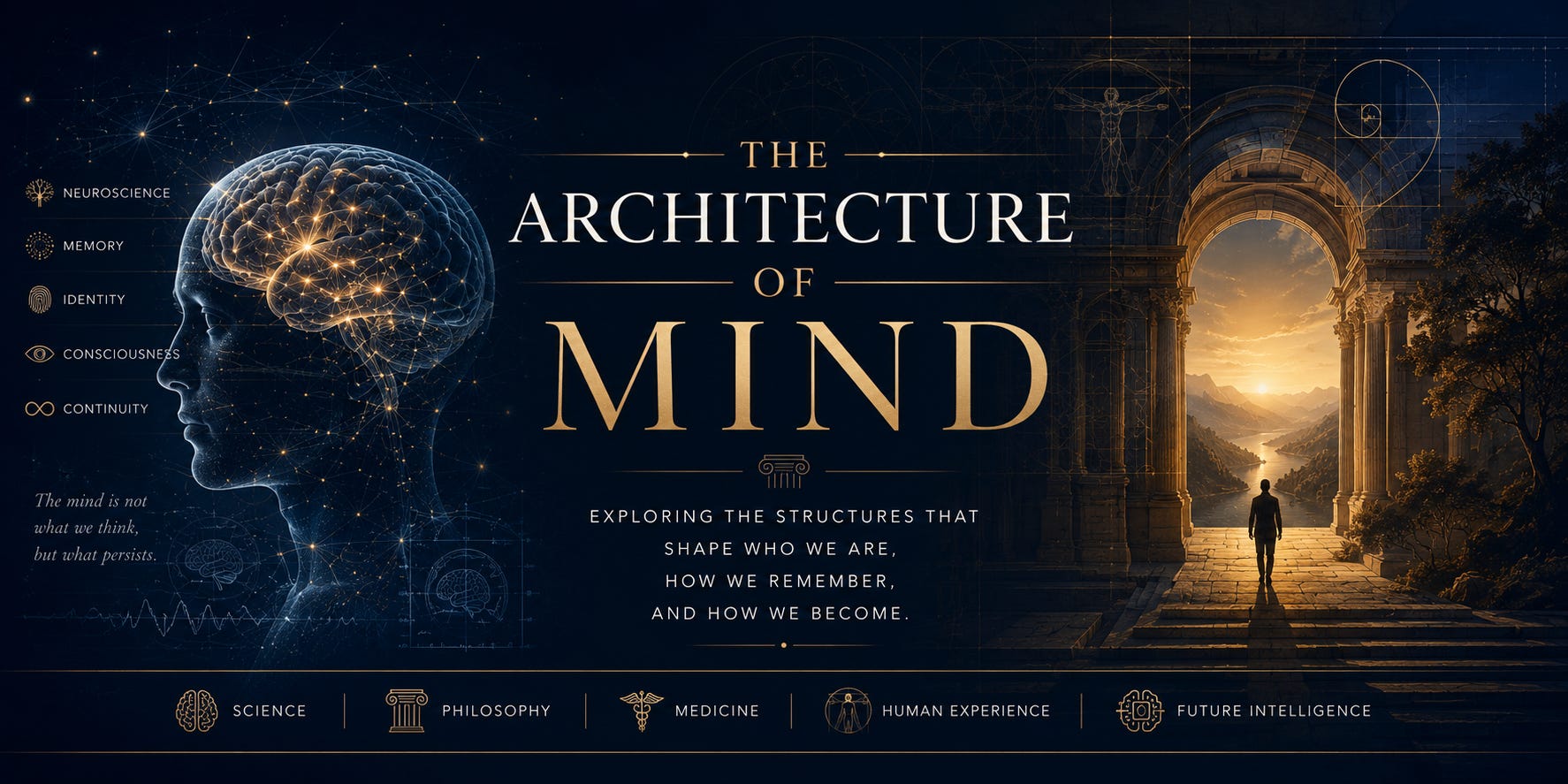
This essay examines thought as a foundational architecture of human experience, situated at the intersection of philosophy, medicine, and neuroscience. It argues that human beings do not merely inhabit a material world but continuously interpret, organize, and transform that world through invisible mental structures composed of memory, emotion, language, belief, and embodied experience. By framing thought as both a biological process and an existential construction, the essay explores how ideas arise, stabilize, fracture, and are reconstructed across individual and collective life.
The central problem developed throughout the text is the biological paradox of a finite brain capable of producing seemingly unbounded forms of meaning: imagination, self-reflection, symbolic worlds, scientific inquiry, metaphysical questioning, and identity. Rather than reducing consciousness to mechanism or detaching it from matter, the essay proposes a more nuanced position: cerebral processes make human experience possible, yet lived experience cannot be fully exhausted by neurobiological description alone. This tension between neural mechanism and subjective meaning becomes the conceptual space in which the essay unfolds.
Particular attention is given to the formative power of memory, affect, childhood, relational experience, and narrative in the construction of identity. The essay emphasizes that human beings are not passive possessors of ideas; they are gradually shaped by the ideas, stories, and interpretive frameworks they inhabit. At the same time, because thought remains plastic and revisable, the architecture of the self is presented as unfinished and transformable. The work therefore advances a vision of intellectual life as an ongoing process of construction, deconstruction, and reconstruction.
Ultimately, The Architecture of Mind is presented not as a closed theoretical system but as a methodological and philosophical invitation: to think slowly, to resist premature certainty, and to examine the invisible structures through which human beings become capable of meaning. Its contribution lies in proposing a dialogical framework in which neuroscience, clinical reflection, and philosophical inquiry may illuminate one another without collapsing their differences. The essay thus offers a reflective foundation for future explorations of consciousness, development, identity, suffering, and the still unresolved relationship between matter and meaning.
Alexis O. Kaya, MD, PhD, Neuroscientist
Download
