


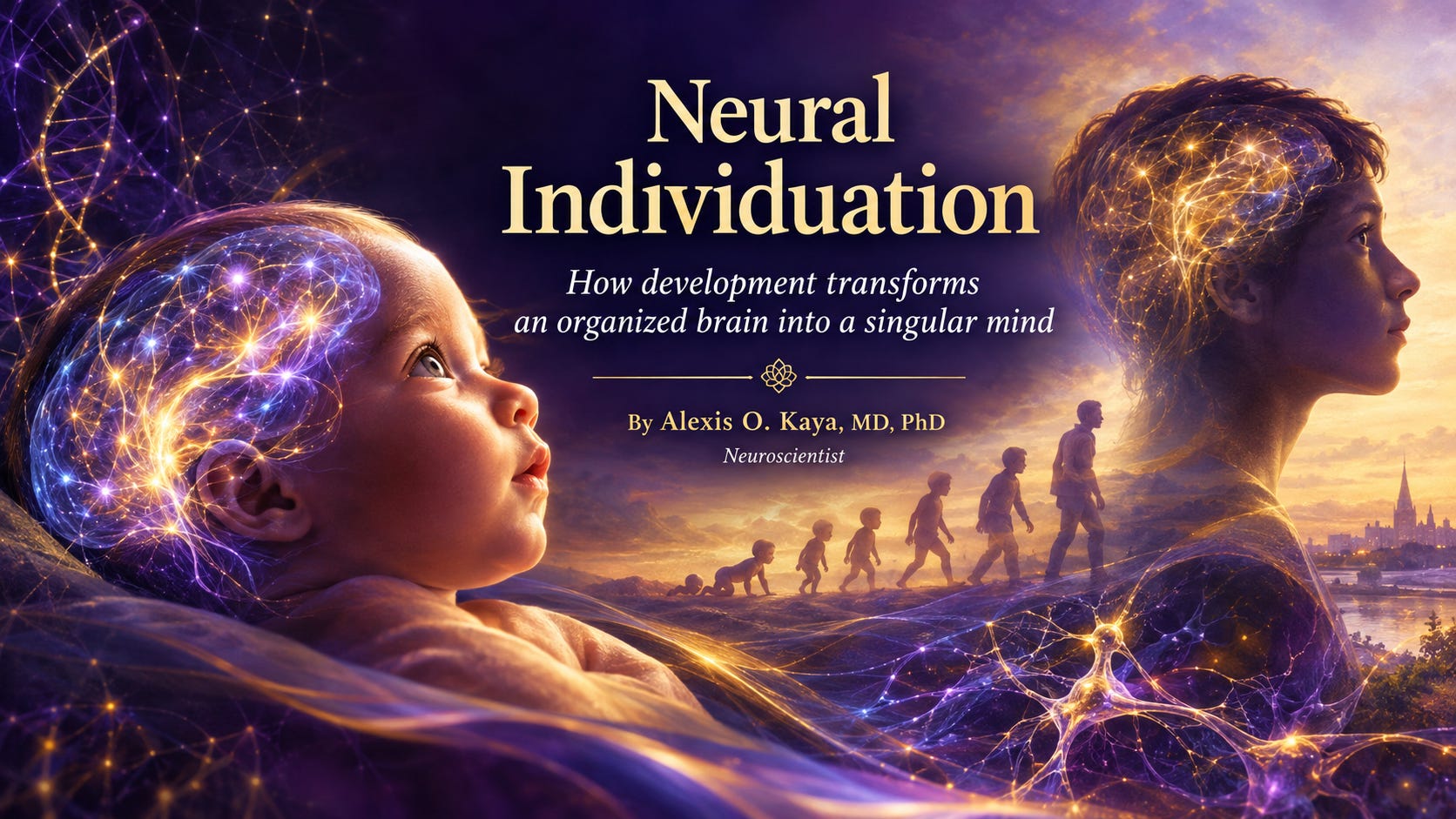
By Alexis O. Kaya, MD, PhD, Neuroscientist.
Keywords: developmental neuroscience; neural individuation; experience-dependent plasticity; neurodevelopment; sensorimotor calibration; perceptual learning; language acquisition; autobiographical memory; self-development; developmental continuity.
Abstract
The human neonate possesses an extensively organized nervous system yet lacks the mature sensorimotor, linguistic, perceptual, mnemonic, and self-representational capacities that later characterize an individual mind. This article develops an integrative account of that developmental paradox. It argues that neurodevelopment is neither the inscription of experience upon an initially empty substrate nor the maturation of a fully specified neural program, but the progressive individuation of a biologically constrained and developmentally open architecture. Evidence and concepts drawn from prenatal brain organization, locomotor learning, language acquisition, perceptual development, synaptic refinement, memory, and self-construction illustrate how recurrent activity calibrates neural systems to a changing body, selectively tunes them to environmental and social regularities, and coordinates distributed networks into increasingly stable forms of competence. Synaptogenesis, activity-dependent modification, selective stabilization, pruning, myelination, and changing network dynamics provide interacting mechanisms through which experience becomes biologically consequential, while prior organization determines which experiences can be detected, generated, and incorporated. Development is therefore transactional, multilevel, and path dependent: shared species-typical constraints coexist with singular histories that progressively differentiate brains, minds, and identities. This framework motivates a science of developmental continuity capable of linking cellular and network mechanisms to embodied action, biography, cultural participation, and lifelong plasticity. The central claim is that a human brain becomes functionally itself by becoming historically specific.
The paradox of the newborn
How can the neonate possess a recognizably human brain while lacking most of the competencies that characterize the mature human mind?
The paradox arises from the coexistence of substantial prenatal organization and profound postnatal dependence. By birth, neurogenesis, neuronal migration, regional differentiation, and the initial assembly of sensory, motor, and affective systems have already produced a highly structured nervous system. The cerebral cortex displays its characteristic lamination and broad areal organization; major ascending and descending pathways are established; and neural activity already supports perception, orienting, learning, and adaptive responses. The neonate is therefore neither neurologically formless nor functionally inert.
Nevertheless, this organized brain does not yet sustain independent locomotion, linguistic competence, explicit conceptual knowledge, mature social cognition, or autobiographical continuity. Such capacities cannot be inferred from the mere presence of the neural systems that will eventually support them. Their emergence depends on prolonged interactions among neural maturation, bodily growth, spontaneous activity, environmental input, and socially structured experience. Anatomical availability is thus a necessary condition for development, but it is not equivalent to functional mastery.
The distinction is between possessing an architecture and having organized that architecture through a history of use. Prenatal development establishes species-typical systems, developmental constraints, and structured capacities for learning. Postnatal experience does not create these systems ex nihilo; rather, it calibrates their parameters, coordinates their interactions, stabilizes recurrent patterns of activity, and progressively adapts them to the body, language, relationships, and material environment of a particular child. What is initially absent is therefore not neural structure as such, but the individualized organization that can arise only through development.
This formulation excludes two symmetrical errors. The neonate is not a tabula rasa upon which the environment inscribes an otherwise unstructured mind: early perception, preferential orienting, elementary learning, and adaptive regulation presuppose substantial prior organization. Nor is the neonate a miniature adult whose latent abilities need only be released by maturation. The protracted acquisition of posture, locomotion, language, perceptual expertise, executive regulation, and social understanding demonstrates that mature cognition is constructed through developmental processes rather than simply unveiled.
Development proceeds through repeated cycles of activity, feedback, prediction, error, and plastic modification. Sensorimotor exchanges align neural commands with the changing biomechanics of the body; linguistic exposure selectively tunes perceptual and associative systems to the regularities of a particular language; social interaction organizes expectations about other agents; and memory links otherwise transient events into a cumulative personal history. Across these domains, experience is not merely added to an unchanged substrate. It alters the probabilities, efficiencies, and coordination of future neural activity, thereby converting broad biological potential into increasingly reliable competence.
The consequence is progressive neural individuation. Although children share a broadly conserved developmental architecture, no two nervous systems encounter the same sequence of bodies, caregivers, languages, contingencies, opportunities, and constraints. With time, neural organization becomes increasingly specialized by this singular history. The infant who initially lacks independent action and autobiographical continuity acquires coordinated skills, durable representations, preferences, values, relationships, and forms of self-reference. Development, in this sense, is not merely growth or the accumulation of information; it is the historical organization of a nervous system into a particular mind.
The newborn paradox therefore reframes the relation between brain and mind. A human brain is present at birth, but the mature mind is not contained within it as a completed object. Mind emerges as inherited neural organization is progressively calibrated, selected, integrated, and rendered biographically specific. The same principle extends beyond childhood: the architecture that first learns to control the body later supports literacy, mathematics, scientific expertise, and the continuing revision of identity. Human beings are born with brains whose organization makes development possible; they become persons through the histories those brains are capable of incorporating.
The myth of the empty mind
Few metaphors have exerted greater influence on accounts of human development than the tabula rasa. Although the image has a longer philosophical genealogy, it became especially associated with John Locke’s empiricism and with the proposition that the contents of the mind derive principally from experience. In its strongest developmental interpretation, the newborn is treated as cognitively unformed, while education, culture, and environmental exposure progressively supply the representations and competencies that later constitute the mature mind. The metaphor remains compelling because postnatal change is both extensive and conspicuous: children acquire language, motor skills, social conventions, and knowledge of the physical world with extraordinary rapidity.
Historically, however, empiricist accounts were opposed by nativist theories, which argued that learning itself presupposes antecedent organization. The acquisition of language, the detection of perceptual regularities, and the coordination of adaptive behavior appeared too structured to be explained by undifferentiated experience alone. On this view, the organism must contribute species-typical predispositions, representational constraints, or domain-relevant mechanisms that delimit what can be learned and how learning proceeds. The resulting debate was frequently cast as a choice between an initially empty mind constructed by experience and a substantially preconfigured mind whose development primarily unfolds an intrinsic design.
Contemporary developmental neuroscience renders this opposition inadequate. Long before birth, neurogenesis, neuronal migration, axonal guidance, regional patterning, and activity-dependent processes have already generated a highly organized nervous system. Major cortical and subcortical territories are differentiated; sensory pathways display functional organization; motor and regulatory circuits are active; and spontaneous neural activity contributes to circuit formation. The neonate therefore enters extrauterine life with neither a blank substrate nor a mature cognitive apparatus, but with an architecture whose organization both enables and constrains subsequent learning.
Crucially, the presence of such organization does not imply that mature psychological contents are encoded in advance. Genetic and epigenetic mechanisms specify developmental sequences, molecular identities, gradients, and connectivity biases rather than a complete catalogue of future knowledge. Prenatal sensory exposure and endogenous activity further shape emerging circuits before birth, already complicating any strict separation between “nature” and “experience.” What is inherited is consequently better described as a structured developmental system: one prepared to extract particular regularities, to respond selectively to relevant inputs, and to reorganize as a function of use.
Experience acts upon this structured system not by depositing information into an otherwise passive container, but by modifying the organization through which information is selected, interpreted, and retained. Recurrent activity strengthens some synaptic relations, weakens others, coordinates distributed networks, and calibrates perception and action to the statistical and social properties of the child’s environment. Language, attachment, object knowledge, preferences, autobiographical memory, and culturally specific skills emerge through these transactions. They are neither present as completed representations at birth nor produced independently of the neural dispositions that make their acquisition possible.
The classical nature–nurture dichotomy thus gives way to a reciprocal, multilevel account of developmental causation. Biological organization determines the range and topology of possible transformations, whereas experience selects, calibrates, and stabilizes particular trajectories within that range. At the same time, the child is not a passive recipient of environmental influence: the developing organism actively samples its surroundings, generates actions, elicits responses from caregivers, and thereby helps constitute the very experiences that modify its nervous system. Development is therefore transactional, with changes in neural architecture altering subsequent experience and subsequent experience, in turn, altering neural architecture.
This framework also explains why human immaturity is unusually prolonged. A long period of dependence permits neural systems to be tuned to highly variable ecological, linguistic, technological, and cultural environments while maintaining sufficient plasticity for multiple developmental outcomes. Shared biological constraints therefore coexist with substantial individual variation. No two children encounter identical bodies, temporal sequences, social relationships, or learning opportunities; accordingly, no two brains undergo precisely the same history of stabilization and reorganization. Individuality is not superimposed upon a finished universal brain but emerges through the development of a common architecture along singular trajectories.
The claim that the mind is not empty must therefore be distinguished from the claim that it is complete. At birth, neural systems exhibit organization, specialization, and developmental direction, yet they have not acquired the functional precision, cross-system integration, or biographical continuity characteristic of later cognition. The relevant circuits are present in varying degrees of maturity, but their enduring configuration remains contingent on activity and experience. What is absent is not structure, but the individualized history through which structure becomes competence, knowledge, and selfhood.
The enduring error of the blank-slate metaphor is thus not its recognition that experience is constitutive, but its failure to acknowledge that experience operates through an already organized and actively developing organism. Conversely, the error of a rigid nativism is to mistake developmental preparedness for predetermined outcome. A more adequate account begins from their interdependence: the child is born with a structured capacity to become, and development is the process by which that capacity is progressively specified. To understand this process, the analysis must now turn from the philosophical metaphor of emptiness to the biological architecture demonstrably present at birth.
The architecture present at birth
If the newborn mind is neither empty nor complete, the relevant question is not whether organization exists at birth, but what form that organization takes. The answer requires distinguishing an anatomically and functionally patterned nervous system from the mature cognitive operations that will later depend upon it. Birth marks neither the beginning of neural construction nor the completion of cerebral development; it is a transition within a prolonged developmental process that begins in utero and continues across childhood and adolescence.
Prenatal brain development proceeds through tightly coordinated but overlapping processes, including neural induction, progenitor proliferation, neurogenesis, neuronal migration, differentiation, axonal guidance, synaptogenesis, and programmed cell death. Newly generated neurons migrate from proliferative zones toward their eventual positions, where molecular gradients, cell–cell interactions, and patterns of spontaneous activity contribute to the formation of cortical layers, subcortical nuclei, and long-range pathways. Disruption at any stage can alter subsequent organization, underscoring that later cognition depends upon a developmental history already well advanced before birth.
Genetic regulation is indispensable to this construction, but the familiar metaphor of a fixed blueprint is misleading. Genes specify molecular identities, temporal sequences, signaling gradients, growth rules, and biases in connectivity; they do not enumerate every synapse or encode a complete inventory of future psychological contents. Epigenetic regulation, cellular context, mechanical constraints, placental and maternal conditions, endogenous neural activity, and prenatal sensory exposure participate in the same causal system. The architecture present at birth is therefore highly structured yet developmentally open: organized enough to channel learning, but sufficiently plastic to be modified by the conditions under which development unfolds.
Sensory systems illustrate this combination of preparedness and incompleteness. Retinal, thalamic, and cortical components of the visual system differentiate before patterned vision begins, while spontaneous retinal activity contributes to the organization of early visual pathways. The auditory system becomes responsive during gestation, permitting the fetus to register acoustic regularities, including properties of voices and prosody, before speech can be understood. Comparable prenatal organization is evident in somatosensory, vestibular, olfactory, and gustatory systems. These capacities demonstrate functional readiness for selective engagement with the environment, not mature perception: meaningful perceptual constancies and categories still require extensive postnatal calibration.
Motor development follows the same logic. Spinal pattern-generating networks, brainstem pathways, cerebellar circuits, basal ganglia, corticospinal projections, and sensorimotor cortical regions are present in differing degrees of maturation at birth. They support fetal movement, neonatal reflexes, spontaneous motor activity, and early adaptive behavior, yet they do not constitute an adult locomotor system in miniature. Voluntary control depends on the progressive integration of descending commands with proprioceptive, vestibular, tactile, and visual feedback, as well as on myelination, musculoskeletal growth, changing body proportions, and repeated action. The substrate for movement precedes the mastery of movement.
Affective and regulatory systems likewise exhibit early organization without psychological completion. Neonates display differentiated responses to pain, novelty, soothing, biological motion, faces, voices, and caregiver-associated stimuli; autonomic, hypothalamic, limbic, brainstem, and cortical mechanisms contribute to these responses. Such organization enables early regulation and social engagement, but it should not be conflated with the elaborated emotions, attachment representations, or personality structures observed later in development. These emerge as biologically prepared systems are repeatedly coordinated within relationships and progressively incorporated into memory, expectation, and self-regulation.
Across these domains, the central distinction is between circuitry and expertise. A circuit is not a self-sufficient module whose mature function is guaranteed by its anatomical presence; it is a component of a developing system whose operation depends on connectivity, physiological state, interregional coordination, bodily constraints, and a history of activity. Experience accordingly does more than supply “content” to a stable framework. It participates in the selective stabilization, refinement, and integration through which initially broad capacities become efficient, context-sensitive functions. This is why neural preparedness can coexist with profound behavioral immaturity.
The architecture present at birth should thus be understood as a system of structured developmental possibilities rather than as either an empty substrate or a finished design. Prenatal development establishes the major components, constraints, and initial dynamics of the human nervous system; postnatal activity reorganizes them in relation to a particular body and environment. Nature does not merely precede experience, and experience does not merely decorate nature: each stage of organization changes what the organism can encounter, while each encounter alters the conditions of subsequent organization. The acquisition of upright locomotion provides an especially clear demonstration of this reciprocal calibration.
Why a child must learn to walk
Among the achievements of early childhood, independent walking is so familiar that its developmental complexity is easily underestimated. It is anticipated by caregivers, monitored clinically, and eventually acquired by most children without formal instruction. Yet upright locomotion constitutes a major reorganization of the relation among brain, body, and environment. The neonate possesses limbs, muscles, spinal and brainstem circuitry, a cerebellum, basal ganglia, and developing motor cortices, but these components do not initially operate as a fully integrated locomotor system.
The delay between anatomical availability and behavioral mastery reflects the need for calibration rather than the absence of motor organization. Locomotion must be adapted to a body whose mass, proportions, strength, joint mechanics, and center of gravity change rapidly during infancy. Neural commands that are effective at one stage may become inadequate at another. Motor development therefore cannot consist in the simple release of a fixed program; it requires the continuous adjustment of control policies to the evolving biomechanical properties of the child.
The pathway to walking is correspondingly exploratory and variable. Infants acquire head and trunk control, roll, sit, crawl or use alternative forms of ground mobility, pull to stand, cruise, and take unsupported steps in sequences that differ across individuals and cultures. Repeated falls are not incidental failures but informative perturbations: each attempt generates proprioceptive, vestibular, tactile, and visual consequences that can be compared with intended outcomes. Through this iterative process, the nervous system estimates the changing dynamics of the body and learns how particular actions alter stability and displacement.
Walking is not a unitary command but a distributed control problem. Effective locomotion requires the temporally precise recruitment of many muscles, alternation and coordination across the two sides of the body, stabilization of the head and trunk, anticipatory postural adjustments, and rapid compensation for disturbances. Spinal pattern-generating networks contribute rhythmic organization, while brainstem pathways, cerebellar circuits, basal ganglia, sensorimotor cortex, and descending tracts modulate initiation, timing, force, direction, and adaptation. Competence emerges from their coordination, not from the isolated maturation of any single structure.
Upright balance adds a distinctive computational demand. Even quiet stance entails continuous postural sway and recurrent correction. To maintain the body’s center of mass within a narrow base of support, the developing nervous system must integrate signals from muscle spindles and joints with cutaneous information, vestibular estimates of head motion and orientation, and visual cues about self-motion and the surrounding surface. These signals differ in latency, reliability, and reference frame; their relative weighting must be learned and flexibly revised as the child encounters new surfaces, inclines, obstacles, and speeds.
Locomotor learning is therefore inseparable from perceptual learning. The child must relate visual flow to bodily displacement, distinguish stable from unstable support, scale a step to an obstacle, and anticipate how momentum will affect balance. Action generates sensory evidence, and sensory evidence modifies subsequent action. This reciprocal coupling allows the infant to learn not only a repertoire of movements but the conditions under which each movement is effective. What develops is an increasingly accurate mapping among neural commands, bodily states, and environmental affordances.
The cerebellum is central to this adaptation, although it acts within a broader cortico-subcortical system. By integrating efference-related signals with sensory consequences, cerebellar circuits contribute to temporal precision, predictive control, and the updating of movement when outcomes depart from expectation. Basal ganglia and cortical networks participate in action selection, reinforcement, planning, and voluntary adjustment, while spinal and brainstem mechanisms sustain rapid postural and rhythmic responses. Practice progressively reduces error, stabilizes successful coordinations, and permits control to become faster, less variable, and less dependent on conscious attention.
From this perspective, walking is learned because locomotor architecture must become calibrated to a particular organism in a particular world. Genes and prenatal development provide components, constraints, and initial dynamics; experience specifies how those resources are coordinated under real conditions. With repetition, control that was initially effortful and unstable becomes increasingly robust and automatic—not because experience has been added to an otherwise unchanged system, but because the system has incorporated the statistical regularities of its own actions and their consequences.
This account also explains why the timing and form of locomotor development vary without implying a single optimal trajectory. Differences in bodily growth, opportunities for movement, caregiving practices, physical environments, and prior experience alter the problems that each child must solve. The developmental achievement lies not in reproducing an invariant sequence, but in attaining adaptive control through the progressive organization of available resources. Walking thus provides an early and visible instance of a more general principle: neural systems become competent by being selectively tuned through use. Language acquisition extends the same principle from sensorimotor calibration to the experience-dependent specialization of distributed perceptual, cognitive, and social networks.
Learning a language
If the acquisition of walking reveals how neural systems are calibrated to a particular body, language acquisition reveals how they become specialized for a particular symbolic and social environment. Within a few years, the child progresses from perceptual sensitivity to speech and prosody, through babbling and early word production, to the comprehension and generation of structured utterances. This transformation depends on extensive neural reorganization across auditory, motor, associative, attentional, mnemonic, and social-cognitive systems; it cannot be reduced either to passive exposure or to the maturation of a circumscribed language module.
Early in life, infants discriminate a wider range of phonetic contrasts than do adult speakers of any single language. This broad sensitivity is not evidence that every language is represented in advance. Rather, it reflects a perceptual system prepared to detect linguistically relevant variation before experience has assigned differential weight to the contrasts of the ambient language. Prenatal exposure to rhythm and prosody, followed by postnatal engagement with speech, provides an initial statistical and social context within which this perceptual space is progressively reorganized.
During the first year, sensitivity becomes increasingly aligned with the phonological organization of the language or languages encountered. Frequently sampled distinctions are maintained or sharpened, whereas sensitivity to some nonnative contrasts declines under ordinary conditions. This phenomenon, often termed perceptual narrowing, is better understood as functional specialization than as a simple loss of capacity. By reallocating processing resources toward recurrent and behaviorally relevant regularities, the developing system gains speed, reliability, and predictive efficiency within its linguistic environment, albeit at the cost of reduced spontaneous sensitivity to certain alternatives.
This reorganization is driven not by acoustic frequency alone, but by learning in a communicative context. Infants segment speech by tracking distributional regularities, transitional probabilities, stress patterns, and recurrent sound sequences; simultaneously, gaze, turn-taking, joint attention, affective contingency, and referential cues indicate which signals carry interpersonal significance. Language learning is therefore socially gated and intrinsically multimodal. Auditory representations are progressively coupled to articulatory gestures, visual information, inferred intentions, and the consequences of the child’s own vocal productions.
Lexical development extends this process from phonological categories to relations among forms, referents, actions, properties, and events. A word is not stored as an isolated acoustic item. Its representation is progressively stabilized through converging encounters that link sound patterns to perceptual features, motor routines, affective significance, discourse context, and prior knowledge. As vocabulary expands, each new item enters an increasingly differentiated semantic network; consequently, learning a word modifies not only the representation of that word but also the relational organization of concepts already acquired.
Grammatical development introduces a further level of abstraction. Children must infer how their language encodes relations among agents, actions, objects, time, number, and perspective, despite receiving input that is variable and rarely organized as explicit instruction. Distributional learning, analogy, memory for constructions, semantic expectations, and sensitivity to communicative intention jointly support the discovery of recurring patterns. The resulting knowledge is productive rather than merely reproductive: children learn to understand and generate utterances they have never previously encountered.
At the neural level, these achievements depend on the progressive differentiation and coordination of distributed networks rather than on the addition of language to an otherwise unchanged brain. Experience modifies phonological representations, strengthens mappings between auditory and motor systems, expands semantic and combinatorial networks, and improves communication among temporal, frontal, parietal, subcortical, and cerebellar circuits. Myelination, synaptic modification, and changes in network dynamics contribute to increasing processing speed and stability. Operations that initially demand sustained attention thereby become rapid, predictive, and largely automatic.
Exposure to more than one language further demonstrates that specialization need not entail commitment to a single system. Multilingual development may distribute attention across several phonological, lexical, and grammatical regularities, with developmental profiles shaped by the amount, timing, context, and social quality of exposure. Variation in the rate or pattern of acquisition should therefore not be mistaken for the absence of organization. The relevant outcome is the adaptive coordination of multiple linguistic systems within a shared and plastic neural architecture.
Language acquisition thus exemplifies a general developmental transition from broad preparedness to selective expertise. The child does not merely accumulate words and rules; recurrent communicative activity reorganizes the systems that perceive, predict, produce, and interpret linguistic signals. In adulthood, the apparent immediacy of comprehension conceals this developmental history: years of exposure have embedded language within the brain’s operational organization. The same principle applies more widely to perception. Before sensory information can support stable knowledge, neural systems must learn which features, relations, and invariances are consequential—a problem addressed in the education of the senses.
The education of the senses
Perception is experienced as immediate: adults open their eyes and encounter objects, hear speech and apprehend meaning, or move through space without deliberate reconstruction of the sensory conditions that make these achievements possible. This phenomenological transparency can obscure the extensive processing on which perception depends. Sensory receptors register variations in light, pressure, chemical composition, and acoustic energy; they do not deliver a complete description of the external world. Perception arises when neural systems select, combine, and interpret these signals in relation to prior organization, current bodily states, and accumulated experience.
The neonate is not perceptually unorganized. Early sensitivities to contrast, motion, biological configurations, voices, prosody, touch, and multisensory correspondence reveal substantial prenatal and species-typical preparation. Nevertheless, sensory responsiveness is not equivalent to mature perceptual knowledge. Developing systems must learn which variations reflect stable properties of objects, which signals originate from the child’s own movements, which cues should be integrated, and which discrepancies warrant revised interpretation. The education of the senses therefore consists not in creating perception from nothing, but in progressively increasing its selectivity, reliability, and ecological validity.
Vision makes this problem especially clear. The retina transduces spatial and temporal distributions of light, while successive neural populations extract contrasts, orientations, motion, depth cues, and other regularities. Yet the perceptual world is organized in terms of bounded objects, surfaces, agents, and events rather than isolated luminance values. To achieve this organization, the developing visual system must coordinate local features across space and time, segregate figures from backgrounds, and determine which changes belong to an object and which result from illumination, viewpoint, or self-motion.
Object recognition consequently requires the extraction of constancy from variable sensory encounters. A face, cup, or toy projects different retinal patterns as distance, orientation, occlusion, and lighting change, yet mature perception treats these patterns as manifestations of the same entity. Repeated encounters support the formation of representations that preserve diagnostic relations while tolerating irrelevant variation. Such learning is guided by intrinsic biases and by the statistical structure of natural scenes, but it is also refined through touch, manipulation, naming, and social attention. Visual categories are therefore neither arbitrary constructions nor complete innate templates; they emerge from constrained learning across convergent sources of information.
Spatial perception develops within the same reciprocal relation between sensing and acting. Reaching, grasping, crawling, and walking generate lawful correspondences among visual displacement, proprioceptive change, vestibular input, and tactile consequence. The child thereby acquires increasingly accurate estimates of distance, direction, support, object location, and the possibilities for action afforded by a scene. Internal models of body and environment are not inferred from vision alone; they are calibrated through active exploration, in which action tests perceptual predictions and sensory feedback updates subsequent action.
Auditory development illustrates an analogous transformation. The auditory system initially analyzes frequency, intensity, timing, and spatial cues; with experience, recurrent acoustic patterns become associated with sources, events, speakers, affective states, and linguistic categories. Speech perception further requires the segmentation of a rapidly varying signal and the integration of acoustic information with visual articulation, contextual expectation, and communicative intention. Meaning is therefore not contained in sound as a directly recoverable property. It emerges from learned mappings between auditory structure and the perceptual, motor, semantic, and social systems with which that structure becomes coordinated.
Across modalities, perceptual development depends on learning how much confidence to assign to different cues. Visual, auditory, tactile, proprioceptive, vestibular, olfactory, and interoceptive signals vary in precision according to context, and they may converge, compete, or conflict. Developing neural systems progressively learn their statistical dependencies and recalibrate their relative weighting when bodies and environments change. Multisensory integration is thus not the mechanical addition of inputs, but an adaptive process through which the nervous system constructs estimates of the causes most likely to have generated them.
With repeated use, these inferential and coordinative operations become increasingly rapid, stable, and inaccessible to introspection. Adult perception appears effortless precisely because developmental plasticity has embedded the relevant regularities within recurrent neural dynamics. The child learns more than facts about an already intelligible world: through patterned experience, the systems by which the world becomes perceptually intelligible are themselves refined. This claim does not deny innate organization; it specifies how such organization acquires functional precision. The next question is therefore mechanistic: by what cellular and network processes does experience stabilize some patterns of neural organization while weakening or eliminating others? That question motivates the analysis of synaptic sculpting.
Synaptic sculpting
If perceptual and behavioral systems acquire precision through experience, the corresponding neural question concerns the mechanisms by which activity modifies developing circuits. Plasticity provides the general answer, but the term encompasses several processes operating across molecular, synaptic, cellular, and network scales. Development does not simply activate a pre-existing adult architecture. It alters synaptic efficacy, dendritic and axonal structure, myelination, inhibitory–excitatory balance, and the coordination of distributed populations, thereby changing the conditions under which subsequent activity occurs.
Synaptogenesis is a central component of this transformation. Synapses begin to form prenatally and proliferate rapidly after birth, but their trajectories differ substantially across cortical regions, layers, cell types, and developmental periods. In several human cortical areas, synaptic density transiently exceeds typical adult levels before declining toward a more differentiated configuration. This pattern is often described as exuberant connectivity. It should not be interpreted as a global surplus produced at a single stage, but as a heterogeneous and temporally ordered expansion of potential interactions within developing circuits.
Transient abundance enlarges the repertoire of configurations available for subsequent selection and refinement, but it does not render the immature brain equipotential. Patterns of gene expression, cell identity, laminar position, molecular recognition, spontaneous activity, and early connectivity constrain which synapses form and which signals can modify them. Developmental flexibility therefore arises within an organized system. Experience selects among structured possibilities; it does not generate arbitrary architectures unconstrained by prior biology.
Patterns of neural activity contribute to determining which connections are stabilized. Correlated pre- and postsynaptic activity can strengthen synaptic transmission, whereas other temporal relations and prolonged patterns of use may weaken it. These changes involve receptor trafficking, intracellular signaling, gene transcription, structural remodeling, and interactions with glial cells. Hebbian formulations capture one important principle—that coordinated activity can reinforce functional relations—but developmental refinement also depends on homeostatic mechanisms that regulate overall excitability and prevent networks from becoming unstable.
Synaptic pruning is the complementary process through which some connections are reduced or eliminated as circuits mature. Pruning is neither indiscriminate destruction nor a simple consequence of disuse. Its expression varies across regions and developmental stages and involves activity-dependent competition, trophic signaling, local structural changes, and contributions from microglia and other glial mechanisms. The removal of selected synapses can improve signal-to-noise relations, sharpen representational boundaries, and reorganize pathways around recurrent demands. Functional specialization thus depends on selective subtraction as well as addition.
Changes in synaptic number constitute only one dimension of cerebral development. Increases in brain volume reflect multiple processes, including dendritic arborization, axonal growth, glial proliferation and differentiation, vascular change, and progressive myelination; they cannot be equated with the storage of increasing quantities of information. Nor does greater connectivity necessarily entail superior function. Efficient computation depends on the topology, timing, strength, and metabolic cost of connections, as well as on their coordination within larger networks. Developmental improvement may therefore accompany local growth, selective reduction, or redistribution, depending on the system and developmental interval under examination.
The influence of experience is likewise developmentally regulated. Sensitive periods arise when particular circuits are especially responsive to classes of input because maturational state, inhibition, neuromodulation, extracellular structure, and prior activity jointly permit extensive reorganization. Appropriate experience during these intervals can consolidate species-typical functions, whereas atypical or absent input may redirect developmental trajectories. Plasticity persists beyond early childhood, but its mechanisms, magnitude, and energetic costs change over time; later learning generally proceeds within architectures already shaped by earlier selections.
At the network level, learning emerges from the coordination of these mechanisms across repeated episodes. Motor practice stabilizes relations among commands, predicted consequences, and sensory feedback; linguistic exposure reorganizes phonological and semantic mappings; perceptual experience modifies the weighting of diagnostic cues. No single meaningful event need produce a durable structural trace, and similar behavioral outcomes may be supported by different neural changes. What matters is the cumulative interaction among activity, consolidation, sleep, neuromodulatory state, and subsequent experience through which some patterns become increasingly accessible and others less probable.
The metaphor of sculpting is useful only if it preserves this mechanistic complexity. The developing brain is not carved by an external environment acting upon passive material; neural activity is generated by an organism that selects, interprets, and modifies its own conditions of engagement. Synaptic formation, strengthening, weakening, elimination, and myelination participate in a reciprocal process through which inherited organization and lived activity become progressively inseparable. Experience is thereby incorporated into architecture, while the resulting architecture constrains the experiences that can subsequently be detected, learned, and remembered.
Synaptic sculpting therefore identifies a set of mechanisms by which developmental possibility becomes selective organization. It does not imply that every experience leaves a discrete or permanent mark, nor that synapse number provides a direct measure of knowledge or competence. Rather, biologically constrained plasticity allows recurrent patterns of activity to alter the future dynamics of neural systems. The next section extends this account from cellular refinement to the cumulative manner in which experience, memory, expectation, and action become embedded within a developing life history.
Experience writes the architecture
Development unfolds within a continuous stream of sensory events, bodily actions, linguistic exchanges, social contingencies, successes, errors, and affective states. Most individual episodes are transient, and many leave no independently retrievable memory. Their developmental significance lies less in the permanence of each event than in the capacity of recurrent, salient, or strongly modulated patterns to alter subsequent processing. Experience “writes” the architecture only in this qualified sense: activity can induce changes that modify what the nervous system is thereafter prepared to perceive, predict, learn, and do.
Such incorporation is distributed across multiple forms of plasticity. Changes in synaptic efficacy, dendritic and axonal structure, myelination, neuromodulatory responsiveness, inhibitory control, and network coordination can persist over different timescales and interact with later activity. These modifications are neither uniform nor exact replicas of the events that produced them. They are selective transformations governed by prior organization, physiological state, attention, affective significance, repetition, and consolidation. Learning is therefore physically instantiated, but its neural realization is dynamic, multiscale, and context dependent.
The relation between experience and architecture is consequently reciprocal. Existing neural organization determines which signals are detected, which actions are generated, and which outcomes are treated as informative; the resulting experience then alters the probabilities and coordination of future neural activity. The child is thus neither a passive recipient of stimulation nor an autonomous system insulated from context. By acting, attending, exploring, and engaging other people, the developing organism partly selects and produces the experiences through which its own organization is revised.
The consequences extend beyond the encoding of discrete memories. Repeated sensorimotor exchanges establish relations among vision, proprioception, force, and object dynamics; recurrent linguistic interactions coordinate phonological, articulatory, semantic, and social representations; dependable caregiving contingencies shape expectations about regulation, availability, and interpersonal response. In each case, development consists not merely in adding items to a store of knowledge, but in reorganizing relations among systems. Skills, concepts, and social expectations emerge as increasingly integrated patterns of prediction and control.
As these relations stabilize, behavior becomes more efficient and the environment more intelligible. Movements require less deliberative control, perceptual categories become more differentiated, language supports increasingly abstract combinations, and problem solving draws upon previously organized structures. Knowledge accumulates not as an inventory of independent facts, but as a set of interconnected models that constrain interpretation. The developing brain learns regularities concerning objects, agents, causal relations, social norms, and the likely consequences of action, thereby converting uncertainty into graded expectation.
Expectations, habits, and preferences arise within the same cumulative process. Outcomes that are repeatedly predicted or reinforced become easier to anticipate and enact, whereas alternatives may become less accessible. These tendencies influence attention, valuation, decision making, and subsequent learning, but they are not immutable inscriptions. Their persistence depends on continued use, compatibility with later experience, and the plastic capacities of the systems in which they are embedded. Development produces path dependence rather than absolute determination: prior history biases future trajectories without closing them.
Memory is indispensable to this temporal organization because it permits the effects of experience to extend beyond the moment in which an event occurs. Encoding, consolidation, retrieval, reconsolidation, and forgetting jointly determine how prior encounters influence present behavior. Memory does not preserve an exhaustive record; it selectively maintains and reconstructs information in relation to current goals and existing knowledge. Through these processes, otherwise discontinuous episodes can contribute to durable skills, semantic structures, emotional expectations, and eventually autobiographical continuity.
The developing brain may therefore be described as a historical system, provided that history is not confused with a literal archive. Its present organization reflects the cumulative consequences of prior maturation, activity, learning, relationships, and environmental conditions; at the same time, this organization remains open to revision. Experience becomes architecture when its effects are integrated into the dispositions of neural systems, and architecture becomes history when those dispositions preserve continuity across change. This reciprocal accumulation prepares the conditions under which a child can represent not only a world, but a persisting self within that world.
The construction of the self
Among the transformations of childhood, the emergence of a persisting self is among the most consequential and conceptually difficult. The neonate already possesses a body, affective and homeostatic states, sensory capacities, action tendencies, and forms of learning; nevertheless, these capacities do not amount to the temporally extended, explicitly represented identity characteristic of later childhood and adulthood. The self should therefore be approached not as an entity that appears at a discrete moment, but as a progressively organized set of processes through which bodily regulation, agency, memory, language, and social recognition become integrated.
A useful account must distinguish several partially dissociable dimensions of selfhood. A minimal or embodied self depends on the integration of interoceptive, proprioceptive, vestibular, tactile, and motor signals that specify the organism as a bounded locus of regulation and action. A sense of agency develops as predicted sensory consequences are compared with the outcomes of self-generated movements, while a rudimentary distinction between self and other is refined through contingency detection and reciprocal interaction. These early forms of self-organization precede reflective self-knowledge, yet provide its sensorimotor and affective foundations.
Memory extends this organization across time. Through the interaction of implicit learning, semantic knowledge, episodic encoding, consolidation, retrieval, and reconstruction, present behavior becomes informed by prior states and events. Autobiographical continuity does not require an exhaustive record of experience; it depends on the selective integration of episodes into relatively stable knowledge about one’s body, capacities, relationships, and history. As children become able to relate what happened previously to current goals and anticipated futures, they acquire not merely memories, but the temporal perspective from which experiences can be understood as belonging to the same person.
Language greatly expands this temporal and representational capacity. Pronouns, names, mental-state terms, temporal markers, and narrative constructions allow children to refer to themselves as objects of thought, attribute experiences to a continuing subject, and communicate those experiences to others. Linguistic self-reference is not the origin of every form of selfhood, but it transforms the self by making its contents categorisable, revisable, and narratively organized. Through conversation, children learn culturally available ways of explaining motives, evaluating conduct, and linking past events to present character and future possibility.
Self-development is equally inseparable from the social environment. Caregivers regulate arousal, respond contingently to signals, direct attention, assign names, interpret intentions, and provide evaluative feedback. Within attachment relationships and later interactions with siblings, peers, teachers, and communities, the child encounters representations of who they are and what is expected of them. These responses do not simply add social information to an independently formed identity; they become incorporated into expectations about worth, competence, belonging, obligation, and the likely reactions of others.
Imitation, joint attention, instruction, and participation in shared practices further embed the developing self within a cultural world. Children acquire norms, values, roles, and categories that organize both behavior and self-interpretation. Because these resources differ across families and societies, identity is neither purely private nor culturally invariant. Personal distinctiveness emerges through the appropriation, negotiation, and sometimes rejection of socially available meanings, as individual temperament and experience interact with collective forms of life.
At the neural level, no single region contains the self, and no individual memory, representation, or network is sufficient to constitute identity. Self-related processing recruits distributed and dynamically interacting systems involved in interoception, body representation, action monitoring, valuation, memory, language, perspective taking, and social cognition. Their contribution varies with task, context, and developmental stage. The unity of the self is therefore a functional achievement of coordination across systems rather than evidence for a discrete neural center.
These components develop reciprocally. Memory supplies material for narrative; language reorganizes what can be encoded, rehearsed, and communicated; relationships influence attention, affect, and recollection; and action provides continuing evidence of agency and competence. Their integration yields a sufficiently coherent model of a person who persists across changing circumstances, possesses characteristic dispositions, and remains accountable for prior actions. Such coherence is graded and revisable rather than absolute: identity can remain continuous despite contradiction, forgetting, developmental change, and the acquisition of new roles.
The self is consequently neither fully present at birth nor constructed from an absence of organization. Its earliest conditions lie in embodied regulation, perceptual contingency, and agency; its later forms depend increasingly on autobiographical memory, linguistic reflection, social recognition, and cultural participation. Identity becomes more stable as these processes acquire depth and mutual constraint, yet it remains plastic because new experiences can revise their organization. The child becomes a self gradually, as a developing nervous system acquires the capacity to preserve continuity while incorporating change. This conception of selfhood as historically organized neural, bodily, and social continuity defines a central challenge for the future of developmental science.
The future of developmental science
Developmental science has traditionally been organized around questions of timing, mechanism, and variation: when language emerges, how motor coordination is acquired, which conditions promote learning, and why some developmental trajectories diverge from population-typical patterns. These questions remain indispensable to neuroscience, psychology, pediatrics, and education. Yet the architectural account developed here suggests a more integrative problem: how does a biologically prepared but unfinished nervous system become an individualized human mind?
Answering this question requires moving beyond inventories of milestones toward explanations that connect change across temporal and organizational scales. Genes, epigenetic regulation, cellular differentiation, network dynamics, bodily growth, behavior, relationships, and cultural environments do not constitute independent layers that can be studied in isolation. They participate in reciprocal causal processes whose effects accumulate over time. The principal challenge is therefore to determine how events at one level alter the constraints, opportunities, and susceptibilities operating at others, and how these interactions generate both species-typical regularities and individual variation.
Such an account will depend on longitudinal and multimodal designs capable of following the same individuals through periods of rapid transition. Neuroimaging, electrophysiology, molecular measures, computational modelling, dense behavioural sampling, and ecologically valid observations can each reveal different aspects of developmental organization, but no single method is sufficient. Progress will require models that accommodate nonlinear change, developmental timing, heterogeneity, and bidirectional influence, while distinguishing correlation, prediction, and causal mechanism. The objective is not merely to map the maturing brain, but to explain how changing neural organization supports changing forms of action, learning, and experience.
Methodological refinement must be accompanied by conceptual discipline. Measures of cortical thickness, white-matter microstructure, functional connectivity, oscillatory activity, or molecular state are informative only when interpreted within age-appropriate models and linked cautiously to behaviour. Developmental change cannot be reconstructed by treating children as incomplete adults or by inferring individual trajectories from cross-sectional group averages alone. The field must therefore improve harmonization across sites, measurement reliability, transparent analytic practices, representative sampling, and the integration of normative variation into its explanatory frameworks.
Education provides an important domain of translation, provided that neuroscientific findings are not converted into premature prescriptions. Learning environments influence attention, practice, motivation, feedback, sleep, stress, and opportunities for retrieval and generalization—all conditions under which neural systems change. The relevant insight is not that each lesson directly constructs a specific circuit, but that instruction participates in cumulative developmental histories. Educational research should therefore examine how the timing, spacing, social organization, and adaptive difficulty of experience interact with prior knowledge and individual variability, while evaluating outcomes at behavioural as well as neural levels.
The persistence of plasticity throughout life further complicates any sharp boundary between development and adulthood. Early plasticity is distinctive because many systems are being organized for the first time, often during periods of heightened sensitivity and under conditions of rapid bodily and social change. It is not uniformly greater across all circuits, nor is it without costs: openness to modification can entail vulnerability to deprivation, dysregulation, or atypical input. Future research must characterize which mechanisms remain available at different ages, how earlier organization constrains later learning, and under what conditions adaptive reorganization can be promoted without overstating reversibility.
The explanatory value of an architectural perspective is especially apparent in the study of neurodevelopmental diversity. Conditions such as autism cannot be understood adequately as static collections of behavioural deficits, nor should neural difference be romanticized in ways that obscure disability, distress, or support needs. The scientific task is to identify how heterogeneous biological processes interact with sensory environments, learning histories, compensatory strategies, and social contexts to produce distinct developmental profiles. Longitudinal analyses of trajectories, rather than comparisons with a single normative endpoint, may therefore provide a critical test of whether the framework can explain both shared developmental mechanisms and meaningful individual differences.
A second test of the framework arises from comparison with artificial intelligence, although the analogy must remain constrained. Contemporary artificial systems can acquire statistical regularities and generate complex behaviour, yet human development occurs in a living organism whose learning is embodied, metabolically regulated, affectively modulated, socially scaffolded, and continuous with prenatal organization. Computational models may nevertheless formalize hypotheses about representation, prediction, exploration, and plasticity, while developmental neuroscience can challenge artificial systems to account for open-ended learning, changing bodies, self-generated experience, and the cumulative construction of agency. The comparison is therefore informative not because artificial and biological development are equivalent, but because their differences clarify which properties are constitutive of human neural individuation.
These directions converge on what may be termed a science of developmental continuity: the study of how biological systems establish persistence without ceasing to change. Developmental neuroscience examines how continuity is first constructed through the stabilization of sensorimotor, cognitive, mnemonic, and social organization; research on ageing, learning, and identity examines how that organization is subsequently maintained, revised, or lost. The two problems are inseparable because every mature architecture bears the history of its formation, and every new experience acts upon structures inherited from that history. The future of the field lies in explaining this recursive relation with sufficient precision to connect mechanism, biography, and variation.
The central research programme can therefore be stated precisely: to explain how an initially structured yet developmentally open architecture becomes a distinctive mind through reciprocal interactions among maturation, activity, embodiment, memory, and culture. Success will require theories that predict trajectories rather than merely redescribe outcomes, interventions that respect heterogeneity rather than enforce uniformity, and methods capable of linking population-level regularities to individual histories. The task of the concluding section is not to restate this programme, but to identify the principle that unifies its empirical domains: developmental organization preserves the consequences of experience while continually redefining the conditions of future change.
The brain that becomes itself
This article began with an apparent contradiction: the newborn possesses a recognizably human brain yet lacks most of the organized competencies through which a mature human mind is expressed. The contradiction dissolves once neural architecture is distinguished from its developmental realization. At birth, the nervous system is neither an undifferentiated substrate awaiting inscription nor a completed cognitive design awaiting release. It is a highly structured, biologically constrained, and developmentally open system whose future organization depends on prolonged reciprocal interactions among maturation, activity, embodiment, and experience.
The developmental evidence examined across domains supports this interpretation. Prenatal neurogenesis, migration, regional differentiation, and circuit formation establish the conditions under which later learning can occur, but they do not specify mature locomotion, language, perceptual expertise, autobiographical continuity, or reflective selfhood. Each capacity requires a history of activity through which distributed systems are calibrated to a changing body, selectively tuned to recurrent environmental regularities, and coordinated with other neural and behavioural functions. Anatomical presence is therefore indispensable, but it is not equivalent to functional mastery.
Walking showed that motor architecture must be calibrated to the biomechanics of a particular organism and to the affordances of its environment. Language revealed how broad perceptual preparedness becomes specialized through statistical learning, communicative interaction, and the integration of auditory, motor, semantic, and social systems. Perception itself proved to be an achievement of constrained inference, as developing networks learn which features, correspondences, and invariances reliably disclose objects, agents, and events. In each case, experience is constitutive not because it supplies content to a passive brain, but because recurrent activity modifies the organization through which subsequent signals are selected, interpreted, and acted upon.
Synaptic formation, activity-dependent modification, selective stabilization, pruning, myelination, and changing network dynamics provide mechanisms by which this developmental history becomes biologically consequential. Their effects are cumulative yet selective: not every event produces a durable trace, and no single measure of connectivity or synaptic number can stand as a direct index of knowledge. Memory extends the influence of prior experience through encoding, consolidation, retrieval, reconstruction, and forgetting. The mature nervous system is consequently historical in a precise sense—its present dispositions bear the integrated consequences of earlier organization and constrain the range of transformations that remain possible.
This history is also the basis of individuality. Children share a species-typical developmental architecture, yet they do not inhabit identical bodies, relationships, languages, cultures, opportunities, or contingencies. Their neural systems therefore undergo distinct sequences of selection, reinforcement, coordination, and revision. The self emerges within this process as an increasingly coherent, though never immutable, organization of embodied regulation, agency, memory, language, social recognition, and narrative continuity. No single region contains that self; its relative unity is achieved through the dynamic coordination of systems whose relations have been shaped across time.
The child thus builds a brain not by constructing neural tissue from an initial absence, but by progressively organizing inherited biological resources into a functional and biographical architecture. This process does not end when childhood milestones have been reached. The systems that learn to stand and walk later acquire literacy, mathematics, scientific expertise, social commitments, and new forms of self-understanding; each achievement both depends on prior organization and alters the conditions of future learning. Development is therefore the inaugural phase of a lifelong continuity in which plasticity operates upon structures already marked by history.
The central conclusion can therefore be stated without recourse to either environmental or biological reductionism. Genes and prenatal development establish structured possibilities; activity and experience select, calibrate, and integrate particular trajectories; memory and social participation confer cumulative and biographical form. Possessing a brain is not yet possessing a history, and possessing an architecture is not yet having realized a mind. A human mind becomes possible because the brain is organized before experience, transformable through experience, and capable of preserving selected consequences of experience. Neural individuation names this progressive conversion of shared developmental resources into a historically specific organization of perception, action, knowledge, and selfhood.
Bibliography
Changeux, Jean-Pierre, and Antoine Danchin. “Selective Stabilisation of Developing Synapses as a Mechanism for the Specification of Neuronal Networks.” Nature 264, no. 5588 (1976): 705–12. https://doi.org/10.1038/264705a0.
Damasio, Antonio. Self Comes to Mind: Constructing the Conscious Brain. New York: Pantheon Books, 2010.
Greenough, William T., James E. Black, and Christopher S. Wallace. “Experience and Brain Development.” Child Development 58, no. 3 (1987): 539–59. https://doi.org/10.1111/j.1467-8624.1987.tb01400.x.
Hebb, Donald O. The Organization of Behavior: A Neuropsychological Theory. New York: Wiley, 1949.
Hensch, Takao K. “Critical Period Plasticity in Local Cortical Circuits.” Nature Reviews Neuroscience 6, no. 11 (2005): 877–88. https://doi.org/10.1038/nrn1787.
Huttenlocher, Peter R., and Arun S. Dabholkar. “Regional Differences in Synaptogenesis in Human Cerebral Cortex.” Journal of Comparative Neurology 387, no. 2 (1997): 167–78. https://doi.org/10.1002/(SICI)1096-9861(19971020)387:2<167::AID-CNE1>3.0.CO;2-Z.
Johnson, Mark H., and Michelle de Haan. Developmental Cognitive Neuroscience: An Introduction. 4th ed. Chichester, UK: Wiley-Blackwell, 2015.
Kaya, Alexis O. “Neurotenacity & The Architecture of Mind.” Accessed September 28, 2026. https://neurotenacity.com/.
Knudsen, Eric I. “Sensitive Periods in the Development of the Brain and Behavior.” Journal of Cognitive Neuroscience 16, no. 8 (2004): 1412–25. https://doi.org/10.1162/0898929042304796.
Kuhl, Patricia K. “Early Language Acquisition: Cracking the Speech Code.” Nature Reviews Neuroscience 5, no. 11 (2004): 831–43. https://doi.org/10.1038/nrn1533.
Sporns, Olaf. Networks of the Brain. Cambridge, MA: MIT Press, 2010. https://doi.org/10.7551/mitpress/8476.001.0001.
Stiles, Joan, and Terry L. Jernigan. “The Basics of Brain Development.” Neuropsychology Review 20, no. 4 (2010): 327–48. https://doi.org/10.1007/s11065-010-9148-4.
Tau, Gregory Z., and Bradley S. Peterson. “Normal Development of Brain Circuits.” Neuropsychopharmacology 35, no. 1 (2010): 147–68. https://doi.org/10.1038/npp.2009.115.
Tomasello, Michael. Constructing a Language: A Usage-Based Theory of Language Acquisition. Cambridge, MA: Harvard University Press, 2003.
Werker, Janet F., and Richard C. Tees. “Cross-Language Speech Perception: Evidence for Perceptual Reorganization during the First Year of Life.” Infant Behavior and Development 25, no. 1 (2002): 121–33. https://doi.org/10.1016/S0163-6383(02)00093-0. Originally published in Infant Behavior and Development 7, no. 1 (1984): 49–63.
Declarations
Author Contributions: The author conceived the theoretical framework, developed the argument, and prepared the manuscript.
Funding: No external funding was reported for this work.
Conflict of Interest: The author declares no commercial or financial relationships that could be construed as a potential conflict of interest.
Data Availability: No new datasets were generated or analyzed because this article presents a theoretical perspective.
Ethics Statement: Ethical approval was not required because this article does not report research involving human participants or animals.