


Alexis O. Kaya, M.D., Ph.D., Neuroscientist.
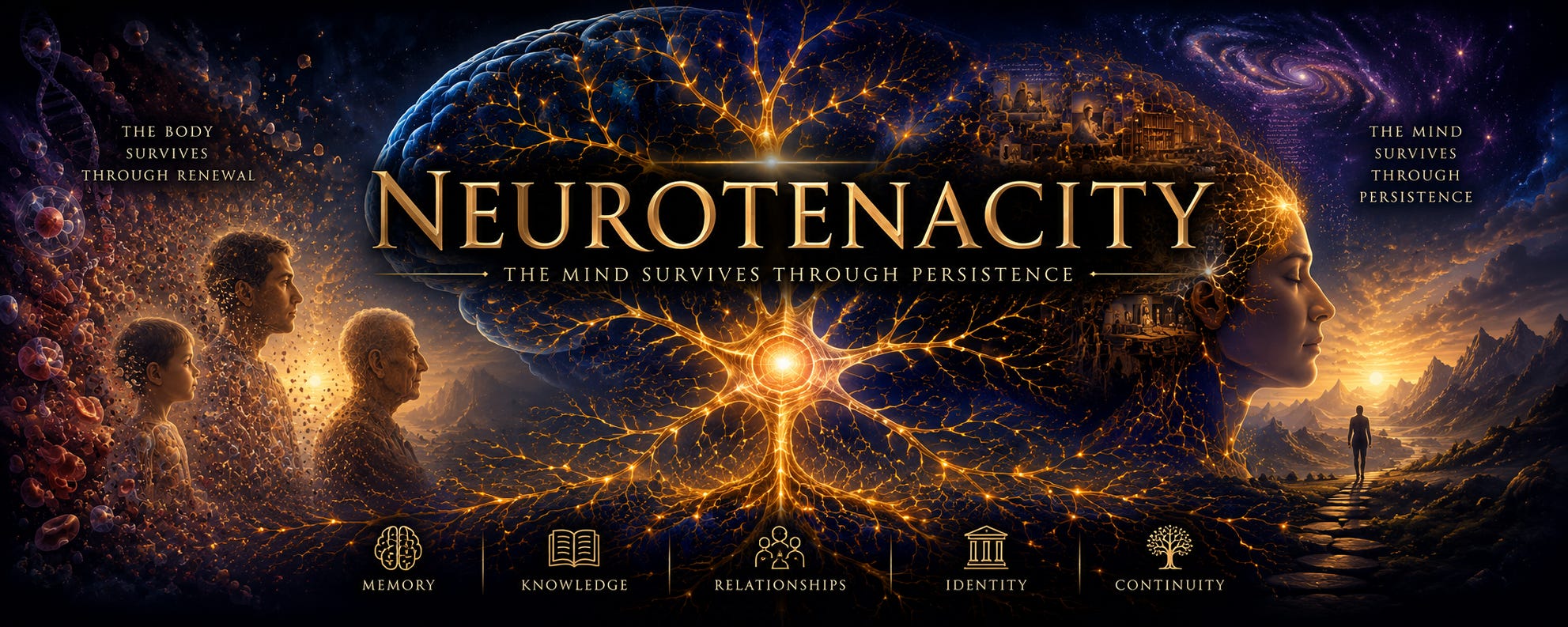
The problem of human continuity
How does a human being remain recognizably the same person while the body undergoes continual change?
Among the questions addressed by contemporary neuroscience, few are as deceptively simple—and as conceptually unsettling—as this one. Human beings possess an intuitive sense of continuity. Each morning, we awaken persuaded that we are the same individuals who existed the day before. We recognize our childhood as our own, our memories as belonging to us, and our experiences as episodes within a single unfolding life. We ordinarily speak of ourselves as though an invisible thread connected every stage of existence, from birth to old age. Biology, however, presents a markedly different picture.
The human body is not a monument designed to remain unchanged through time. It is a dynamic, continuously evolving system. Beneath the apparent stability of bodily form, processes of renewal unfold incessantly. Cells are generated, perform their functions, die, and are replaced. Tissues regenerate. Molecular structures are dismantled and rebuilt. At its most fundamental level, life is sustained through motion and turnover.
The skin that protects the body from the external environment continuously renews itself. The blood circulating through the vascular system today is not exactly the same as that of previous years. Immune cells emerge and disappear in response to shifting biological demands. The intestinal lining undergoes rapid turnover in order to sustain one of the body’s most exacting interfaces with its environment. Even bone, which appears solid and immutable, is constantly remodeled through a delicate balance of resorption and formation. The body endures through renewal.
Nature appears to have chosen replacement as one of its principal strategies for preserving life. Yet despite this perpetual biological transformation, something extraordinary persists: memory endures.
A melody heard decades earlier can suddenly return with astonishing clarity. The scent of a childhood home may revive emotions long thought forgotten. A face encountered only briefly many years ago may remain recognizable despite the passage of time. Fragments of experience survive within us, often with a persistence that seems out of proportion to the instability of the biological structures that support them.
More striking still, personality often exhibits a notable degree of continuity. Although experience, education, suffering, love, loss, and maturation shape the individual across the lifespan, certain traits remain recognizable over decades. A person in old age may still discern traces of the child he once was. Temperament persists. Preferences endure. Character evolves, yet something remains identifiable beneath the transformations imposed by time.
Identity itself seems to resist biological change. This observation confronts us with a paradox.
If the body is constantly renewed, why does personal continuity survive? If biological matter changes, why are memories not continuously erased? If cells disappear and are replaced, what preserves the architecture of a life? More fundamentally, what allows a human being to remain recognizably the same person across decades of biological transformation?
These questions extend beyond philosophy alone. They reach into the core concerns of neuroscience, medicine, psychology, and the biological sciences more broadly. Continuity is not merely a subjective impression; it is a biological condition upon which learning, memory, language, relationships, culture, and social life depend. Without continuity, experience could not accumulate, learning could not consolidate, and personal history would lose coherence.
Somewhere within the changing landscape of the human organism, there must be mechanisms capable of preserving information across time. Somewhere within the body, a biological principle must reconcile change with permanence, adaptation with continuity, and renewal with memory.
The search for such a principle leads inevitably to a remarkable organ—one whose function is not merely to sustain life, but to preserve experience; one capable of transforming transient moments into enduring memories, sensations into knowledge, and existence into identity: the brain.
Within the extraordinary persistence of its neurons may lie one of the deepest biological explanations for the continuity of the human self.
The body as change, the brain as persistence
The living world is governed by a remarkable principle: survival through renewal. From the simplest organisms to the most complex forms of life, biological systems are engaged in ongoing processes of repair, replacement, and regeneration. Life endures not because matter remains unchanged, but because it is continually renewed. The relative permanence of the organism is secured through the impermanence of its components. This principle is so pervasive that it often escapes notice. The human body appears stable; it presents itself as a coherent and enduring whole. Yet beneath that appearance lies ceaseless biological activity ordered toward preservation through change: cells age, cells die, and cells are replaced. Through this continual cycle, life persists.
The intestinal epithelium provides one of the most striking examples of this regenerative logic. Constantly exposed to mechanical stress, digestive enzymes, microorganisms, and dietary substances, it undergoes rapid and continuous renewal. Millions of cells are replaced each day to preserve the integrity of one of the body’s most critical interfaces with the external world.
The skin follows a similar strategy. It continuously sheds and regenerates layers of cells, maintaining a protective barrier between the organism and its environment. What appears to be a stable surface is, in reality, a dynamic process of biological replacement.
The blood is equally remarkable. Red blood cells circulate for only a limited period before being replaced. Immune cells emerge, respond to biological challenges, disappear, and are renewed. The bloodstream itself becomes a moving illustration of biological impermanence.
Even bone, often perceived as one of the most durable structures of the body, is far from static. Throughout life, skeletal tissue undergoes continuous remodeling. Old bone is resorbed, new bone is formed, and the architecture of the skeleton adapts to mechanical demands and physiological conditions.
The liver, among the most resilient organs of the human body, possesses an extraordinary regenerative capacity. Following injury, significant portions of hepatic tissue can recover through cellular proliferation and structural reorganization. Across biology, the same lesson recurs: to survive is to renew.
The body endures because it continually replaces itself. Renewal is not an exception within biological life; it is one of its governing rules. As so often in science, however, the most illuminating insights arise not only from the rule, but from its exceptions.
Among all the organs of the human body, one appears to follow a profoundly different logic: the brain, more specifically, the neuron.
Whereas many tissues depend on cellular replacement to maintain function, neurons display a striking tendency toward persistence. Once incorporated into neural networks, many survive for decades and may accompany the individual across much of the lifespan. In this respect, the nervous system differs from most other major biological systems.
The skin regenerates; neurons persist. Blood renews itself; neurons persist. Bone remodels; neurons persist. While countless cells throughout the body are replaced, many neurons remain. This observation introduces a revealing biological paradox: the organ most responsible for adaptation appears to be composed, in large part, of some of the least replaceable cells in the body. The brain is unquestionably dynamic: it learns, adapts, reorganizes itself, acquires new knowledge, forms new memories, and modifies existing networks throughout life. Yet many of the cells that make these transformations possible remain.
Plasticity exists, but it exists within persistence. This distinction may be more important than it first appears. If biological life generally survives through replacement, the nervous system may survive through a different strategy. The brain may preserve itself not by renewing its fundamental cellular architecture, but by continually reorganizing it.
Adaptation and permanence, on this view, need not be opposites. They may instead be complementary principles. The body changes in order to survive. The brain may persist in order to remember. Within this exception, one begins to discern the outlines of a concept that may help explain why continuity, memory, and identity depend upon a form of persistence rarely encountered elsewhere in the living world.
Before introducing that concept, however, another question must be addressed. Why would nature choose permanence over renewal in the very organ responsible for storing the experience of a lifetime?
Why does the brain resist renewal?
The question now follows naturally. If biological life generally endures through renewal, why does the nervous system appear to follow a different path? Why are neurons not subject to the same large-scale replacement observed in so many other tissues of the body? Why would nature preserve certain cells for decades while continuously replacing so many others?
At first glance, this may appear to be a limitation of biology. Neurons might simply lack the regenerative capacities found elsewhere in the organism. The nervous system may represent an evolutionary compromise: a remarkable but imperfect structure whose inability to renew itself leaves it vulnerable to injury, aging, and degeneration. This interpretation is not unreasonable.
Another possibility, however, deserves consideration. What if neuronal persistence is not merely the consequence of biological limitation? What if it is one of biology’s most sophisticated solutions? What if neurons persist because certain forms of information require persistence?
To approach this possibility, one must first recognize that the brain differs fundamentally from every other organ in the body. The heart circulates blood. The lungs exchange gases. The liver processes nutrients and toxins. The kidneys regulate internal chemistry. Each performs indispensable physiological functions. But the brain does something unique: it accumulates experience. It does not merely sustain life; it records life.
Every conversation, every lesson, every fear, every attachment, every language acquired, every face remembered, every skill mastered, every loss endured, and every hope imagined leaves traces within the nervous system. The brain carries not only biological information; it carries biography.
Within this architecture reside the experiences that transform an organism into a person. A human life is not measured solely by the years that pass, but by the experiences that accumulate. The nervous system is the only known biological structure capable of preserving those accumulated experiences across decades. This observation presents a significant challenge: experience is not stored as an isolated object. Memory is not a collection of detached fragments deposited inside the brain like books on shelves. Rather, experience emerges from organized networks of neurons whose relationships have been shaped by development, learning, repetition, and adaptation. The architecture matters. The pathways matter. The organization matters. The history of the network matters.
If this is true, then continuity may depend not only upon information itself, but upon the persistence of the structures that organize that information.
Here we encounter a provocative possibility. If neurons were continuously replaced on a massive scale throughout life, what would become of the networks they compose? What would happen to the intricate architectures built through years of learning? What would happen to the countless connections established through experience?
Every memory depends on relations among neurons. Every skill relies upon organized circuitry. Every dimension of identity emerges from patterns that have developed over time.
If these structures were repeatedly dismantled and rebuilt, continuity itself might become difficult to preserve. The architecture of experience could become unstable; the pathways through which memories are accessed might be disrupted; and the biological substrate upon which personal history depends could lose the permanence that makes continuity possible. This does not imply that the brain is static. Far from it.
The nervous system is among the most dynamic structures in nature. It learns, adapts, and reorganizes itself continuously. New synaptic relationships emerge. Existing pathways strengthen or weaken. Networks are modified across the lifespan. The brain changes constantly, but it may do so chiefly through reorganization rather than wholesale replacement. Its remarkable plasticity unfolds within an equally remarkable persistence.
The distinction is subtle, yet potentially profound. Memory may require not only the capacity to change, but also the capacity to endure. The biological challenge of the nervous system may therefore be not adaptation alone, but the reconciliation of adaptation with continuity.
In this light, neuronal persistence begins to appear less like a limitation and more like a functional necessity. The nervous system may preserve its fundamental architecture because experience itself depends upon enduring architecture.
Learning modifies networks. Memory stabilizes them. Identity emerges from them. All three may therefore require a degree of structural persistence rarely encountered elsewhere in biology. If so, memory may depend less on biological regeneration than on biological continuity.
If this proposition contains even a fraction of truth, then the extraordinary longevity of neurons ceases to be a biological curiosity. It becomes a central feature of human existence.
The brain would then appear not merely as an organ that changes, but as an organ uniquely capable of preserving change across time. This unusual balance between transformation and persistence may be precisely what allows a human being to remain recognizably the same person across the course of a lifetime.
The question that follows is therefore unavoidable: If neuronal persistence serves such a fundamental role, how should we describe this remarkable biological property? It is here that we may introduce a concept capable of naming what has, until now, remained largely unnamed:
Neurotenacity.
Neurotenacity as a biological principle
The concept proposed here is Neurotenacity: a theoretical construct intended to describe the capacity of the nervous system to maintain sufficient structural and functional continuity across time to support memory, cognitive coherence, and personal identity.
The central hypothesis is that neuronal longevity is not only a passive biological constraint, but may also represent an adaptive condition for the long-term preservation of organized neural architecture.
Definition. Neurotenacity is defined as the biological property by which the nervous system preserves sufficient structural and functional continuity to sustain memory, identity, and cognitive persistence across time.
This definition requires careful qualification. Neurotenacity does not imply that the brain is immutable. It does not suggest that neural circuits remain unchanged, that learning fails to reshape the nervous system, or that plasticity is subordinate to permanence. On the contrary, the concept becomes intelligible only when considered alongside plasticity. The brain changes, but it does not change in the manner of the skin. It adapts, but not in the manner of the blood. It reorganizes itself, but it does not renew itself like the intestinal epithelium. The nervous system appears to follow a distinct biological logic: it transforms through continuity.
This is the central intuition behind Neurotenacity. The brain may preserve enough of its cellular and architectural identity to allow experience to accumulate without dissolving the structures that make such accumulation possible. It may remain sufficiently stable to remember while remaining sufficiently plastic to learn. Neurotenacity should therefore not be understood as the opposite of neuroplasticity, but as its necessary counterpart. Plasticity enables the brain to change; Neurotenacity may enable it to remain itself through change.
The hypothesis can be operationalized through three interdependent dimensions: structural persistence, functional continuity, and identity preservation.
A. Structural persistence
The first pillar of Neurotenacity is structural persistence. Neurons are among the rare biological cells capable of enduring across extraordinary spans of time. Many are generated early in life, incorporated into neural circuits, and maintained for decades. Their survival is not passive; it depends upon complex mechanisms of protection, maintenance, metabolic regulation, synaptic adaptation, and cellular resilience. A persistent neuron is not merely a cell that avoids death; it is a cell that remains available to participate in the continuity of a network. This distinction is essential.
The significance of neuronal persistence lies not solely in the survival of individual cells, but in the preservation of the architecture to which those cells belong. A neuron is never truly isolated in the living brain. It exists within circuits, pathways, systems, and functional relationships. Its significance is therefore relational.
To preserve a neuron is therefore, at least in part, to preserve a position within an architecture. If memory depends upon patterns of connectivity, then neuronal persistence may help preserve the scaffolding upon which memory is built.
Structural persistence does not mean rigidity. It means that the biological substrate of experience is not continuously erased and replaced. It means that the brain retains enough of its architecture to allow the past to remain biologically relevant to the present.
In this sense, Neurotenacity begins with a simple but powerful observation: the brain does not survive chiefly by replacing itself; it survives by preserving itself.
B. Functional continuity
The second pillar of Neurotenacity is functional continuity. A neuron may persist structurally, but structure alone is insufficient. What matters is not only that neurons survive, but that circuits remain functionally coherent enough to sustain cognition, memory, perception, emotion, and behavior. The brain is not a museum of preserved cells; it is a living system of organized activity. Neurotenacity must therefore be understood not only at the cellular level, but also at the level of networks.
A memory is not contained within a single neuron. A skill is not housed in an isolated cell. A language is not preserved at a single anatomical point. These phenomena emerge from organized relations across neural systems. Functional continuity refers to the persistence of those relations. Circuits may adapt; synaptic strengths may change; some pathways may be reinforced while others are weakened, and new associations may be formed. Yet for a person to maintain a recognizable continuity of experience, the overall organization of neural function must remain sufficiently coherent across time. This is why the brain can change without becoming entirely new: learning modifies function without abolishing continuity, and experience reshapes networks without necessarily destroying the identity of the system. Neurotenacity therefore suggests that the durability of the mind depends not only on the survival of neurons, but also on the persistence of meaningful functional architecture.
A brain that remembers is not a brain frozen in time. It is a brain capable of preserving functional coherence through continuous transformation.
C. Identity preservation
The third pillar of Neurotenacity is identity preservation. Here the biological question becomes inseparable from the human one: why does neuronal persistence matter?
It matters because human beings do not merely perform biological functions; they possess histories. A person is not only an organism that breathes, eats, sleeps, and moves. A person is also an autobiographical being, carrying memories, attachments, fears, hopes, languages, gestures, emotional patterns, moral intuitions, and forms of self-recognition. All of these require continuity.
Without continuity, there is no autobiography. Without continuity, there is no stable memory. Without continuity, the sense of self becomes fragile, fragmented, or impossible. This is not merely philosophical speculation. Clinical reality reminds us that when neural architecture is progressively damaged, identity itself may be altered. In neurodegenerative disease, traumatic brain injury, severe amnesia, and certain disorders of consciousness, we witness the profound relationship between neural integrity and the continuity of personhood. The human self is not suspended above biology; it depends on it.
Yet the relevant dependency is not upon biology in general, but upon a specific form of biological continuity: the continuity of neural architecture. This is why neuronal persistence may have implications far beyond cellular biology. It may constitute one of the conditions under which the self persists.
Without neuronal persistence, psychological continuity might become impossible. This sentence should be understood not as a final conclusion, but as the guiding hypothesis of Neurotenacity. It proposes that the long life of neurons is not incidental to human existence. It may be one of the biological foundations through which the mind remains connected to itself across time.
The body changes. The world changes. Experience changes us. Yet within the living architecture of the nervous system, enough must persist for a human being to say: I remember, I recognize, I have been, I remain myself. In this sense, Neurotenacity is not only a concept about neurons; it is a concept about continuity. It asks whether the mystery of personal identity may depend, in part, upon the extraordinary biological patience of the nervous system. It therefore invites neuroscience to consider a principle that may stand alongside plasticity: not only the brain’s power to change, but also its power to endure.
The brain as an architecture of memory
If Neurotenacity seeks to explain why certain elements of the nervous system persist, another question immediately follows: What exactly is being preserved?
The answer cannot simply be “neurons.” A neuron, taken in isolation, explains very little. A single neuron does not contain a language. A single neuron does not contain a memory. A single neuron does not contain a personality. A single neuron does not contain a human life.
The significance of the nervous system emerges not from its individual components taken separately, but from the relations that bind them: the brain is not merely a collection; it is an architecture.
This distinction may appear subtle, yet it changes everything. Throughout the history of neuroscience, there has been a natural tendency to focus on the neuron itself. Neurons can be observed, counted, classified, stimulated, and recorded. They are tangible biological entities. They possess cellular bodies, axons, dendrites, synapses, and measurable electrical activity.
Yet a cathedral cannot be understood merely by counting its stones, and a city cannot be understood merely by counting its buildings. Likewise, the human mind cannot be understood simply by counting neurons. The organization matters. The pathways matter. The hierarchy matters. The architecture matters.
The extraordinary power of the brain may reside less in the mere existence of neurons than in the manner in which those neurons are organized into coherent systems capable of integrating information across time.
Thought, memory, perception, and perhaps even consciousness itself appear to emerge from relations. The brain is therefore not merely a biological organ; it is a living architecture of pathways.
Billions of neurons form networks. Networks interact with other networks. Functional systems communicate across multiple levels of organization. Sensory information converges, diverges, integrates, and is continuously reorganized within a hierarchy of interconnected structures. Vision, hearing, language, emotion, memory, movement, and attention do not exist as isolated entities. They emerge from a vast architecture of communication.
A sound reaches the ear. Signals travel through auditory pathways, and networks interpret frequencies. Associations activate memories. Emotions become attached to perception, and meaning emerges.
What appears to us as a simple experience is, in reality, the product of an immense architectural process. The nervous system does not merely receive information; it organizes it.
Nowhere is this more evident than in memory. When we remember, we often imagine that the brain retrieves a stored object, as though memory were a library, a filing cabinet, or a digital archive in which experiences have simply been deposited and preserved. Yet memory may be something more architectural. A memory is not merely a thing located somewhere in the brain; it may instead be a pathway that remains accessible—an organized route through which experience can be reconstructed. What persists may not be the experience itself, but the architecture that permits its reassembly.
In this sense, remembering resembles navigating a familiar city. The city does not remain recognizable because one remembers every stone. It remains recognizable because its structure persists: the streets continue to connect, landmarks remain related to one another, and pathways preserve coherence. Likewise, memory may depend less upon the preservation of isolated pieces of information than upon the persistence of organized neural relations.
The brain becomes intelligible when viewed as an architecture. And this perspective offers another way of understanding learning itself. Learning is often imagined as the addition of knowledge to an empty system. But the nervous system is never truly empty.
Long before a child speaks, neural pathways already exist. Long before reading becomes possible, circuits capable of supporting language have begun to organize. Long before experience fills the mind, an architecture is already emerging. Development provides the structure; experience provides the content.
Biology builds the house; life furnishes the rooms. Learning should therefore not be understood as the construction of the brain from nothing. Learning does not create architecture; it inhabits architecture. As experience accumulates, pathways become reinforced, networks specialize, patterns emerge, meanings become attached to perception, and skills are integrated into existing systems. The architecture becomes increasingly personalized through interaction with the world.
Every human life leaves its imprint upon the neural structure that supports it. Each memory becomes a piece of furnishing, each lesson a doorway, each emotion a mark upon the rooms, each relationship an expansion of the house. Over time, a unique architecture emerges.
No two minds become identical because no two lives furnish the same structure in exactly the same way. This perspective also sheds light on the importance of Neurotenacity.
If memory depends upon architecture, then architecture must possess sufficient continuity to remain inhabitable across time. The nervous system cannot rebuild itself endlessly without consequence, because architecture matters: pathways matter, organization matters, and the history embedded within that organization matters. Neurotenacity may therefore designate the biological condition that allows architecture to persist long enough for experience to accumulate. Without persistence, architecture dissolves; without architecture, memory fragments; without memory, identity becomes unstable.
This may help explain why the nervous system occupies such a singular place within biology. Other organs sustain life; the brain sustains a life—not merely biological survival, but the continuity of experience itself. Seen in this way, the brain appears not simply as an organ of thought, nor merely as a collection of neurons, but as a living architecture through which experience becomes memory, memory becomes identity, and identity becomes a human life.
A question for modern neuroscience
Any attempt to understand neuronal persistence must confront one of the most important findings of modern neuroscience: the brain is not static.
For much of scientific history, the nervous system was often viewed as a largely fixed structure. Once development was complete, neural architecture was assumed to remain essentially unchanged, gradually declining with age and disease. Learning could modify behavior, but the underlying biological substrate was thought to possess only limited capacity for adaptation.
Over the past decades, this view has been profoundly transformed. Research on neuroplasticity has demonstrated that the brain remains remarkably dynamic throughout life. Synaptic connections strengthen and weaken. Neural networks reorganize in response to experience. Learning reshapes circuitry. Injury may trigger adaptive reconfiguration. Even in adulthood, the nervous system retains an extraordinary capacity for modification.
Few discoveries have influenced contemporary neuroscience more deeply than the recognition that the brain changes continuously. Plasticity is no longer considered an exception; it is now understood as one of the defining properties of nervous tissue. This insight has revolutionized our understanding of learning, memory, rehabilitation, development, and recovery after neurological injury.
At first glance, plasticity may appear to challenge the concept of Neurotenacity. If the brain changes continuously, how can one simultaneously argue for persistence?
The apparent contradiction deserves careful examination, for change and persistence are not necessarily opposed. A city may evolve while preserving its identity. A language may transform while remaining recognizable. A civilization may change across centuries while retaining continuity with its origins. The brain may follow a comparable logic.
Plasticity describes the capacity to modify organization, and Neurotenacity concerns the capacity to preserve continuity through modification. These concepts may therefore be complementary rather than competing. A second scientific question emerges from research on adult neurogenesis.
During embryonic development, the production of neurons occurs on a massive scale. For many years, neuroscientists assumed that this process ceased almost entirely after birth. Subsequent studies challenged this assumption by suggesting that new neurons may continue to be generated in specific regions of the adult brain, particularly within the hippocampus, a structure strongly associated with learning and memory. These findings generated considerable excitement.
If new neurons could emerge throughout life, then the adult brain might possess regenerative capacities previously considered impossible. Yet the story remains unresolved. Despite decades of investigation, important questions continue to be debated. Studies have produced differing conclusions regarding the extent, significance, and persistence of adult neurogenesis in humans. Some researchers argue that meaningful neuronal generation continues throughout adulthood, particularly in restricted regions such as the hippocampal dentate gyrus. Others suggest that its occurrence may be limited, highly restricted, or considerably less prominent than initially proposed.
The controversy itself is instructive. Regardless of where the final scientific consensus ultimately settles, a deeper question remains: How much neuronal replacement can occur without compromising continuity?
Even if new neurons emerge, they must enter networks that already possess organization. They must integrate into circuits that have accumulated years, and sometimes decades, of experience. They must become part of architectures that support memory, perception, emotion, and identity. The problem is therefore not merely one of cellular generation; it is one of architectural integration.
A new neuron entering an existing circuit does not arrive in an empty brain. It enters a living structure shaped by previous experience. It must participate in patterns that already possess meaning. This observation returns us to a central intuition of Neurotenacity: the continuity of cognition may depend less on the absolute permanence of every individual neuron than on the preservation of organized neural architecture. What matters may not be whether some neurons are replaced, but whether continuity of organization survives that replacement. A library can acquire new books without ceasing to be the same library. A city can construct new buildings without losing its identity. Likewise, a neural system may tolerate limited renewal while preserving the architecture that makes continuity possible. This perspective allows Neurotenacity to coexist with contemporary neuroscience rather than oppose it.
The concept does not require that every neuron persist indefinitely, nor does it deny plasticity, adaptation, or the possibility of adult neurogenesis. It proposes, rather, that beneath biological change there remains a requirement for sufficient structural and functional continuity.
Without such continuity, memory could not accumulate, learning could not stabilize, and identity could not persist. In this sense, the central question is not whether the brain changes; it unquestionably does.
The more fundamental question is how the brain changes while remaining itself. This is where Neurotenacity may offer a useful conceptual framework. Even where limited neuronal renewal occurs, the persistence of organized circuitry appears indispensable to cognitive continuity. The future of neuroscience may therefore require simultaneous attention to plasticity and persistence, adaptation and continuity, change and endurance. The mind learns because it changes, but it remembers because enough remains.
The philosophy of persistence
If neurons persist, what exactly persists within us? This question marks the point at which biology encounters philosophy.
Throughout this essay, we have examined the remarkable durability of neurons, the persistence of neural architecture, and the possibility that memory depends upon forms of biological continuity. We have seen that the nervous system appears to differ from much of the body in preserving structures that may accompany an individual across an entire lifetime. Yet even if all of these arguments were correct, a deeper question would remain unresolved: if neurons persist, what exactly survives through their persistence? Do memory, identity, and consciousness persist, or are they transient phenomena arising from biological processes whose continuity merely creates the appearance of permanence?
The question is ancient. Long before neuroscience emerged as a discipline, philosophers grappled with the problem of continuity. Human beings have always confronted the same unsettling fact: despite constant change, they continue to recognize themselves.
The child becomes an adult; the adult grows old. The body changes, beliefs evolve, knowledge accumulates, and relationships appear and disappear. Entire worlds are gained and lost. Yet despite these transformations, a person often experiences himself as remaining somehow the same—not identical, not unchanged, but continuous.
This continuity is one of the most familiar experiences of human existence, and yet one of the most difficult to explain. For if everything changes, what remains? If nothing remains, how can continuity exist?
The paradox lies at the heart of human experience. It is not merely a neuroscientific problem; it is a temporal one. It concerns what it means to exist through time.
Few philosophers explored this question more profoundly than Martin Heidegger. For Heidegger, human existence could never be understood as a static object occupying a moment in time. Human beings exist historically. They are always stretched between what has been, what is, and what is yet to come. We do not simply exist in time; we are temporal beings. Our memories carry the weight of what has already occurred. Our decisions orient us toward possibilities that have not yet arrived. Our present is constantly shaped by both.
Human existence is therefore not a fixed state but an unfolding continuity. This insight resonates in a surprising way with the neuroscientific questions explored throughout this essay.
The nervous system itself appears to be organized around continuity. Memory connects the past to the present. Learning transforms the future through the accumulation of experience. Identity emerges from the ongoing integration of both. The human mind is not a collection of isolated moments; it is an architecture extended through time. Persistence matters not because permanence is valuable in itself, but because continuity requires something capable of enduring long enough to connect one moment of existence to another.
Without continuity, experience would fragment, memory would dissolve into disconnected episodes, and the autobiographical narrative through which human beings understand themselves could not exist. This autobiographical dimension deserves particular emphasis. Every person carries within himself a silent narrative—not necessarily written, and not always accurate, but a narrative nonetheless. We remember where we came from. We remember successes and failures, loves and losses, hopes and fears, and the transformations through which we have passed. These memories do more than preserve information: they organize meaning, create coherence, and allow a person to experience life as belonging to a single story.
Neuroscience may describe the biological mechanisms that support this process, but philosophy reminds us why it matters. Because autobiography is not merely memory; it is identity interpreted through memory. And identity itself may depend on the continuity that Neurotenacity seeks to illuminate.
Yet identity may not be the deepest question. There remains the question of consciousness. There remains the mystery of subjective experience. There remains the simple but astonishing fact that the brain does not merely process information; it experiences, suffers, hopes, imagines, and wonders. And perhaps most remarkably, it wonders about itself. No description of neuronal persistence can entirely dissolve this mystery.
Even a complete map of neural architecture would leave unanswered the question of why experience has a first-person character at all—why a biological system becomes a conscious self. Neurotenacity does not claim to answer this question. Its ambition is more modest: it proposes that continuity may be one of the biological conditions that make such a question possible.
Before consciousness can reflect upon itself, something must persist long enough to sustain that reflection. Before identity can recognize itself, something must remain sufficiently continuous to permit recognition. Before autobiography can be formed, something must preserve the traces of experience. And before a human being can ask who he is, something must endure through time long enough to pose the question.
This may be the deepest implication of neuronal persistence: not that it explains the self, consciousness, or the mind, but that it may provide one of the biological conditions under which all three become possible.
The human condition may ultimately depend upon a remarkable balance between change and permanence. Too much change, and continuity disappears. Too much permanence, and adaptation becomes impossible. Life requires both. The body changes, the world changes, and experience changes us. Yet something must remain sufficiently stable to preserve the thread connecting one moment of existence to another.
This may be why neuronal persistence deserves philosophical attention. Beneath a biological observation lies a profoundly human question: how does a person remain himself while everything else changes? The answer may begin with a simple possibility: continuity is not the opposite of change; it is what allows change to become a life.
Neurotenacity and the future of human survival
Scientific concepts reveal their true value not only through what they explain, but through the questions they make possible.
At first glance, Neurotenacity may appear to concern a relatively narrow biological observation: the persistence of neurons across time. Yet if the argument developed in this essay contains even a measure of truth, its implications extend far beyond cellular longevity. Neuronal persistence is not merely a question about cells; it is a question about memory, continuity, and what allows a human life to remain connected to itself across decades of biological change. Once those questions are posed, broader horizons inevitably open.
The study of memory, for example, may benefit from treating neuronal persistence not merely as a background condition of cognition, but as one of its central organizing principles. Modern neuroscience has made remarkable progress in identifying mechanisms of learning, synaptic plasticity, and memory consolidation. Yet much about memory remains imperfectly understood. Why do some memories persist for a lifetime while others vanish within hours? How does the nervous system preserve information across decades despite constant physiological activity? What forms of biological continuity are required for experience to remain accessible through time? Such questions suggest that persistence itself may deserve a more explicit place within future theories of memory. The same may be true of neurodegenerative disease.
Conditions such as Alzheimer’s disease and other disorders of cognitive decline confront us with a striking reality: when neural architecture deteriorates, memory, identity, and continuity may gradually deteriorate with it. The study of degeneration is therefore also, in a profound sense, the study of disrupted persistence. To understand what is lost, one must first understand what had been preserved. Neurotenacity may offer a conceptual framework through which such questions can be explored.
Developmental neuroscience raises equally important questions. Human cognition emerges through the progressive organization of neural architecture during development. Every child begins life with extraordinary biological potential, yet the path from infancy to mature cognition depends on a complex interaction among neural structure, experience, learning, and adaptation. How does continuity emerge during development? How do stable architectures arise from dynamic growth? How are neural networks organized in ways that allow learning without sacrificing coherence? Such questions invite further reflection on the relationship between persistence and development.
Likewise, future investigations into neurodevelopmental conditions may benefit from examining the balance between neural stability and neural organization. The purpose of Neurotenacity is not to provide premature explanations for conditions whose origins remain incompletely understood. Rather, it encourages exploration of a broader question: What forms of persistence are necessary for the emergence of coherent cognitive architecture?
The concept may also invite renewed attention to the architecture of the nervous system itself.
Throughout this essay, the brain has been described not merely as an organ, but as an organized architecture of pathways. If this perspective is valid, then understanding cognition may require us to think increasingly in terms of systems, networks, hierarchies, and structural continuity rather than isolated cellular events alone.
The future of neuroscience may depend as much on understanding organization as on understanding individual components. Beyond these scientific questions lies a more speculative horizon. If continuity depends upon persistence, then the preservation of neural architecture becomes a matter of exceptional significance. How much of a human being resides in the continuity of the nervous system? Which dimensions of identity depend upon enduring neural organization? To what extent does the persistence of neural architecture condition the persistence of the self? These questions remain largely unanswered. They belong not only to neuroscience, but also to philosophy, medicine, ethics, and perhaps to future technologies not yet fully imagined.
For centuries, humanity has sought ways to extend life. Most efforts have focused on the body: the heart, the lungs, the liver, the immune system, and the countless biological systems that sustain survival. Yet the nervous system occupies a singular position among them. It is the only organ known to preserve the accumulated architecture of experience itself. This observation does not justify extravagant conclusions; it does, however, justify careful reflection.
If continuity of mind depends upon continuity of neural architecture, then understanding neuronal persistence may ultimately bear upon some of the deepest questions human beings can ask about aging, memory, identity, and survival. Neurotenacity does not claim to answer those questions. Its purpose is more modest: it seeks to offer a framework within which they may be explored, directing attention toward a biological phenomenon whose implications may be larger than previously recognized.
Time will determine whether this concept proves useful. Yet if neuronal persistence truly participates in the preservation of memory, identity, and cognitive continuity, then its significance may extend far beyond the boundaries of contemporary neuroscience. To understand why neurons endure may ultimately reshape how we think about memory, disease, aging, and perhaps even survival itself.
The most patient cells in life
Every scientific journey begins with an observation. Some begin with a telescope pointed toward the heavens. Others begin with a microscope directed toward the invisible world of cells. This one begins with a paradox: How does a human being remain the same person while the body constantly changes?
Throughout this essay, we have followed that question through multiple layers of inquiry. We have observed the extraordinary regenerative logic that governs much of biological life. We have seen how tissues renew themselves, how cells are replaced, and how the body survives through perpetual transformation. Yet we have also encountered a remarkable exception: the nervous system—more specifically, the neuron.
While much of the body renews itself, many neurons appear to endure. They accompany the individual across decades of learning, memory, adaptation, suffering, and growth. They remain part of the architecture through which an entire life is experienced. This observation may seem modest, yet its implications are considerable.
If memory depends on continuity, if identity depends on memory, and if continuity depends in part on enduring neural architecture, then neuronal persistence may represent far more than a biological curiosity. It may be one of nature’s solutions to the problem of permanence.
The concept of Neurotenacity was introduced in this spirit: not as a replacement for neuroplasticity, not as a denial of adaptation, learning, or change, but as a complementary principle. It suggests that the nervous system achieves something extraordinary: it changes without entirely abandoning itself; it learns without erasing its history; it adapts without surrendering continuity; it transforms while preserving the possibility of remembering.
This balance between change and persistence may be one of the most remarkable achievements of biological evolution. Too much rigidity would impede adaptation; too much instability would destroy continuity. The human nervous system appears to navigate a narrow path between these extremes—a path along which learning becomes possible because enough remains, memory becomes possible because enough endures, and identity becomes possible because enough persists. This perspective invites a broader reflection.
Modern neuroscience has rightly devoted immense effort to understanding how the brain changes. Plasticity, development, learning, and adaptation have been explored with extraordinary success. Equal attention may now be due to a different question: what allows continuity to survive change? What allows a memory to remain accessible decades after it was formed? What allows a person to recognize himself across time? What allows experience to accumulate without dissolving into biological impermanence?
Neurotenacity offers no final answers. It offers a direction of inquiry, and it suggests that persistence itself may deserve a more central place in our understanding of the nervous system.
The history of neuroscience has often been written as a history of activity. Perhaps part of its future will be written as a history of endurance. The implications of this possibility extend beyond memory alone. They touch on development, neurodegeneration, identity, consciousness, and perhaps even the long-term future of human existence. They invite us to reconsider the relation between biological permanence and psychological continuity. They encourage us to look not only at what changes in the brain, but also at what remains.
In the end, continuity may be one of the most extraordinary phenomena in nature. The body changes. The world changes. Experience changes us. Yet a thread persists—a thread connecting childhood to adulthood, memory to identity, and past to present. That thread may be woven, at least in part, through the extraordinary persistence of the nervous system itself. The greatest secret of the nervous system may be this: while the body survives through change, the mind survives through persistence. The enduring mystery of the neuron may therefore be not merely that it lives so long, but that through its persistence an entire human life may remain connected to itself.
Neurons may be among the most durable cells in life because memory itself demands endurance.
Bibliography
1. Alberts, Bruce, Alexander Johnson, Julian Lewis, David Morgan, Martin Raff, Keith Roberts, and Peter Walter. Molecular Biology of the Cell. 6th ed. New York: Garland Science, 2014.
2. Damasio, Antonio R. Self Comes to Mind: Constructing the Conscious Brain. New York: Pantheon Books, 2010.
3. Eriksson, Peter S., Ekaterina Perfilieva, Thomas Björk-Eriksson, Ann-Marie Alborn, Claes Nordborg, Daniel A. Peterson, and Fred H. Gage. “Neurogenesis in the Adult Human Hippocampus.” Nature Medicine 4, no. 11 (1998): 1313–1317.
https://doi
.org/10.1038/3305.
4. Gage, Fred H. “Adult Neurogenesis in Mammals.” Science 364, no. 6443 (2019): 827–828.
https://doi
.org/10.1126/science.aav6885.
5. Hebb, Donald O. The Organization of Behavior: A Neuropsychological Theory. New York: Wiley, 1949.
6. Kandel, Eric R., John D. Koester, Sarah H. Mack, and Steven A. Siegelbaum, eds. Principles of Neural Science. 6th ed. New York: McGraw-Hill Education, 2021.
7. Kandel, Eric R. In Search of Memory: The Emergence of a New Science of Mind. New York: W. W. Norton, 2006.
8. LeDoux, Joseph. Synaptic Self: How Our Brains Become Who We Are. New York: Viking, 2002.
9. Moreno-Jiménez, Elena P., Miguel Flor-García, Julia Terreros-Roncal, Alberto Rábano, Fabio Cafini, Noemí Pallas-Bazarra, Jesús Ávila, and María Llorens-Martín. “Adult Hippocampal Neurogenesis Is Abundant in Neurologically Healthy Subjects and Drops Sharply in Patients with Alzheimer’s Disease.” Nature Medicine 25, no. 4 (2019): 554–560.
https://doi
.org/10.1038/s41591-019-0375-9.
10. Sorrells, Shawn F., Mercedes F. Paredes, Arantxa Cebrian-Silla, Kadellyn Sandoval, Dashi Qi, Kevin W. Kelley, David James, Simone Mayer, Julia Chang, Kurtis I. Auguste, Edward F. Chang, Antonio J. Gutierrez, Arnold R. Kriegstein, Gary W. Mathern, Michael C. Oldham, Eric J. Huang, José Manuel García-Verdugo, Zhengang Yang, and Arturo Alvarez-Buylla. “Human Hippocampal Neurogenesis Drops Sharply in Children to Undetectable Levels in Adults.” Nature 555, no. 7696 (2018): 377–381.
https://doi
.org/10.1038/nature25975.
11. Spalding, Kirsty L., Olaf Bergmann, Kanar Alkass, Samuel Bernard, Mehran Salehpour, Hagen B. Huttner, Emil Boström, Isabelle Westerlund, Céline Vial, Bruce A. Buchholz, Göran Possnert, Deborah C. Mash, Henrik Druid, and Jonas Frisén. “Dynamics of Hippocampal Neurogenesis in Adult Humans.” Cell 153, no. 6 (2013): 1219–1227.
https://doi
.org/10.1016/j.cell.2013.05.002.
12. Squire, Larry R., and Eric R. Kandel. Memory: From Mind to Molecules. 2nd ed. Greenwood Village, CO: Roberts and Company Publishers, 2008.
13. Tulving, Endel. Elements of Episodic Memory. Oxford: Oxford University Press, 1983.
thearchitectureofmind.ca & neurotenacity.com