


by Alexis O. Kaya, MD, PhD, Neuroscientist
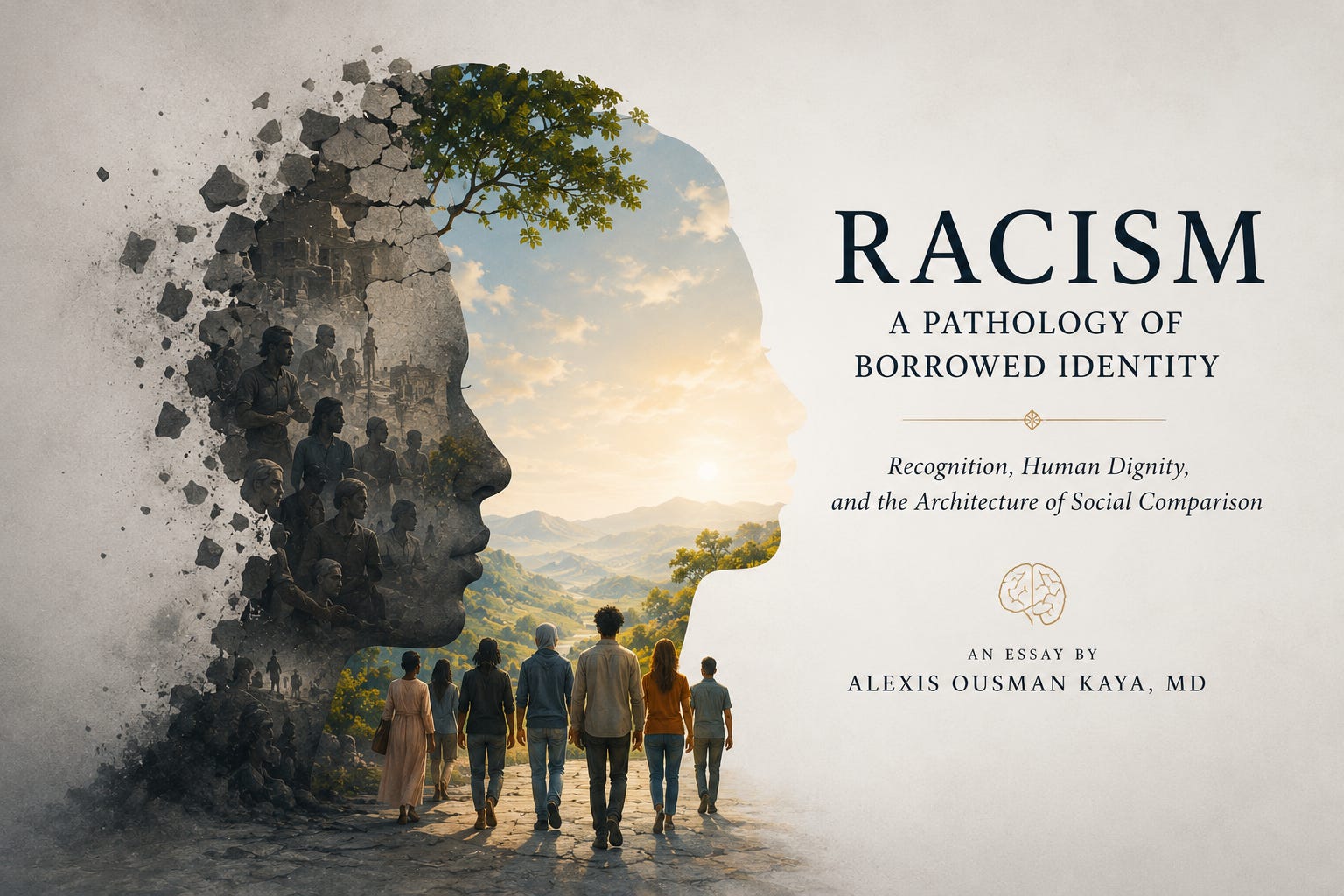
This essay inaugurates the first special philosophical issue of The Architecture of Mind. While the journal usually approaches neuroscience through a philosophical lens, these monthly interludes will step aside from the laboratory and enter the moral theatre of human existence. Their purpose is to ask what kind of beings we become when we look at one another, when we classify one another, and when we forget that dignity is never a privilege bestowed by birth but a responsibility revealed through life.
The challenge of civilization is not to eliminate human comparison, but to prevent comparison from becoming a justification for unequal human dignity.
Understanding Rather Than Judging
Racism is usually summoned before the tribunals of morality, law, politics, and history. These tribunals are necessary; they name the injury, preserve the memory of suffering, and remind civilization of the wounds it has inflicted upon itself. Yet beneath their judgments there remains a quieter and more disturbing question: why does a human being, already fragile in the search for his own worth, feel compelled to borrow dignity from the imagined inferiority of another?
This essay begins from the conviction that such a question deserves philosophical examination. Its purpose is neither to defend nor to condemn those who hold racist beliefs. Moral judgment alone cannot explain the psychological processes that give rise to such beliefs, nor can legal condemnation, however necessary, reveal the deeper mechanisms through which they emerge, persist, and sometimes become embedded within entire societies. To understand a phenomenon is not to excuse it. It is to seek the conditions that make it possible.
The central argument of these pages is that racism is not, at its deepest level, a doctrine about race. It is a drama of identity. It appears whenever a person or a community, unable to sustain dignity through what they have become, seeks refuge in what they were born into. Race then becomes a convenient mask: behind the language of superiority lies a more intimate anxiety, the need to feel valuable by making another human being appear less so.
From this perspective, racism is neither an isolated anomaly nor the property of one people, one nation, or one age. It is one possible expression of a broader human temptation: to secure one’s own worth by lowering the symbolic value of those whose difference can be made to appear permanent.
This distinction leads to a deeper philosophical question. Does authentic human dignity arise from what one inherits at birth, or from what one patiently constructs throughout life? Throughout this essay, I shall argue that the more personal identity depends upon inherited characteristics, the more vulnerable it becomes to comparison and domination. Conversely, the more identity is grounded in one’s own intellectual, moral, and creative achievements, the less it requires the humiliation of others for its affirmation.
The aim of this essay is therefore not simply to reflect on racism. It is to investigate what racism reveals about the architecture of human identity itself. In doing so, the discussion seeks to move beyond the categories of race and prejudice toward a broader understanding of one of humanity’s most enduring questions: how do we come to know our own worth without diminishing that of others?
The Architecture of Human Comparison
1. Human Beings Are Comparative Beings
No human being enters the world alone in meaning. From the first gestures of childhood, the self awakens among other selves. A child does not merely discover his hands, his voice, his hunger, or his fear; he discovers that others are stronger, faster, admired, consoled, praised, or ignored. Long before language gives him the word identity, comparison has already begun to sketch the outline of who he believes himself to be.
This tendency should not be regarded as a moral defect. It is one of the ordinary mechanisms through which human cognition constructs identity. To know who we are is, in part, to understand how we relate to others. Comparison therefore precedes judgment; it is a cognitive operation before it becomes a social one.
At its most constructive, comparison serves as a source of learning. It allows individuals to identify strengths to cultivate, weaknesses to overcome, and models to emulate. In this form, comparison contributes to education, creativity, scientific progress, and personal growth. Yet the very mechanism that enables development also contains the possibility of distortion. When the search for self-knowledge gradually becomes the search for superiority, comparison ceases to be an instrument of learning and becomes an instrument of domination.
2. Hierarchy Is Older Than Humanity
Human hierarchies did not emerge in a historical vacuum. Across the living world, social organisms develop forms of organization that distribute roles, regulate access to resources, and reduce conflict within groups. Such structures can be observed among primates, wolves, elephants, birds, and many other social species.
Hierarchy, in itself, is therefore neither pathological nor immoral. It often performs an adaptive function by facilitating cooperation and limiting internal competition. A society without any organization would struggle to coordinate collective action.
It is essential, however, to distinguish hierarchy from domination. A hierarchy describes differences in roles, responsibilities, or functions. Domination begins when those differences are transformed into claims of intrinsic human worth. Leadership does not necessarily require humiliation; authority does not necessarily require degradation. The philosophical problem arises precisely when functional distinctions become moral hierarchies.
3. The Search for Recognition
If comparison provides information, recognition provides meaning.
If comparison tells us where we stand, recognition tells us whether our standing matters. Human beings do not merely wish to survive; they wish to be seen. They long for the quiet assurance that their presence has weight, that their efforts are not invisible, that their name is not merely pronounced but acknowledged. Recognition is therefore not a decorative desire added to life from the outside. It is one of the inner beams upon which identity is built.
Healthy recognition encourages responsibility, achievement, and contribution. It allows individuals to develop confidence without denying the dignity of others. Yet recognition can also become fragile. When individuals fail to establish a stable sense of personal worth through their own actions and achievements, they may begin searching for alternative sources of value.
At this point, an essential distinction emerges.
Some forms of identity are constructed through knowledge, character, responsibility, and accomplishment. Others are inherited independently of personal effort: ancestry, ethnicity, language, nationality, or physical appearance. The former invite continuous development; the latter require no achievement to possess. Whenever inherited identity becomes the principal foundation of self-worth, the temptation arises to transform belonging into superiority.
The argument developed throughout this essay begins here. The deepest problem is not comparison itself, nor hierarchy, nor even the desire for recognition. The problem begins when individuals cease to derive their value from what they become and instead derive it from what they believe themselves to have been by birth.
Two Directions of Human Comparison
The human tendency to compare oneself with others is neither inherently virtuous nor inherently destructive. Comparison is simply a cognitive instrument through which individuals locate themselves within their social world. Whether it contributes to personal growth or to social division depends not upon the existence of comparison itself, but upon the direction in which it is oriented.
Comparison may become a path toward self-development, or it may become a search for superiority. These two orientations originate from the same psychological mechanism, yet they lead to profoundly different conceptions of identity and human worth.
1. Vertical Comparison: Becoming Better Than Oneself
The most constructive form of comparison is directed toward one’s own development.
Its implicit question is simple: “Can I become better than I was yesterday?” In this orientation, other individuals are not adversaries but sources of inspiration. Their achievements become evidence of what is possible rather than threats to one’s own value. Excellence is admired because it expands the horizon of human potential.
Nearly every form of genuine human progress emerges from this orientation. Scientific discovery seeks a deeper understanding than previous generations achieved. Philosophical inquiry refines inherited ideas through continuous criticism and reflection. Artistic creation aspires to produce works that surpass the artist’s own earlier accomplishments. Education itself rests upon the conviction that human beings are capable of becoming more than they presently are.
In this sense, comparison remains present, but its objective has changed. The individual no longer seeks validation through the defeat of others, but through the continual construction of a more accomplished self. Personal worth is derived from growth rather than from relative superiority.
2. Horizontal Comparison: Becoming Better Than Someone Else
Comparison may also follow a different trajectory. Instead of asking “Can I become a better version of myself?”, the individual begins asking “Can I establish that I am superior to someone else?”. The purpose of comparison is no longer self-improvement but social positioning. Recognition becomes dependent upon occupying a higher place within an imagined hierarchy of human value.
Prestige, status, influence, and dominance gradually replace learning as the principal objectives. Success is no longer measured by what one has become, but by whom one has surpassed.
Such comparison is not inherently immoral. Human societies inevitably recognize competence, leadership, and achievement. The problem emerges when social distinction becomes the primary source of personal identity. At that moment, self-worth becomes fragile because it depends upon the continued existence of someone perceived as inferior. Identity ceases to be constructed through one’s own accomplishments and begins to depend upon relative position.
3. When Comparison Becomes Domination
The passage from comparison to domination rarely announces itself. It begins almost imperceptibly, at the moment when the other is no longer encountered as a companion in the shared labor of becoming, but as a mirror arranged to make one’s own image appear taller. Difference is no longer contemplated; it is ranked. The other is no longer a person before whom the self may learn, but a surface against which the self attempts to rise.
From this moment onward, difference is no longer merely observed; it is ranked. Diversity becomes hierarchy. Hierarchy becomes justification. And justification ultimately seeks permanence. Whenever personal identity cannot secure its value through knowledge, character, creativity, or responsibility, it becomes increasingly tempted to anchor that value in inherited characteristics that require no personal achievement. The individual no longer asks, “What have I become?” but rather, “To which group do I belong?”
This distinction is fundamental to the argument developed throughout this essay. Racism does not arise because human beings compare themselves with one another. Comparison is universal and indispensable. Racism becomes possible when comparison abandons the pursuit of self-construction and becomes a search for enduring superiority grounded not in achievement, but in inherited identity.
The psychological movement is therefore subtle but decisive: the search for excellence becomes the search for dominance; the construction of the self becomes the preservation of status; and identity, once grounded in personal development, gradually dissolves into collective inheritance.
Racism as a Compensatory Identity
The previous chapters argued that human beings naturally seek recognition and that comparison may follow either a constructive or a status-oriented direction. Yet these observations leave an important question unanswered. Why do some individuals eventually transform ordinary comparison into systems of exclusion directed toward entire groups of people?
The answer proposed here is not that racism arises from hatred alone, nor that it is the inevitable consequence of human nature. Rather, one of its deepest psychological foundations may lie in a particular form of identity construction: the attempt to restore a fragile sense of personal worth through inherited rather than constructed forms of identity.
1. The Failure of Recognition
Every individual enters society seeking recognition, to be respected, to be admired, and to matter. Ideally, such recognition is earned through competence, character, responsibility, creativity, or contribution to the community. Yet recognition is never distributed equally, and many individuals experience frustration, disappointment, or perceived insignificance within the very groups to which they belong.
Such experiences do not inevitably produce prejudice. Most individuals respond by continuing to develop themselves, redefining their aspirations, or finding new communities in which their abilities are appreciated. Others, however, may search for a more immediate source of personal value.
The psychological question is therefore not why recognition matters, but what happens when recognition appears permanently unattainable.
2. The Displacement of Comparison
This displacement can resemble a concealed form of jealousy, not always jealousy of possessions or power, but jealousy of another group’s mere existence as a bearer of dignity. The other appears to possess a value that unsettles the fragile self. Rather than enlarge his own humanity, the insecure subject seeks to diminish the humanity of the one before him. In this way, racism becomes less a discovery of difference than a wounded reaction to the dignity perceived in another.
This displacement represents a profound transformation of comparison. Excellence becomes secondary. Identity itself becomes the principal source of value. The individual no longer asks, “What have I accomplished?” Instead, the question gradually becomes, “To whom do I belong?”. At this point, inherited characteristics begin replacing personal achievements as the principal currency of self-esteem.
3. The Psychological Paradox
Here lies one of racism’s most revealing paradoxes: it speaks in the language of strength while confessing, beneath that language, a dependence. The racist claims superiority, yet the superiority claimed has not been built by the hand, refined by the mind, or justified by moral grandeur. It is borrowed from a collective fiction, inherited without labor, worn like a borrowed garment over an uncertain self.
The stronger this dependence upon inherited identity becomes, the weaker personal identity risks becoming. Individual accomplishment gradually gives way to collective inheritance as the principal foundation of self-worth. For this reason, racism may be understood not simply as hostility toward another population, but as a particular mode of identity construction in which one’s own value depends upon assigning diminished value to others.
This interpretation does not claim to explain every historical manifestation of racism. Political institutions, economic interests, historical conflicts, and ideological systems have all contributed to its development in different contexts. Rather, the present argument identifies one psychological mechanism capable of sustaining racist thought: the substitution of constructed identity by inherited identity as the principal source of human value.
Seen from this perspective, racism reveals less about biological difference than about the profound human struggle to answer a universal question: How can I believe that my own life possesses value?
Why Race Becomes an Ideal Vehicle for Hierarchy
If the search for recognition can sometimes evolve into the search for superiority, another question naturally follows. Why has race, throughout so many periods of history, become one of the principal foundations upon which human hierarchies have been constructed?
Race becomes powerful in racist imagination not because it explains the human being, but because it appears to freeze him. It offers hierarchy a visible mask and permanence a body. What is historically constructed can then pretend to be natural; what is politically arranged can pretend to be biological; what is merely inherited can pretend to be deserved.
1. The Power of Immutable Identity
Not all aspects of human identity possess the same degree of permanence. Education can be acquired. Wealth may be accumulated or lost. Occupation changes. Religious belief may evolve. Political convictions may be abandoned. Even nationality can sometimes change. Race, however, occupies a different category. Like ancestry or biological lineage, it is generally perceived as fixed from birth. Whether understood biologically, culturally, or socially, racial identity appears resistant to individual choice. This permanence gives race a distinctive symbolic force. It transforms an ordinary human difference into a characteristic that appears immune to effort, merit, or personal transformation. When identity becomes immutable, hierarchy itself acquires an appearance of permanence.
2. Permanence as the Foundation of Hierarchy
Every durable hierarchy seeks stability. A hierarchy grounded in achievement is inherently unstable because achievement can change. Today’s leader may become tomorrow’s follower. Knowledge can be acquired. Excellence can be surpassed. Hierarchies based upon immutable characteristics offer something fundamentally different: they appear self-justifying.
If superiority is believed to originate from birth rather than accomplishment, then social position no longer requires continual demonstration. Privilege becomes hereditary rather than earned. This helps explain why systems of domination throughout history have repeatedly appealed to ancestry, lineage, ethnicity, or race. Immutable identities provide ideological stability because they transform historical circumstances into apparently natural conditions. The greater the permanence of the characteristic, the easier it becomes to present hierarchy as inevitable rather than constructed.
3. From Biological Difference to Social Category
Human biological diversity is real, but biological variation does not, by itself, create racism. The decisive transformation occurs when visible or imagined differences are converted into social categories, and those categories are burdened with claims about intelligence, morality, beauty, competence, or worth. A feature becomes a sign. A sign becomes a rank. A rank becomes an institution. The philosophical point is therefore simple and devastating: biology may offer variation, but society teaches that variation to mean superiority or inferiority.
Race does not become a vehicle of domination because biological differences possess inherent moral significance. It becomes a vehicle of domination because immutable differences offer a uniquely effective foundation upon which durable hierarchies may be constructed and justified. Seen in this light, racism is not fundamentally a theory about biology. It is a theory about permanence. It is the attempt to transform contingent historical relations into immutable truths by anchoring human value in characteristics that no individual can alter.
When Psychology Becomes Institution
The psychological mechanisms explored above cannot, by themselves, explain the long afterlife of racism. A private fear may fade; a wounded pride may soften; an individual prejudice may die with the person who carried it. But once the same fear is translated into law, custom, property, school, market, and memory, it no longer depends on the consciousness that first produced it. The wound has become architecture.
The explanation lies in a decisive transformation: what begins as a pattern of individual thought may eventually become embedded within institutions. Once codified into laws, customs, economic structures, educational systems, and political organizations, psychological tendencies acquire a permanence that far exceeds the lifespan of any individual. History does not merely record prejudice. It gives prejudice structure.
1. From Individual Belief to Institutional Rule
Every institution begins as the product of human decisions; norms become customs; customs become laws. Laws become traditions. Traditions eventually appear so familiar that later generations mistake them for natural features of society rather than historical constructions.
This transformation profoundly alters the nature of prejudice. What originally required active personal conviction may later persist without conscious intention. Individuals begin participating in systems whose underlying assumptions they have never explicitly examined. Prejudice has become institution.
2. Slavery and the Construction of a Durable Hierarchy
Few historical examples illustrate this process more clearly than the development of transatlantic slavery and the racial hierarchy that accompanied it. The enslavement of African populations cannot be reduced to a single cause. Economic interests, colonial expansion, political power, legal institutions, religious interpretations, and later pseudo-scientific theories all contributed to the creation and maintenance of slavery. Yet these diverse forces gradually converged around a common narrative: that one human population possessed an inherently inferior status.
Over time, domination ceased to appear as a historical arrangement and came to be perceived as a natural order. The social position imposed upon enslaved populations was increasingly interpreted as evidence of their supposed intrinsic characteristics, rather than as the consequence of political and economic systems designed to preserve unequal relations of power. This reversal is one of history’s most enduring illusions. A hierarchy created by human institutions came to be mistaken for a hierarchy created by nature.
The consequences extended far beyond slavery itself. Even after legal emancipation, many of the categories, stereotypes, and assumptions forged during that period continued to shape collective imagination, influencing opportunities, expectations, and social interactions across generations.
3. Institutional Racism and Historical Memory
One of the defining characteristics of institutions is their capacity to outlive the intentions of those who created them. Individuals born within an established social order inherit patterns of organization, legal frameworks, cultural narratives, and implicit expectations that predate their own existence. Consequently, institutions may continue reproducing unequal outcomes even when many of the individuals participating in them consciously reject racist beliefs.
Institutional racism should therefore not be understood solely as the presence of openly racist individuals within institutions. It also describes situations in which historical structures continue influencing access to opportunity, recognition, and social participation through mechanisms that have become normalized over time.
Institutions possess a form of historical memory. They preserve ways of organizing society long after the original justifications have disappeared. The endurance of racial inequality cannot therefore be explained exclusively by contemporary prejudice; it must also be understood through the remarkable capacity of institutions to transmit inherited hierarchies across generations.
This observation leads to an important conclusion. If racism originated only within individual psychology, it would likely disappear with the individuals who held such beliefs. Its persistence throughout history demonstrates that ideas acquire extraordinary resilience once they become embedded within institutions, cultural practices, and collective memory. Psychology may initiate a hierarchy, but history is often what allows it to endure.
Dependent Identity and the Illusion of Superiority
The preceding chapters have shown that human beings seek recognition, compare themselves to others, and may transform inherited identities into foundations of hierarchy. One question now remains: why does inherited belonging sometimes become so central that it seems to carry the whole burden of personal worth?
The answer proposed in this chapter is that racism, among its many historical and social dimensions, may also reveal a particular mode of identity construction—one in which personal value depends less upon individual achievement than upon collective inheritance.
1. When Personal Identity Remains Underdeveloped
Every individual possesses multiple sources of identity: some are inherited, others are constructed. Constructed identity emerges gradually through knowledge, character, responsibility, creativity, work, relationships, and moral development. It is never complete; it is continuously shaped throughout life.
Inherited identity, by contrast, exists independently of personal effort. One does not choose one’s ancestry, biological origins, or the social categories assigned at birth.
Neither form of identity is inherently problematic. Difficulties arise only when inherited identity gradually replaces constructed identity as the principal source of personal worth. When individuals cease asking, “Who am I becoming?” and instead define themselves primarily by “What was I born as?”, personal identity risks remaining psychologically dependent upon characteristics over which no individual has exercised agency.
2. The Group as a Psychological Refuge
Human communities provide belonging, solidarity, and mutual protection. These functions are essential to social life and should not be confused with prejudice. Yet belonging may also become a refuge from personal uncertainty.
When personal achievement no longer supplies recognition, collective identity may begin to lend the self a value it has not yet learned to construct. The prestige of the group is then experienced almost as a private accomplishment. Belonging becomes borrowed dignity, and the stronger this dependence grows, the more the group is defended not merely as a home, but as a throne.
3. The Paradox of Borrowed Superiority
One of the deepest paradoxes of racism lies precisely here. The individual appears to proclaim superiority. Yet the superiority being asserted has not been personally created, it is inherited, borrowed, and assumed. The paradox is therefore profound. The louder collective superiority is proclaimed, the less necessary personal accomplishment appears to become. Recognition is sought without construction. Status is claimed without achievement. Identity is affirmed without personal authorship.
This observation does not imply that every individual strongly attached to collective identity will become racist. Communities, traditions, and cultural identities enrich human existence in countless ways. The philosophical distinction concerns not attachment itself but dependence. Whenever personal dignity depends upon the degradation of another group, identity has ceased to be autonomous. It has become dependent upon comparison.
Racism may therefore be understood as one possible consequence of a deeper anthropological problem: the substitution of constructed identity by borrowed identity as the principal foundation of human value.
From this perspective, the opposite of racism is not merely tolerance. It is the patient construction of an identity whose dignity no longer requires the humiliation of others in order to exist.
Beyond Race: The Universal Logic of Identity-Based Hierarchies
If the argument developed throughout this essay is correct, racism cannot be understood as an isolated phenomenon. It represents one historical expression of a broader psychological tendency through which human beings organize social value around inherited or collectively shared identities. Race is therefore not the origin of this mechanism. It is one of its most powerful vehicles.
The underlying psychological process extends far beyond racial categories and reappears whenever identity itself becomes the principal criterion by which human worth is measured.
1. Identity Is Not the Problem
Human beings naturally belong to communities: families, cultures, languages, religions, nations, professional traditions, etc. These forms of belonging are neither accidental nor inherently dangerous. They provide continuity, solidarity, meaning, and shared memory. They allow individuals to locate themselves within history and to participate in projects larger than themselves. The philosophical problem does not arise from identity itself. It arises when identity becomes hierarchy.
The transition is subtle but decisive. A shared characteristic gradually ceases to describe who people are and begins to determine what they are believed to deserve. Identity has become a scale of human value.
2. Different Objects, the Same Psychological Mechanism
The object changes; the structure remains. Race, religion, nation, language, class, caste, gender, culture, ideology, education, and professional prestige may all become mirrors in which groups seek a superior image of themselves. Difference becomes inequality; inequality asks for justification; justification hardens into doctrine. The same psychological movement returns under different names.
The specific object changes, the psychological structure remains strikingly similar. Whenever personal worth depends primarily upon collective identity, comparison naturally shifts from mutual recognition toward competition between groups. Difference gradually becomes inequality; inequality seeks justification; justification eventually hardens into ideology. The mechanism therefore transcends any particular historical context. It reflects a recurrent tendency to transform descriptive differences into normative hierarchies.
3. Identity-Based Hierarchies
One of the central claims of this essay is that racism belongs to a wider family of phenomena that may be described as identity-based hierarchies. These systems differ in their historical forms, political consequences, and cultural expressions. Yet they share a common psychological architecture. They replace individual accomplishment with inherited belonging. They substitute personal construction with collective inheritance. They derive dignity not from what a person becomes but from the category into which that person is placed.
Seen in this light, racism is not unique because it relies upon race. It is unique because race constitutes one of the most stable and difficult identities to modify. The underlying psychological logic, however, can readily migrate toward other immutable or symbolically powerful identities whenever historical conditions permit.
This broader perspective carries an important implication. Eliminating one form of hierarchy does not necessarily eliminate the psychological tendency that produced it.
If human beings fail to construct autonomous identities grounded in knowledge, character, responsibility, and personal achievement, new forms of collective hierarchy may simply emerge around different symbols of belonging. The enduring challenge, therefore, is not merely to dismantle particular systems of discrimination. It is to cultivate forms of identity that no longer require inherited categories as the primary foundation of human dignity.
Toward an Autonomous Identity
If racism is one expression of a deeper habit of deriving worth from inherited identity, the central question is not whether every trace of prejudice can be erased from the human heart. It is whether the conditions that convert comparison into domination can be transformed.
A definitive answer is likely beyond our reach. Yet the preceding analysis suggests that the more important question is not whether racism can be eradicated once and for all, but whether the psychological conditions that sustain identity-based hierarchies can be transformed.
The answer proposed here is cautiously optimistic. Human beings may never cease comparing themselves with one another. What can change is the direction, purpose, and meaning of that comparison.
1. Can Human Comparison Be Eliminated?
Comparison appears to be an ordinary feature of human cognition. From childhood onward, individuals evaluate themselves through relationships with others. This process contributes to learning, adaptation, and the gradual construction of personal identity. For this reason, the complete elimination of comparison is neither realistic nor desirable. A world without comparison would also be a world without models of excellence, without inspiration, and perhaps without much of what motivates human development. The problem, therefore, is not comparison itself. It is the transformation of comparison into domination.
2. Redirecting the Search for Value
Although comparison cannot be abolished, it can be reoriented. When comparison is directed toward one’s own development, it becomes a source of learning rather than exclusion. The question changes: not, Am I greater than someone else? but, Am I becoming greater than I once was?
This shift transforms the psychological meaning of success. Knowledge replaces inherited privilege. Competence replaces symbolic superiority. Creation replaces exclusion. Merit replaces birth. The individual no longer requires another person’s inferiority in order to experience personal worth. Recognition becomes the consequence of contribution rather than domination.
3. Building a Society That Reduces the Need for Domination
No society can eliminate every form of prejudice. Yet societies can profoundly influence the conditions under which prejudice flourishes. Educational systems that cultivate critical thinking encourage individuals to derive confidence from understanding rather than inherited identity. Just institutions reduce the perception that dignity depends upon membership in privileged groups. Equality of opportunity increases the likelihood that recognition will be earned through achievement rather than predetermined by birth.
Communities that acknowledge the dignity of every individual diminish the psychological attraction of collective superiority as a substitute for personal accomplishment. Such measures cannot eliminate every form of identity-based hierarchy. They can, however, reduce the need for borrowed dignity by expanding opportunities for constructed dignity. The deepest challenge facing every society is therefore not simply to condemn prejudice whenever it appears. It is to create conditions under which individuals no longer need inherited identities to experience their own value.
The ultimate antidote to racism is not the disappearance of difference. It is the emergence of autonomous identities—identities grounded in knowledge, character, responsibility, creativity, and contribution rather than in inherited categories over which no individual has exercised choice. For as long as human beings seek dignity through borrowed identities, new forms of hierarchy will continue to emerge, even if older ones disappear.
The enduring task of civilization is therefore not to erase human differences, but to ensure that no difference becomes the foundation upon which human worth is measured.
What Racism Reveals About Human Nature
Throughout this essay, racism has served not merely as a historical or political phenomenon, but as a philosophical lens through which to examine a more fundamental dimension of human existence. Its deepest lesson does not concern race alone. It concerns the fragile ways in which human beings construct their own sense of worth.
The analysis developed in these pages has argued that comparison is neither accidental nor pathological. It belongs to the ordinary architecture of human cognition. Likewise, the desire for recognition is not a moral failing but an essential condition of social life. The tragedy begins only when recognition ceases to be grounded in what individuals become and instead becomes anchored in what they inherit.
Whenever personal dignity depends upon inherited identity, the temptation inevitably arises to transform difference into hierarchy. Whether the marker is race, religion, nationality, language, social class, gender, culture, or any other collective identity, the psychological movement remains remarkably similar. The object changes; the underlying search for borrowed dignity endures. For this reason, racism should not be understood merely as prejudice directed toward another population. It reveals a more universal difficulty: the human struggle to construct a sense of personal value that does not depend upon the diminished value of others.
This observation also explains why the complete disappearance of racism remains uncertain. As long as individuals continue seeking dignity through inherited identities rather than through the patient construction of their own lives, new forms of identity-based hierarchy may continually emerge, even if older ones disappear.
The ultimate challenge is therefore not simply to eliminate prejudice. It is to cultivate forms of identity capable of generating autonomous dignity. An autonomous identity does not deny history, ancestry, culture, or community. It simply refuses to make them the principal measure of human worth. It recognizes that what we inherit may shape our beginnings, but it cannot determine the full measure of who we become.
Perhaps this is what racism finally reveals: not that difference is dangerous, but that the human being becomes dangerous when he cannot bear the dignity of another without feeling his own diminished. The enemy of equality is not diversity; it is the hunger for a self that can exist only by lowering someone else. Against that hunger, civilization must teach a harder and nobler art: to build an identity so deeply rooted in knowledge, character, responsibility, and creation that it no longer needs another person’s humiliation as its foundation. Only then can human beings meet one another not as rival categories in a hierarchy of birth, but as unfinished lives, each carrying the same inviolable claim to dignity.
The Persistence of Racism: From Eradication to Transformation
If racism is examined through the lens of human psychology, an important question emerges: can racism truly disappear from human societies?
A realistic answer requires distinguishing between two different realities. Racism, understood as a system of beliefs, institutions, and practices that assigns unequal human value on the basis of racial identity, can and must be challenged. However, the psychological mechanisms that make racism possible are much deeper. They belong to fundamental aspects of human cognition: comparison, categorization, belonging, and the search for recognition.
Human beings naturally compare themselves with others. This tendency is not, in itself, a moral failure. It is one of the mechanisms through which individuals understand their place in the world, evaluate their abilities, and pursue improvement. Within the same community, people constantly compare themselves with one another. They compare intelligence, achievements, wealth, beauty, influence, and social recognition. Yet such comparisons are generally not considered racism because they occur within a shared identity framework.
The difficulty emerges when comparison extends from individuals to groups and transforms difference into hierarchy. When a person or a society begins to evaluate another population as inherently inferior or superior because of a collective characteristic such as race, ethnicity, or ancestry, comparison becomes a mechanism of exclusion. The problem, therefore, is not the existence of difference. The problem is the transformation of difference into a measure of human worth.
Throughout history, powerful civilizations have often interpreted their technological, military, or economic advantages as evidence of inherent superiority. A society that develops more advanced tools, stronger institutions, or greater material resources may gradually confuse historical circumstances with natural qualities. Its achievements become interpreted not as the result of geography, historical events, social organization, or accumulated knowledge, but as proof of a superior nature.
This process has repeatedly allowed groups to claim a monopoly over knowledge, civilization, or intelligence while denying the capacities of others. Historical inequality is then transformed into an argument for permanent inequality. For this reason, racism should not be viewed only as an individual prejudice. It is also a recurring human tendency: the temptation to transform relative success into absolute superiority.
The objective of humanity, therefore, should perhaps not be framed as the impossible task of eliminating every possibility of racist thought. Human beings will continue to compare, classify, and seek recognition. The deeper challenge is to transform the meaning of comparison itself. A healthier society is not one in which individuals cease to recognize differences. It is one in which differences no longer determine human value.
The most effective response to racism is therefore not only moral condemnation, although condemnation remains necessary when discrimination occurs. It is also the creation of social conditions in which every population has genuine opportunities to develop, contribute, and demonstrate its abilities.
When education, institutions, economic opportunities, and social recognition are accessible to all, superiority can no longer be justified by historical exclusion. Competence replaces inherited assumptions. Achievement replaces stereotypes. Personal accomplishment replaces collective judgment.
The goal is not to create a world without differences. It is to create a world in which no difference can be made into a verdict against another person’s potential. Humanity may never cease comparing, classifying, or seeking recognition. But it can learn to compare without degrading, to classify without imprisoning, and to recognize itself without denying the dignity of those who stand before it.
This is the ethical horizon toward which every inquiry into the architecture of mind must finally move: not only to understand how human beings think, compare, and belong, but to ask how those same powers may be educated toward justice. For the mind is never merely an organ of perception. It is also an architect of worlds.
Summary
This essay argues that racism is not merely a doctrine of race, but a pathology of identity: a way of borrowing dignity from the imagined inferiority of others. Through the lenses of comparison, recognition, inherited belonging, and institutional memory, it shows how human beings may transform difference into hierarchy when personal worth depends too heavily on what is received at birth rather than on what is patiently constructed through knowledge, character, responsibility, and creation. The ethical task, therefore, is not to erase human difference, but to build individuals and societies in which dignity no longer requires domination.
References
Arendt, H. (1958). The human condition. University of Chicago Press.
Fanon, F. (1952). Black skin, white masks. Éditions du Seuil.
Hegel, G. W. F. (1977). Phenomenology of spirit (A. V. Miller, Trans.). Oxford University Press. (Original work published 1807)
Honneth, A. (1995). The struggle for recognition: The moral grammar of social conflicts. MIT Press.
Taylor, C. (1992). Multiculturalism and “the politics of recognition”. Princeton University Press.
Brewer, M. B. (1999). The psychology of prejudice: Ingroup love or outgroup hate? Journal of Social Issues, 55(3), 429–444.
Tajfel, H. (1981). Human groups and social categories: Studies in social psychology. Cambridge University Press.
Tajfel, H., & Turner, J. C. (1979). An integrative theory of intergroup conflict. In W. G. Austin & S. Worchel (Eds.), The social psychology of intergroup relations (pp. 33–47). Brooks/Cole.
Festinger, L. (1954). A theory of social comparison processes. Human Relations, 7(2), 117–140.
Goffman, E. (1963). Stigma: Notes on the management of spoiled identity. Prentice-Hall.
Weber, M. (1978). Economy and society: An outline of interpretive sociology. University of California Press. (Original work published 1922)
Fredrickson, G. M. (2002). Racism: A short history. Princeton University Press.
Omi, M., & Winant, H. (2015). Racial formation in the United States (3rd ed.). Routledge.
Tomasello, M. (2019). Becoming human: A theory of ontogeny. Harvard University Press.
Frankl, V. E. (2006). Man’s search for meaning. Beacon Press. (Original work published 1946)
Sen, A. (2006). Identity and violence: The illusion of destiny. W. W. Norton.
About the Author
Alexis O. Kaya is a physician, medical scientist, and thinker whose work explores the foundations of human nature. Trained in medicine and deeply interested in neuroscience and child development, he studies how the brain, experience, and social environment interact to shape identity, behavior, and consciousness.
His intellectual journey is guided by a central question: how does the human being become who he is? His reflections examine the relationship between biology and culture, individual development and collective history, personal identity and social recognition.
Through his writings, he explores themes at the crossroads of neuroscience, psychology, philosophy, and anthropology, seeking to understand both the complexity of the human mind and the structures through which societies define value, belonging, and dignity.
His work reflects a lifelong interest in the architecture of human experience: the mechanisms that shape thought, the origins of social behavior, and the conditions that allow individuals and communities to achieve a more profound understanding of themselves and others.