


Alexis O. Kaya, M.D., Ph.D., Neuroscientist.
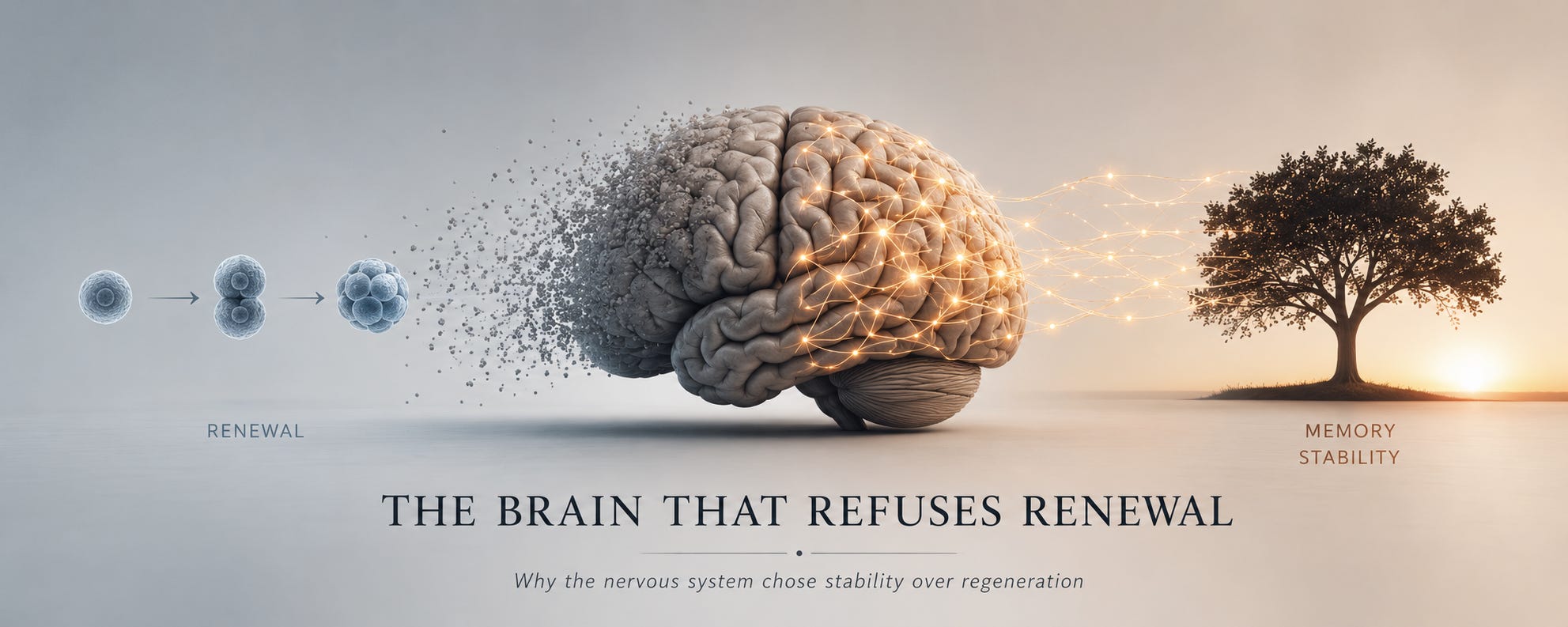
The central claim of this essay is not that neuronal regeneration is absent, nor that cellular replacement would necessarily erase memory. Rather, it is that extensive neuronal replacement in the mature nervous system may carry a distinctive informational cost. Because memory, learning, and identity-like continuity appear to depend on distributed patterns of connectivity and synaptic organization, the preservation of experience may require a balance between structural persistence and plastic reconfiguration.
The organ that chose another path
Why does biology regenerate so many tissues, yet appear to spare the organ that stores experience? At first glance, the question seems deceptively simple: living systems are built upon renewal.
Across the immense diversity of biological life, survival depends upon the capacity to repair, replace, and regenerate. Cells die and are replaced. Tissues heal after injury. Organs continuously renew many of their components. Even when damage occurs, living systems possess remarkable mechanisms designed to restore function and preserve integrity.
Life survives because it changes, and it persists because it renews itself. This principle is so widespread that it almost appears universal. The skin constantly replaces its outer layers; blood cells are continuously produced and removed; the intestinal epithelium renews itself with remarkable speed; bone tissue undergoes lifelong remodeling; and the liver possesses a regenerative capacity that has fascinated physicians for centuries. Across biology, replacement is not the exception; it is the rule.
Nature appears to have discovered a powerful solution to the problem of survival: when components deteriorate, they are replaced; when structures are damaged, they are rebuilt; when cells die, new ones emerge. Yet within the human body there is an organ that follows a different path: the nervous system.
Among the many tissues that compose the organism, the brain occupies a singular position. While most organs rely heavily on cellular renewal, neurons often persist for decades. Many survive throughout adult life. Some may remain present from early development until the final stages of existence. The contrast is striking: the body embraces renewal; the brain appears to resist it. This observation creates a paradox.
From an evolutionary perspective, regeneration can be advantageous, but it is never universally beneficial. A tissue capable of replacing damaged components may gain resilience, yet every regenerative strategy also imposes constraints: energetic costs, risks of inappropriate growth, challenges of integration, and potential disruption of pre-existing organization. Why, then, would the mature nervous system exhibit such limited large-scale neuronal replacement compared with many other tissues? The answer is unlikely to be simple. It may involve intrinsic properties of differentiated neurons, inhibitory environments in the central nervous system, metabolic demands, developmental specialization, and the informational value of preserving established circuits.
One might expect the brain, of all organs, to possess the most robust regenerative capacities. After all, no organ is more essential to survival. The nervous system governs perception, movement, memory, learning, behavior, and consciousness itself. If regeneration is beneficial, why would the brain appear so conservative? Perhaps the question itself points toward the answer; perhaps the brain is not merely preserving tissue; perhaps it is preserving something else. Something more difficult to replace than biological matter.
A skin cell can be replaced; a blood cell can be replaced. Even portions of an organ may be replaced.
But what happens when a neuron participates in a network shaped by decades of experience? What happens when a cell becomes embedded within memories, habits, learned skills, emotional associations, and personal history?
The replacement of tissue may not be the same as the replacement of information. The replacement of matter may not be the same as the replacement of experience. This possibility suggests a profound alternative perspective. Perhaps the apparent fragility of the nervous system is not a failure of evolution; perhaps it is a consequence of what the nervous system must protect. For while most organs are primarily concerned with maintaining biological function, the brain carries an additional burden: it must preserve the history of a life.
Every learned language, every acquired skill, every remembered face, every emotional association, and every fragment of personal history depends upon this accumulated organization. The nervous system is not merely an organ; it is an archive, an architecture, and a living record of experience unfolding across time. If this is true, then neuronal persistence may not represent a failure of evolution. It may represent an evolutionary compromise: a preference for continuity over replacement, for stability over renewal, and for the preservation of history over the unlimited regeneration of tissue. The question, therefore, becomes deeper than regeneration itself. It is no longer only why neurons survive; it is what would be lost if they did not.
The regenerative logic of life
To understand why the nervous system appears exceptional, we must first understand the rule from which it departs. Life is not built upon permanence; it is built upon renewal. From the smallest cellular processes to the maintenance of entire organs, biological systems survive because they possess the ability to repair, replace, and regenerate their components. Throughout nature, deterioration is inevitable. Cells age. Molecules become damaged. Tissues experience wear. Environmental insults constantly challenge the integrity of living organisms. Yet life persists, not because biological structures are indestructible, but because they are replaceable. This principle is so fundamental that it can be observed throughout nearly every organ system of the human body. The skin provides one of the most visible examples.
As the body’s primary interface with the external environment, the skin is subjected to continuous mechanical, chemical, and microbial challenges. Every day, millions of superficial cells are shed and replaced. The epidermis functions as a dynamic structure in perpetual renewal, maintaining protection through constant regeneration. The intestinal epithelium operates according to an even more remarkable rhythm. Cells lining the gastrointestinal tract are exposed to digestive enzymes, mechanical stress, and a dense microbial environment. To preserve function, the intestinal lining continuously renews itself. Entire populations of epithelial cells are replaced within a matter of days, making the intestinal mucosa one of the most rapidly renewing tissues in the body.
Blood provides another illustration of biological renewal. Red blood cells circulate for approximately four months before being removed and replaced. White blood cells undergo continual turnover as part of the immune response. Platelets are constantly produced and consumed. The bloodstream remains functional because its cellular components are continuously replenished.
Even organs that appear stable reveal significant regenerative capacity. The liver has long fascinated physicians and biologists because of its extraordinary ability to recover after injury. Few organs demonstrate such resilience. Under appropriate conditions, liver tissue can regenerate sufficiently to restore function even after substantial loss.
Bone, often perceived as rigid and unchanging, also participates in a lifelong cycle of renewal. Through the coordinated actions of osteoclasts and osteoblasts, skeletal tissue undergoes constant remodeling. Old bone is removed. New bone is formed. The skeleton preserves its strength not by remaining unchanged, but by continuously reconstructing itself. These examples reveal a common biological strategy: renewal is not an exception; renewal is a principle. Nature repeatedly solves the problem of deterioration through replacement. When damage accumulates, components are renewed. When structures weaken, new structures emerge. When cells are lost, new cells take their place. From an evolutionary perspective, this strategy is remarkably effective.
Regeneration provides resilience, replacement preserves function, and renewal allows organisms to survive despite the unavoidable consequences of time, injury, and environmental stress. One might therefore expect the most important organs to possess the greatest regenerative capacities. Yet the nervous system follows a strikingly different path. While much of the body survives through renewal, the brain appears to rely upon another strategy entirely. This contrast raises a central question: if regeneration is one of nature’s most successful mechanisms of survival, why does the organ responsible for memory, learning, and consciousness seem so reluctant to embrace it? Perhaps the answer lies not only in what regeneration preserves, but also in what it risks destroying.
The nervous exception
If renewal is one of the great biological strategies of life, the nervous system appears to stand apart: this is the paradox.
The organ most responsible for learning, memory, behavior, adaptation, and consciousness appears to depend on cells that only rarely participate in the regenerative logic observed elsewhere in the body. The brain follows another biological grammar.
Unlike many tissues whose survival depends upon continual cellular replacement, the mature nervous system relies heavily on neurons that have exited the cell cycle. Many neurons are post-mitotic: once developmentally differentiated, they do not normally divide in the manner of epithelial, hematopoietic, or hepatic cells. This does not mean that the adult brain is biologically inert. Glial cells can proliferate, synapses remodel, axons may sprout under certain conditions, and limited neurogenesis has been reported in specific regions and species, with the extent of adult human neurogenesis remaining an active area of debate. The point is more precise: the mature central nervous system does not generally maintain itself through widespread replacement of its principal neuronal populations.
A skin cell may be lost and replaced, a blood cell may die and be replenished, and an intestinal epithelial cell may disappear and be renewed within days, but a cortical neuron, once differentiated and integrated into the architecture of the brain, may remain part of that system for decades. In some cases, it may accompany the individual for a lifetime. The biological meaning of this persistence cannot be overstated. A neuron is not simply a cell occupying space inside the skull. It is a specialized element of communication. It possesses a cellular body, dendrites that receive information, an axon that transmits signals, synapses that connect it to other neurons, and molecular machinery capable of modifying communication through experience. Its identity is not merely cellular. It is relational.
A mature neuron belongs to a network. It occupies a position, it participates in pathways, it contributes to circuits, and it becomes part of the architecture through which perception, memory, movement, emotion, and thought become possible. This is why the nervous exception matters.
When a skin cell is replaced, the body loses a unit of barrier function. A new cell can take its place without altering personal history. When a blood cell is replaced, oxygen transport continues. When an intestinal cell is replaced, absorption and protection persist. But when a neuron is replaced, the issue may be profoundly different.
The question is not only whether a new cell can occupy the same anatomical location. The question is whether it can inherit the same informational history. Can it assume the same relationships? Can it reproduce the same synaptic architecture? Can it preserve the same place within a network shaped by years of experience? This is where the brain becomes biologically singular.
During development, the nervous system undergoes an immense process of construction. Neural progenitors proliferate. Neurons are generated. They migrate to their appropriate locations. They differentiate. They extend axons and dendrites. They form synapses. Circuits are refined through activity, experience, genetic programs, and environmental interaction. By the time mature neural architecture emerges, the system is no longer a simple collection of cells. It has become an organized world.
Developmental maturation transforms neurons into participants in an increasingly precise architecture. The immature brain is not merely growing in size. It is being organized. It is assigning positions, establishing hierarchies, refining pathways, eliminating unnecessary connections, strengthening useful ones, and preparing the organism to interact with the world. This process is difficult to repeat. A mature neuron is not interchangeable in the same way as a renewing epithelial cell. Its role depends upon its connections, its history, its synaptic strengths, its molecular state, and its participation in networks that may have been shaped over many years. This helps explain why the limited regenerative capacity of the nervous system cannot be understood merely as a biological defect. It may also be a consequence of complexity.
The more deeply a cell becomes embedded in informational architecture, the more difficult it may become to replace without consequence. The nervous system is therefore exceptional not only because its neurons rarely divide, but because their replacement would require more than cellular substitution.
It would require architectural reintegration. This distinction is central. Generating a neuron is not equivalent to restoring a circuit; restoring a circuit is not equivalent to restoring a memory. The mature brain may therefore limit extensive neuronal replacement not because regeneration is intrinsically undesirable, but because its functional organization depends on the stability of highly specific relationships. Its cells are biological units, but also nodes within networks shaped by development, activity, and experience. The nervous system is thus profoundly plastic yet relatively conservative: it adapts primarily by modifying synaptic weights, network dynamics, dendritic structure, and functional connectivity rather than by rebuilding itself through massive neuronal turnover. The paradox becomes sharper the more we consider it: the brain’s apparent resistance to renewal may reflect not a simple deficit, but a constraint imposed by circuit-level organization.
On one side lies the advantage of regeneration: the capacity to replace damaged cells and restore tissue integrity. On the other lies the risk of disrupting information-bearing organization: the possibility that replacement could alter networks carrying learned associations, procedural skills, affective patterns, and autobiographical memory. The nervous system may therefore represent a biological compromise. It does not simply sacrifice renewal for stability; rather, it distributes repair across other mechanisms, including synaptic remodeling, glial responses, compensatory network recruitment, molecular maintenance, and limited forms of structural reorganization. This does not deny the importance of neurogenesis, axonal sprouting, or experimental regenerative strategies. It suggests only that, in the mature brain, large-scale neuronal replacement is not the dominant mode of adaptation. The nervous exception may therefore be best understood as a difference in scale, mechanism, and informational constraint rather than as a complete absence of renewal.
The informational cost of replacement
The paradox of the nervous system becomes clearer once we distinguish between two very different realities: biological material and biological organization.
Throughout most of the body, these two dimensions are closely related but relatively independent. Cells can be replaced without fundamentally altering the function of the organ they compose. A skin cell may disappear and another may take its place. A blood cell may die and be replaced by a newly generated cell. The tissue remains functional because what matters is primarily the preservation of biological activity rather than the preservation of a specific cellular history. The replacement of matter does not necessarily alter the identity of the system. This principle governs much of biology. Yet the nervous system appears to operate under a different constraint. For the brain does not merely perform functions. It accumulates information; it stores experience; it preserves learning; it integrates memories; it maintains relationships among countless neural elements that have been shaped by years, sometimes decades, of interaction with the world. This distinction may be crucial. Replacing a cell is relatively straightforward; replacing information is not. A biological structure can often regenerate its material components, but can it regenerate the history embedded within those components? This question introduces what may be called the informational cost of replacement. Whenever a cell is replaced, biology must preserve more than tissue. It must preserve function. In most organs, this challenge remains manageable because function depends largely upon maintaining a general organizational pattern. The nervous system presents a far greater difficulty. Here, organization itself may constitute the function. A neuron is not important merely because it exists. It is important because of where it exists; because of the cells to which it connects; because of the pathways in which it participates; because of the history that has shaped those connections. Its significance lies less in its biological substance than in its position within an architecture. This idea becomes easier to understand through a simple analogy.
Imagine a library: the shelves may be replaced, the walls may be repaired, the lighting may be modernized. Even the building itself may undergo renovation. As long as the books remain organized and accessible, the knowledge contained within the library survives.
Now imagine a different scenario: the shelves remain intact, the building remains standing, but the books disappear: the architecture remains, but the information is lost. The true value of the library was never the wood, the bricks, or the furniture. It was the organization of knowledge.
The nervous system may face a similar challenge. Neurons are not merely biological components. They are carriers of relationships. Their value lies not only in their physical existence but in the informational architecture they collectively sustain. Memories do not appear to be stored inside individual neurons like files within a cabinet. Rather, they emerge from patterns of connectivity distributed across networks. Learning modifies these networks. Experience refines them. Repetition strengthens certain pathways while weakening others. Over time, an increasingly complex architecture emerges. An architecture shaped by a unique history. An architecture that cannot easily be recreated from scratch.
From this perspective, regeneration acquires a different meaning. The challenge is no longer simply producing a new neuron. The challenge is producing a new neuron capable of assuming the precise informational role of the neuron it replaces. The challenge is preserving relationships, preserving connectivity, preserving history, preserving organization. And this may be far more difficult than generating biological material itself. The distinction is subtle but profound.
A liver cell can often be replaced because the informational burden carried by that individual cell is relatively limited. A neuron embedded within a network shaped by decades of experience may carry a vastly different burden. Its replacement would require more than structural reconstruction. It would require informational reconstruction. This possibility suggests an intriguing evolutionary interpretation. Perhaps the nervous system did not abandon regeneration because regeneration was impossible. Perhaps it limited regeneration because regeneration carried risks: not risks to tissue, but risks to information. The more valuable the information embedded within a network, the greater the potential cost of disrupting that network. Under such conditions, persistence may become a more effective strategy than replacement. Evolution may therefore have faced a biological dilemma: should the nervous system maximize regeneration? Or should it maximize continuity? The answer may have favored continuity.
For an organism can survive the loss of many cells. It may be far less tolerant of the loss of accumulated experience. Seen from this perspective, neuronal persistence ceases to appear as a limitation. It begins to resemble a protective strategy. A strategy designed not merely to preserve biological structures, but to preserve informational architectures. The nervous system may therefore reveal a principle rarely encountered elsewhere in biology.
In many organs, the preservation of material function is the dominant challenge. In the brain, material preservation and informational preservation are deeply intertwined. The challenge is not only to maintain tissue viability, but to maintain patterns of organization through which experience remains accessible and behavior remains coherent.
Memory as a stability requirement
The possibility that neuronal persistence serves an informational purpose becomes even more compelling when we consider one of the brain’s most remarkable capacities: memory.
Among all the functions of the nervous system, memory occupies a unique position. Perception allows us to experience the present, movement allows us to act upon the world. But memory allows experience to survive beyond the moment in which it occurs. Without memory, learning would disappear, knowledge would vanish, personal history would dissolve. Every experience would remain trapped within the present. Memory is therefore not merely a cognitive function. It is the mechanism through which experience acquires duration. It transforms events into history.
To understand why this matters, we must first ask a fundamental question: what exactly is a memory? Contrary to popular intuition, memories are not stored like files within isolated cells. Current neuroscience instead points toward distributed and partially overlapping patterns of activity, synaptic modification, and network reactivation. Engram research suggests that specific populations of neurons can participate in memory traces, but these traces are not static objects. They involve dynamic interactions among neurons, synapses, molecular states, and systems-level consolidation across brain regions. In this sense, memory is architectural, but not rigidly architectural: it depends on organization that must remain stable enough for retrieval and flexible enough for updating.
If memories emerge from organization, then preserving memory requires preserving organization. The problem is no longer simply biological; it becomes structural.
Experience continuously modifies the nervous system. Every lesson learned, every language acquired, every face recognized, every emotional encounter, and every skill mastered, leaves traces within neural networks. These traces accumulate across time. They become integrated into increasingly complex architectures.
Over years and decades, the nervous system gradually acquires a history, a personal history, an informational history, and a biological history of experience. The mature brain is therefore not simply an organ, it is an archive of accumulated organization. Each new experience is incorporated into structures already shaped by countless previous experiences. Learning does not occur in isolation, it occurs within a network that already possesses memory. This observation leads to an important question: What would happen if neuronal replacement became widespread throughout the mature nervous system?
At first glance, the answer may seem simple: new neurons would appear and old neurons would disappear. The tissue might remain anatomically present. Yet the informational consequences would depend on whether new cells could acquire appropriate identities, migrate or remain in suitable positions, establish correct synaptic partners, integrate into existing oscillatory and modulatory regimes, and participate in prior patterns of activity. A new neuron might occupy a similar anatomical region, but would it assume the same computational role? Would it reproduce the same synaptic strengths? Would it participate in the same ensemble dynamics? These questions remain empirical rather than merely philosophical.
These questions highlight a central challenge: the nervous system may tolerate widespread replacement less easily than other tissues because many of its functions depend upon accumulated organization. Large-scale neuronal replacement could, in principle, threaten stored associations, learned procedures, and autobiographical continuity. This claim should be framed cautiously. Memory is not reducible to the survival of single neurons, and neural systems possess redundancy, degeneracy, and compensatory capacity. Nevertheless, if experience is encoded through distributed patterns of connectivity, then preserving those patterns becomes a condition for preserving meaningful continuity.
The brain may not resist renewal because it lacks regenerative potential. It may resist renewal because excessive replacement carries informational risks. A system designed to preserve experience may require a degree of permanence. A system designed to accumulate history may require continuity. From this perspective, neuronal persistence appears less mysterious: the nervous system may have evolved a strategy unlike that of most organs because it performs a task unlike that of most organs.
Other tissues preserve biological function; the brain preserves experience. Other tissues must survive; the nervous system must remember. Memory may therefore impose constraints that few other biological systems encounter.
The more information becomes embedded within an architecture, the greater the potential cost of disrupting that architecture. What appears to be biological conservatism may therefore represent informational protection. Neuronal persistence may not be a failure of regeneration, it may be the price paid for memory. This possibility leads directly to the central hypothesis of the present essay: memory may require persistence because experience requires continuity. And if continuity is indispensable to experience, then the remarkable longevity of neurons may represent one of the most important biological adaptations in the history of the nervous system.
The evolutionary trade-off
Evolution is often described as a process of optimization. In reality, it may be more accurately understood as a process of compromise. Biological systems are rarely perfect. Instead, they emerge from countless trade-offs between competing demands. An organism must be strong, but not so heavy that it cannot move. An immune system must be aggressive enough to eliminate pathogens, but not so aggressive that it destroys its own tissues. A skeleton must be rigid enough to support the body, yet flexible enough to absorb mechanical stress. Throughout biology, adaptation frequently arises from balance rather than maximization.
The nervous system appears no different. To understand why neurons persist for such extraordinary periods of time, it may be useful to consider the possibility that the brain itself emerged from an evolutionary compromise. A compromise between two competing biological needs: flexibility and stability.
At first glance, flexibility appears unquestionably advantageous. An organism capable of adapting rapidly to changing environments possesses obvious evolutionary benefits. It can acquire new behaviors, modify existing strategies, respond to novel challenges, learn from experience, and adaptation is one of the defining characteristics of life.
Without flexibility, organisms become trapped within rigid patterns of behavior and lose the capacity to respond effectively to changing conditions. In evolutionary terms, excessive rigidity can become a liability. Yet stability has its own advantages. Biological systems must not only adapt; they must also preserve what has already proven valuable. An organism that forgets every useful adaptation as soon as it acquires it gains little from learning. A nervous system that cannot preserve successful patterns of organization would struggle to accumulate experience across time. This creates a fundamental tension: too much stability may limit adaptation, while too much flexibility may undermine continuity. The nervous system appears to exist precisely at this intersection.
Consider two hypothetical extremes. In the first, a nervous system is perfectly stable; its neurons persist; its connections remain fixed; its architecture never changes. Such a system would preserve continuity extraordinarily well, but it would learn little. It would struggle to adapt to new environments. Its responses would remain largely predetermined. Experience would leave few lasting modifications. The price of absolute stability would be cognitive rigidity.
Now imagine the opposite extreme. A nervous system characterized by constant renewal. Neurons are continuously replaced, networks are repeatedly reconstructed, and architectures are perpetually rebuilt. Such a system might exhibit extraordinary regenerative capacity: damaged cells could easily be replaced, tissues could recover rapidly. Yet another problem emerges. How would experience accumulate? How would learning persist? How would memories remain stable?
If the underlying architecture changed too rapidly, continuity itself might become fragile. The price of excessive renewal could be informational instability. Neither extreme appears optimal. Evolution rarely favors extremes. Instead, it often selects solutions capable of balancing competing demands.
The mature nervous system may represent precisely such a balance. It preserves enough stability to maintain continuity and enough flexibility to permit adaptation. It remembers, yet it learns; it persists, yet it changes. Rather than relying primarily on cellular replacement, the brain appears to rely heavily on reorganization: synapses strengthen or weaken, networks reorganize, functional relationships evolve, and patterns of activity change. The architecture adapts without requiring the wholesale replacement of its principal components. In this way, the nervous system acquires flexibility while preserving continuity.
Neurotenacity, as used here, should be understood as a conceptual proposal rather than an established technical term. It names the tendency of mature neural systems to preserve core elements of their organization across time. Neuroplasticity, by contrast, refers to well-established processes through which synapses, circuits, and functional networks change in response to development, experience, injury, and learning. Together, these two ideas describe a possible framework: persistence provides continuity, while plasticity provides adaptive change. This interpretation remains hypothetical, but it helps organize a central feature of the brain: its ability to preserve accumulated information while remaining open to transformation.
Evolution does not leave behind explicit explanations for its choices. Yet the architecture of the nervous system suggests that continuity itself may possess adaptive value. The preservation of memory, the accumulation of experience, the maintenance of learned behaviors, and the emergence of personal history, all depend upon some degree of stability. The nervous system may therefore have evolved toward an optimal compromise, not complete rigidity, not unrestricted renewal, but a dynamic balance between persistence and change. A balance sufficiently stable to remember, a balance sufficiently flexible to learn, and perhaps this is the deepest lesson offered by the nervous system. Its greatest achievement may not be adaptation alone, nor continuity alone, but the remarkable coexistence of both. For the nervous system may have sacrificed regeneration in order to preserve continuity.
Plasticity as an alternative to regeneration
At this point, a legitimate question emerges. If the nervous system limits regeneration, how does it remain capable of adaptation? How can an organ built upon such remarkable cellular persistence continue to learn, develop, and respond to change? The answer lies in one of the most important discoveries of modern neuroscience: neuroplasticity.
For much of scientific history, the mature brain was often viewed as a relatively fixed structure. Once development was complete, many researchers assumed that its organization remained largely stable. Learning occurred, but the underlying architecture was believed to possess limited capacity for modification.
The last century profoundly transformed this view. Research in synaptic physiology, learning, and neural development revealed a very different reality: the brain is not static; it is continuously adapting; it modifies itself throughout life. Experience changes it, learning changes it, injury changes it, and development changes it. Even thought itself may contribute to subtle modifications in neural organization. Yet these changes occur without requiring the large-scale replacement of neurons. This distinction is crucial.
The nervous system appears to rely on another solution to the problem of adaptation. Rather than replacing its principal neuronal components at large scale, it often modifies the relationships between them. Neuroplasticity refers to the capacity of the nervous system to alter its functional and structural organization in response to experience, development, or injury. This process operates at multiple levels: synaptic strength can increase or decrease; dendritic spines can appear, stabilize, or disappear; axons can sprout; inhibitory and excitatory balance can shift; glial cells can modulate synaptic environments; and large-scale networks can reorganize their activity. Throughout life, the brain reshapes its internal architecture while much of its principal neuronal population remains intact: the cells often persist, but the relationships change.
Regeneration seeks to solve biological problems through replacement; plasticity seeks to solve them through reorganization. In most tissues, repair often requires generating new cells; in the nervous system, adaptation frequently occurs through modifying existing networks. The implications are profound: learning does not necessarily require new neurons; it often requires new relationships.
A child learning language is not continuously rebuilding the brain from scratch. Rather, existing neural architectures become progressively organized through experience. A musician mastering an instrument does not replace the neurons responsible for motor control. Instead, repeated practice modifies connectivity, strengthens pathways, and refines network efficiency. A patient recovering after neurological injury may regain functions not because lost neurons are fully replaced, but because surviving networks reorganize themselves to compensate for damage. In each case, adaptation emerges through modification of relationships rather than wholesale cellular renewal. This strategy may offer an elegant evolutionary solution: the nervous system preserves continuity while retaining flexibility. It avoids the informational risks associated with large-scale neuronal replacement. At the same time, it remains capable of learning from new experiences.
Plasticity allows change without requiring reconstruction. This may explain why the mature brain can simultaneously appear stable and dynamic. Stable because its principal cellular architecture persists. Dynamic because the relationships within that architecture remain modifiable. The apparent paradox disappears once we recognize that adaptation does not necessarily require replacement.
A city can evolve without demolishing every building; a language can develop without abandoning every word; a civilization can transform while preserving continuity with its past. The brain may operate according to a similar principle. Its evolution occurs primarily through reorganization rather than reconstruction. Its history accumulates through modification rather than replacement. Its continuity survives because change is directed toward relationships rather than components.
From this perspective, neuroplasticity and neuronal persistence are not opposing forces. They are complementary strategies. One preserves continuity; the other permits adaptation. One protects history; the other allows new history to emerge. The nervous system may therefore have solved a problem that many biological systems never encounter: how can an architecture remain itself while continuously changing? Its answer appears remarkably sophisticated: preserve the components, modify the relationships, remember the past, and adapt to the future.
Neuroplasticity may not represent an alternative to persistence. It may represent the mechanism that makes persistence possible. For a system unable to adapt would eventually become obsolete. A system unable to preserve continuity would lose its history. The brain achieves both; it learns without rebuilding itself; it changes without replacing itself; and it evolves without abandoning itself. In this sense, neuroplasticity became the brain’s solution to the limits of regeneration.
The paradox of adaptive stability
Throughout this essay, two seemingly contradictory observations have repeatedly emerged. The brain changes continuously; yet the brain preserves continuity. The nervous system adapts; yet it remains recognizable.
At first glance, these realities appear incompatible: How can a system simultaneously preserve itself and transform itself? How can an organ remain stable while constantly adapting?
The paradox becomes even more striking when compared with other biological systems. Many tissues achieve adaptation through renewal: old components are replaced and new ones emerge. Function is preserved through regeneration. The nervous system appears to have chosen another path. It changes extensively, yet much of its principal cellular architecture persists. The more neuroscience advances, the more apparent this paradox becomes. The brain is not static: neural activity fluctuates, synapses strengthen and weaken, networks reorganize, functional pathways evolve, learning modifies communication among neurons, and experience reshapes connectivity. Yet despite this constant activity, continuity survives. The individual remains connected to the past: memories remain accessible, learned skills persist, and personal history accumulates.
Identity endures. Something remains sufficiently stable to preserve the architecture of experience.
The coexistence of these two realities suggests that stability and adaptation should not be viewed as strict opposites. They may be complementary aspects of a deeper principle that can be described as adaptive stability. This term is used here as a conceptual framework, not as a settled doctrine. It refers to the capacity of a system to preserve essential continuity while modifying its organization in response to experience. Adaptive stability is neither rigidity nor instability, neither immobility nor perpetual reconstruction. It represents a dynamic equilibrium between persistence and transformation. This framework may help explain one of the most remarkable achievements of biological evolution: the nervous system does not solve adaptation by abandoning continuity, nor continuity by resisting all change. Instead, it maintains coherence through regulated change.
A useful analogy may be found in the growth of a city. Over decades or centuries, a city evolves continuously. Roads are modified, buildings are renovated, neighborhoods emerge, technologies transform infrastructure, population patterns change. Yet despite these transformations, the city remains recognizable. Its history remains embedded within its organization; its continuity survives through adaptation. The brain appears to operate according to a similar principle.
Neural pathways are refined, connections are reorganized, patterns of activity evolve. Yet the architecture retains sufficient continuity to preserve the accumulated history of experience. The same principle may be observed in human development: the infant brain differs profoundly from the adult brain, knowledge increases, language emerges, motor skills improve, and social cognition develops. The nervous system undergoes immense transformation. Yet continuity persists across every stage.
The adult does not experience himself as a succession of disconnected individuals. He experiences himself as a single life unfolding through time. Adaptive Stability may help explain why. The brain changes enough to learn. It remains stable enough to remember; it adapts enough to survive; and it preserves enough continuity to remain itself. This balance may represent one of the most sophisticated solutions ever produced by evolution.
Too much stability would prevent adaptation. Too much change would threaten continuity. The nervous system appears to occupy the narrow space between these extremes. A space where learning remains possible without sacrificing history; a space where transformation occurs without destroying identity.
From this perspective, neuroplasticity and neurotenacity are not competing principles; they are complementary dimensions of adaptive stability. Neuroplasticity provides the capacity to change. Neurotenacity provides the capacity to endure. Together, they allow the nervous system to solve a challenge that few biological systems encounter: the preservation of accumulated experience within a continuously changing world.
This interpretation may help explain why the brain appears so different from most other organs. Its primary challenge is not merely survival; its primary challenge is continuity. It must preserve the past while remaining open to the future; it must protect history while permitting innovation; it must remember while learning. And perhaps this is why the nervous system remains one of the most extraordinary structures in biology. Its genius lies not in resisting change. Its genius lies in organizing change. For the brain survives not by remaining unchanged, but by changing without replacing itself.
When stability fails
The preceding sections have explored a possibility. Perhaps the persistence of neurons contributes to the preservation of memory. Perhaps continuity of neural architecture helps sustain continuity of experience. Perhaps the nervous system limits regeneration because stability possesses informational value. Yet every hypothesis must eventually confront reality.
For neuroscience is not only the study of healthy brains. It is also the study of what happens when brains begin to fail. And nowhere is the importance of continuity more visible than in neurological disease. Clinical medicine offers a unique perspective on the problem of stability. It allows us to observe what occurs when the architecture of the nervous system becomes disrupted: not in theory, not in models, but in human lives.
Across a wide range of neurological disorders, one observation repeatedly emerges: the loss of continuity is often accompanied by a loss of function. This relationship appears so consistently that it deserves careful attention.
Consider Alzheimer’s disease. Its clinical significance cannot be reduced to memory loss alone, but memory impairment is often one of its most recognizable early manifestations. The heart may continue to beat, the lungs may continue to function, and many physiological systems may remain operational for years, yet episodic memory, orientation, language, executive function, and social recognition can progressively deteriorate. At the biological level, the disease involves complex interactions among amyloid pathology, tau pathology, synaptic dysfunction, inflammation, vascular factors, and neuronal vulnerability. At the experiential level, these processes may erode continuity: personal history becomes increasingly difficult to access, names disappear, faces become unfamiliar, and experiences once central to identity become fragmented.
This observation raises an important question: what exactly is disappearing? Is the problem simply neuronal death, or is something more complex occurring?
Parkinson’s disease provides a different perspective. Although classically associated with motor symptoms, it can also involve cognition, emotion, motivation, sleep, autonomic function, and behavior. Degeneration of dopaminergic neurons in the substantia nigra and related network dysfunction produce consequences that extend beyond movement. A relatively focal pathological process can therefore generate widespread changes in circuit dynamics. The effects cannot be explained solely by counting lost cells; the timing, location, connectivity, neurotransmitter systems, and compensatory responses all matter.
Traumatic brain injury offers another illustration: two individuals may sustain injuries of apparently similar size. Yet their outcomes can differ dramatically. One patient recovers many functions. Another experiences profound cognitive consequences. The difference often reflects more than the quantity of damaged tissue; it reflects the location of damage within a network. Certain pathways possess strategic importance; certain connections serve as critical bridges between systems. The disruption of a small architectural element may produce consequences disproportionate to its physical size. The nervous system behaves less like a collection of independent components and more like an integrated architecture.
This principle becomes even more evident in neurodegenerative disorders. Across many diseases of the nervous system, measurable functional disturbances may precede extensive neuronal loss. Synaptic dysfunction, altered excitability, impaired neuromodulation, network disconnection, and inflammatory changes can emerge before large-scale tissue destruction is obvious. These observations suggest that neurological disease cannot always be understood simply as a problem of cell death. The brain is not merely an inventory of neurons; it is an organized system of relationships, and relationships can be disrupted before entire structures disappear.
This possibility is profoundly important. If function depends upon organization, then the loss of continuity may begin long before the loss of large amounts of tissue. A network can become fragmented while many of its components remain present. An architecture can become unstable while much of its material survives. A memory may become inaccessible even when portions of the underlying system remain intact. The distinction recalls a theme developed earlier in this essay: replacing matter and preserving information are not identical challenges; clinical medicine repeatedly demonstrates that biological survival does not guarantee informational continuity. The organism may remain alive; the architecture may not remain fully coherent.
This realization forces us to confront a deeper question: what exactly is being lost? Cells, certainly, in many diseases; connections, undoubtedly, as communication between neural systems is disrupted. Yet perhaps the most important loss occurs at another level: the level of organization itself, where individual elements become integrated into a coherent whole and where memory, learning, and experience are woven into a continuous architecture. If this interpretation is correct, neurological disease reveals something fundamental about the nervous system. Its most valuable property may not be its cellular composition alone, but the continuity of its organization.
When that continuity begins to fracture, function often follows, memory weakens, learning becomes impaired, and identity may become uncertain: the architecture loses coherence. And as coherence diminishes, the nervous system becomes progressively less capable of preserving the history it was designed to protect.
Clinical medicine therefore offers an unexpected lesson. The greatest threat to the brain may not always be the loss of cells. It may be the loss of continuity. When stability fails, the consequences extend far beyond biology: they reach into memory, identity, and experience itself. This may be why neurological disease remains so devastating. It does not merely damage tissue; it threatens the architecture through which a life remains connected to itself.
The future of neurotenacity
Every scientific idea begins as a question. Some questions disappear once they are answered. Others expand. The more they are explored, the larger they become. The concept of Neurotenacity may belong to the second category.
What began as a simple observation—the remarkable persistence of neurons throughout life—has gradually revealed deeper implications: Why do neurons endure? Why does the nervous system appear to favor continuity over extensive regeneration? Why does the organ responsible for memory, learning, and consciousness seem to follow biological rules different from those governing much of the rest of the body? These questions may ultimately lead far beyond cellular biology.
For if neuronal persistence serves an informational purpose, then Neurotenacity may touch many of the most important challenges facing contemporary neuroscience. The first of these challenges is memory. Throughout this essay, memory has repeatedly emerged as a central theme. The nervous system does not merely process information. It preserves experience; it transforms moments into history; it allows learning to accumulate across decades. If continuity contributes to memory, then understanding why neurons persist may become essential to understanding how memories survive.
The future study of memory may therefore require a deeper understanding of the biological mechanisms that sustain long-term neural continuity. A second challenge concerns identity. Human beings experience themselves as continuous individuals.
The child, the adolescent, the adult, and the elderly person all perceive themselves as participants in the same life. Yet this continuity remains one of the great mysteries of neuroscience. If identity emerges from organized neural continuity, then Neurotenacity may help explain why a self remains connected to its own history despite continuous biological change.
The persistence of neurons may ultimately prove relevant not only to memory, but to personhood itself. Another horizon emerges in developmental neuroscience and the study of neurodevelopmental conditions. Among these, autism presents particularly intriguing questions.
Contemporary research has explored genetic, molecular, synaptic, and developmental mechanisms in considerable depth. Yet many aspects of neural organization remain incompletely understood. Could certain neurodevelopmental conditions involve alterations in the establishment, refinement, maintenance, or stabilization of neural architectures? Could differences in the balance between persistence and reorganization contribute to developmental diversity? These questions must be framed carefully. They do not imply a deficit model of neurodivergence, nor do they reduce complex conditions to a single mechanism. They are speculative research questions that would require empirical validation, ethical sensitivity, and attention to individual variability. The concept also carries implications for aging.
The human brain possesses an extraordinary capacity to preserve information across many decades. Some memories survive for a lifetime. Some skills remain accessible after years of disuse. Some experiences continue to influence behavior long after they occurred. Yet aging inevitably introduces challenges to continuity. Neural systems become more vulnerable; repair mechanisms become less efficient; degenerative processes may emerge. Understanding how neurons achieve such longevity may therefore become one of the most important questions in the neuroscience of aging: What protects neural architecture for so long? Why do some systems remain resilient while others become vulnerable? What determines the limits of neural endurance? The future study of aging may increasingly depend upon answers to these questions.
Neurotenacity may also prove relevant to one of the most ambitious goals of modern neuroscience: neural preservation. If continuity possesses informational value, preserving neural architecture becomes more than a technical challenge. It becomes a challenge of preserving history, memory, and accumulated experience. The question is no longer simply how to maintain biological tissue; it becomes how to maintain informational continuity. This distinction may profoundly influence future approaches to neuroprotection, neurodegenerative disease, and long-term brain preservation. Beyond these horizons lies a final question, speculative, controversial, and deeply philosophical: the question of survival.
For centuries, humanity has searched for ways to extend life. Most efforts have focused on the body: improving organs, repairing tissues, treating disease, and delaying aging. These achievements have transformed medicine. Yet if continuity resides primarily within neural architecture, another possibility emerges. Perhaps the most important biological structure to preserve is not the body itself, but the system that carries memory, experience, and identity. Such ideas currently belong more to hypothesis than to established science.
They raise profound technical, biological, and ethical challenges. Any discussion of neural preservation must therefore remain cautious. Preserving tissue is not the same as preserving function; preserving structure is not necessarily preserving consciousness; and preserving connectivity does not by itself solve the problem of subjective continuity. Nevertheless, these questions illustrate the potential scope of the issue. Understanding why neurons endure may influence how neuroscience thinks about aging, neuroprotection, memory disorders, and the limits of biological continuity. For this reason, Neurotenacity should not be viewed merely as a property of individual neurons. It may represent a broader principle linking memory, identity, development, aging, and preservation through a common theme: continuity.
The nervous system appears unique among biological systems because it must do more than survive.
It must remember; it must preserve history; it must maintain the architecture through which experience becomes a life. Whether Neurotenacity ultimately proves to be a fundamental principle of neuroscience remains uncertain. Science advances through evidence, not intuition. Yet the question itself appears increasingly difficult to ignore.
Hidden within the extraordinary longevity of neurons may lie clues to some of the deepest mysteries of the human mind. Perhaps neuroscience will one day discover that neural longevity was never merely a biological curiosity, but one of its central questions all along.
The organ that chose memory
We began with a deceptively simple question: Why does biology regenerate almost everything except the organ that stores experience? At first glance, the answer appeared difficult to understand.
Throughout the living world, renewal is one of nature’s most successful strategies. Cells die and are replaced; tissues repair themselves; organs regenerate; and life survives through renewal: the principle appears nearly universal. Yet the nervous system follows another path.
Among the many structures composing the human body, the brain occupies a singular position. Its neurons often persist for decades. Many survive throughout adult life. Some may accompany an individual from early development until the end of existence. The more closely we examine this phenomenon, the more remarkable it becomes: the organ most responsible for adaptation appears built upon some of the most enduring cells in the body. The organ most responsible for learning appears reluctant to embrace large-scale renewal. The organ most responsible for change appears committed to continuity. This paradox has guided the present essay: Why would evolution favor persistence where regeneration seems advantageous? Why would the nervous system preserve cells that are difficult to replace? Why would nature limit renewal within its most complex organ? The answer remains uncertain.
Science has not yet provided a single definitive explanation for the limited regenerative profile of the mature human brain. The argument developed throughout this article therefore should be read as a conceptual hypothesis rather than a settled conclusion. It suggests that the nervous system may face a challenge unlike that of most other organs: it must preserve viable tissue, but also maintain the organized patterns through which learning, memory, and continuity become possible.
A skin cell can be replaced with little consequence. A blood cell can be replaced. An intestinal cell can be replaced. The function remains. The organism continues. But a neuron occupies a different role. It participates in networks; it contributes to pathways; it becomes embedded within architectures shaped by learning, memory, and experience. Its significance extends beyond biology; it becomes part of history. This distinction may explain why continuity matters so profoundly within the nervous system.
The challenge is not merely preserving tissue; it is preserving information; it is preserving relationships; it is preserving the architecture through which a lifetime of experience becomes organized. Memory appears inseparable from continuity. Learning appears inseparable from organization. Identity itself may depend upon the persistence of accumulated neural architecture. If these observations are correct, then neuronal longevity ceases to appear as a biological curiosity. It becomes a biological strategy.
The nervous system may have evolved toward a compromise unlike that of most other tissues. Rather than relying primarily upon regeneration, it relies upon persistence combined with plasticity: neurons endure, connections adapt, networks reorganize, experience accumulates, and history survives. The brain changes continuously. Yet enough remains for continuity to persist. This possibility has been described throughout this essay through the concepts of Neurotenacity and Adaptive Stability. Neurotenacity emphasizes persistence. Neuroplasticity emphasizes change. Together, they allow the nervous system to achieve something extraordinary: the preservation of continuity within a constantly changing world.
The implications extend far beyond cellular biology. They reach into memory, into identity, into aging, into neurodegeneration, into the future study of neural preservation, and perhaps into questions that neuroscience has only begun to explore. For hidden within the persistence of neurons may lie clues to some of the deepest mysteries of the human mind.
The nervous system remains an unfinished question. Its longevity remains an unfinished question. Its relationship with memory remains an unfinished question. Yet one insight emerges from this exploration: many organs preserve function through replacement, whereas the brain appears to preserve much of its function through the regulated coexistence of persistence and plasticity. Neurons may endure not because renewal is impossible, but because experience may require continuity. The deepest lesson of the nervous system may therefore be expressed with caution: the brain does not simply refuse renewal; it reorganizes the terms of renewal so that memory, learning, and continuity can persist within a changing biological world.
Bibliography
Kandel, Eric R., John D. Koester, Sarah H. Mack, and Steven A. Siegelbaum. Principles of Neural Science. New York: McGraw-Hill Education, 2013.
Kandel, Eric R. In Search of Memory: The Emergence of a New Science of Mind. New York: W. W. Norton, 2006.
Hebb, Donald O. The Organization of Behavior: A Neuropsychological Theory. New York: Wiley, 1949.
Sporns, Olaf. Networks of the Brain. Cambridge, MA: MIT Press, 2011.
Seung, Sebastian. Connectome: How the Brain’s Wiring Makes Us Who We Are. Boston: Houghton Mifflin Harcourt, 2012.
Damasio, Antonio. Self Comes to Mind: Constructing the Conscious Brain. New York: Pantheon Books, 2010.
Maynard Smith, John, and Eörs Szathmáry. The Major Transitions in Evolution. Oxford: Oxford University Press, 1995.
Squire, Larry R., and Eric R. Kandel. Memory: From Mind to Molecules. New York: Roberts & Company Publishers, 2009.
Mesulam, Marsel M. Principles of Behavioral and Cognitive Neurology. Oxford: Oxford University Press, 2000.
Alberts, Bruce, Alexander Johnson, Julian Lewis, David Morgan, Martin Raff, Keith Roberts, and Peter Walter. Molecular Biology of the Cell. 6th ed. New York: Garland Science, 2014.
About the author
Alexis O. Kaya is a physician, published author, and researcher in the neurosciences of learning, memory, and human development at the Université de Montréal. His work lies at the intersection of medicine, neuroscience, philosophy, and developmental science, with a particular interest in the principles that govern cognitive maturation, memory formation, identity, and the continuity of human experience across the lifespan.
Drawing from both scientific inquiry and philosophical reflection, he explores the hidden architectures through which the brain organizes knowledge, preserves experience, and transforms development into cognition. His research seeks to bridge biological mechanisms with broader questions concerning consciousness, learning, behavior, and the emergence of the human self.
He is the originator of the concept of Neurotenacity, a theoretical framework proposing that the persistence of neural architecture may constitute a fundamental biological condition for memory, identity, and cognitive continuity. Through this and related works, he advocates for a renewed examination of continuity, organization, and temporal structure as central themes in contemporary neuroscience.
His current research focuses on large-scale principles of neurodevelopmental organization, including the temporal dynamics of neural activation, the hierarchical emergence of cognitive networks, and the mechanisms through which neural architectures mature across development.