


Alexis O. Kaya, M.D., Ph.D., Neuroscientist.
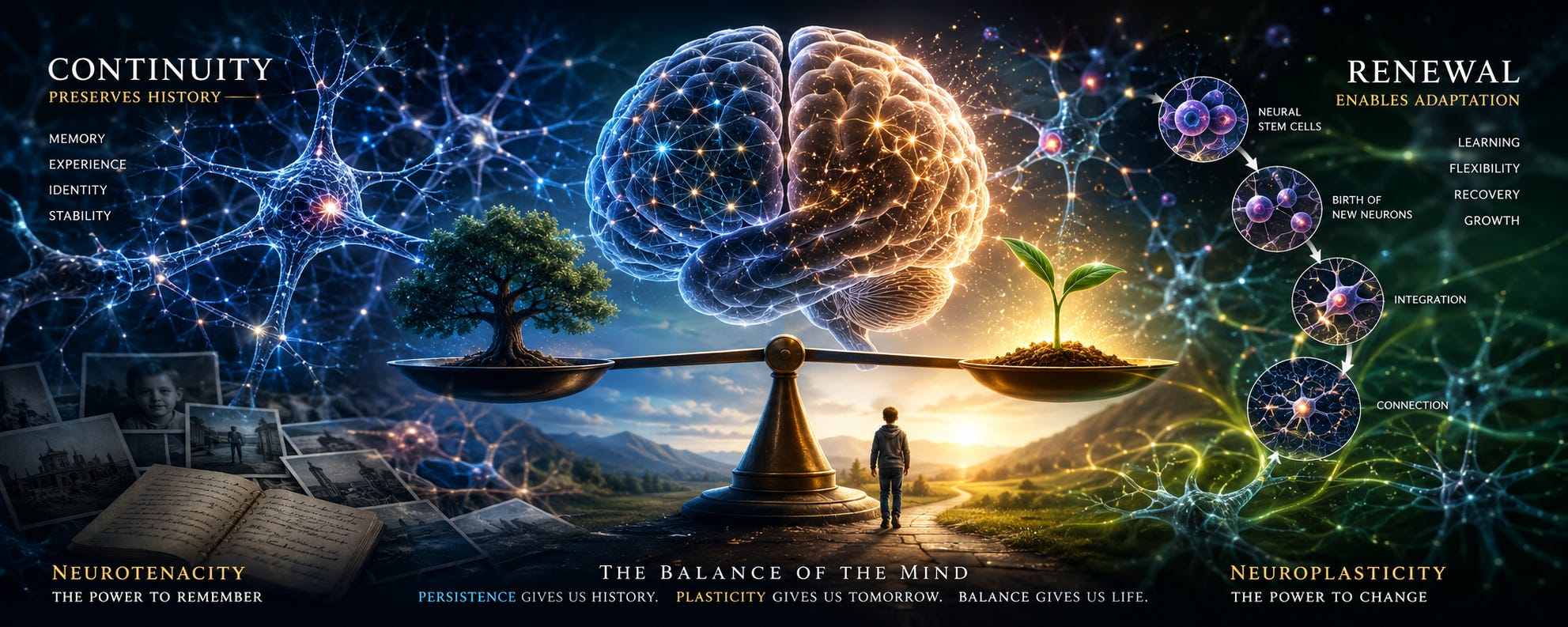
Excessive neuronal renewal may destabilize established informational architecture. The functional value of a new neuron may therefore depend less on its mere production than on the architecture into which it is incorporated.
When renewal becomes a scientific problem
If regeneration is advantageous across so many biological systems, why is large-scale neuronal renewal so restricted in the mature brain? At first sight, the question appears paradoxical.
Across the living world, regeneration is commonly understood as an adaptive virtue. Damaged tissues are repaired, lost cells are replaced, and deteriorating structures are renewed. From an evolutionary perspective, regeneration appears to be one of biology’s most successful strategies: it enhances resilience, improves survival, and protects organisms from injuries that might otherwise prove catastrophic.
The advantages are apparent. A tissue capable of replacing lost components is better equipped to endure; a system capable of repair can resist injury and age-related deterioration. For this reason, renewal is widely distributed throughout the body.
The skin constantly renews itself. Blood cells are continuously replaced. The intestinal epithelium regenerates at extraordinary speed. The liver possesses remarkable regenerative abilities. Even bone tissue undergoes lifelong remodeling. Everywhere we look, renewal appears as a solution.
Regeneration can thus be understood as a biological response to wear, injury, and aging. The underlying logic appears straightforward: damaged components are replaced, deteriorating structures are rebuilt, and lost cells are regenerated. One might therefore expect this principle to reach its most powerful expression in the nervous system.
The brain governs movement, perception, learning, memory, thought, and consciousness itself. If any organ seemed likely to benefit from extensive regenerative capacity, it would be the brain. Yet biological reality appears more restrained.
The mature nervous system remains one of the body’s most conservative biological structures. Many neurons persist for decades, and some survive throughout adult life. Compared with tissues such as skin, blood, or intestinal epithelium, large-scale neuronal replacement is remarkably limited. This contrast raises a fundamental possibility: regeneration may not be universally advantageous. In some systems, replacement may entail costs as well as benefits.
This proposition may initially appear counterintuitive. How could renewal become problematic? How could regeneration, one of biology’s most powerful strategies, generate difficulties rather than solutions? The answer may lie in the distinctive responsibilities of the nervous system.
The liver processes molecules; the skin protects the body; blood transports oxygen. These functions are indispensable. The brain, however, performs an additional task: it accumulates experience, preserves learning, stores memory, integrates personal history, and transforms transient moments into continuity.
The nervous system is therefore not merely an organ of function; it is an organ of information. Information changes the problem of renewal.
Replacing a cell may restore biological material. But does it restore the information embedded within that cell’s relationships? Does it preserve the architecture shaped by years of experience? Does it maintain the continuity required for memory?
These questions guide the present essay. Replacing information-rich cells may be fundamentally different from replacing cells whose roles are primarily structural or metabolic. A new skin cell can assume the role of the cell it replaces; a new blood cell can transport oxygen. By contrast, a neuron embedded within a network shaped by decades of learning participates in an architecture of far greater informational complexity.
Its significance may lie not only in its biological existence, but in the informational architecture to which it belongs.
If this is true, neuronal renewal becomes more than a problem of cellular production. It becomes a problem of preserving accumulated information while introducing new elements into an already organized system. Could excessive neuronal renewal alter the architectures that make memory possible? Could continuity itself impose limits on replacement? These questions remain speculative, but they are scientifically meaningful.
They are not conclusions, but hypotheses. They suggest that the limited renewal of the mature nervous system may reflect not only biological constraint but also the extraordinary informational burden carried by the brain. If so, understanding the cost of new neurons may become as important as understanding their potential benefits.
The promise and limits of neurogenesis
Before examining whether new neurons may carry informational costs, it is necessary to acknowledge one of the major conceptual shifts in modern neuroscience.
For much of the twentieth century, the prevailing view was remarkably clear. The mature brain was believed to be largely incapable of generating new neurons. This position was famously associated with the work of Santiago Ramón y Cajal, one of the founding figures of modern neuroscience.
Cajal’s anatomical work transformed scientific understanding of the nervous system. By demonstrating that the brain is composed of individual neurons organized into complex networks, he helped establish the neuron doctrine as a cornerstone of neuroscience. Yet he also advanced a view that shaped scientific thought for decades: in the adult nervous system, neuronal pathways were largely fixed.
His famous statement became almost legendary: “In the adult centers the nerve paths are something fixed, ended, immutable.” For much of the twentieth century, this view remained largely unchallenged.
The mature brain was regarded as a structure capable of modifying its activity but not of producing substantial numbers of new neurons. The situation began to change in the 1960s.
Joseph Altman reported observations suggesting that new neurons might be generated in adult mammalian brains. At the time, these findings were controversial. The prevailing scientific framework left little room for such a possibility. As a result, Altman’s observations received far less attention than they perhaps deserved.
Only decades later did advances in cellular labeling and molecular methods allow researchers to revisit these questions with greater precision. The modern revival of adult neurogenesis is closely associated with Fred Gage and other investigators who provided evidence that new neurons can arise in specific regions of the adult brain. These discoveries transformed an old certainty into a new scientific problem: not whether neurogenesis is possible in principle, but where it occurs, to what extent, and with what functional consequences.
Today, the strongest evidence for adult neurogenesis concerns the hippocampus, particularly the dentate gyrus. The hippocampus occupies a central position in learning and memory. New neurons generated in this region appear capable of integrating into existing circuits under certain conditions. These findings have stimulated intense interest because they suggest that the mature brain may retain a limited capacity for cellular renewal.
Research involving rodents has also identified substantial neurogenesis within structures associated with olfaction, particularly the olfactory bulb. In several species, newly generated neurons migrate and become incorporated into existing sensory networks. These observations demonstrate that neuronal production and integration are biologically possible. The brain is not entirely closed to renewal. Yet the story remains more complicated than it first appears.
One reason for caution is that many questions remain unresolved. The extent of adult hippocampal neurogenesis in humans continues to be debated. Some studies report evidence consistent with the persistence of hippocampal neurogenesis in adulthood, whereas others report a sharp decline after childhood. For this reason, claims about adult neurogenesis should be framed as conditional and region-specific rather than as a uniform property of the adult human brain.
Differences in methodology, tissue preservation, molecular markers, postmortem delay, age, neurological status, and analytical criteria have contributed to this controversy. The disagreement should not be treated as a minor technical detail; it is central to the interpretation of the field. The strongest formulation is therefore not that adult neurogenesis is firmly established throughout the human brain, but that limited neurogenic processes have been reported in specific contexts and remain the subject of active empirical dispute.
This discovery constitutes one of the most significant revisions of classical neuroscience. It also introduces a deeper question, often overshadowed by the excitement surrounding neuronal birth itself: what happens after a neuron is born?
A new neuron entering the adult brain does not enter an empty landscape. It enters circuits shaped by years, and sometimes decades, of accumulated experience: networks that have already learned, connections that have stabilized, pathways that already carry information, and memories that already exist.
At this point, an essential distinction must be made.
Generating a neuron and integrating a neuron are not the same problem. Producing biological material may be only the first step; incorporating that material into an established informational architecture may be considerably more difficult. The existence of adult neurogenesis therefore does not resolve the questions explored in this essay. It sharpens them. If the adult brain can generate new neurons, we must ask how they are integrated into a system whose greatest achievement may be the preservation of continuity.
New cells in old networks
The discovery of adult neurogenesis overturned one of the oldest assumptions in neuroscience. New neurons can appear within the mature brain. For many researchers, this finding demonstrated that the nervous system is not entirely closed to renewal. Yet it immediately raises a more demanding question: what happens next?
The birth of a neuron is only the beginning of a longer biological and functional process. A newly generated neuron does not become meaningful merely by existing. It must integrate, connect, communicate, and acquire a place within an architecture that already exists. This may be more difficult than generating the cell itself.
The adult nervous system is not an unfinished structure awaiting completion. It is an architecture shaped by experience. Every memory, skill, language, emotional association, habit, and repeatedly encountered perception contributes to the organization of neural networks.
The mature brain therefore resembles less a construction site than a living city. Its pathways are established, its routes repeatedly used, its hierarchies organized, and its information distributed across complex patterns of connectivity.
Into this environment arrives a new neuron. The challenge immediately becomes apparent. How does a new element enter a system that has already learned? How does it become part of a history it did not experience? How does it integrate into networks whose organization predates its existence? This problem is not merely anatomical. It is informational.
The first challenge concerns synaptic integration. A neuron that remains isolated contributes little to network function. To become useful, it must establish synaptic relationships with existing neurons. It must receive information. It must transmit information. It must become incorporated into ongoing patterns of communication. This process is biologically remarkable. Yet it also raises questions. A mature network is not random. Its connections reflect years of refinement. Learning has strengthened some pathways. Experience has weakened others. Repeated activity has shaped patterns of communication. The architecture possesses a history. A new neuron entering such a system must somehow become compatible with this pre-existing organization.
The second challenge involves competition for connectivity. Neural networks do not possess unlimited opportunities for integration. Connections are resources. Inputs are resources. Outputs are resources.
A new neuron entering an established circuit may compete with existing elements for participation within the network. This competition is not necessarily harmful.
Indeed, it may contribute to adaptation and learning. Nevertheless, integration is not passive. Every new connection influences existing organization, and every new participant alters the architecture, however subtly. A third challenge concerns network adaptation. When a new neuron becomes integrated, surrounding circuits must adjust. Communication patterns, signal flow, and functional relationships may change as the architecture reorganizes to accommodate the newcomer.
This adaptive capacity is one of the strengths of neuroplasticity. Yet adaptation is not without implications. The more extensively a network must reorganize, the greater the possibility that existing informational structures may be affected. This does not mean that integration is harmful; it means that integration is not free.
Architectures must adjust, relationships must be renegotiated, and the system must incorporate novelty while preserving continuity. This balance may be one of the most delicate tasks performed by the nervous system. Every complex structure imposes constraints on future modification: the more organized it becomes, the harder it is to alter without consequence.
A small cabin may be redesigned easily. A cathedral presents a different challenge. The brain increasingly resembles the latter. As experience accumulates, organization becomes more complex. Connections become more specialized. Networks become more integrated. The informational value of continuity increases. Under these circumstances, the introduction of new elements may become progressively more demanding.
A useful analogy is that of an orchestra performing a symphony. Each musician occupies a specific position. Each instrument contributes to a larger pattern. The music emerges not from individual performers alone but from their coordinated relationships.
Now imagine introducing a new musician into the orchestra while the symphony is already being performed. The challenge is not merely providing an instrument. The challenge is ensuring that the musician knows the score. Understands the tempo. Recognizes the cues. Integrates harmoniously into an ongoing performance.
Without proper integration, additional musicians may increase complexity without improving coherence.
The same principle may apply to neural systems. The appearance of a new neuron does not automatically improve function. Its value depends upon successful incorporation into existing architecture. Its contribution depends upon its ability to participate in relationships already shaped by experience. From this perspective, adult neurogenesis becomes even more fascinating. The remarkable question is not that new neurons can be created. The remarkable question is that they can be integrated at all. This observation leads directly to the central dilemma explored in the present essay.
If continuity has informational value, every new neuron introduces both opportunity and challenge: opportunity because new elements may support adaptation; challenge because adaptation must occur without destabilizing existing organization. The nervous system must remain open to novelty while protecting architecture. This may help explain why neuronal renewal is so limited in the mature brain.
The issue may not be the production of neurons alone. It may be the preservation of the informational world into which they must enter. The challenge is not merely to create a neuron; it is to create its place.
Memory as architectural stability
To understand why neuronal renewal might carry informational consequences, we must first reconsider one of the most fundamental questions in neuroscience: What is a memory?
At first glance, the answer appears obvious. A memory is something we remember. A face. A place. A language. A skill. A moment from childhood. An important event. A fragment of personal history. Yet beneath this familiar experience lies one of the deepest mysteries of the nervous system. How does the brain preserve information across years, decades, and sometimes an entire lifetime? How does experience survive the passage of time?
For many years, memory was often imagined as a form of storage: an event occurred, the brain recorded it, and the information was later retrieved. Although useful as a metaphor, this model can be misleading.
Modern neuroscience increasingly suggests that memory is not a discrete object stored in a single location. Rather, memory emerges from organization, relationships, and architecture. The nervous system does not merely accumulate information; it structures it.
This distinction is fundamental. A memory is not a single neuron, molecule, or synapse. It appears to arise from distributed patterns across networks. During learning, synapses change, communication pathways are modified, activation patterns are reinforced, and relationships among neurons are reorganized. Over time, these modifications accumulate, and memories become embedded within an evolving architecture.
The significance of this process cannot be overstated. What the brain preserves is not merely information itself. It preserves the organization through which information acquires meaning.
A learned language is not stored inside a single neuron. A childhood memory is not contained within a single cell. A skill acquired through years of practice is not localized to one isolated structure. These experiences emerge from coordinated patterns of connectivity distributed across vast networks. Memory therefore depends upon organization. And organization depends upon continuity.
Every new experience is incorporated into structures already shaped by previous experiences. Every memory becomes connected to earlier memories. Every lesson learned modifies architectures that already possess history. Learning is cumulative. Memory is cumulative. Architecture is cumulative.
The brain resembles less a storage device than a continuously evolving city. Each layer of experience leaves traces; new pathways emerge, existing routes are reinforced, and connections acquire significance through repeated use. As life progresses, this informational landscape becomes richer, more interconnected, and more deeply organized.
The older a network becomes, the more information may be embedded within its organization. A mature neural architecture does not merely contain memories; it reflects decades of accumulated adaptation.
Every modification influences countless other relationships. Every pathway exists within a broader context. Every connection participates in a larger informational structure. The consequence is profound.
As architecture becomes increasingly organized, preserving continuity may become increasingly important. The value of a mature network may reside less in its individual components than in the history of interactions that produced it. This idea has important implications for the question of neuronal renewal.
If memories emerge from organized relationships, then replacing components may involve more than replacing biological material. The challenge becomes preserving organization. The challenge becomes preserving accumulated history. The challenge becomes preserving informational continuity.
A new neuron entering a mature network does not enter a neutral environment. It enters an architecture already shaped by countless experiences. It enters relationships that already possess meaning. It enters pathways that already contribute to memory. The question therefore becomes unavoidable. Can a network continuously replace its components without altering the architecture upon which memory depends?
The answer remains uncertain. Yet the problem itself is revealing. Memory may depend more deeply on continuity than is often recognized. What appears stable in experience may reflect a remarkable stability in the architectures that support it.
The persistence of memory may therefore depend not only on biological survival but also on organizational survival: the preservation of relationships, patterns, and structure. From this perspective, memory becomes inseparable from architecture, and experience becomes inseparable from continuity.
The brain may not preserve neurons because individual neurons are inherently irreplaceable. It may preserve them because they participate in informational structures whose continuity has become extraordinarily valuable.
The cost of rewriting a network
The possibility of adult neurogenesis invites an intriguing question. If generating new neurons is possible, would generating more of them necessarily be beneficial?
At first glance, the answer seems obvious. More neurons should increase the brain’s capacity for repair.
More neurons should enhance resilience. More neurons should strengthen recovery after injury. From a purely biological perspective, increased renewal appears advantageous. After all, regeneration is widely regarded as one of nature’s most successful strategies. Why would the nervous system not benefit from more of it?
Yet the question becomes less straightforward once memory and information are considered. The brain differs from many other organs in a crucial respect: its primary challenge is not merely to maintain tissue, but to maintain organized experience.
The nervous system must preserve relationships accumulated across years of learning, architectures shaped by memory, and networks that embody history. Under these conditions, renewal may involve more than replacement. It may involve rewriting.
Imagine, for a moment, a mature neural network that has accumulated decades of experience. Languages have been learned. Skills have been mastered. Memories have been consolidated. Patterns of behavior have become established. Relationships among neurons have been refined through countless interactions. The architecture has acquired depth.
Now imagine dramatically increasing neuronal renewal within this system. New neurons begin appearing in large numbers. Old neurons are progressively replaced. The overall volume of the network remains similar. The biological material is preserved. But what happens to the architecture? This question lies at the heart of the present hypothesis.
The first potential consequence concerns connectivity. Every neuron occupies a specific position within a network. Every neuron participates in patterns of communication that have developed over time. Replacing a neuron does not merely replace biological material. It introduces a new participant into an existing system. Connections may need to be re-established. Communication pathways may need to be reorganized. The architecture must adapt. In small amounts, such adaptation may be manageable. In large amounts, the consequences become more difficult to predict.
A second possibility involves the redistribution of information. If memories emerge from organized relationships rather than isolated cells, then modifications to those relationships may influence how information is represented within the network.
The issue is not necessarily loss. The issue may be redistribution. Information that was once organized in one manner may gradually become organized in another. The architecture evolves. The question becomes whether continuity remains fully preserved during this process.
A third possibility concerns network instability. Complex systems often depend upon stable organizational principles. The greater the complexity of a structure, the more sensitive it may become to large-scale modification. An architecture built gradually over decades may not respond to extensive reconstruction in the same way as a newly developing system. Changes that appear small at the cellular level may produce larger consequences at the network level.
The concern here is not the existence of new neurons. The concern is the cumulative effect of introducing many new elements into a highly organized system. Finally, increased neuronal renewal could theoretically interfere with memory consolidation. Consolidation refers to the process through which experiences become stabilized within neural networks. Memories are not instantly fixed. They gradually become integrated into existing architectures. This process depends upon continuity across time.
If the underlying architecture were subject to extensive reconstruction, one might reasonably ask whether long-term stabilization could become more difficult. Could excessive renewal complicate consolidation? Could continual replacement introduce a form of informational turbulence?
At present, neuroscience does not provide definitive answers. And it is important to emphasize this point. The ideas explored here remain speculative. They are not established conclusions. They are not demonstrations.
They are hypotheses emerging from a broader reflection on continuity, memory, and organization. Importantly, experimental work in animals has shown that neurogenesis may support some forms of learning while also contributing, under particular conditions, to the remodeling of circuits associated with forgetting. The relationship between neurogenesis and memory should therefore be described as context-dependent rather than simply beneficial or harmful.
The present argument does not oppose neurogenesis. Rather, it asks whether limits may exist: whether an optimal balance is necessary, and whether more renewal is always better renewal. This distinction is essential.
Biological systems rarely operate according to absolute principles. Health often emerges from equilibrium rather than maximization. The immune system can become harmful when excessively active. Inflammation can become destructive when unchecked. Growth can become pathological when uncontrolled.
Neuronal renewal may follow a similar logic. A certain degree of renewal may be beneficial, whereas excessive renewal may carry costs. The nervous system may therefore face a delicate balancing act: it must remain adaptable enough to learn, flexible enough to recover, and dynamic enough to integrate new experience, yet stable enough to preserve accumulated history.
The value of a new neuron cannot therefore be assessed solely by its existence. It depends on the architecture into which the neuron is introduced. Every new neuron may carry not only opportunity, but also informational cost.
Lessons from development
One of the most informative ways to examine the relationship between neuronal renewal, plasticity, and stability is to consider the developing brain. Developmental neuroscience provides a privileged view of the nervous system during the period in which its architecture is actively constructed. The mature brain exhibits remarkable specialization, supporting functions such as language, memory, reasoning, emotional regulation, and self-awareness. Yet this organization does not emerge fully formed; it is built gradually across development.
The brain of a newborn differs profoundly from the brain of an adult. Not because it possesses entirely different structures, but because its architecture remains under construction. During childhood, the nervous system enters one of the most dynamic periods of biological change found anywhere in nature.
Neural networks expand rapidly. Connections proliferate. Sensory experiences continuously reshape organization. Learning influences architecture on an extraordinary scale.
The developing brain appears designed to maximize adaptability. One of the most striking features of early neural development is exuberant connectivity. The immature brain initially produces far more synaptic connections than will ultimately be retained. This overproduction creates a rich landscape of possibilities. Numerous pathways become available. Multiple patterns of organization can emerge.
The system remains highly responsive to environmental input. Experience acts as a sculptor, and the architecture remains open to modification. The developing brain therefore favors flexibility: exploration over optimization, potential over specialization, and possibility over stability. This strategy allows language acquisition, motor learning, social development, cognitive adaptation, and environmental calibration.
The young brain can respond to circumstances with remarkable efficiency precisely because its architecture remains highly malleable. Yet development does not stop at expansion. Equally important is the process that follows. As experience accumulates, the nervous system begins a large-scale refinement of its architecture. Connections that prove useful are strengthened. Frequently activated pathways become reinforced. Other connections weaken. Some disappear altogether.
This process, commonly referred to as synaptic pruning, is not a form of destruction but of refinement. The brain gradually shifts from abundance toward efficiency, from possibility toward organization, and from flexibility toward specialization. As this transition occurs, networks become more coherent, communication pathways more efficient, and functional systems more integrated.
The result is a nervous system that sacrifices some degree of plasticity in exchange for greater stability. This developmental trajectory is revealing. The immature brain is extraordinarily adaptable. But it is also comparatively unstable.
The mature brain is less adaptable. Yet it possesses far greater organizational continuity. These observations suggest an important possibility. The value of flexibility may not remain constant throughout life. Nor may the value of stability.
The needs of a developing system differ from those of a mature system. A young brain contains relatively little accumulated information. Its primary challenge is acquisition: to learn, adapt, explore, and construct.
An adult brain faces a different challenge. It has accumulated decades of experience; memories have formed, skills have been acquired, and relationships have become embedded within neural architecture. Its primary challenge is therefore no longer acquisition alone, but preservation. The architecture now contains history.
The more information a system contains, the more costly large-scale disruption may become. A newly constructed building can be modified easily. A centuries-old cathedral presents different constraints. Every alteration risks affecting structures accumulated over time.
The mature brain may face a similar problem. Its organization reflects decades of adaptation. Its architecture embodies experience. Its continuity possesses informational value. This perspective does not imply that plasticity disappears in adulthood. Far from it. The adult nervous system remains capable of learning throughout life. New memories continue to form. Skills continue to improve. Networks continue to reorganize. Yet the balance appears to shift. Plasticity remains. But stability gains importance.
The nervous system increasingly seeks to preserve what it has learned while remaining capable of acquiring new information. This developmental transition offers an important lesson for the present discussion: the central challenge of the mature brain may not be maximizing change, but balancing change against continuity.
The issue may not simply concern biological capacity. It may concern informational priorities. The mature nervous system may protect continuity because continuity becomes progressively more valuable as experience accumulates. From this perspective, development itself offers a subtle argument in favor of organizational persistence.
The young brain demonstrates the power of plasticity; the mature brain demonstrates the value of stability. Both are essential, and neither is sufficient alone. One of the deepest lessons of development may therefore be that the architecture of the mind gradually shifts from building itself to preserving itself.
Autism, development, and architectural questions
The preceding discussion naturally leads to a broader question. If continuity has informational value, what happens when the processes responsible for neural organization follow an atypical developmental trajectory? This question is particularly relevant in the context of neurodevelopmental conditions.
Among these conditions, autism spectrum disorder occupies a unique position. Over the past decades, autism has become one of the most intensely studied subjects in neuroscience. Research has identified numerous contributing factors, including genetic influences, developmental timing, synaptic regulation, neuronal signaling pathways, and large-scale patterns of connectivity. Yet despite remarkable progress, no single explanatory framework has succeeded in fully accounting for the diversity and complexity of autistic development.
Autism remains a condition that challenges simple explanations. Some researchers have emphasized genetics. Others have focused on synaptic proteins and molecular pathways. Others have proposed alterations in functional and structural connectivity. Still others have examined differences in developmental timing and network maturation.
These approaches have generated valuable insights. Yet they also reveal an important reality. The architecture of the developing brain remains extraordinarily complex. Many questions remain unanswered. Within this context, it may be useful to consider a broader architectural perspective.
Throughout this essay, we have explored the possibility that cognition depends upon a balance between persistence and reorganization. The nervous system must remain sufficiently adaptable to learn. Yet sufficiently stable to preserve continuity. Development itself may involve a continuous negotiation between these two demands. This observation raises a speculative question. Could certain neurodevelopmental conditions involve alterations in the balance between neural persistence and neural reorganization?
At present, this question remains open. The purpose of raising it is not to propose a definitive explanation for autism, but to identify a potentially fruitful direction for future investigation. The developing brain may require precise coordination among the formation of new neural elements, the stabilization of networks, and the consolidation of emerging architectures.
If this balance were altered, even subtly, neural organization might follow trajectories different from those observed in typical development. From this perspective, autism may be discussed as a neurodevelopmental condition involving differences in genetic regulation, synaptic maturation, developmental timing, and network organization. This formulation is deliberately cautious: it does not reduce autism to a single mechanism, nor does it imply that architectural difference is synonymous with deficit.
Such a framework is compatible with many contemporary observations emphasizing connectivity, network integration, and developmental timing. It also raises a more speculative possibility. If continuity contributes to the stabilization of information, what might occur when new elements are introduced into networks that are already undergoing rapid organization? Could differences in the timing, extent, or integration of neuronal development influence the way information becomes embedded within emerging architectures?
At present, neuroscience cannot answer this question with certainty. Nevertheless, the question itself may be worth exploring. Indeed, certain characteristics sometimes observed in autism invite reflection from an architectural perspective. Many autistic individuals display remarkable abilities in specific domains. Some exhibit exceptional memory for details. Others demonstrate unusual patterns of learning, perception, categorization, or information processing.
At the same time, the integration of experiences may follow pathways that differ from those commonly observed in neurotypical development. These observations should not be reduced to deficits of memory. On the contrary, many autistic individuals display remarkable memory capacities. The issue may concern not the quantity of memory, but the architecture through which memories become interconnected.
A network may preserve information effectively while organizing it differently. An architecture may remain highly functional while following developmental principles that diverge from typical patterns.
The present hypothesis therefore concerns organization rather than deficiency. It concerns architecture rather than impairment. Future research may clarify how connectivity, synaptic stabilization, excitation-inhibition balance, developmental timing, genetic variation, and experience interact during critical periods of neural maturation. At this stage, however, any link between neurotenacity and autism must remain explicitly hypothetical.
At present, the evidence is insufficient to support firm conclusions. The ideas presented here should therefore be understood as research questions rather than explanations. Their value lies not in providing answers, but in suggesting new ways of asking questions. The study of autism repeatedly shows that the brain cannot be understood solely by examining individual neurons; it must also be understood as an architecture.
A dynamic architecture shaped by development, experience, and organization. Perhaps future research will reveal that some of the most important insights into neurodevelopment emerge not from the number of neurons present within a network, but from the manner in which those neurons become integrated into an evolving informational structure.
If so, autism may help neuroscience address one of its deepest questions: how does a developing brain transform biological growth into organized continuity?
When more is not better
One of the most persistent assumptions in biology is that more of a beneficial process must necessarily be better. If repair is useful, more repair should be advantageous. If regeneration promotes recovery, more regeneration should improve resilience. If new neurons can contribute to adaptation, then greater neuronal renewal should appear desirable.
At first glance, this reasoning seems logical. Yet biology repeatedly shows that it is incomplete. Living systems rarely operate according to unlimited expansion. They operate according to regulation, proportion, and balance. The most successful biological strategies are not necessarily those that maximize a function, but those that optimize it.
Throughout physiology, examples of this principle can be found everywhere. Consider the immune system. An effective immune response protects the organism from infection. Without immunity, survival becomes impossible. Yet an immune system that becomes excessively active creates new dangers.
Autoimmune diseases emerge when protective mechanisms begin attacking the organism they were designed to defend. The problem is not immunity itself. The problem is excess. Too little immunity threatens survival. Too much immunity threatens stability. Health emerges between these extremes.
The same principle appears in endocrinology. Hormones regulate growth, metabolism, reproduction, stress responses, and countless physiological processes. Their effects are essential. Yet hormonal systems function effectively only within specific ranges. Deficiency creates dysfunction. Excess creates dysfunction. Balance becomes the defining principle. The biological goal is not maximal hormone production. It is optimal regulation.
Inflammation offers another illustration. Inflammatory responses play a crucial role in tissue repair and defense against injury. Without inflammation, healing becomes difficult. Yet excessive inflammation can itself become destructive. The very mechanisms designed to protect tissues may contribute to their damage when regulation is lost. Again, the issue is not the existence of the process. The issue is its proportion. The issue is balance.
These examples reveal a broader biological lesson. Nature rarely rewards abundance for its own sake. It rewards equilibrium.
The nervous system may follow the same principle. Adult neurogenesis appears capable of contributing to learning, adaptation, and neural flexibility under certain circumstances. Its existence may provide important advantages.
The present essay does not challenge this possibility. On the contrary, the ability to generate new neurons may represent a remarkable feature of neural biology. Yet the existence of a beneficial process does not imply that unlimited expression of that process would necessarily remain beneficial. This distinction is critical.
The question is not whether neuronal renewal is valuable. The question is whether there exists an optimal level of renewal: one that supports adaptation without compromising continuity, permits flexibility without destabilizing organization, and introduces novelty without eroding accumulated history.
The issue is no longer renewal versus persistence. The issue becomes balance between renewal and persistence. The mature nervous system may require both. Too little renewal could limit adaptability. Too little flexibility could impair recovery. Too little plasticity could restrict learning. Yet excessive renewal might introduce different challenges.
Networks could become increasingly difficult to stabilize. Established architectures could become more vulnerable to disruption. Accumulated information could become harder to preserve. Whether such effects actually occur remains uncertain.
Current neuroscience does not provide definitive answers. Nevertheless, the principle itself remains biologically plausible. Complex systems often depend upon carefully regulated equilibrium. The nervous system may be no exception. Indeed, the very existence of limited rather than unlimited adult neurogenesis may itself hint at such regulation.
Nature rarely maintains costly biological processes without reason. Nor does it usually maximize them without constraint. Instead, biological systems tend to evolve toward functional compromises. Solutions that preserve multiple objectives simultaneously. In the case of the nervous system, those objectives may include both adaptability and continuity. Both learning and memory. Both change and persistence. This possibility aligns naturally with the broader themes explored throughout this essay. Neuroplasticity enables adaptation. Neurotenacity preserves continuity. Neither principle appears sufficient alone. Together, they may define the optimal operating range of a mature nervous system.
A brain incapable of change would struggle to learn. A brain incapable of stability would struggle to remember. Biological success may therefore depend not on maximizing either process, but on maintaining the balance between them. The most effective nervous system may not be the one that generates the greatest number of new neurons, nor the one that preserves every existing structure indefinitely. It may be the one that regulates how much change to allow and how much continuity to protect.
Neurotenacity and the preservation of history
The questions explored throughout this essay ultimately converge upon a single idea. Why do neurons endure?
At first glance, neuronal persistence may appear to be little more than an unusual biological characteristic. A curious exception to the regenerative logic that governs much of the living body. Yet as the discussion has progressed, another possibility has gradually emerged. Perhaps neuronal persistence is not merely a biological fact. Perhaps it serves a biological purpose.
If memories depend on organized networks, if experience becomes embedded within architecture, and if continuity contributes to the preservation of that architecture, then neuronal longevity may acquire deeper significance. It may help protect the informational history accumulated throughout life. In this essay, the term neurotenacity is used as a proposed conceptual framework: the biological tendency of neuronal systems to preserve structural and functional continuity across time.
This concept should not be treated as an established category in neuroscience. Rather, it is introduced here as a heuristic term for examining the possible relationship between neuronal longevity, network stability, and informational continuity. Its scientific value will depend on whether it can generate testable predictions and be connected to measurable biological mechanisms.
The distinction is important. A neuron is not valuable merely because it survives. Its importance derives from what it participates in. Every neuron belongs to a network. Every network belongs to an architecture. Every architecture contains traces of experience. Over time, these traces accumulate. Learning leaves marks. Memories become integrated. Skills become refined. Relationships become embedded.
The nervous system gradually transforms experience into organization. As years pass, the informational value of that organization may increase. The architecture becomes richer. More interconnected. More specialized. More deeply shaped by personal history. This observation leads to a possibility that has appeared repeatedly throughout the present essay.
The longer experience accumulates, the more valuable continuity may become. A developing network contains potential; a mature network contains history. Potential can be generated, but history cannot. This distinction is central. The mature brain carries both, yet it is history that gives continuity its special significance.
Every remembered conversation. Every learned language. Every acquired skill. Every emotional experience. Every adaptation to the world. Contributes to an informational structure that did not exist previously.
The longer life unfolds, the more extensive this structure becomes. And the more extensive it becomes, the more significant its preservation may become. From this perspective, Neurotenacity may be understood as a form of biological conservation. Not conservation of matter alone. Conservation of organization. Conservation of accumulated experience. Conservation of informational continuity.
The nervous system may therefore differ from many other biological systems because it must preserve something uniquely vulnerable. Not tissue. History. A damaged liver may regenerate. A fractured bone may heal. A wounded skin surface may repair itself. But the informational architecture generated by decades of experience may be far more difficult to reconstruct.
Once continuity is lost, history may become inaccessible. Once organization is disrupted, accumulated experience may become fragmented. The challenge therefore extends beyond biological survival; it becomes a question of preserving informational identity across time. Neuroplasticity allows history to grow. Neurotenacity allows history to endure. Together, they permit the nervous system to accumulate and preserve experience across a lifetime.
The significance of this idea extends far beyond the present article. If continuity possesses informational value, then Neurotenacity may become relevant to memory, learning, aging, neurodegeneration, and perhaps even questions concerning long-term preservation of neural architecture. The concept therefore invites a broader reflection.
The nervous system may not preserve neurons because neurons themselves are absolutely irreplaceable. It may preserve them because the histories supported by their relationships become increasingly valuable with time. In this sense, neurotenacity may be understood not as a demonstrated evolutionary strategy, but as a hypothesis about how continuity could protect experience across the decades of a human life.
The present essay has explored this possibility from multiple perspectives. Each points toward the same conclusion: memory requires organization, organization requires continuity, and continuity may require persistence.
The future of the question
Scientific progress often begins not with answers, but with questions. The present essay has not attempted to prove that neuronal renewal disrupts memory, nor to deny the importance of neurogenesis. It has explored a possibility arising from a simple observation: the nervous system appears to value continuity in a way that few other biological systems do.
They reach into some of the most important questions confronting contemporary neuroscience. The first of these questions concerns memory. For decades, neuroscientists have sought to understand how experiences become preserved across time. How does a fleeting moment become a lifelong memory? How can information survive for decades within a biological system whose molecular components are constantly changing? The problem remains one of the great mysteries of the brain.
If continuity contributes to memory, then understanding the relationship between persistence and renewal may become essential to understanding how memory itself survives. The same question naturally extends to aging.
The human nervous system possesses a remarkable capacity for longevity. Many neurons survive for extraordinary periods of time. Yet aging eventually alters even the most resilient biological structures.
Why do some neural systems remain stable for decades while others become increasingly vulnerable?
What determines the limits of neural persistence? Could understanding the mechanisms underlying neuronal longevity help explain the difference between healthy aging and pathological decline? These questions acquire even greater importance when considered in the context of neurodegenerative disease.
Conditions such as Alzheimer’s disease, Parkinson’s disease, and other neurodegenerative disorders are often described in terms of neuronal loss. Yet the clinical reality is frequently more complex. Patients do not simply lose cells. They lose memories. They lose abilities. They lose continuity. The question therefore becomes deeper than degeneration alone. What aspects of neural architecture must be preserved in order to maintain cognitive continuity? Which elements of organization are most vulnerable? Which forms of continuity are most essential? The study of neurodegeneration may ultimately depend as much upon understanding preservation as understanding loss.
The issue also returns us to adult neurogenesis. If continuity has informational value, future research must examine not only how new neurons are generated, but how they are integrated. The challenge may not be increasing neuronal production alone, but identifying the conditions under which renewal remains compatible with stability.
This distinction could prove increasingly important as regenerative neuroscience advances. The future of neural repair may depend upon understanding not only how to generate neurons, but how to preserve architecture.
Another emerging field offers a particularly intriguing perspective. Connectomics. The effort to map neural networks and characterize the organization of the brain at increasingly detailed levels has transformed modern neuroscience. Connectomics shifts attention away from isolated components and toward relationships. Toward patterns. Toward architecture. In many respects, this field aligns naturally with the central themes explored throughout this essay.
If cognition emerges from organized connectivity, then continuity may ultimately depend upon preserving relationships rather than merely preserving cells. The future study of neural architecture may therefore become one of the most important arenas in which questions of persistence and renewal are investigated.
Beyond biology, these questions increasingly intersect with artificial intelligence. Modern AI systems can learn. They can adapt. They can modify internal representations. Yet they also confront challenges related to stability, memory retention, and catastrophic forgetting. Remarkably, some of the problems faced by artificial systems resemble questions long confronted by biological nervous systems. How does a system continue learning without erasing what it has already learned? How does it remain adaptable without sacrificing continuity? How does it incorporate novelty while preserving accumulated knowledge?
The parallels are striking. The future dialogue between neuroscience and artificial intelligence may reveal that continuity is as important to intelligence as adaptation. Ultimately, all of these questions appear to converge upon a common theme. The nervous system exists at the intersection of two competing demands. It must change. Yet it must remain. It must learn. Yet it must remember. It must adapt. Yet it must preserve continuity.
Throughout this essay, neurotenacity has been proposed as one possible framework for examining this balance. It is not presented as a completed theory, but as a question worthy of investigation. Perhaps the deepest challenge facing the nervous system is neither change nor stability alone, but the successful coexistence of both.
The future of neuroscience may therefore depend not merely on understanding regeneration or persistence in isolation, but on understanding their relationship. This possibility leads to a question that may guide future research: can neuroscience determine the optimal balance between renewal and continuity?
The price of possibility
We began this essay with a seemingly simple question. If regeneration is one of biology’s most successful strategies, why does the mature nervous system appear so reluctant to embrace large-scale neuronal renewal?
At first glance, the question appeared paradoxical. Throughout the body, replacement is often associated with resilience. Damaged tissues recover. Cells are renewed. Structures are repaired. Regeneration allows biological systems to resist injury and survive the passage of time.
The advantages seem obvious. Yet the nervous system presents a striking exception. Neurons frequently persist for decades. Many remain present throughout adult life. The brain appears to value continuity in a manner unlike most other organs. This observation led us toward a broader reflection. Perhaps the nervous system confronts a challenge different from that faced by other biological systems. It must do more than maintain tissue. It must preserve information. It must preserve memory. It must preserve history.
Throughout this essay, we have explored the possibility that continuity itself possesses biological value. Memories appear to emerge from organization rather than from isolated components. Experience becomes embedded within networks, learning modifies architecture, and personal history accumulates across patterns of connectivity. The mature brain therefore contains more than cells; it contains organized experience.
This observation does not diminish the importance of neurogenesis. The capacity to generate new neurons remains one of the remarkable discoveries of modern neuroscience. Nor does it imply that neuronal renewal is harmful. Under many circumstances, renewal may contribute to adaptation, flexibility, and resilience. Yet the existence of benefits does not eliminate the possibility of costs.
The central question explored throughout this essay has therefore been deliberately modest. Not whether neurogenesis occurs. Not whether neurogenesis is valuable. But whether continuity imposes constraints upon renewal. Whether an architecture rich in accumulated information may require protection. Whether excessive reconstruction could carry informational consequences.
At present, neuroscience cannot provide definitive answers. Many of the ideas discussed here remain speculative and should be presented as hypotheses rather than established facts. Their scientific strength will depend on future empirical work capable of distinguishing between metaphor, conceptual plausibility, and measurable mechanism.
The value of a hypothesis lies not in certainty, but in its capacity to reveal new avenues of inquiry. In that spirit, this essay has proposed a simple possibility: the nervous system must remain capable of change while preserving continuity. It must remain adaptable without sacrificing history, and open to novelty without losing itself.
This balance may ultimately explain why neuronal renewal appears limited rather than unlimited. Not because regeneration lacks value. But because continuity possesses value as well. The future of neuroscience may reveal that the relationship between persistence and renewal is far more important than currently appreciated.
Research into memory, neurodegeneration, aging, connectomics, neurogenesis, and even artificial intelligence may eventually converge upon this same problem. How can a system continue changing without disrupting the organization that defines it?
The answer remains unknown. Yet the question itself may prove increasingly important. Perhaps the greatest challenge facing the nervous system is not learning, nor remembering, but learning while remembering; changing while remaining; growing while preserving history. This may be the true price of possibility. New neurons are promising, but every addition must be integrated into an existing history. The challenge is not merely whether the brain can generate new neurons, but whether it can do so without disrupting what already exists. The value of a new neuron may ultimately depend on the architecture it enters.
Bibliography
Altman, Joseph. 1962. “Are New Neurons Formed in the Brains of Adult Mammals?” Science 135 (3509): 1127–1128.
Altman, Joseph, and Gopal D. Das. 1965. “Autoradiographic and Histological Evidence of Postnatal Hippocampal Neurogenesis in Rats.” Journal of Comparative Neurology 124 (3): 319–335.
Gage, Fred H. 2019. Adult Neurogenesis. 2nd ed. Cold Spring Harbor, NY: Cold Spring Harbor Laboratory Press.
Kandel, Eric R., James H. Schwartz, Thomas M. Jessell, Steven A. Siegelbaum, and A. J. Hudspeth. 2021. Principles of Neural Science. 6th ed. New York: McGraw-Hill.
Kandel, Eric R. 2006. In Search of Memory: The Emergence of a New Science of Mind. New York: W. W. Norton.
Byrne, John H., ed. 2008. Learning and Memory: A Comprehensive Reference. Oxford: Elsevier.
Bullmore, Ed, and Olaf Sporns. 2012. Networks of the Brain. Cambridge, MA: MIT Press.
Sporns, Olaf. 2011. Networks of the Brain. Cambridge, MA: MIT Press.
Ramón y Cajal, Santiago. 1995. Histology of the Nervous System of Man and Vertebrates. Translated by Neely Swanson and Larry W. Swanson. New York: Oxford University Press. (Original work published 1899–1904.)
Spalding, Kirsty L., et al. 2013. “Dynamics of Hippocampal Neurogenesis in Adult Humans.” Cell 153 (6): 1219–1227.
Sorrells, Shawn F., et al. 2018. “Human Hippocampal Neurogenesis Drops Sharply in Children to Undetectable Levels in Adults.” Nature 555: 377–381.
Kempermann, Gerd, Fred H. Gage, Ludwig Aigner, Hongjun Song, Maurice A. Curtis, Sandrine Thuret, H. Georg Kuhn, et al. 2018. “Human Adult Neurogenesis: Evidence and Remaining Questions.” Cell Stem Cell 23 (1): 25–30.
Akers, Katherine G., Alonso Martinez-Canabal, Leonardo Restivo, Adelaide P. Yiu, Antonietta De Cristofaro, Hwa-Lin Hsiang, Anne L. Wheeler, et al. 2014. “Hippocampal Neurogenesis Regulates Forgetting During Adulthood and Infancy.” Science 344 (6184): 598–602.
Frankland, Paul W., and Sheena A. Josselyn. 2016. “Hippocampal Neurogenesis and Memory Clearance.” Neuropsychopharmacology 41: 382–383.
Faust, Timothy E., Pranav Gunner, and Dorothy P. Schafer. 2021. “Mechanisms Governing Activity-Dependent Synaptic Pruning in the Developing Mammalian CNS.” Nature Reviews Neuroscience 22: 657–673.
Geschwind, Daniel H., and Pat Levitt. 2007. “Autism Spectrum Disorders: Developmental Disconnection Syndromes.” Current Opinion in Neurobiology 17 (1): 103–111.
Hutsler, Jeffrey J., and Heng-Wei Zhang. 2010. “Increased Dendritic Spine Densities on Cortical Projection Neurons in Autism Spectrum Disorders.” Brain Research 1309: 83–94.
Moreno-Jiménez, Eduardo P., et al. 2019. “Adult Hippocampal Neurogenesis Is Abundant in Neurologically Healthy Subjects and Drops Sharply in Patients with Alzheimer’s Disease.” Nature Medicine 25: 554–560.

About the author
Alexis O. Kaya is a physician, published author, and researcher in the neurosciences of learning, memory, and human development at the Université de Montréal. His work lies at the intersection of medicine, neuroscience, philosophy, and developmental science, with a particular interest in the principles that govern cognitive maturation, memory formation, identity, and the continuity of human experience across the lifespan.
Drawing from both scientific inquiry and philosophical reflection, he explores the hidden architectures through which the brain organizes knowledge, preserves experience, and transforms development into cognition. His research seeks to bridge biological mechanisms with broader questions concerning consciousness, learning, behavior, and the emergence of the human self.
He is the originator of the concept of Neurotenacity, a theoretical framework proposing that the persistence of neural architecture may constitute a fundamental biological condition for memory, identity, and cognitive continuity. Through this and related works, he advocates for a renewed examination of continuity, organization, and temporal structure as central themes in contemporary neuroscience.
His current research focuses on large-scale principles of neurodevelopmental organization, including the temporal dynamics of neural activation, the hierarchical emergence of cognitive networks, and the mechanisms through which neural architectures mature across development.