


By Alexis O. Kaya, MD, PhD, Neuroscientist
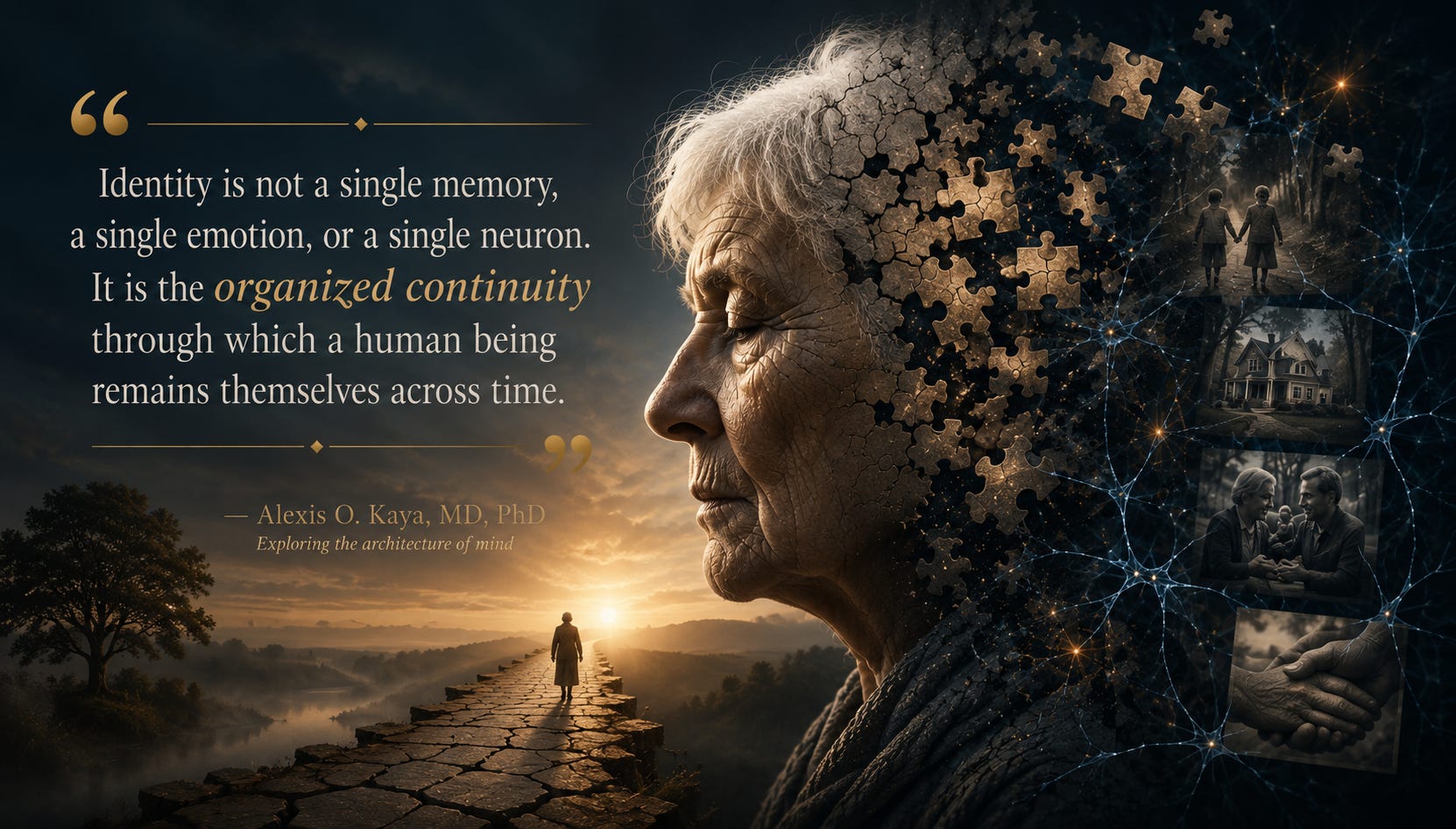
This article argues that neurodegenerative diseases do more than impair memory, cognition, or behavior; they expose the biological conditions through which personal continuity is maintained. By progressively disrupting neural networks, synaptic organization, autobiographical memory, emotional regulation, and relational responsiveness, these disorders reveal that personhood cannot be reduced to a single faculty, a single brain region, or a single moment of consciousness. Identity is best understood as organized continuity: a historically accumulated architecture of memory, emotion, attachment, values, habits, and neural connectivity through which a human being remains recognizably themselves across time. The erosion of this architecture clarifies both the fragility and the resilience of the self, suggesting that neurodegeneration is not only a pathology of cellular loss but also a disorder of continuity, organization, and personhood.
When someone begins to disappear
When does a person begin to disappear? The question appears, at first, to belong to the domain of death: a person disappears when biological life ends, when the body ceases to function, and when the organism no longer survives. Within ordinary experience, this answer seems sufficient. Neurodegenerative disease, however, unsettles that certainty.
In clinical practice, disappearance is not always synchronized with biological death. Neurologists, psychiatrists, geriatricians, nurses, caregivers, and families often encounter a more ambiguous phenomenon: the organism remains alive, while the continuity through which a person is recognized begins to weaken.
Families affected by neurodegenerative disease often describe this experience with striking consistency. Clinicians repeatedly hear variations of the same painful statements: “He is no longer the person he used to be.” Or: “She is still here, but she is not the same.”
These statements are clinically and philosophically significant because they express a contradiction that neuroscience cannot dismiss. The individual remains physically present: the body, the face, the voice, the hands, and the eyes remain. Biological life continues; the heart beats, the lungs breathe, and the organism survives. Yet families perceive a disturbance in something less visible but equally fundamental: the continuity of the person.
They are not merely describing memory loss or cognitive decline; they are describing an alteration in personhood. This observation raises one of the deepest questions in neuroscience: What do we mean when we say that someone remains the same person across time? What allows an individual to remain recognizably themselves across years, decades, and changing circumstances? Conversely, what must be disrupted before the person we know begins to feel only partially present?
The question becomes especially urgent in neurodegenerative disease. A patient may retain many physical characteristics while progressively losing aspects of memory, personality, judgment, language, emotional regulation, or social behavior. The transformation is often gradual: a forgotten appointment, a repeated question, a misplaced object, a subtle change in temperament, and, eventually, a widening gap between biological presence and personal continuity.
Over time, these alterations accumulate. The architecture of cognition shifts, familiar patterns of recognition and response become unstable, and the continuity that once appeared effortless becomes increasingly fragile. Families often struggle to name what they are witnessing because they encounter continuity and discontinuity at the same time.
The person remains present, but the familiar organization of that person appears altered. Fragments of the former self coexist with unfamiliar behaviors; recognition alternates with confusion; moments of clarity alternate with moments of absence. The resulting uncertainty is not merely emotional. It is conceptual and scientific: When does change become transformation? When does transformation become loss? At what point does continuity begin to fracture?
These questions do not belong to medicine alone. They also belong to philosophy, psychology, and neuroscience. For centuries, thinkers have debated the nature of personal identity: whether it depends upon memory, consciousness, personality, the body, the brain, or some relation among them.
Neurodegenerative disease brings these debates into clinical view. It transforms philosophical questions into observable processes by progressively altering the neural systems through which memory, emotion, behavior, and social recognition are organized.
In this sense, neurodegeneration functions as a natural experiment in personhood. It reveals dimensions of identity that ordinarily remain hidden because continuity, when intact, is almost invisible. Only when continuity begins to erode do its biological conditions become apparent.
The study of neurodegenerative disease therefore offers more than an account of pathology. It illuminates the biological conditions under which identity remains possible and exposes the organizational structures through which a human life maintains coherence across time.
The progressive disruption of neural architecture thus forces neuroscience to confront a question at the heart of human existence: How can a person remain biologically alive while becoming psychologically altered, relationally unfamiliar, or partially absent? This article argues that the answer lies in continuity—not continuity as an abstraction, but continuity as an organized biological architecture through which memory, emotion, relationship, and selfhood remain integrated over time.
The biology of continuity
Before we can understand what neurodegeneration destroys, we must first understand what it threatens: What exactly allows a human being to remain the same person across time?
The question is deceptively simple. Every individual undergoes profound biological change throughout life: cells die, tissues renew themselves, organs age, molecular components are continuously replaced, and the body that exists today is not identical to the body that existed twenty years ago. Despite this perpetual biological transformation, a remarkable form of continuity persists: the individual remembers a childhood, recognizes a personal history, maintains relationships, and retains preferences, habits, values, and emotional associations accumulated across decades.
Something survives biological change, and remains sufficiently stable to allow the experience of being the same person through time. The search for this stability lies at the heart of the concept of Neurotenacity.
In previous reflections, Neurotenacity was proposed as the biological property through which neurons preserve structural continuity over extended periods of time. Unlike many cells of the human body, neurons frequently exhibit extraordinary longevity: many survive for decades, and some may persist throughout the entire lifespan of an individual. This persistence is not merely a biological curiosity; it may represent one of the most important foundations of cognitive continuity.
The significance of neuronal longevity becomes clearer when we consider the nature of the nervous system itself: the brain is not simply an organ; it is an informational architecture. Its function depends upon relationships, connections, networks, and patterns of communication established through years of experience.
Learning modifies these patterns and stabilizes them, while life continuously sculpts them. Every conversation, friendship, acquired skill, emotional experience, and lesson learned leaves traces within neural organization.
Over time, the nervous system becomes increasingly shaped by its own history. The result is a uniquely individualized architecture; no two brains possess identical networks, no two lives generate identical patterns of organization. Each person gradually constructs a neural architecture reflecting a lifetime of accumulated experience.
The importance of Neurotenacity emerges precisely here. If neural architecture constitutes the biological substrate of memory, identity, and experience, then continuity requires more than momentary activity; it requires preservation. The architecture must endure long enough for experience to accumulate within it. Without persistence, continuity would become impossible: every day would begin upon a newly reconstructed foundation, and every experience would risk becoming disconnected from what preceded it.
The nervous system therefore solves a fundamental biological problem: it allows change without sacrificing continuity. Neuroplasticity permits adaptation, whereas Neurotenacity permits preservation. Together, they create the biological conditions through which identity can remain recognizable despite lifelong modification.
The nervous system must simultaneously remain flexible and stable. Too much rigidity would prevent learning, whereas too much instability would threaten continuity. The human brain exists within this delicate equilibrium: a structure capable of constant modification while preserving the organizational coherence necessary for memory and selfhood.
This perspective transforms our understanding of continuity. Continuity is not merely a psychological experience, nor is it merely a philosophical concept; it is also a biological phenomenon.
The feeling of remaining oneself may depend upon the persistence of the neural architecture supporting personal history. This possibility becomes particularly significant when viewed through the lens of neurodegeneration. If continuity depends upon persistent neurons, stable networks, and preserved architecture, then diseases disrupting these foundations can reveal their importance with exceptional clarity. The healthy brain allows continuity to appear effortless; the individual awakens each morning with the assumption of being the same person who existed yesterday.
The architecture quietly performs its work in the background; its stability is rarely noticed because it is rarely threatened. Only when continuity begins to fracture do we become aware of the biological foundations supporting it. In this sense, neurodegenerative disease does more than destroy cognitive function; it exposes the hidden mechanisms through which continuity is maintained.
The progressive erosion of neural organization allows us to observe what normally remains invisible. It reveals the structures upon which identity depends. Continuity is not an abstract property existing independently of biology; it is rooted in living architecture, built across decades, shaped by experience, and preserved through persistence. Identity requires biological continuity, and the self survives because its architecture survives.
The diseases of disrupted architecture
To understand what neurodegeneration reveals about identity, we must first understand what neurodegeneration actually destroys. The answer may appear obvious: neurodegenerative diseases kill neurons, damage brain tissue, produce cellular dysfunction, and impair communication among neural systems. These statements are correct, but they do not capture the full significance of the process. The nervous system is not merely a collection of cells; it is an organized architecture, a vast and highly structured network through which information, memory, emotion, perception, and identity emerge.
When neurodegeneration occurs, the consequences therefore extend beyond the loss of individual neurons: the architecture itself begins to deteriorate. This distinction is fundamental.
Throughout the body, cells can be lost without fundamentally altering the identity of an organ; the skin continuously replaces cells, blood cells die and are renewed, intestinal tissues regenerate, yet the overall function of these systems remains relatively stable.
The nervous system differs because its function depends not only on the existence of cells but on the organization linking them together. A neuron derives its significance from its place within a network: its value lies in its connections, its role within pathways, and its participation in larger architectures.
When these architectures become disrupted, the consequences extend far beyond cellular loss: they affect information itself, memory itself, and continuity itself.
This reality becomes particularly apparent when examining the major neurodegenerative diseases. Although these disorders differ in their biological mechanisms, they share a common feature: each progressively disrupts neural architecture. Alzheimer’s disease provides the most familiar example. It is characterized by amyloid-beta deposition, tau pathology, synaptic dysfunction, neuronal loss, and widespread cortical degeneration.
Patients therefore do not merely lose neurons; they lose memories, orientation, and continuity of personal history. The clinical manifestations emerge because architecture is being disrupted. The disease gradually damages the networks through which memory and identity are organized.
Frontotemporal dementia reveals a different but equally illuminating pattern. Rather than initially targeting memory systems, the disease often affects frontal and temporal networks involved in personality, behavior, judgment, language, and social cognition. Families frequently report profound changes in character: a compassionate individual may become indifferent; a reserved individual may become impulsive; or a socially attentive person may lose sensitivity to others. The body remains, and many memories remain, yet the person appears altered. Again, the phenomenon cannot be fully explained by cell loss alone. The disease is reorganizing the architecture through which personality is expressed.
Parkinson’s disease offers another perspective. Although commonly associated with motor dysfunction, Parkinson’s disease also affects cognition, emotion, motivation, and executive function. Degeneration within dopaminergic systems alters communication across distributed neural networks. The resulting changes demonstrate how even selective architectural disruption can influence multiple dimensions of human experience: the effects extend beyond movement and influence the organization of thought itself.
Lewy body dementia further illustrates the importance of architecture. Patients often experience fluctuations in cognition, attention, perception, and awareness. Periods of relative clarity may alternate with profound confusion. Such fluctuations suggest that cognitive continuity depends not merely on the presence of surviving neurons but on the integrity of the networks linking them together. The architecture becomes unstable, access to information becomes inconsistent, and continuity becomes fragile.
Huntington’s disease provides yet another example. Progressive degeneration of striatal and cortical systems leads to disturbances in movement, cognition, emotional regulation, and behavior. As the disease advances, increasingly large portions of neural architecture become affected. The consequences are not confined to isolated functions; they extend across the organizational systems supporting personhood itself.
Despite their differences, these diseases reveal a common principle: neurodegeneration is fundamentally a disorder of organization. Cells die, connections disappear, networks fragment, and communication deteriorates. The architecture loses coherence, and the result is not simply biological damage; it is informational damage.
The significance of this observation becomes clearer when viewed through the lens of Neurotenacity. Previous articles have proposed that the persistence of neural architecture contributes to memory, continuity, and identity; if this proposition is correct, then neurodegenerative disease represents the progressive failure of that continuity.
The disease process gradually dismantles structures that may have required decades to construct. Every experience, memory, learned behavior, and emotional association exist within organized networks. When those networks deteriorate, the informational consequences become unavoidable.
This perspective also helps explain why neurodegenerative diseases are often experienced as disorders of the self. Families do not merely observe cognitive decline, they witness changes in recognition, personality, memory, judgment, emotional responsiveness, and social behavior. The architecture supporting the continuity of personhood begins to fragment, but the individual remains biologically alive.
The organization through which identity is expressed becomes increasingly vulnerable. The tragedy therefore extends beyond neuronal death: it involves the gradual erosion of a life’s accumulated architecture. Neurodegeneration reveals that the brain is not simply a biological organ; it is a historical structure and a repository of relationships, experiences, memories, and personal continuity. When that structure begins to disintegrate, the consequences reach far beyond cellular biology. Neurodegeneration is not merely cell loss; it is architectural loss.
Memory and the erosion of self
Among the consequences of neurodegenerative disease, few are more unsettling than the gradual disappearance of personal history. The loss is not merely cognitive; it is existential. Patients do not simply forget information; they lose access to the narrative through which their lives have been organized. A name may be forgotten, a place may become unfamiliar, and a face may no longer be recognized. At first, these changes appear isolated: minor lapses and momentary failures.
As the disease progresses, the losses begin to accumulate; the architecture of memory gradually becomes less accessible, and with each loss, continuity becomes increasingly fragile. This phenomenon raises a profound question: What remains of identity when memory begins to disappear?
The question has occupied philosophers for centuries. Neurodegenerative disease transforms it from an abstract problem into a clinical reality. Every day, physicians encounter patients whose memories are progressively eroding; every day, families witness the gradual transformation of someone they have known for decades. The experience forces an uncomfortable reflection: How much of the self depends upon memory?
To appreciate the significance of this question, it is necessary to understand the role memory plays in ordinary human existence. Memory does more than preserve facts; it preserves continuity. Autobiographical memory allows individuals to recognize themselves as the same person across time; it links childhood to adulthood, it connects past decisions to present circumstances, and it transforms isolated experiences into a coherent life story.
Without autobiographical memory, existence becomes fragmented; moments remain, but continuity weakens. The narrative structure that ordinarily binds experience together begins to dissolve. In many patients, recent events become difficult to recall, personal experiences become fragmented, and the temporal organization of life begins to blur. The patient may remember distant periods while losing access to more recent chapters of their history. The result is not merely forgetting; it is the progressive disruption of personal narrative.
Recognition presents another dimension of this process. Human identity depends not only upon remembering oneself but also upon recognizing others. Relationships constitute an essential component of personal history: parents, children, friends, partners, and colleagues, each relationship contributes to the architecture of the self.
When recognition begins to fail, these relational foundations become unstable. The consequences are profound: the patient may no longer recognize a spouse, a child may become unfamiliar, and a lifelong friend may appear as a stranger. The emotional impact of such losses extends far beyond memory itself. For relationships are among the structures through which identity is maintained; temporal continuity also becomes vulnerable.
Healthy individuals experience themselves as existing within an unfolding timeline: yesterday connects to today; today connects to tomorrow. Past experiences provide context for present decisions, and future plans emerge from remembered history. This temporal integration allows life to appear coherent.
Neurodegenerative disease progressively undermines this coherence; the ability to situate oneself within time becomes increasingly fragile: past and present lose their connection, experiences become disconnected from one another, the continuity of existence begins to fracture, and personal history suffers a similar fate. A life consists not merely of events but of organized recollections.
The meaning of an experience often depends upon its relationship to other experiences. Memories form networks, stories, patterns, and themes; together, they create the narrative architecture through which individuals understand who they are.
As neurodegeneration disrupts this architecture, portions of personal history become inaccessible. The person may retain fragments while losing the structure that once united them. This observation helps explain why families often describe neurodegenerative disease as a transformation of identity.
They are not merely observing memory failure; they are witnessing the gradual disintegration of continuity. The patient remains biologically alive, while the narrative through which that life has been understood becomes increasingly difficult to access. The significance of memory therefore extends beyond information storage: memory provides coherence, continuity, and historical depth. Without memory, the self loses one of its principal mechanisms of organization. Still, caution is necessary.
The relationship between memory and identity is profound, but it is not absolute. Patients frequently retain emotional responses long after autobiographical memory has deteriorated. They may continue to express affection and to respond to familiar music. They may preserve habits, preferences, and aspects of temperament. These observations remind us that memory is not the entirety of personhood; human identity extends beyond conscious recollection.
The self cannot be reduced to a database of remembered events. Nevertheless, memory remains one of its essential foundations: it provides continuity across time, preserves the architecture of personal history, and allows individuals to recognize themselves as participants in an ongoing life.
When that foundation begins to erode, the consequences extend far beyond forgetting. The gradual loss of autobiographical memory reveals how deeply continuity depends upon the preservation of history. Neurodegenerative disease therefore demonstrates that the self is neither a single memory nor a single moment of consciousness; it emerges from continuity, organization, and the preservation of experience across time. Memory is not the entirety of the self, but it is one of its foundations.
The family’s question
Among the many questions raised by neurodegenerative disease, one stands apart from all the others. It is not usually found in medical textbooks; it rarely appears in scientific journals. Yet clinicians hear it repeatedly. Families ask it in consultation rooms; they ask it beside hospital beds, they ask it in moments of confusion, grief, uncertainty, and love. The question is simple and devastating: “Is she still the same person?”
Few questions reveal more clearly the human reality of neurodegeneration. For the family, the problem is not merely cognitive decline, memory loss, or the progression of disease. The deeper concern is identity: the fear that the person they have loved for years may be slowly disappearing before their eyes.
The question emerges because neurodegenerative disease produces a peculiar form of ambiguity. The patient remains present, changes progressively, and still inhabits a familiar body. The face remains recognizable, the voice often remains the same, and biological life continues. Nevertheless, something feels different—something difficult to name, involving the continuity of the person rather than the continuity of the organism.
Families therefore find themselves living within a paradox: they experience continuity and discontinuity simultaneously. On some days, the person appears unchanged, a familiar expression returns, a shared memory emerges unexpectedly, a characteristic gesture reappears, and a recognizable sense of humor resurfaces. For a brief moment, the continuity seems complete; the person appears fully present, then the moment passes, confusion returns, recognition disappears, language falters, and personality seems altered. The continuity becomes uncertain once again.
The result is a profoundly complex emotional experience. The patient appears both present and absent, both familiar and unfamiliar, both continuous and transformed. This ambiguity helps explain why family members often struggle to answer their own question. Part of them wishes to say yes; part of them fears the answer may be no. Neither response feels entirely correct, because reality often lies somewhere in between.
Many caregivers describe the experience in remarkably similar terms; they speak of fragments of personality, of memory, of emotional connection, and of the individual they once knew. The former self appears intermittently.
A look, a smile, a phrase, or a habit may be preserved despite extensive cognitive decline. These moments possess extraordinary emotional significance: they suggest that continuity has not entirely disappeared; something remains. At the same time, the fragmented nature of these encounters reveals that continuity is no longer effortless; it has become fragile. The phenomenon raises an important scientific question: What exactly are families recognizing in these moments? If memory has deteriorated, if cognition has declined, and if behavior has changed, what remains sufficiently stable to produce the feeling of familiarity?
The answer remains uncertain. The question itself is revealing. It suggests that identity may not depend upon a single function—not upon memory alone, not upon language alone, and not upon reasoning alone. Instead, personhood may emerge from a complex architecture composed of multiple interacting dimensions.
When parts of that architecture deteriorate, continuity may become incomplete without disappearing entirely. This possibility aligns closely with the concept of Neurotenacity. Previous articles proposed that identity emerges from organized continuity sustained across time. Neurodegeneration gradually disrupts this continuity. Yet the process is rarely absolute; architectures often deteriorate progressively rather than instantaneously: some pathways survive, some networks remain functional, and some aspects of personal history continue to influence behavior and emotional expression.
The result is a person whose continuity becomes fragmented rather than entirely abolished. Clinical medicine confronts this reality every day. Physicians may describe disease progression through imaging studies, cognitive assessments, and neurological examinations. Families experience something different: the changing presence of a human being. They witness continuity struggling against disorganization and persistence struggling against erosion.
The question they ask therefore possesses significance far beyond emotion. It touches the central problem explored throughout this work: the Persistence Problem.
How does a person remain the same person across time? And what happens when the biological foundations of that continuity begin to fail?
For families confronting neurodegenerative disease, this is no longer a philosophical thought experiment; it is a lived reality. The Persistence Problem leaves the realm of theory and enters the everyday experience of human loss. This may explain why the family’s question remains so difficult to answer: neurodegeneration reveals that identity is neither entirely preserved nor entirely destroyed. It often survives in fragments of memory, personality, relationship, continuity, and a life still struggling to remain connected to itself. In those fragments, families continue searching for the person they love.
Alzheimer’s disease as a natural experiment
Among all neurodegenerative disorders, Alzheimer’s disease occupies a unique position in the study of human identity. It is not merely one of the most common causes of dementia; it is also one of the most revealing.
If the self depends upon neural continuity, Alzheimer’s disease provides an extraordinary opportunity to observe what happens when that continuity gradually deteriorates. In many respects, the disease functions as a natural experiment—not one designed by scientists, but one produced by biology itself.
The progressive degeneration of neural systems allows us to observe the relationship between architecture and identity in real time. The process unfolds slowly, sometimes over years, sometimes over decades; and within this gradual unfolding lies one of the most profound questions in neuroscience: What happens to the self when the architecture supporting it begins to disappear?
The earliest pathological changes of Alzheimer’s disease often involve structures critical for memory formation and retrieval. Among these, the hippocampus occupies a central role. The hippocampus contributes to the consolidation of new memories and to the integration of experiences into coherent autobiographical narratives. As hippocampal integrity declines, patients frequently experience increasing difficulty retaining new information. Recent conversations become difficult to recall; events lose their temporal context. The continuity linking present experience to personal history begins to weaken. The significance of this change extends beyond memory alone.
Human identity depends upon the ability to situate oneself within an ongoing story. Every remembered event contributes to a broader narrative, and the hippocampus helps maintain this narrative continuity. When its function deteriorates, the narrative itself becomes increasingly fragmented. Alzheimer’s disease, however, does not remain confined to the hippocampus.
As pathology progresses, degeneration spreads across cortical systems. Neural communication becomes less efficient, networks lose coherence, and connections weaken. Regions that once interacted seamlessly begin to function less effectively as integrated systems. From the perspective of network neuroscience, the disease can be understood as a progressive disruption of communication within a highly organized architecture.
The consequences become visible at multiple levels: memory deteriorates, language becomes less precise, recognition becomes less reliable, reasoning becomes less flexible, and attention becomes increasingly vulnerable. These effects appear diverse, but they may reflect a common underlying process: the gradual breakdown of connectivity.
The architecture begins to lose its ability to function as a unified whole. This perspective helps explain one of the most important features of Alzheimer’s disease: identity rarely disappears suddenly; it changes gradually. At first, only subtle differences are noticeable: a forgotten appointment, a repeated question, or a misplaced object. More significant alterations then emerge: memories become fragmented, conversations become repetitive, and relationships become increasingly difficult to navigate. Even in advanced stages, fragments of the former self often remain: a familiar expression, a characteristic gesture, an emotional response, a preference for a particular song, or a reaction to a loved one’s presence. Continuity is weakened, but it is not immediately abolished.
This gradual evolution invites a fascinating question: if identity depends upon neural architecture, does identity erode at the same rate as architecture?
The answer remains uncertain. The relationship appears neither simple nor linear. Some cognitive abilities disappear rapidly, others remain surprisingly resilient. Some memories vanish, others endure. Certain aspects of personality change dramatically, others persist despite extensive neurodegeneration. The self appears both vulnerable and remarkably resistant.
This observation suggests that identity may be distributed across multiple layers of neural organization. Rather than residing in a single region, it may emerge from interactions among memory systems, emotional networks, social cognition, autobiographical representations, and countless other forms of neural activity. The gradual nature of Alzheimer’s disease allows us to observe these layers as they become progressively disrupted.
The process resembles the slow deterioration of a historical city: buildings do not collapse simultaneously, roads deteriorate at different rates, districts lose connectivity, and landmarks disappear gradually. For a time, the city remains recognizable despite ongoing decay. The same may be true of identity.
The self may persist even as portions of its supporting architecture begin to fail. Alzheimer’s disease therefore offers more than a model of memory loss; it offers a model of continuity under pressure, a model through which neuroscience can explore the relationship between architecture and personhood.
The disease reveals both the fragility and resilience of the self. It demonstrates that continuity depends upon biological structures. Yet it also suggests that identity may possess a remarkable capacity to persist despite substantial disruption.
Ultimately, Alzheimer’s disease confronts us with one of the deepest questions in human neuroscience. As neural architecture gradually deteriorates, what exactly happens to the self? Does identity disappear suddenly? Does it fragment? Does it fade continuously? Or does it survive longer than we imagine within the remnants of a once coherent architecture?
The answers remain incomplete. Alzheimer’s disease nevertheless offers an extraordinary opportunity to investigate them. Its most important lesson is not simply that memory can be lost; it is that the gradual erosion of architecture allows us to observe the gradual erosion—and persistence—of the self. This observation leads to a question that remains unresolved: Does the self erode continuously as architecture erodes?
Personhood beyond memory
The relationship between memory and identity is profound. Throughout this article, we have seen how autobiographical memory contributes to continuity, personal history, and the experience of remaining the same person across time. Memory loss often appears to threaten the foundations of the self. An important question nevertheless remains: Is memory the entirety of personhood?
The clinical reality of neurodegenerative disease suggests that the answer is no. Indeed, one of the most striking observations in dementia care is that aspects of personhood frequently survive even when memory has deteriorated significantly. Patients may forget names, dates, places, and entire chapters of their personal history, yet they often continue to display recognizable emotional responses, preferences, forms of attachment, and ways of relating to others.
These observations challenge a simplistic equation between memory and identity; they suggest that the self extends beyond explicit recollection.
Consider the role of emotion. Many patients who can no longer recall specific events continue to respond emotionally to familiar people, places, music, or experiences. A person may fail to recognize a family member by name while nevertheless displaying warmth, trust, comfort, or affection in that person’s presence. The memory appears impaired, but the emotional relationship remains partially intact.
This phenomenon has been documented repeatedly in clinical practice. It suggests that emotional continuity may survive even when autobiographical continuity becomes fragile. Attachment offers another important example.
Human beings develop enduring relational bonds throughout life. These bonds are not merely collections of remembered facts; they become embedded within patterns of emotional organization. As a result, some patients continue to seek comfort from loved ones even when explicit recognition becomes inconsistent. The relationship persists in ways that cannot be fully explained through conscious recollection alone.
The architecture of attachment appears more resilient than memory itself. Preferences reveal a similar pattern: individuals often retain characteristic likes and dislikes despite substantial cognitive decline. Favorite foods, songs, routines, and ways of interacting with the world may survive long after autobiographical details have faded. The persistence of such preferences suggests that personal identity is distributed across multiple layers of neural organization; not all layers are equally vulnerable, and not all depend upon explicit memory.
Moral intuitions may also endure. Patients frequently continue to express concern for others, to value kindness, to respond emotionally to suffering, and to display aspects of character that have shaped their lives for decades. Although judgment may become impaired, certain fundamental orientations toward the world often remain recognizable.
These observations invite a broader understanding of personhood. Identity may not be a single faculty; rather, it may be an organized constellation of capacities to which memory, emotion, attachment, values, and relational patterns all contribute.
The self emerges not from one system but from the interaction of many systems. This perspective becomes particularly important when considering Alzheimer’s disease and related disorders. If identity depended exclusively upon autobiographical memory, then severe memory loss would necessarily imply the complete disappearance of personhood. Yet this is not what clinicians observe. Instead, they frequently encounter patients who continue to express meaningful aspects of themselves despite profound cognitive impairment.
The person changes without simply vanishing; something remains. The challenge lies in understanding what that “something” represents. From the perspective of Neurotenacity, the answer may involve the persistence of multiple layers of neural architecture. Different aspects of personhood may depend upon different forms of organization: some layers prove highly vulnerable, whereas others display remarkable resilience.
Autobiographical memory may deteriorate while emotional networks remain functional; narrative continuity may weaken while relational continuity survives; and explicit recollection may fade while patterns of attachment endure. The result is a person whose identity becomes altered but not entirely erased.
This interpretation also helps explain why families often continue to recognize the individual they love despite extensive cognitive decline. They are responding not only to memory but also to emotional, behavioral, and relational continuity—fragments of a deeper architecture that remains partially intact.
Such observations caution against overly reductionist theories of the self. Human identity cannot be reduced to a database of remembered experiences, nor can it be localized to a single brain region or cognitive function. Personhood appears to emerge from a distributed and highly integrated architecture; memory is one of its pillars, but it is not the whole structure.
The self extends beyond recollection. It encompasses patterns of feeling, relating, valuing, and responding that often survive even when memory begins to fail. Neurodegeneration therefore teaches a lesson that is both scientific and deeply human.
The loss of memory matters profoundly. The persistence of emotion, attachment, and relational presence nevertheless shows that personhood cannot be measured solely by what an individual can remember. The self is more than recollection, and neurodegenerative disease demonstrates that identity may survive in forms that memory alone cannot fully explain.
The architecture of the self
Throughout this article, a recurring question has emerged: What remains when memory begins to fade?
The question initially appeared straightforward. Each attempt to answer it, however, revealed additional complexity: memory contributes to identity, but memory alone does not fully explain personhood; emotion contributes to identity, but emotion alone is insufficient. Relationships matter; personal history, preferences, values, and continuity matter as well.
The self appears larger than any single component from which it emerges. This observation suggests that identity may not reside within a particular structure of the brain, nor depend upon a single cognitive function. Instead, identity may arise from the organization linking multiple systems together.
In this sense, personhood may be best understood architecturally. The architecture of the self begins with memory, and memory provides historical depth. It connects past experience to present awareness.
It transforms isolated events into a coherent narrative.
Without memory, continuity becomes fragile; the individual loses access to portions of the history through which life has been organized. Yet memory alone cannot account for the full richness of human identity. A person is more than the story they can consciously tell.
The architecture extends beyond recollection; neural networks provide a second essential component: every experience modifies patterns of connectivity, every relationship leaves traces, and every learned skill alters pathways. Over time, the brain becomes increasingly individualized.
The architecture acquires a unique organization shaped by decades of interaction with the world. Identity therefore depends not only upon what is remembered but upon how experience has structured the nervous system itself.
The architecture is cumulative; it is built gradually, layer upon layer, connection upon connection. Life becomes embedded within organization.
Emotional systems contribute another dimension: human beings are not merely repositories of information, they are creatures of attachment, meaning, and feeling. Emotions influence memory, and memory influences emotion. Together they form highly integrated networks that shape behavior and decision-making.
The emotional significance of an experience often survives even when factual details disappear. A person may forget an event while retaining the emotional traces it left behind. This persistence suggests that emotional organization forms part of the architecture supporting continuity.
Relationships provide yet another layer: human identity develops through interaction. The self is never constructed in isolation. Parents, friends, partners, children, colleagues, and communities each contribute to the organization of personal experience.
Through relationships, individuals acquire values, beliefs, habits, aspirations, and emotional patterns that become integrated into neural architecture. A life becomes woven into a network of connections extending beyond the individual alone. The self therefore emerges from multiple forms of continuity operating simultaneously: narrative, emotional, relational, behavioral, and neural continuity. None alone is sufficient. Together they form an organized system capable of preserving identity across time.
This perspective helps explain many of the observations discussed throughout the present work. Neurodegenerative disease rarely destroys personhood all at once. Some dimensions of identity deteriorate earlier than others. Memory may decline while emotional responsiveness remains; language may weaken while attachment persists; recognition may become inconsistent while preferences endure. The architecture becomes fragmented.
Nevertheless, aspects of continuity survive because identity is distributed rather than localized. The self exists within the organization of the whole. This interpretation aligns closely with the concept of Neurotenacity. If neural architecture persists across decades, then the structures supporting continuity may also persist. The significance of long-lived neurons therefore extends beyond biology.
Their persistence contributes to the preservation of an organized history, an architecture shaped by experience, capable of sustaining identity. The implications are considerable.
For centuries, philosophers have debated whether the self is a substance, a soul, a narrative, or an illusion. Neuroscience does not resolve these debates. It increasingly suggests, however, that identity depends upon organization: not merely upon matter, and not merely upon memory, but upon the continuity of relationships linking countless elements into a coherent whole.
The self may therefore be understood less as an object than as a process of organized persistence: a dynamic architecture continuously modified by experience yet sufficiently stable to remain recognizable across time. From this perspective, personhood is neither a fixed entity nor a fleeting collection of mental states. It is structured continuity, a living architecture constructed across a lifetime and capable of adaptation without losing coherence.
This formulation summarizes the central argument of the present article: identity is organized continuity. The self is not a single memory, a single emotion, a single neuron, or a single moment of consciousness. It is the enduring organization through which these elements become integrated across time. This is why neurodegeneration reveals so much about human nature.
As architecture begins to fragment, we become aware of the structures that once sustained continuity. Disease exposes what healthy cognition conceals; it reveals that personhood may ultimately depend upon organization more than substance. The self may be less a thing than a stable architecture.
What neurodegeneration teaches us
The primary purpose of medicine is often assumed to be the study of disease. Yet one of the most important functions of disease is that it teaches us about health. Pathology reveals principles that remain hidden during normal function. When a system operates successfully, its underlying mechanisms often become invisible. Only when those mechanisms begin to fail do we recognize their importance.
This principle has shaped neuroscience from its earliest beginnings. The study of language disorders revealed the organization of language; the study of visual deficits revealed the organization of perception; and the study of memory disorders revealed the organization of memory. In the same way, neurodegenerative disease may reveal the organization of identity itself.
For this reason, the significance of neurodegeneration extends beyond pathology. These disorders do not merely show us what is lost, they show us what was required all along; they reveal the hidden foundations of continuity.
Throughout this article, one recurring theme has emerged: the self appears neither completely stable nor completely fragile. Some aspects of personhood disappear rapidly; others persist despite profound neurological damage. Some capacities prove remarkably vulnerable; others demonstrate extraordinary resilience. The contrast itself is revealing. Neurodegeneration therefore becomes a tool for distinguishing among the components of human identity: it helps us identify what is fragile, what persists, what disappears, and, most importantly, what remains.
Memory offers one answer, particularly autobiographical memory. The narrative continuity that links a lifetime together can be disrupted by relatively selective neurological damage: recent experiences disappear, personal history becomes fragmented, and temporal coherence weakens. The vulnerability of memory reminds us that continuity depends upon biological structures more than intuition often suggests. The ability to remember ourselves is not guaranteed; it is maintained by living architecture.
What disappears? Neurodegenerative disease demonstrates that certain dimensions of identity can be profoundly altered: language may deteriorate, recognition may fail, judgment may become impaired, and behavior may change. The familiar organization of cognition can become progressively disrupted. The self that once appeared unified may become fragmented. The losses are often painful because they expose how much of personhood depends upon continuity.
Disease also teaches us what persists. This may be its most surprising lesson. Patients frequently retain emotional responses long after memory begins to fail. They continue to experience comfort, affection, attachment, and connection. Music may evoke recognition when language no longer can; a familiar touch may communicate meaning when conversation becomes impossible; relationships often survive in forms that transcend explicit recollection. These observations suggest that continuity operates across multiple levels.
The architecture of personhood possesses layers: some deteriorate earlier, and others prove more resistant. What remains, then, may be as important as what disappears. Indeed, the persistence of emotional and relational continuity may reveal dimensions of identity that are deeper than narrative memory alone. The self appears neither reducible to memory nor independent of it, neither reducible to biology nor separable from biology. Instead, personhood emerges as a complex architecture whose components exhibit different degrees of resilience.
Neurodegeneration reveals this architecture by dismantling it gradually. The process resembles the restoration of an ancient structure. As layers are removed, hidden supports become visible, and features previously taken for granted suddenly emerge as essential.
Disease exposes the framework that ordinary life conceals. This insight aligns closely with the concept of Neurotenacity. The persistence of neurons and neural architecture allows continuity to exist. The erosion of that architecture reveals how much continuity depends upon preservation. Without persistence, memory becomes vulnerable; without continuity, identity becomes fragile, and without organization, personhood becomes difficult to sustain.
The lesson extends far beyond clinical neurology. It reaches into philosophy, psychology, and the broader study of human nature. For centuries, philosophers have asked what makes a person the same individual across time. Neurodegeneration does not answer this question completely. Yet it narrows the possibilities: it demonstrates that continuity matters; it demonstrates that organization matters; it demonstrates that identity depends upon structures capable of preserving experience across years and decades.
The diseases therefore become teachers: reluctant teachers, painful teachers, but teachers nonetheless. Through them, we discover which dimensions of the self can be lost, which dimensions can survive, and which dimensions appear indispensable to personhood itself.
Ultimately, neurodegeneration confronts us with one of the deepest questions in neuroscience, a question that remains unresolved, a question that may define future investigations into memory, consciousness, and identity: What must survive for a person to remain themselves?
The answer may lie not in any single memory, emotion, or neuron, but in the persistence of an organized continuity capable of linking a lifetime together. Disease exposes what healthy cognition conceals: the self depends upon continuity most clearly when continuity begins to fail.
The future of continuity
The study of neurodegeneration begins with disease, yet it ultimately leads toward a much larger question: How does continuity survive across time?
Throughout this article, we have examined the consequences of this erosion: what happens when memory becomes fragmented, when networks lose coherence, when architecture begins to deteriorate, and when identity itself becomes increasingly fragile. The scientific significance of continuity, however, extends far beyond pathology.
One of the most important lessons of neurodegenerative disease is that continuity deserves to become a central object of investigation in its own right, because it lies at the intersection of some of the most profound questions in modern neuroscience.
The future study of the brain may increasingly become the study of how continuity is preserved. One emerging field concerns brain preservation. For centuries, medicine has focused primarily on preserving biological life. Yet the preservation of life and the preservation of personhood are not necessarily identical objectives; the continuity of a person depends not only upon cellular survival but upon the preservation of organized neural architecture.
As technologies for neural imaging, connectomics, and neuroprotection continue to advance, an important question emerges: what exactly must be preserved to preserve a person?
The answer may ultimately depend upon continuity itself. Connectomics introduces a second frontier. Modern neuroscience increasingly seeks to map the structural and functional organization of the nervous system. The goal is no longer simply to identify neurons; it is to understand the relationships among neurons: the architecture, the pathways, the networks, and the organizational principles through which cognition emerges. This shift is significant.
If identity depends upon continuity of organization, connectomics may provide one of the most powerful tools ever developed for studying the biological foundations of personhood. Future advances may reveal which forms of organization are most essential for preserving continuity across time. The concept of Neurotenacity naturally occupies a central position within this discussion.
Previous articles have proposed that neuronal persistence contributes to the preservation of memory, identity, and informational architecture. If this hypothesis proves fruitful, Neurotenacity may become more than a descriptive biological property; it may become a framework for understanding how continuity is maintained despite aging, adaptation, and change.
The persistence of neurons may represent one of biology’s solutions to the problem of preserving accumulated experience. Aging itself introduces another dimension. The human brain survives for decades while continuously adapting to new experiences. Remarkably, most individuals retain a recognizable sense of self throughout this process. This observation raises a fascinating question: What mechanisms allow continuity to survive despite lifelong biological change?
The answer remains uncertain. Understanding healthy continuity may prove just as important as understanding pathological disruption. The study of aging may therefore become inseparable from the study of continuity. Questions concerning consciousness lead even deeper. The relationship between continuity and consciousness remains one of the great mysteries of neuroscience: conscious experience appears continuous, identity appears continuous, yet both emerge from biological systems that are constantly changing. How continuity of subjective experience is maintained remains largely unknown.
Neurodegenerative disease exposes the vulnerability of this process. Future neuroscience may reveal the mechanisms that normally sustain it. Artificial intelligence introduces another unexpected perspective. Modern AI systems can acquire information, modify behavior, and adapt to experience. Yet many struggle with problems analogous to those explored throughout this work: catastrophic forgetting, loss of prior knowledge, and disruption of previously learned representations. The challenge resembles a fundamental biological problem: How can a system continue learning without losing itself?
The parallel is striking. Both brains and artificial systems must balance adaptation with continuity. Future collaborations between neuroscience and artificial intelligence may therefore contribute to a deeper understanding of identity itself. The most speculative implications concern the possibility of preserving continuity beyond ordinary biological limits.
Throughout history, human beings have sought forms of survival that transcend mortality. Most such aspirations belonged to philosophy, religion, or mythology. Today, however, advances in neuroscience invite new questions: if identity depends upon organized continuity, what aspects of that continuity are indispensable? Can continuity survive extensive biological transformation? Can it survive technological intervention? Can it survive partial replacement of neural systems? Or can it survive the failure of the biological substrate itself?
At present, these questions remain profoundly unanswered. They belong more to the future than to contemporary science. They also illustrate the extraordinary reach of the continuity problem: a question that begins with memory eventually reaches consciousness; a question that begins with neurodegeneration eventually reaches personhood; and a question that begins with aging eventually reaches survival itself.
The future of neuroscience may therefore depend not only upon understanding how the brain functions but also upon understanding how continuity is preserved. Continuity may be the hidden thread linking memory, identity, consciousness, and personhood across time. If neurodegeneration teaches us anything, it is that continuity is neither automatic nor guaranteed; it is constructed, maintained, protected, and sometimes lost. This leads to one final question, a question that may define much of the future study of mind and brain: Can continuity be preserved even when biology fails?
The architecture that breaks
This article began with a question that is simultaneously clinical, philosophical, and neuroscientific: When does a person begin to disappear?
The intuitive answer locates disappearance at biological death. Neurodegenerative disease complicates that answer by demonstrating that the continuity of a person can become vulnerable before biological life ends.
Again and again, families confront this intermediate condition: the body remains, the face remains, the voice often remains, and life continues, while the patterns through which the person was recognized become progressively unstable. The problem is therefore not only the survival of the organism, but the preservation of the organized continuity through which personhood is expressed.
This observation leads to the central claim of the article: identity is organized continuity.
Neurodegeneration has served here as a privileged lens for examining that claim. By progressively disrupting neural architecture, these diseases expose structures that ordinarily remain invisible. They reveal that memory, emotional responsiveness, attachment, recognition, habit, value, and social relation are not isolated functions but interdependent dimensions of a broader architecture of personhood.
The lessons are therefore both specific and general. Autobiographical memory contributes profoundly to identity because it preserves personal history and temporal coherence. When memory begins to erode, the self loses one of its principal means of organization. Yet memory does not exhaust personhood. Emotional responses, attachments, preferences, moral orientations, and relational patterns may persist even when explicit recollection has weakened.
These dissociations suggest that the self is neither localized in a single structure nor reducible to a single cognitive faculty. Personhood emerges from a distributed organization accumulated across decades of experience, shaped by learning, relationships, emotions, memories, values, and history, and sustained through continuity.
The concept of Neurotenacity provides one framework for articulating this continuity. The persistence of neurons supports the persistence of networks; the persistence of networks supports the persistence of organization; and the persistence of organization supports the preservation of personal history. From that organized history emerges the experience of being oneself.
Neurodegeneration reveals the importance of this architecture precisely by dismantling it. The diseases examined throughout this article do not merely destroy cells; they progressively degrade the organizational structures through which continuity is maintained. Connections weaken, networks fragment, communication deteriorates, and the architecture loses coherence.
As this process unfolds, personhood becomes increasingly fragile without necessarily disappearing at once. Fragments remain: moments of recognition, emotional bonds, familiar gestures, characteristic preferences, and traces of responsiveness continue to emerge from within an architecture under strain.
This gradual transformation carries an important theoretical implication. Identity should not be conceived as a fixed substance, a discrete memory, or a single neural locus. It is better understood as organized continuity sustained by living neural architecture. Neurodegenerative disease therefore becomes more than a medical condition; it becomes a model for studying the biological organization of personhood. By observing continuity under erosion, neuroscience gains insight into the structures that support continuity under ordinary conditions.
The implications extend beyond clinical neurology. They reach into the study of memory, aging, consciousness, identity, and survival. If continuity is a foundation of personhood, then continuity itself should become a central object of neuroscientific investigation.
The scientific challenge is therefore to determine which forms of neural organization are indispensable for maintaining personal continuity, which forms can deteriorate while personhood remains recognizable, and which forms of disruption mark the transition from alteration to loss.
This challenge is not merely conceptual. It has implications for dementia care, neuroethics, brain preservation, connectomics, aging research, and the philosophy of mind. To understand neurodegeneration only as cellular decline is to miss its deepest significance: it is also the progressive disorganization of the architecture through which a human being remains historically, emotionally, and relationally themselves.
The deepest tragedy of neurodegeneration is therefore not only the loss of memory, cognition, or autonomy. It is the gradual fracture of the organized continuity that once allowed a person to remain themselves. By studying that fracture, neuroscience may come closer to understanding one of its most difficult objects: the living architecture of identity.
Bibliography
Addis, Donna Rose, and Lynette Tippett. “Memory of Myself: Autobiographical Memory and Identity in Alzheimer’s Disease.” Memory 12, no. 1 (2004): 56–74.
Damasio, Antonio. Self Comes to Mind: Constructing the Conscious Brain. New York: Pantheon Books, 2010.
Hebb, Donald O. The Organization of Behavior: A Neuropsychological Theory. New York: Wiley, 1949.
Kandel, Eric R. In Search of Memory: The Emergence of a New Science of Mind. New York: W. W. Norton, 2006.
Kandel, Eric R., John D. Koester, Sarah H. Mack, and Steven A. Siegelbaum, eds. Principles of Neural Science. 6th ed. New York: McGraw Hill, 2021.
Kitwood, Tom. Dementia Reconsidered: The Person Comes First. Buckingham: Open University Press, 1997.
Parfit, Derek. Reasons and Persons. Oxford: Oxford University Press, 1984.
Ricoeur, Paul. Oneself as Another. Translated by Kathleen Blamey. Chicago: University of Chicago Press, 1992.
Seung, Sebastian. Connectome: How the Brain’s Wiring Makes Us Who We Are. Boston: Houghton Mifflin Harcourt, 2012.
Sporns, Olaf. Networks of the Brain. Cambridge, MA: MIT Press, 2011.
Squire, Larry R., and Eric R. Kandel. Memory: From Mind to Molecules. 2nd ed. Greenwood Village, CO: Roberts and Company, 2009.
Strohminger, Nina, and Shaun Nichols. “Neurodegeneration and Identity.” Psychological Science 26, no. 9 (2015): 1469–1479.
By Alexis O. Kaya, MD, PhD, Neuroscientist