


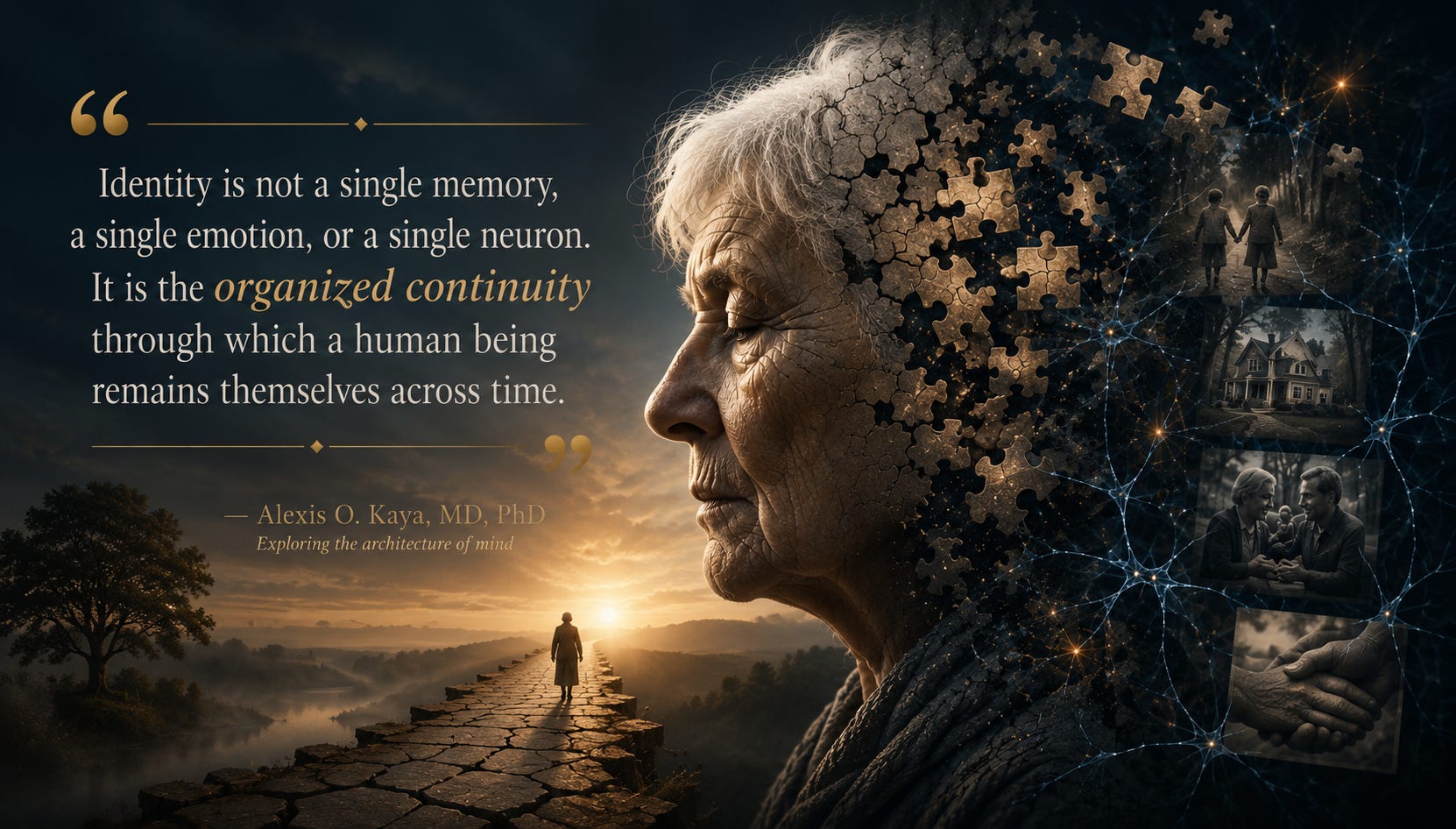
Essay No. 8
The Fragility of Continuity

This article argues that neurodegenerative diseases do more than impair memory, cognition, or behavior; they expose the biological conditions through which personal continuity is maintained. By progressively disrupting neural networks, synaptic organization, autobiographical memory, emotional regulation, and relational responsiveness, these disorders reveal that personhood cannot be reduced to a single faculty, a single brain region, or a single moment of consciousness. Identity is best understood as organized continuity: a historically accumulated architecture of memory, emotion, attachment, values, habits, and neural connectivity through which a human being remains recognizably themselves across time. The erosion of this architecture clarifies both the fragility and the resilience of the self, suggesting that neurodegeneration is not only a pathology of cellular loss but also a disorder of continuity, organization, and personhood.
Alexis O. Kaya, MD, PhD, Neuroscientist
Download