



By Alexis O. Kaya, M.D., Ph.D., Neuroscientist.
This essay advances the thesis that civilizations should not be understood primarily by what they produce, conquer, build, or accumulate, but by the way they organize the recognition of human value. Across history, the place of the human being has been repeatedly redefined according to changing systems of labor, technology, power, and social organization. From physical labor to mechanical production, from cognitive specialization to artificial intelligence, each age has transformed the criteria through which human beings are seen as necessary, useful, dignified, or expendable.
The central argument is that the contemporary age represents a decisive threshold. Artificial intelligence, automation, demographic change, migration, and global economic restructuring are not merely technical or political phenomena; they are symptoms of a deeper civilizational transition. They compel societies to ask whether human worth can continue to be grounded in usefulness, productivity, or cognitive superiority once machines can increasingly perform tasks formerly considered uniquely human.
To address this question, the essay introduces the Theory of Reflective Human Value (TRHV), whose foundational axiom is that human value is relational and reflective: to deny the value of another human being ultimately weakens the very structure through which one’s own value is recognized. Human value is therefore defined as a stable structure of recognition whose historical manifestation becomes visible wherever recognition is incomplete, contested, or denied.
The essay further proposes the Diamond Structure of Human Value, composed of four irreducible dimensions: ontological value, moral value, social value, and economic value. A civilization is mature not when it maximizes wealth, power, or technological efficiency, but when it preserves the equilibrium of these four dimensions and recognizes every human being beyond function, status, origin, or productivity.
The ultimate thesis is therefore anthropological and civilizational: the greatest challenge of the coming age is not whether machines will become more intelligent, but whether humanity will preserve the wisdom to recognize itself. The measure of civilization will not be the intelligence of its technologies, but the humanity it protects, includes, and continues to affirm.
Opening Reflection: What ultimately defines a civilization?
Civilizations are often approached through what they produce, accumulate, or dominate. They are measured by the scale of their monuments, the reach of their conquests, the sophistication of their technologies, or the wealth they concentrate across time. In this dominant interpretative tradition, history becomes a comparative catalogue of achievements: architectural grandeur, scientific revolutions, military power, and economic expansion. Civilizations appear, in this sense, as entities defined by external magnitude.
Yet such a perspective, however intuitive, may conceal a deeper and more fundamental question. If civilizations are more than aggregates of material success, then what is it that allows us to recognize them as civilizations in the first place? What persists when their monuments have eroded, when their political structures have vanished, and when their technologies have become obsolete?
It is at this level of inquiry that a different hypothesis becomes necessary. Perhaps civilizations are not ultimately remembered for what they build, but for what they decide to value. Not for the instruments of their power, but for the principles that govern the distribution of that power. Not for the complexity of their systems, but for the manner in which those systems define the place of the human being within them.
From this perspective, the question of civilization ceases to be primarily material or technological. It becomes ethical, anthropological, and deeply philosophical. A civilization is no longer defined by what it produces, but by how it interprets the significance of human existence within its own structure.
It is therefore possible to formulate a more fundamental criterion of civilizational memory: what remains of a civilization is not simply its artifacts, but the implicit and explicit conception of human worth that it has institutionalized across time. In other words, civilizations are not only remembered for what they did, but for what they considered a human being to be.
This leads to a crucial inversion of perspective. If history is often narrated as the succession of economic systems, political regimes, and technological revolutions, it may instead be understood as the continuous transformation of a single underlying question: what is the value of a human being within a changing world?
Different epochs have offered radically different answers to this question. At times, human beings were considered primarily as sources of physical labor, embedded within systems of coercion or servitude. At other times, they were redefined as citizens, workers, producers, consumers, or units of cognitive and creative capacity. Each historical transformation did not merely modify economic structures; it reconfigured the implicit ontology of the human being within society.
This perspective suggests that civilizations do not evolve simply through accumulation, but through redefinition. Each major historical transition can thus be interpreted as a shift in the way human value is conceptualized, distributed, and legitimized. Even when such transformations are framed in technical or economic terms, they often conceal a deeper anthropological reorganization.
It is within this horizon that contemporary transformations acquire their significance. The emergence of artificial intelligence, the acceleration of automation, the restructuring of global labor markets, and the intensification of migration flows are not isolated phenomena. They may be interpreted as converging expressions of a broader civilizational transition: a moment in which the traditional frameworks for assigning human value are undergoing structural stress.
Yet before engaging with these contemporary dynamics, it is necessary to return to a more fundamental formulation. If civilizations are ultimately judged neither by their wealth nor by their technological sophistication, then on what basis are they judged? What remains constant across historical change is not the form of civilization, but the persistent question it must answer: how does it recognize the human being?
It is this question that silently structures every historical epoch, even when it is not explicitly formulated. And it is precisely this question that will guide the reflection developed in what follows.
History Repeats Its Questions Before It Repeats Its Events
Historical consciousness is often shaped by a paradox: we tend to interpret the past through its most visible ruptures while overlooking the continuity of its underlying interrogations. Wars, revolutions, technological breakthroughs, and economic transformations appear as discontinuities that divide history into distinct epochs. Yet beneath these apparent breaks, a deeper pattern may persist—less visible, but more structurally significant.
It is commonly assumed that history repeats itself in the form of events: that similar political crises, economic cycles, or social conflicts reappear across time under different guises. However, such an interpretation may remain at the surface of historical phenomena. A more fundamental hypothesis suggests itself: history does not repeat its events; it repeats its questions.
What changes across time is not the existence of certain problems, but the conditions under which they are posed, and the institutional frameworks through which they are answered. Civilizations do not simply experience different historical episodes; they continuously renegotiate a small number of persistent questions under evolving material, technological, and ideological constraints.
Among these persistent questions, one appears with remarkable regularity across distinct historical configurations: how does a civilization redefine human value when its economic foundations change?
This question does not belong to a single epoch. It emerges whenever the relationship between human beings and the structures of production undergoes a transformation. In such moments, societies are compelled to reassess not only how value is generated, but also who or what is considered a legitimate bearer of value.
Consider, for instance, the institution of slavery. Within many ancient and pre-modern societies, human beings were systematically integrated into economic systems as instruments of physical labor. Their social identity was inseparable from their productive function. While the historical forms of slavery varied significantly across regions and periods, a common structural feature can be identified: the reduction of certain categories of human beings to their economic utility within a given system of production.
In later historical configurations, forced labor and coercive economic arrangements continued to express, under different institutional forms, a similar logic of instrumentalization. Even when explicit systems of slavery were formally abolished, their structural residues often persisted in modified forms of dependency and constrained autonomy.
Colonial systems introduced another transformation. Here, the reorganization of economic extraction was accompanied by a geographical and political reconfiguration of human populations. Entire societies were integrated into global systems of production in ways that redistributed both labor and value across unequal power structures. The human being, once again, became embedded within a broader economic logic that defined the terms of recognition and participation.
The industrial revolution marked yet another shift. Mechanization altered the relationship between human labor and production, progressively displacing physical effort from the center of economic systems. Human beings were redefined not only as laboring bodies, but increasingly as specialized agents within complex technical systems. This transition did not eliminate the question of human value; it transformed its locus. Value was no longer exclusively tied to physical endurance, but increasingly to adaptability, skill, and cognitive function.
In contemporary societies, the emergence of large-scale migration movements adds another layer to this historical sequence. Migration is often discussed in political or demographic terms, yet it also reflects deeper structural dynamics: disparities in economic development, technological access, and labor demand across regions of the world. Human mobility thus becomes one of the mechanisms through which global systems redistribute both labor and opportunity.
Across these diverse historical configurations—slavery, forced labor, colonization, industrialization, and modern migration—a common structural question persists beneath the surface of historical variation. Each of these phenomena can be interpreted as a distinct answer to a recurring problem: how does a civilization redefine human value when its economic foundations change?
It is important to emphasize that this formulation does not aim to equate these historical realities, nor to reduce their complexity to a single explanatory model. On the contrary, the intention is to identify a shared underlying interrogation that manifests itself differently depending on context. The forms of violence, organization, and transformation vary significantly, but the structural question remains remarkably stable.
Seen from this perspective, historical rupture does not eliminate continuity; it redistributes it. What appears as discontinuity at the level of events may, at a deeper level, reflect the persistence of unresolved philosophical and anthropological questions. Civilizations change not only by replacing institutions, but by repeatedly reinterpreting the place of the human being within evolving systems of production and recognition.
It is within this continuity of questioning that the contemporary moment must be situated. The present is not an exception to history, but a continuation of its most persistent inquiry, now intensified by the convergence of technological acceleration and global economic restructuring.
Immigration Is Not the Question
Public discourse often organizes itself around visible and politically salient issues. Among these, immigration has become one of the most recurrent and emotionally charged topics in contemporary societies. It is discussed in terms of borders, labor markets, cultural integration, national identity, and political stability. Within this framing, immigration appears as a central question of governance, demanding immediate policy responses and ideological positioning.
Yet there is a methodological risk in treating highly visible social phenomena as fundamental explanatory variables. What appears most urgent is not always what is most structurally significant. In certain historical moments, societies concentrate their attention on surface-level expressions of deeper transformations, mistaking symptoms for causes.
From this perspective, immigration may not be the foundational question of contemporary civilizational change. It may instead function as a visible manifestation of a broader and more complex transition, in which the underlying structure of societies is undergoing simultaneous and interacting shifts.
Several converging dynamics are currently reshaping the global landscape. These include demographic change, technological acceleration, large-scale automation of labor processes, the rapid development of artificial intelligence systems, increasing political uncertainty within and between states, and the ongoing restructuring of global economic systems. Each of these factors, taken individually, would constitute a significant historical development. Taken together, they suggest a systemic transformation affecting the very architecture of social organization.
Within such a context, it becomes necessary to reconsider the interpretive framework through which contemporary debates are conducted. Immigration, rather than being understood as an isolated issue, can be reinterpreted as one expression of a broader redistribution of human roles within changing economic and technological systems.
This does not imply that immigration lacks political, social, or ethical significance. Rather, it suggests that its significance cannot be fully understood if it is detached from the structural conditions that shape it. Migration flows are not merely the result of individual decisions or national policies; they are also embedded within global systems of inequality, labor demand, technological substitution, and geopolitical instability.
When viewed through this lens, the intensity of contemporary debates on immigration may reflect something deeper than migration itself. It may indicate a moment in which societies are attempting to stabilize their understanding of human value under conditions of rapid structural change. The discussion about who enters or leaves a territory is, at a deeper level, entangled with questions about who is considered economically necessary, socially integrated, or politically recognizable within evolving systems of production.
This is where a crucial inversion becomes possible. Rather than treating immigration as the primary problem, it may be more accurate to interpret it as a secondary expression of a more fundamental question: how is the place of the human being being redefined within contemporary civilization?
This question becomes particularly salient when considered alongside the increasing capacity of technological systems to perform tasks previously reserved for human labor. Automation and artificial intelligence are not simply replacing specific jobs; they are altering the distribution of value across entire sectors of human activity. In such a context, anxieties surrounding labor, integration, and economic participation cannot be separated from broader concerns about substitution, redundancy, and recognition.
Political uncertainty further amplifies these dynamics. As traditional ideological frameworks struggle to accommodate rapid structural change, public discourse tends to concentrate on visible points of tension. Immigration, in this sense, becomes a focal point through which deeper insecurities about identity, economic stability, and social cohesion are articulated.
Economic restructuring adds another layer to this configuration. Global supply chains, shifting labor demands, and uneven development across regions create conditions in which human mobility becomes both structurally necessary and politically contested. These contradictions are not anomalies; they are structural features of a world in transition.
Taken together, these converging processes suggest that contemporary societies are not merely debating immigration as a policy issue. They are, perhaps unconsciously, negotiating a broader transformation in the way human value is defined, distributed, and recognized.
It is within this context that the apparent centrality of immigration must be reconsidered. What appears as the main question may in fact be a surface articulation of a deeper civilizational transition: one in which the boundaries of human necessity, economic relevance, and social recognition are being renegotiated under the pressure of technological and structural change.
The Five Ages of Human Value
To understand the present transformation of human societies, it is not sufficient to describe isolated technological or political changes. What is required is a broader interpretive framework capable of situating these changes within a long-term evolution of how human value itself is defined, organized, and redistributed.
From this perspective, history may be read not only as a sequence of events or institutions, but as a succession of distinct configurations in the relationship between human beings and the structures of production, knowledge, and power. Each major historical transition does not merely alter economic systems; it modifies the underlying conditions under which human value is recognized and operationalized within society.
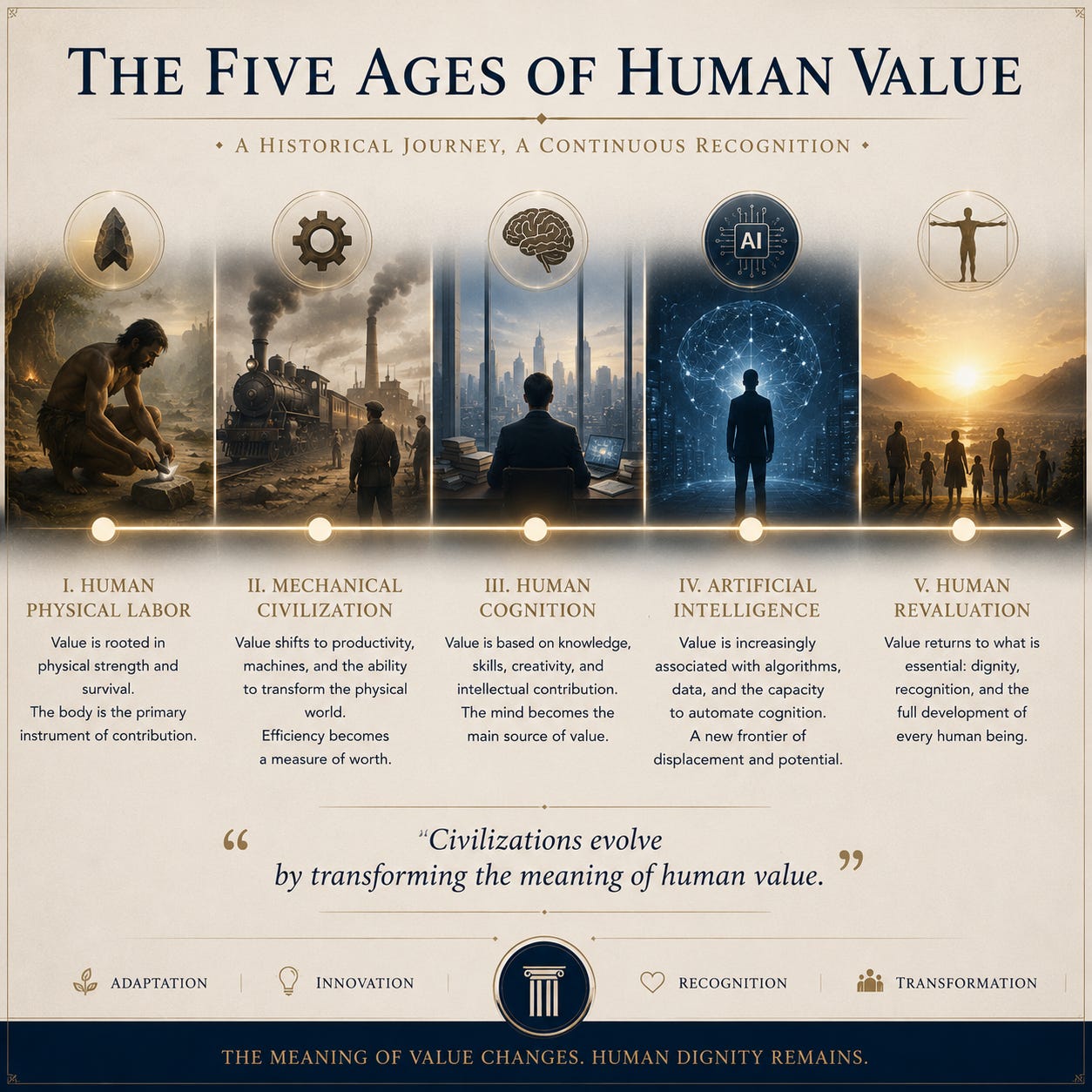
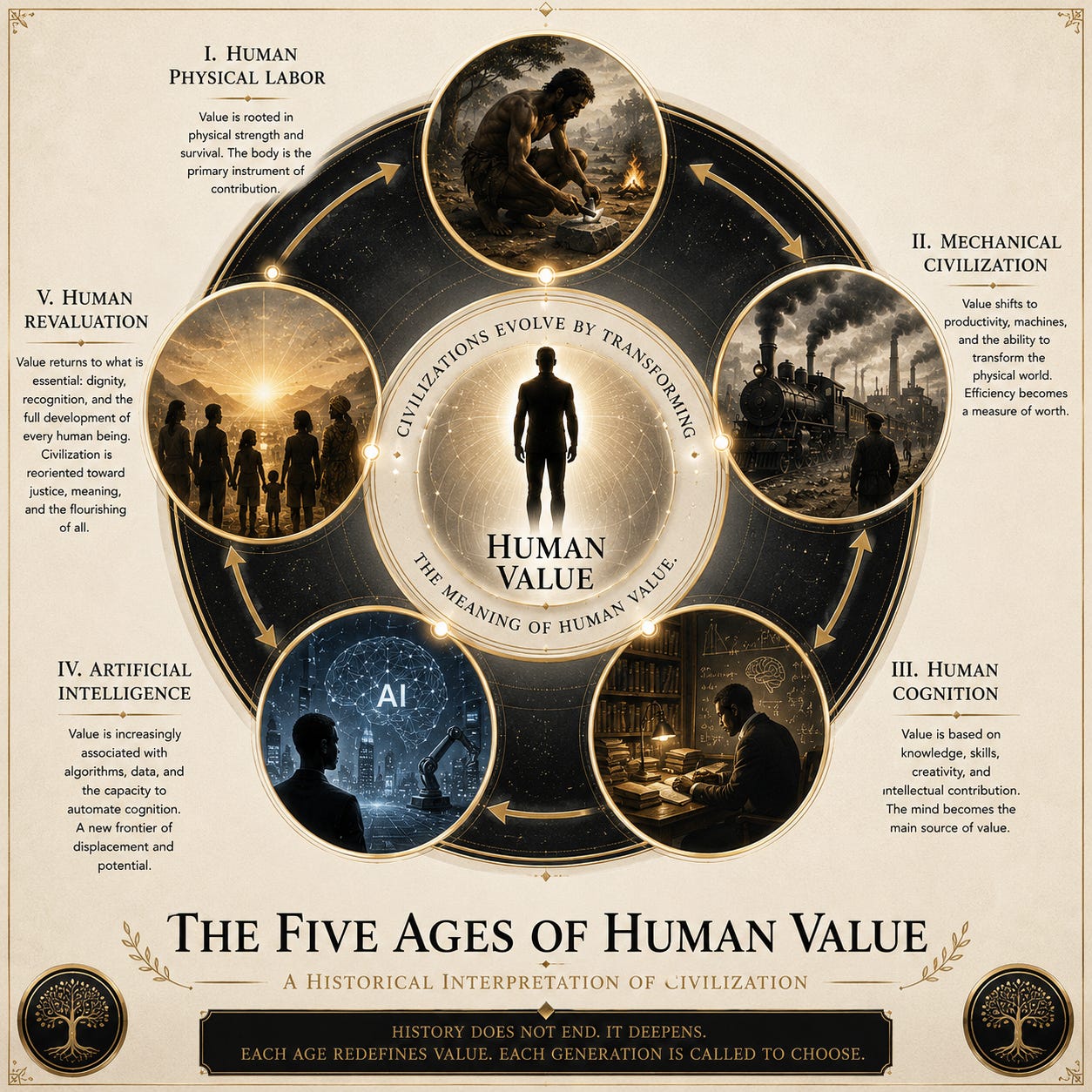
It is possible, in this sense, to propose a conceptual model composed of five successive and partially overlapping phases. These phases should not be understood as rigid chronological periods, but rather as dominant configurations of human value that emerge, stabilize, and gradually transform under the pressure of technological and structural change.
Age I: Human Physical Labor
In the earliest configuration of organized societies, human physical labor constitutes the primary, and often exclusive, source of productive capacity. The human being is directly embedded in the material processes of survival, agriculture, construction, and basic production. In this context, human value is closely associated with physical endurance, strength, and the capacity to sustain repetitive labor.
Economic systems are largely dependent on bodily effort, and social hierarchies often reflect variations in access to labor roles, control over labor, or exemption from labor obligations. Human existence is thus immediately and directly linked to its physical contribution to collective survival.
Age II: Mechanical Civilization
The introduction and progressive diffusion of mechanical systems fundamentally alters the relationship between human beings and production. Machines begin to extend, amplify, and partially replace human physical capacities.
In this configuration, human value is no longer exclusively tied to physical strength, but increasingly to the ability to operate, manage, and coordinate mechanical systems. Labor becomes more specialized, and productivity is increasingly mediated by technological infrastructures rather than direct bodily effort.
This age marks the beginning of a structural separation between human physical capacity and productive output.
Age III: The Age of Human Cognition
With the expansion of industrial, scientific, and administrative systems, cognitive capacities become central to economic and social organization. Knowledge, expertise, planning, creativity, and problem-solving emerge as primary sources of value.
Human beings are increasingly defined by their intellectual functions rather than their physical labor alone. Education systems expand, professional specialization intensifies, and cognitive labor becomes a dominant factor in economic development.
In this age, human value is strongly associated with mental acuity, analytical capacity, and symbolic or conceptual production.
Age IV: Artificial Intelligence
The development of computational systems capable of performing complex cognitive tasks introduces a profound transformation. Artificial intelligence begins to replicate, augment, and in certain domains surpass human cognitive functions.
This does not eliminate human cognitive value, but it destabilizes its exclusivity. Tasks previously considered uniquely human—pattern recognition, language processing, decision support, and even creative generation—become partially transferable to non-human systems.
As a result, the boundaries between human and machine cognition become increasingly blurred, forcing a reconsideration of what constitutes uniquely human contribution.
Age V: The Age of Human Revaluation
The convergence of automation, artificial intelligence, demographic transitions, and global economic restructuring leads to a new historical configuration: one in which the traditional bases of human value are no longer stable or self-evident.
In this emerging age, the central question is no longer how humans contribute to production in comparison with machines, but how human value itself should be defined when neither physical labor nor cognitive exclusivity can fully ground it.
This is not simply an economic transition. It is a civilizational one. Societies are compelled to reconsider the foundations upon which they recognize, distribute, and institutionalize human value.
The Age of Human Revaluation is therefore characterized by a fundamental epistemic and ethical tension: the necessity to redefine human worth in a context where previous criteria of value are no longer sufficient on their own.
It is within this fifth age that the need for a more formal philosophical framework becomes apparent. If human value is undergoing structural redefinition, then a systematic theory is required to articulate the principles governing this transformation.
This is precisely the role of what will be introduced next: the Theory of Reflective Human Value (TRHV), which seeks to formalize the relational and structural conditions under which human value is recognized across historical change.
Introducing the Theory of Reflective Human Value (TRHV)
At this stage of the argument, it becomes necessary to move beyond interpretive description and historical analysis toward a more formal conceptual articulation. The transformations previously outlined—spanning slavery, industrialization, technological acceleration, and contemporary globalization—suggest the need for a structured theoretical framework capable of accounting for the persistent reconfiguration of human value across time.
The framework proposed here is the Theory of Reflective Human Value (TRHV). Its purpose is not to offer a moral doctrine or a political program, but to articulate the structural conditions under which human value is recognized, distributed, and contested within civilizational systems.
Rather than treating human value as a fixed attribute or a purely subjective judgment, the TRHV approaches it as a relational and dynamic structure, embedded within systems of mutual recognition.
1. The Axiom of Reflective Value
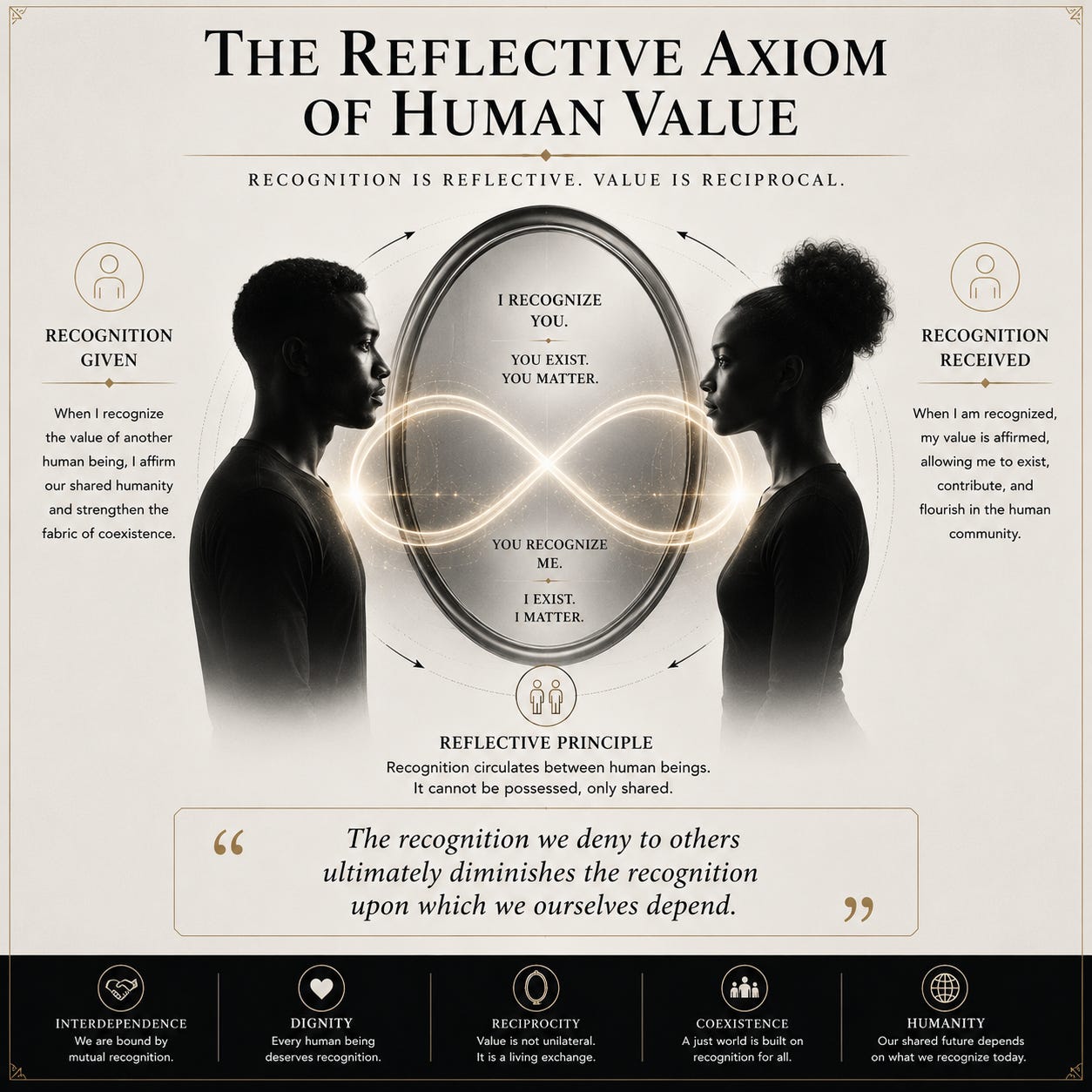
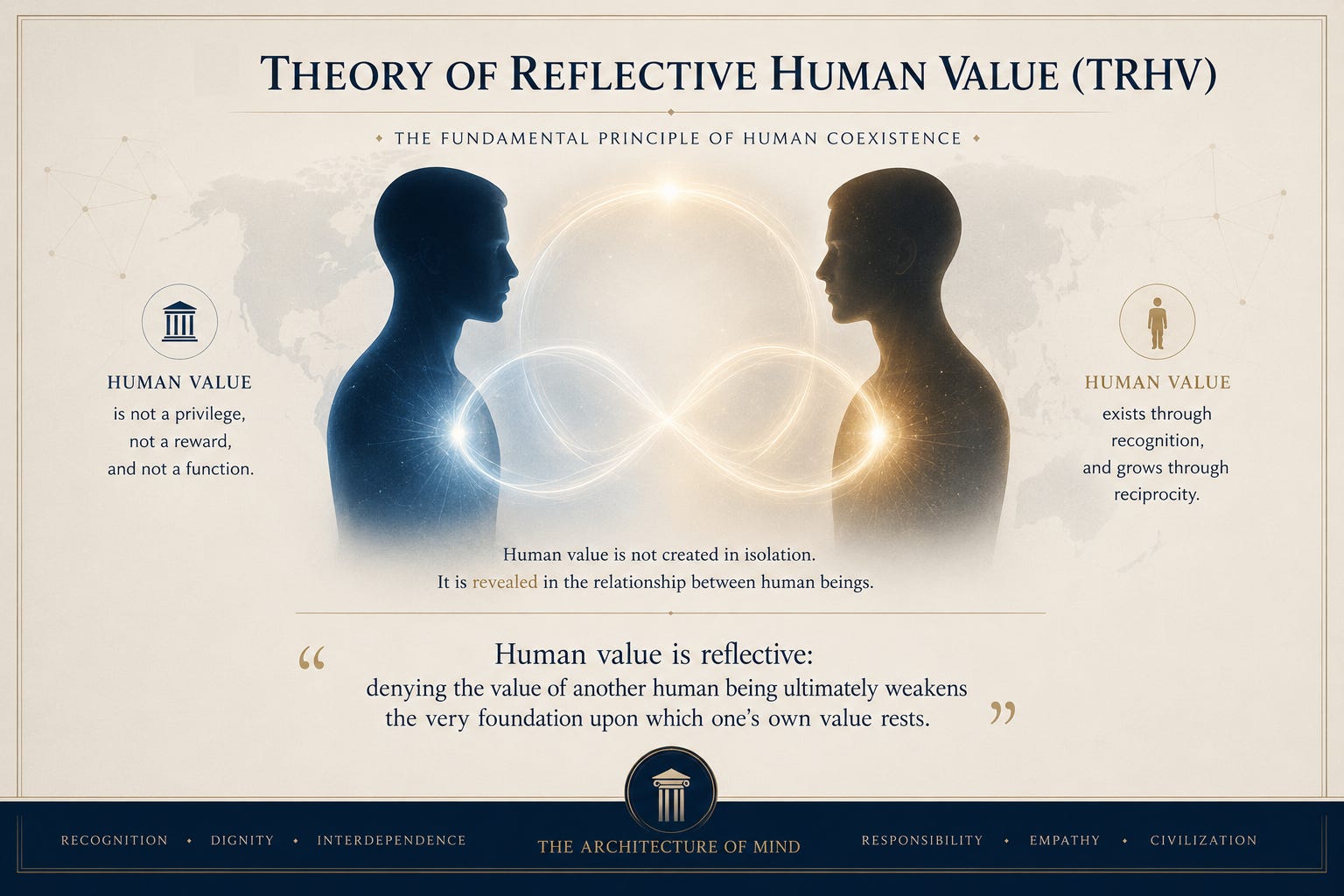
The foundational axiom of the theory is the following: Human value is reflective; denying the value of another human being ultimately weakens the very foundation upon which one’s own value rests.
This axiom establishes a non-reductive relational principle. It does not claim that all individuals are identical in capacity, condition, or social position. Rather, it asserts that the recognition of human value is structurally interdependent: the validity of one’s own claim to value is inseparable from the broader system of recognition in which that claim is embedded.
In this sense, human value is not merely assigned; it is sustained through a network of reciprocal acknowledgment. The erosion of recognition directed toward others does not remain isolated. It modifies the structural integrity of the system of recognition as a whole.
2. Formal Definition of Human Value
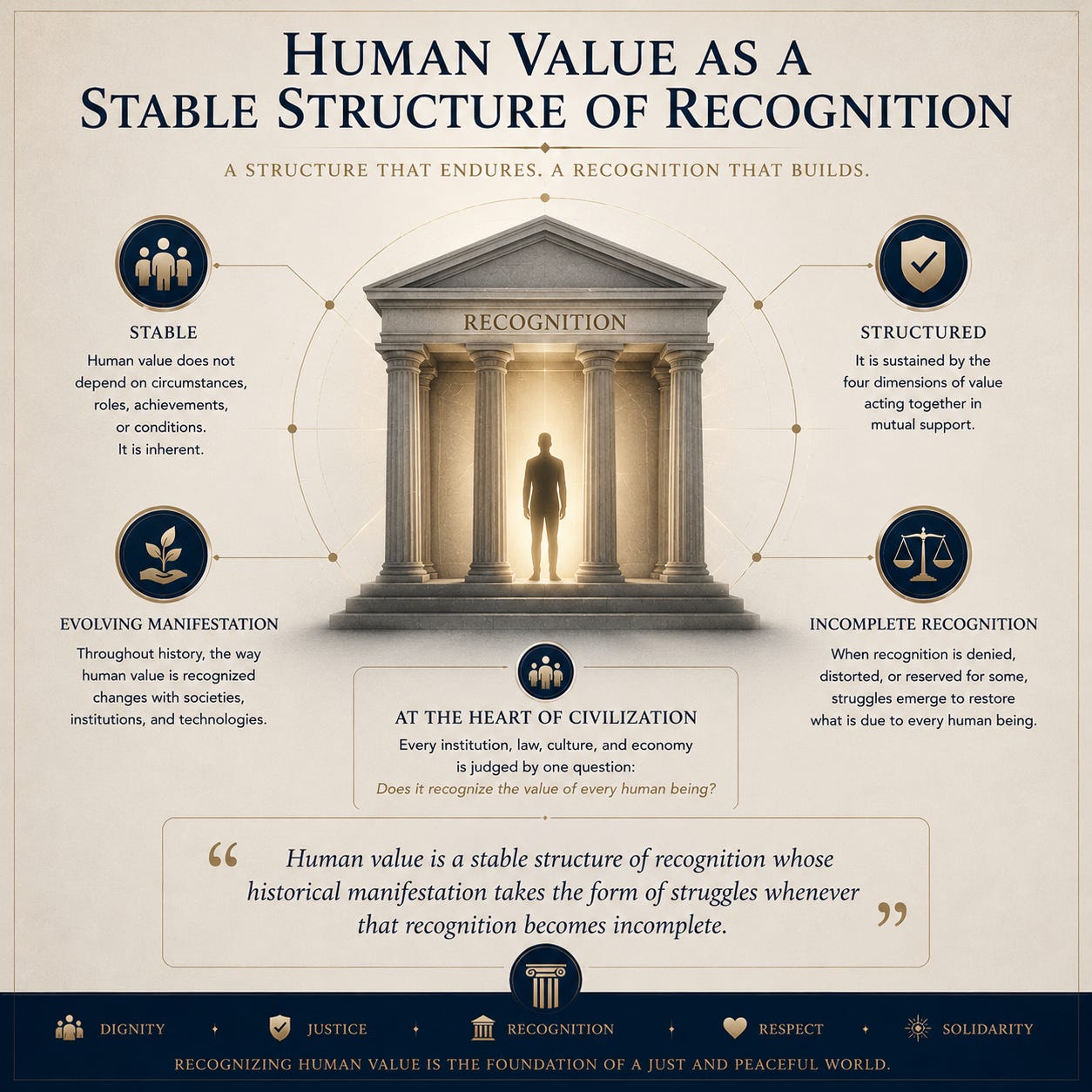
On the basis of this axiom, human value may be defined as follows: Human value is a stable structure of recognition whose historical manifestation takes the form of struggles whenever that recognition becomes incomplete.
This definition introduces three essential components. First, human value is described as a structure, not an isolated property. This implies that it exists only within relational configurations involving multiple agents and institutional frameworks. Second, this structure is characterized as stable, meaning that it persists across historical transformations, even as its modes of expression vary significantly. And third, its historical manifestation is explicitly linked to processes of tension and conflict. Struggles do not generate human value; rather, they reveal conditions under which recognition is partial, contested, or unevenly distributed.
In this framework, conflict is not constitutive of human value itself, but symptomatic of its incomplete realization within a given civilizational context.
3. Methodological Implications
The TRHV does not function as a normative theory prescribing specific political outcomes. Instead, it provides a structural lens through which historical and contemporary phenomena can be interpreted.
Its methodological contribution lies in shifting the analytical focus from isolated events or moral evaluations toward the underlying architectures of recognition that shape how human value is distributed and perceived.
From this perspective, phenomena such as technological transformation, migration, labor reconfiguration, or institutional reform are not treated as independent issues. They are interpreted as expressions of deeper structural adjustments in the system of human recognition.
4. Transition Toward Structural Analysis
Having established the axiomatic and definitional basis of the TRHV, it becomes possible to examine its structural articulation. Human value does not operate as a singular dimension but as a multi-relational configuration.
The next section will therefore introduce the internal architecture of this structure: the four irreducible dimensions through which human value is expressed, maintained, and contested within civilizational systems.
The Diamond Structure of Human Value
If human value is understood as a stable structure of recognition, as proposed by the Theory of Reflective Human Value (TRHV), an immediate question follows: what constitutes this structure? Recognition cannot remain an abstract principle. To become meaningful, it must possess an internal organization that explains both its stability across history and the diverse forms through which it is expressed.
The TRHV proposes that human value is not reducible to a single property, nor can it be adequately described by any isolated criterion such as intelligence, productivity, morality, social status, or biological existence. Every attempt to reduce human value to one of its dimensions inevitably generates forms of exclusion, because it mistakes a part for the whole.
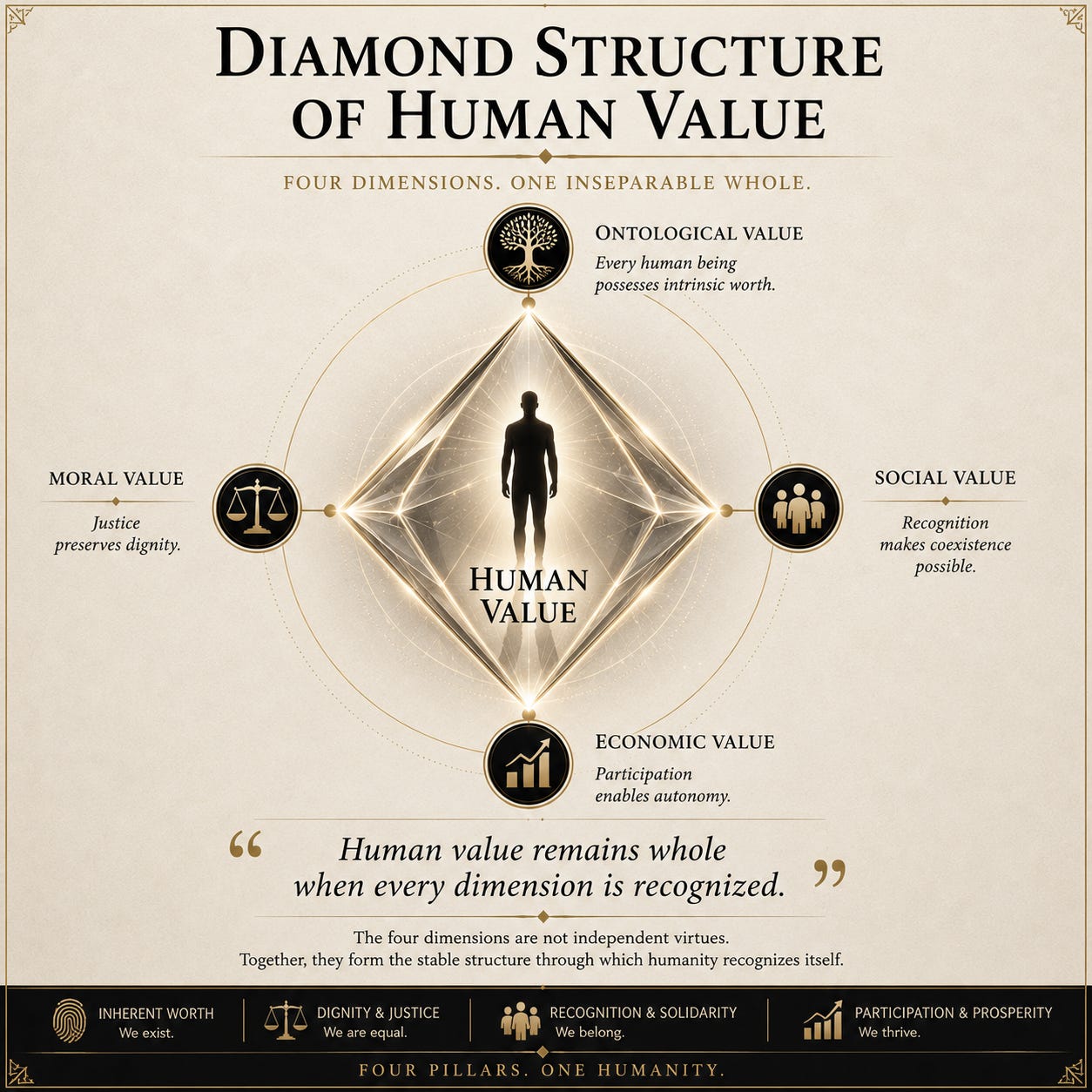
For this reason, the present framework introduces what may be called the Diamond Structure of Human Value, a conceptual model according to which the recognition of every human being depends upon four irreducible and interdependent dimensions. These dimensions do not represent four different kinds of human beings, nor four stages of development. They are four simultaneous relationships through which human existence becomes fully recognizable.
The image of the diamond is not merely illustrative. It is theoretical. A diamond derives neither its stability nor its beauty from the dominance of one side over the others, but from the equilibrium of its entire structure. Likewise, human value does not emerge from the supremacy of one dimension, but from the coherence created by the simultaneous recognition of all four.
These four dimensions are not chosen for their symbolic appeal alone. They correspond to four fundamental relationships that characterize every human existence, regardless of culture, historical period, political system, or economic organization.
1. Ontological Value
The ontological dimension constitutes the foundation of the Diamond Structure. It refers to the intrinsic worth of every human being simply by virtue of existing. This dimension precedes all social recognition, legal status, economic participation, cultural identity, intellectual achievement, or moral evaluation. It is neither earned nor attributed through external validation. It belongs to the human condition itself.
To recognize ontological value is to affirm that no human life can legitimately be reduced to its utility, performance, productivity, origin, physical condition, age, or social function.
This principle applies equally to the newborn child, the elderly individual, the person living with profound disability, the unemployed worker, the refugee, the scientist, and the political leader. Their situations differ profoundly; their ontological value does not. The ontological dimension therefore establishes the irreducible equality of human existence without denying the diversity of human circumstances.
2. Moral Value
Human beings do not merely exist; they coexist within normative communities governed by expectations of justice, reciprocity, responsibility, and mutual respect. The moral dimension recognizes each person as a subject of ethical consideration rather than as an object of instrumental use.
Justice, within this framework, is not understood simply as the equal distribution of resources or opportunities. It is first the refusal to deny the humanity of another person.
Dignity follows naturally from this principle. It is neither a privilege granted by institutions nor a reward for merit. It is the ethical consequence of recognizing ontological value within social life.
Responsibility completes this dimension. Recognition cannot remain passive. To acknowledge another person’s humanity necessarily creates obligations concerning how one acts toward that person. Thus, moral value transforms recognition into ethical practice.
3. Social Value
Human beings are irreducibly social creatures. Identity develops within relationships, institutions, cultures, languages, and shared histories. Yet genuine belonging cannot require the disappearance of individuality.
The social dimension therefore seeks a balance between two equally important realities. On one hand, every individual requires inclusion within a community capable of offering protection, cooperation, dialogue, and participation. On the other hand, no community possesses the moral legitimacy to erase the uniqueness of those who compose it.
Recognition without uniformity becomes the defining principle of this dimension. The individual belongs to society; society does not own the individual. This distinction becomes particularly important during periods of political polarization, cultural conflict, migration, or rapid technological transformation, when pressures toward conformity often increase. The social dimension therefore protects both cohesion and plurality. It rejects isolation without demanding assimilation.
4. Economic Value
Among the four dimensions, the economic dimension has perhaps generated the greatest historical misunderstanding. Within the TRHV, economic value does not refer to market price, accumulated wealth, salary, or productive efficiency alone; nor does it imply that the value of a human being can be measured economically. Rather, economic value concerns the capacity of every person to participate meaningfully in the material conditions that sustain individual and collective life. It includes work, certainly, but it extends beyond employment. It encompasses autonomy, contribution, cooperation, creation, care, innovation, and access to the resources necessary for human flourishing.
The economic dimension therefore expresses participation rather than productivity. This distinction is essential; a society may admire productivity while simultaneously excluding large segments of its population from meaningful participation.
Conversely, a society faithful to the principles of the TRHV seeks to ensure that every individual retains a place within the material organization of collective existence, even as technological systems transform traditional forms of labor.
The emergence of artificial intelligence makes this dimension particularly significant. The central challenge is not merely whether machines will perform more tasks than humans. It is whether human participation itself will remain a recognized component of civilization once productivity becomes increasingly detached from human labor.
The Integrity of Human Value
The Diamond Structure should not be interpreted as a hierarchy. None of its dimensions is superior to the others; nor are they interchangeable. Each represents a distinct relationship that cannot be entirely absorbed into another.
Ontological value cannot replace justice. Justice cannot replace belonging. Belonging cannot replace material participation. Economic participation cannot substitute for intrinsic human worth. The integrity of human value depends upon the simultaneous recognition of all four dimensions.
This does not imply that every dimension is expressed identically throughout every stage of life or within every historical context. Children, older adults, persons with disabilities, and individuals living under radically different social conditions may embody these dimensions in distinct ways. Yet their value remains structurally complete because the dimensions describe relationships of recognition, not levels of performance.
Accordingly, the purpose of the Diamond Structure is not to classify human beings, but to evaluate civilizations. A civilization reveals its maturity not by maximizing one dimension at the expense of the others, but by preserving the equilibrium through which the entirety of human value can be recognized.
The Diamond Structure thus provides the structural core of the Theory of Reflective Human Value. It is through this framework that institutions, technologies, economic systems, and political decisions may be examined—not according to the wealth they generate or the efficiency they achieve, but according to their capacity to recognize the human being in the fullness of these four irreducible dimensions.
Civilization Reconsidered

The preceding sections have proposed two complementary ideas. The first is that the history of civilizations may be interpreted as a succession of changing configurations through which human value is recognized. The second is that human value itself possesses an underlying structure whose integrity depends upon the simultaneous recognition of its ontological, moral, social, and economic dimensions.
Taken together, these propositions invite a reconsideration of one of the most fundamental concepts in the human sciences: civilization itself.
Traditionally, civilizations have been described through their institutions, political systems, religions, artistic achievements, technological innovations, military power, or economic prosperity. Each of these perspectives illuminates an important aspect of collective life. Yet they share a common characteristic: they identify civilizations by what they produce, organize, or accomplish.
The perspective developed here begins elsewhere. Rather than asking what a civilization builds, it asks what a civilization recognizes. This shift may appear subtle, yet its philosophical consequences are considerable. Monuments, institutions, and technologies are never ends in themselves. They are expressions of prior assumptions concerning the place of the human being within collective existence. Every law, every economic system, every educational institution, every scientific achievement, and every technological innovation presupposes—implicitly or explicitly—a particular understanding of human value.
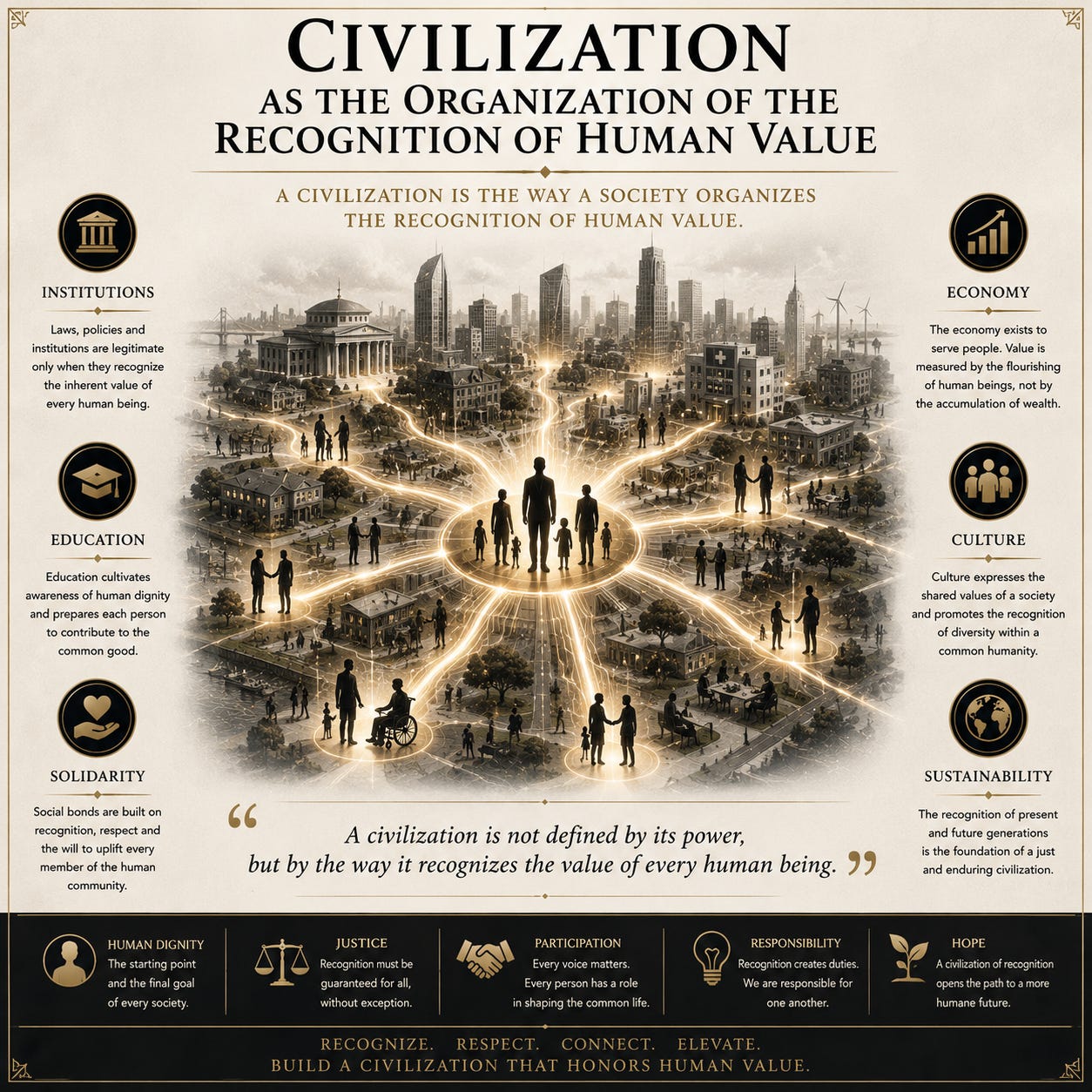
From this observation emerges the following definition: A civilization is the way a society organizes the recognition of human value.
This definition does not reduce civilization to morality, nor does it deny the importance of economic development, scientific progress, political institutions, or technological innovation. Instead, it proposes that these elements acquire their civilizational meaning only through the conception of the human being that they embody and sustain.
Civilization, in this sense, is not measured primarily by what it possesses, but by the manner in which it structures recognition. It is not wealth that distinguishes one civilization from another, but the principles according to which human beings are acknowledged, included, protected, empowered, or excluded.
Such a definition also carries an important methodological implication. If civilization is fundamentally a structure of recognition, then apparently distinct historical phenomena may be examined through a common philosophical framework—not because they are historically identical, but because they each reveal something about the evolving organization of human value.
Slavery, for example, may be understood as a configuration in which recognition was radically restricted by reducing certain human beings to instruments of production. Its defining characteristic is not simply coercion, but the institutional denial of the full structure of human value.
Colonization may likewise be interpreted as a historical reorganization of recognition across unequal political and economic relations. Beyond territorial expansion or resource extraction, it involved the systematic redistribution of authority over whose humanity would be institutionally affirmed, limited, or subordinated.
Migration presents a different configuration. It does not inherently diminish or enhance human value. Rather, it exposes the ways in which contemporary societies negotiate recognition under conditions of demographic transformation, economic interdependence, and political uncertainty. The debates surrounding migration therefore reveal not only disagreements about borders or labor markets, but also competing conceptions of how recognition should be organized within increasingly interconnected societies.
Welfare states provide yet another perspective. They may be interpreted as institutional attempts to preserve dimensions of human recognition that markets alone cannot guarantee. By seeking to protect individuals against illness, unemployment, disability, or old age, they implicitly affirm that participation in the human community cannot be reduced solely to immediate economic productivity. Whether particular welfare systems succeed or fail in this ambition remains an empirical question, but their philosophical significance lies in the recognition they seek to institutionalize.
The emergence of artificial intelligence introduces perhaps the most profound challenge yet encountered. For the first time in history, societies possess technologies capable of performing an expanding range of functions previously considered uniquely human. This development does not merely transform labor markets or productive systems. It compels civilizations to reconsider the basis upon which human value is recognized when functional indispensability can no longer serve as its primary justification.
Seen through this framework, these historical realities are not isolated episodes connected only by chronology. They become different moments in the continuous evolution of a single civilizational question: how should human value be recognized as the conditions of collective existence are transformed?
This perspective also clarifies an essential distinction. The purpose of the TRHV is neither to condemn the past nor to idealize the present. Every civilization inherits forms of recognition that are necessarily incomplete, because no society perfectly realizes the fullness of human value. Historical analysis therefore becomes less an exercise in assigning guilt than in understanding the successive ways civilizations have attempted—successfully or unsuccessfully—to answer the same enduring question.
If this interpretation is accepted, then progress itself requires reconsideration. Scientific discoveries, technological innovations, economic expansion, and political stability remain genuine achievements. Yet none of them, taken in isolation, is sufficient to establish the maturity of a civilization. The decisive criterion lies elsewhere.
A civilization reaches its highest expression not when it maximizes power, wealth, or technological sophistication, but when it progressively enlarges its capacity to recognize the full value of every human being. Under this definition, civilization is no longer simply a stage of historical development. It becomes an ongoing ethical and institutional project: the continuous organization of a world in which every human being can be recognized in the integrity of their humanity.
The AI Threshold
Every major technological revolution has compelled societies to rethink their institutions. The invention of agriculture transformed patterns of settlement and political organization. Mechanization reshaped labor, production, and urban life. The digital revolution altered communication, knowledge, and global interdependence.
Artificial intelligence belongs to this lineage of transformative technologies. Yet it also introduces a qualitative novelty. Unlike previous machines, which primarily extended human physical capacities, contemporary intelligent systems increasingly interact with domains that have long been considered characteristic of human cognition: language, reasoning, learning, planning, pattern recognition, and, in certain contexts, creative production.
The significance of this transformation should not be measured solely by the sophistication of the technology itself. Its deeper importance lies in the questions it forces civilizations to confront.
Public debate frequently concentrates on immediate concerns. Will artificial intelligence eliminate jobs? Which professions are most exposed? How should governments regulate automation? What skills will future generations require? These questions are legitimate and deserve careful attention. Yet they remain secondary to a more fundamental interrogation.

The central question is not whether artificial intelligence will replace particular categories of workers.
The central question is what happens when civilizations begin to reorganize systems of recognition more rapidly than they reorganize the conditions that protect human dignity. Technological innovation possesses a remarkable capacity for acceleration. Institutions do not.
Economic systems often adapt more rapidly than educational systems. Markets evolve more rapidly than legislation. Technological capabilities frequently expand more rapidly than ethical reflection. Civilizations therefore experience periods during which the material organization of society changes faster than the conceptual frameworks through which human beings understand their own place within it. It is precisely such moments that deserve particular philosophical attention.
Automation illustrates this dynamic clearly. Machines capable of performing repetitive physical tasks have existed for generations. Increasingly, however, automation extends into domains requiring perception, judgment, coordination, and decision support. As these capacities expand, the traditional relationship between work and social participation becomes progressively less self-evident.
This observation should not be interpreted as an argument against technological progress. Throughout history, technological innovation has improved health, increased life expectancy, reduced physical hardship, expanded access to knowledge, and created forms of prosperity previously unimaginable. Artificial intelligence will undoubtedly contribute to many similar advances.
The question is therefore not whether technological development should continue. The question is whether the institutions of civilization can evolve sufficiently to preserve the full recognition of human value while the conditions of productive participation are being transformed.
This challenge becomes particularly visible with the emergence of domestic robotics. For centuries, many forms of daily labor depended almost exclusively upon human effort. Intelligent domestic systems now promise to assume an increasing number of these functions. Such technologies may improve quality of life, increase autonomy for older adults and persons with disabilities, and reduce physically demanding work. These possibilities deserve genuine recognition.
Yet they also raise a broader civilizational question. If an expanding range of socially necessary activities can be performed by autonomous systems, upon what basis will societies continue to organize meaningful human participation? This question extends beyond employment statistics.
Work has historically provided more than income. It has often structured identity, social integration, intergenerational transmission of knowledge, personal responsibility, and participation in collective life. If the relationship between labor and social contribution changes profoundly, civilizations will need new ways of recognizing participation without reducing human worth to economic productivity alone. This challenge also invites caution regarding new forms of inequality.
Previous technological revolutions often generated disparities before institutions gradually adapted. Artificial intelligence may produce similar dynamics. Access to technological resources, educational opportunities, computational infrastructures, and economic capital may become increasingly uneven, potentially creating new forms of exclusion that are less visible than those of previous eras but no less significant.
The question is therefore not simply who owns intelligent technologies. It is who continues to be recognized as indispensable within societies transformed by those technologies.
At this point, the reflection returns naturally to the framework developed throughout this essay. If civilization is understood as the organization of human recognition, then artificial intelligence does not merely introduce new machines. It challenges the criteria through which civilizations recognize human participation, autonomy, contribution, and dignity.
This is why the deepest implications of artificial intelligence are not primarily technical. They concern anthropology. They concern our understanding of what it means to remain human when many of the functions historically associated with human indispensability can increasingly be performed by non-human systems.
For this reason, the greatest challenge of artificial intelligence cannot ultimately be reduced to engineering, economics, or regulation alone. It concerns the future architecture of civilization itself. As long as technological innovation remains accompanied by an equally profound reflection on human recognition, artificial intelligence may become one of the greatest instruments of human flourishing ever created.
If, however, technological acceleration outpaces the civilizational capacity to preserve the four dimensions of human value, societies may gradually weaken the very foundations upon which their own legitimacy rests. The greatest risk of artificial intelligence is therefore not technological; it is anthropological.
Beyond Fear
History occupies an ambiguous place within human consciousness. It is at once a source of knowledge and a source of conflict, a foundation for understanding and a potential instrument of division. Societies often return to their past in search of explanations, identities, and lessons. Yet the same historical memory can either expand human awareness or reinforce inherited antagonisms. The difference lies not in whether history is remembered, but in how it is remembered.
A civilization that forgets its history risks repeating the mechanisms that once produced suffering. A civilization that uses history only to assign blame risks remaining trapped within the very divisions it seeks to overcome. The purpose of historical memory is therefore neither accusation nor absolution. Its purpose is recognition.
To remember history is not to search for permanent enemies. It is to understand the structures through which human beings have, at different moments, failed to recognize the humanity of others. This distinction is essential.
Throughout history, systems of domination have rarely emerged by openly declaring the absence of human value. More often, they have developed through gradual processes of separation, classification, justification, and normalization. Certain groups were described as inferior, unnecessary, dangerous, or outside the boundaries of full recognition.
The forms have varied; the mechanisms have transformed; but the underlying question has remained constant: What happens when a society creates conditions in which some human beings are no longer fully recognized as human beings?
This question cannot be confined to a single historical period, geographical region, or population. Human history contains many examples of exclusion, domination, and exploitation occurring across different civilizations and among groups belonging to the same or different cultural, ethnic, or social identities. The temptation to reduce these histories to simple narratives of one group permanently oppressing another risks obscuring the deeper structure that makes such phenomena possible.
The central issue is not the identity of those who suffered or those who exercised power. The central issue is the mechanism through which recognition was denied. This is why historical memory must remain universal.
The history of slavery, for example, is not only the history of particular victims or particular perpetrators. It is the history of a human capacity for reducing human beings to instruments of economic, political, or social purposes.
The history of colonization is not only the history of territorial expansion. It is also the history of how unequal systems of power can reorganize recognition, determining whose knowledge, autonomy, and dignity are institutionally valued.
The history of discrimination is not only the history of prejudice between groups. It is the history of what occurs when societies allow categories of difference to become categories of diminished humanity.
To remember these histories properly is therefore not to inherit hatred; it is to inherit responsibility. The purpose of memory is not to transform past suffering into permanent division, but to develop the moral capacity to identify similar mechanisms when they appear under new forms.
This point becomes particularly important in the contemporary world, where old patterns may reappear through new languages and new institutions. Dehumanization does not always announce itself through explicit declarations of superiority. Sometimes it emerges through economic calculations, administrative categories, technological systems, or political narratives that gradually reduce individuals to functions, risks, costs, or obstacles. The language changes; the structure may remain.
This is why historical awareness is indispensable in the age of artificial intelligence, automation, and global transformation. The challenge of the future will not necessarily reproduce the exact injustices of the past. Societies do not move backward by repeating identical events. They move forward while carrying unresolved questions.
History therefore serves as humanity’s collective memory—not as a tribunal permanently judging individuals, but as a form of consciousness protecting civilizations from their own recurring vulnerabilities.
Within the framework of the Theory of Reflective Human Value, this principle becomes clear: The recognition of human value cannot depend upon belonging to a particular group, culture, nationality, or historical position. It must emerge from the recognition of humanity itself.
The ultimate lesson of history is therefore not that one group should fear another. It is that every society must remain vigilant against the moment when it begins to consider that some human beings matter less than others. Because the erosion of recognition never remains limited to its first victims.
Once a civilization accepts that human value can be selectively granted, the foundation upon which all human value rests becomes unstable. This is the deepest reason why history must remain our memory; not because humanity must remain imprisoned by its past; but because humanity must remain capable of recognizing itself.
The Human Value Question
Every historical period eventually encounters a question that exceeds the immediate concerns of its time. Beyond political debates, economic transformations, and technological innovations, civilizations are confronted with deeper questions concerning the meaning of their own existence. The present century is no exception.
Artificial intelligence, automation, demographic transformation, and global restructuring are often discussed as separate challenges requiring separate solutions. Yet beneath these multiple transformations lies a common philosophical question: what place will the human being occupy in a civilization increasingly capable of producing value through non-human systems?
For centuries, societies have justified human importance through necessity: humans were necessary because they provided physical labor; humans were necessary because they operated machines; and humans were necessary because they possessed knowledge, creativity, and cognitive abilities beyond the reach of technology. Each historical age has therefore recognized human value through a particular form of indispensability.
The emergence of artificial intelligence introduces a profound disruption. For the first time, civilization is confronted with the possibility that many functions traditionally associated with human uniqueness may no longer belong exclusively to humans. This transformation should not necessarily be interpreted as a loss. Throughout history, technological progress has liberated human beings from forms of labor that were exhausting, dangerous, or limiting. The purpose of civilization has never been to preserve every historical function of human beings unchanged.
The deeper challenge is elsewhere. It is whether humanity can recognize human value beyond function.
If human beings are valued only according to what they produce, then every technological advancement capable of producing more efficiently will inevitably redefine who appears necessary.
But if human beings possess value that precedes and exceeds their economic utility, then technology becomes not a replacement for humanity, but an instrument that must remain within a human framework. This distinction may represent the central ethical challenge of the coming century. Perhaps the greatest question raised by artificial intelligence is not whether machines will become more human; it is whether humanity will continue recognizing itself as fully human.
This question returns us to the foundation of the Theory of Reflective Human Value. Human value is not created by technological capability; it is not granted by economic usefulness; it is not dependent upon social status; it is revealed through recognition. The future of civilization will therefore depend not only on what humanity creates, but on what humanity chooses to preserve while creating.
The challenge before future generations will not simply be to govern artificial intelligence, regulate automation, or manage economic transformation. These tasks are necessary, but they remain incomplete without a deeper reflection on the kind of civilization these tools are meant to serve.
A civilization capable of extraordinary technological achievement but incapable of recognizing the full humanity of those who compose it may possess intelligence without wisdom. Conversely, a civilization that places human dignity at the center of its transformations may discover that technology does not diminish humanity, but expands its possibilities.
The question of human value therefore remains unfinished. Not because humanity lacks answers, but because each generation must answer it again under new conditions. Every generation inherits the responsibility of redefining civilization. The measure of its wisdom will never be the intelligence of its machines, but the humanity it preserves.
Original Theoretical Contributions
The present essay offers a set of original conceptual contributions designed to articulate a philosophical framework for interpreting the relationship between human value, civilizational development, technological transformation, and structures of recognition. These contributions are not intended as isolated concepts, but as mutually reinforcing components of a broader theoretical architecture.
1. The Theory of Reflective Human Value (TRHV). The TRHV constitutes the central theoretical framework of the essay. It conceptualizes human value not as an isolated attribute, a subjective judgment, or a merely institutional designation, but as a relational structure sustained through reciprocal recognition. Its central claim is that the recognition of one’s own value is inseparable from the wider system through which the value of others is affirmed, contested, or denied.
2. The Axiom of Reflective Value. The essay formulates the foundational axiom of the TRHV in the following terms: human value is reflective; to deny the value of another human being is to weaken the normative and structural foundation upon which one’s own claim to value rests. This axiom establishes recognition as an interdependent condition rather than a unilateral attribution.
3. The Diamond Structure of Human Value. The Diamond Structure provides the internal architecture of the TRHV. It defines human value through four irreducible and interdependent dimensions: ontological value, moral value, social value, and economic value. The model rejects any reduction of the human being to biological existence, moral status, social belonging, or economic utility alone. A civilization preserves the integrity of human value only insofar as these four dimensions remain jointly recognized.
4. The Five Ages of Human Value. The essay proposes a historical model in which human value is successively reorganized through five dominant configurations: physical labor, mechanical civilization, human cognition, artificial intelligence, and human revaluation. These ages should not be understood as rigid chronological periods, but as historically situated regimes of recognition through which societies define the human being according to changing technological, economic, and institutional conditions.
5. Civilization as the Organization of Human Recognition. The essay advances a definition of civilization as the historically organized structure through which a society recognizes human value. This definition shifts the analysis of civilization away from material accumulation, technological sophistication, or political domination alone, and toward the institutional, moral, social, and economic arrangements through which human beings are acknowledged, included, protected, or excluded.
6. The AI Threshold as an Anthropological Threshold. The essay interprets artificial intelligence not merely as a technological or economic disruption, but as an anthropological threshold. AI destabilizes the historical association between human value and functional indispensability by extending automation into domains formerly associated with human cognition. It therefore compels civilizations to articulate a conception of human worth that is not dependent on productivity, usefulness, or cognitive exclusivity.
7. History as the Repetition of Questions. The essay proposes that history does not primarily repeat its events, but its fundamental questions. Across distinct historical formations—slavery, colonization, industrialization, migration, and artificial intelligence—the recurring question concerns how human value is redefined when the material, technological, and institutional foundations of society are transformed. This formulation allows historical difference to be preserved while identifying a common civilizational problematic.
References
Arendt, Hannah. The Human Condition. Chicago: University of Chicago Press, 1958.
Brynjolfsson, Erik, and Andrew McAfee. The Second Machine Age. New York: W. W. Norton, 2014.
Castles, Stephen, Hein de Haas, and Mark J. Miller. The Age of Migration. 6th ed. New York: Guilford Press, 2019.
Césaire, Aimé. Discourse on Colonialism. New York: Monthly Review Press, 2000.
Cooper, Frederick. Colonialism in Question. Berkeley: University of California Press, 2005.
Crawford, Kate. Atlas of AI. New Haven: Yale University Press, 2021.
Davis, David Brion. The Problem of Slavery in Western Culture. Oxford: Oxford University Press, 1988.
Fanon, Frantz. The Wretched of the Earth. New York: Grove Press, 2004.
Honneth, Axel. The Struggle for Recognition. Cambridge, MA: MIT Press, 1995.
Kant, Immanuel. Groundwork of the Metaphysics of Morals. Edited and translated by Mary Gregor and Jens Timmermann. Cambridge: Cambridge University Press, 2012.
Nussbaum, Martha C. Creating Capabilities. Cambridge, MA: Harvard University Press, 2011.
Sen, Amartya. The Idea of Justice. Cambridge, MA: Harvard University Press, 2009.
Zuboff, Shoshana. The Age of Surveillance Capitalism. New York: PublicAffairs, 2019.

About the Author
Alexis O. Kaya is a physician, medical scientist, and thinker whose work explores the foundations of human nature. Trained in medicine and deeply interested in neuroscience and child development, he studies how the brain, experience, and social environment interact to shape identity, behavior, and consciousness.
His intellectual journey is guided by a central question: how does the human being become who he is? His reflections examine the relationship between biology and culture, individual development and collective history, personal identity and social recognition.
Through his writings, he explores themes at the crossroads of neuroscience, psychology, philosophy, and anthropology, seeking to understand both the complexity of the human mind and the structures through which societies define value, belonging, and dignity.
His work reflects a lifelong interest in the architecture of human experience: the mechanisms that shape thought, the origins of social behavior, and the conditions that allow individuals and communities to achieve a more profound understanding of themselves and others.