


Essay-Interlude No. 02
The Human Value Question

This interlude-essay advances the thesis that civilizations should not be understood primarily by what they produce, conquer, build, or accumulate, but by the way they organize the recognition of human value. Across history, the place of the human being has been repeatedly redefined according to changing systems of labor, technology, power, and social organization. From physical labor to mechanical production, from cognitive specialization to artificial intelligence, each age has transformed the criteria through which human beings are seen as necessary, useful, dignified, or expendable.
The central argument is that the contemporary age represents a decisive threshold. Artificial intelligence, automation, demographic change, migration, and global economic restructuring are not merely technical or political phenomena; they are symptoms of a deeper civilizational transition. They compel societies to ask whether human worth can continue to be grounded in usefulness, productivity, or cognitive superiority once machines can increasingly perform tasks formerly considered uniquely human.
To address this question, the essay introduces the Theory of Reflective Human Value (TRHV), whose foundational axiom is that human value is relational and reflective: to deny the value of another human being ultimately weakens the very structure through which one’s own value is recognized. Human value is therefore defined as a stable structure of recognition whose historical manifestation becomes visible wherever recognition is incomplete, contested, or denied.
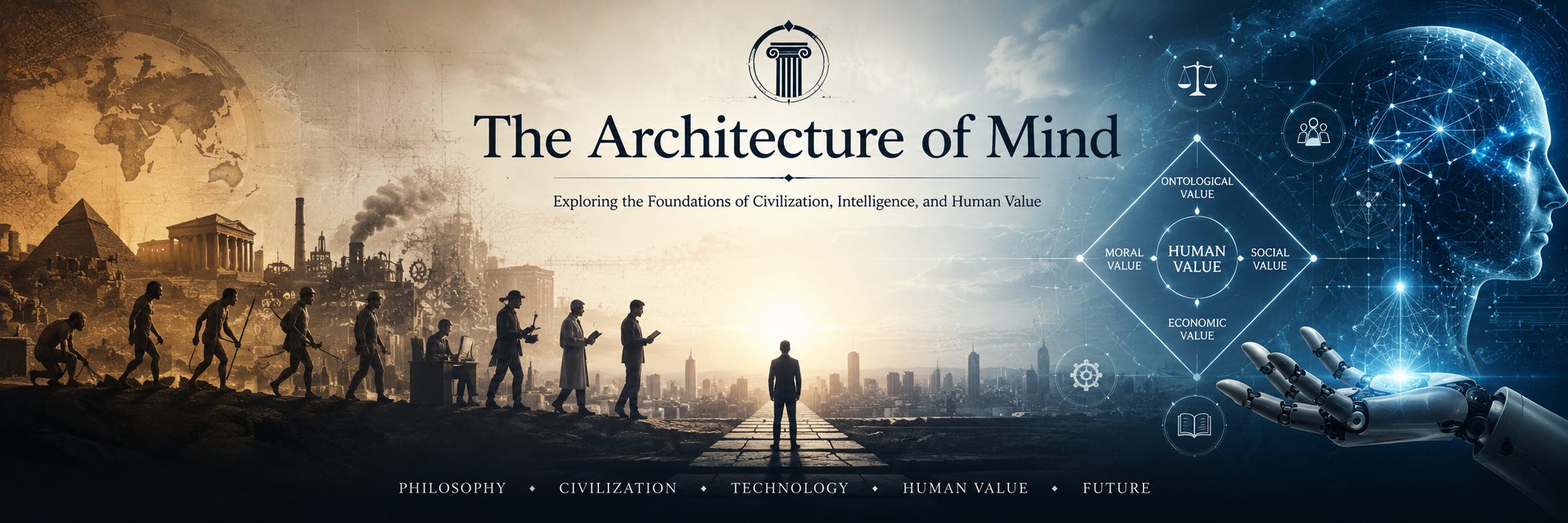
The essay further proposes the Diamond Structure of Human Value, composed of four irreducible dimensions: ontological value, moral value, social value, and economic value. A civilization is mature not when it maximizes wealth, power, or technological efficiency, but when it preserves the equilibrium of these four dimensions and recognizes every human being beyond function, status, origin, or productivity.
The ultimate thesis is therefore anthropological and civilizational: the greatest challenge of the coming age is not whether machines will become more intelligent, but whether humanity will preserve the wisdom to recognize itself. The measure of civilization will not be the intelligence of its technologies, but the humanity it protects, includes, and continues to affirm.
Alexis O. Kaya, MD, PhD, Neuroscientist
Download