


Alexis O. Kaya, M.D., Ph.D., Neuroscientist.
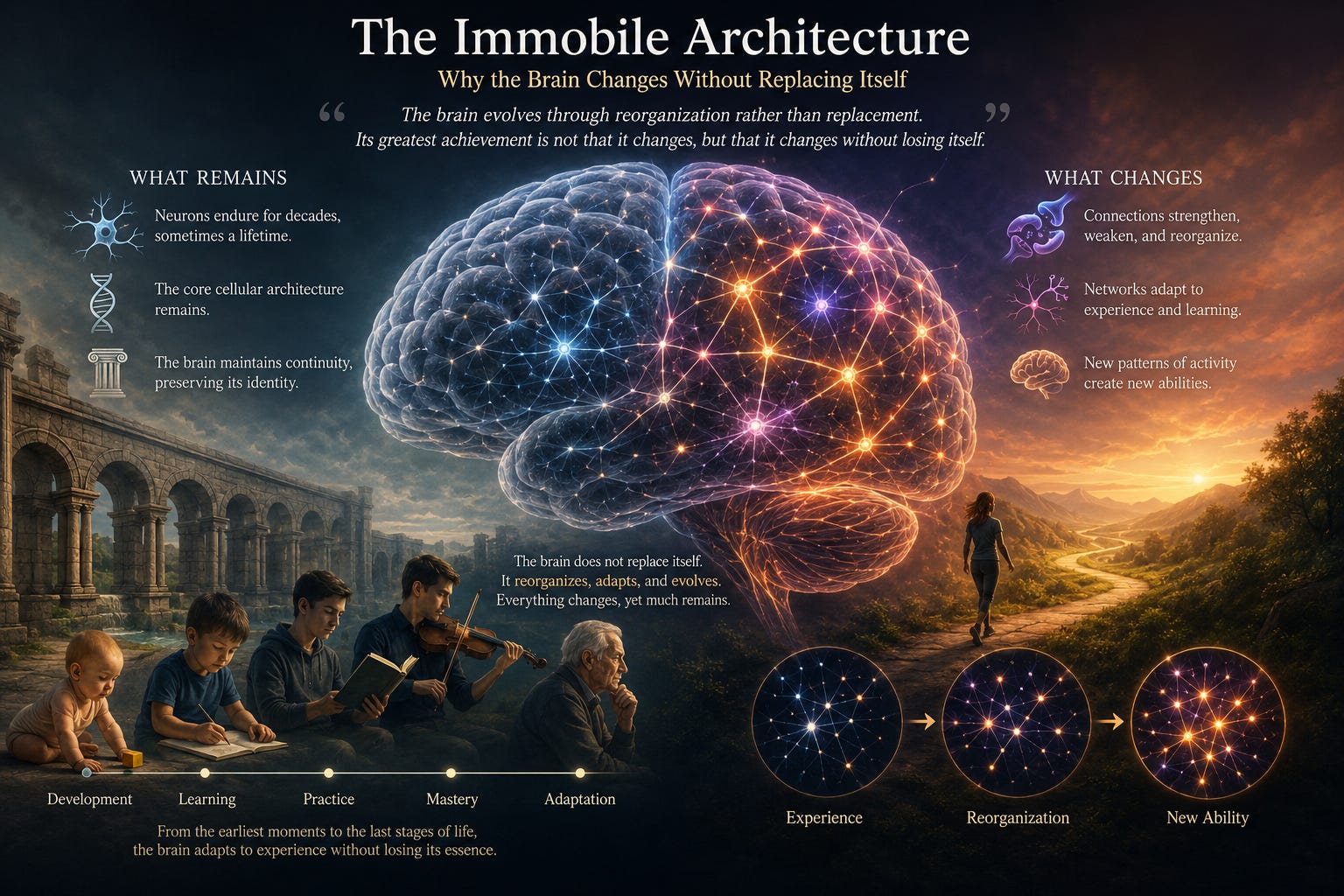
The brain evolves primarily through the reorganization of existing neural architectures rather than through wholesale cellular replacement. Its distinctive achievement lies not merely in its capacity for change, but in its capacity to change while preserving functional and experiential continuity.
THE PARADOX OF MOTION WITHOUT MOVEMENT
How can the most adaptable organ in the human body be built upon some of its most enduring cells? At first sight, this question appears paradoxical: adaptation implies change, whereas persistence implies stability. One evokes movement; the other, permanence. Yet nowhere in biology are these two realities more deeply intertwined than in the human brain.
Among bodily organs, the brain is distinguished by its capacity for experience-dependent modification. Across development and aging, neural organization is continuously shaped by sensory input, learning, social interaction, emotional salience, repeated practice, and injury-related adaptation. Language acquisition, motor expertise, abstract reasoning, and functional recovery after neurological damage all illustrate the capacity of neural systems to alter their organization in response to internal and external demands.
Modern neuroscience has devoted substantial attention to this phenomenon. The concept of neuroplasticity revealed a brain far more dynamic than earlier models suggested. Learning alters synaptic strength, experience reshapes neural networks, and training modifies functional organization. Even in adulthood, the brain retains significant adaptive potential. The image of the brain as a fixed machine has therefore been largely replaced by that of a living, modifiable system.
The brain is thus a biological architecture in motion. Yet beneath this continuous movement lies an equally remarkable fact: much of the cellular framework that supports these transformations persists over time.
The brain changes, yet many of its neurons persist. It learns, reorganizes, and incorporates new information while much of its cellular substrate remains continuous across time. This observation introduces a central problem in neuroscience: how can an organ undergo substantial functional transformation without equivalent structural replacement? In many tissues, adaptation is closely associated with cellular renewal and regeneration. The nervous system appears to rely more heavily on another strategy: adaptive reconfiguration of existing components.
The architecture persists while relationships change; the structural framework endures while patterns of activity and connectivity are transformed. Perhaps the brain does not solve the problem of adaptation by replacing itself, but by continuously reorganizing itself. If so, the exceptional power of the nervous system resides not only in its capacity to change, but also in its capacity to preserve continuity while changing. This raises a central question: what exactly changes when the brain learns, and what remains sufficiently stable to make learning cumulative?
The mystery of the nervous system begins precisely within this tension between transformation and persistence: everything changes, yet something essential remains.
THE GREAT DISCOVERY OF MODERN NEUROSCIENCE
One of the major conceptual shifts in modern neuroscience has been the recognition of neuroplasticity. For much of scientific history, the adult brain was viewed as a relatively stable organ. Once development was thought to be complete, its architecture was often assumed to remain largely fixed. Learning could modify behavior, experience could shape knowledge, and education could influence reasoning, but the biological substrate itself was believed to be comparatively resistant to change.
This view proved incomplete. A central insight of contemporary neuroscience is that the brain is not fixed; it remains capable of structural and functional modification throughout life.
Today, this idea appears almost self-evident. Yet it represents one of the most profound conceptual shifts in the history of brain science. The recognition that neural architecture remains modifiable transformed our understanding of learning, memory, development, rehabilitation, and even human identity.
The modern era of neuroscience may therefore be described, in part, as the age of neuroplasticity. Among the figures who contributed to this transformation, Donald Hebb occupies a central position. In 1949, Hebb proposed a principle that became foundational for theories of learning: when two neurons are repeatedly active together, the connection between them may be strengthened. This idea is often summarized by the phrase, “cells that fire together wire together.”
Although this phrase does not appear in Hebb’s original text, it captures the central implication of his proposal. Learning was no longer understood merely as the accumulation of information; it became a biological process capable of modifying neural relationships. Experience could shape structure, thought could leave a physical trace, and memory could be understood as a form of biological organization.
The implications were substantial: the brain was no longer a static repository of knowledge, but an adaptive system continually reshaped by its interaction with the world.
Several decades later, the work of Eric Kandel provided experimental foundations for many of these ideas. Through studies of learning and memory, particularly in the marine mollusk Aplysia, Kandel showed that experience can modify synaptic function at the cellular level. Learning is therefore not only psychological; it is biological. Neural communication can be strengthened or weakened, and patterns of connectivity can be altered through use.
These discoveries established a direct bridge between behavior and biology. Experience is not simply recorded by the brain; it participates in shaping the system that records it. At the center of this transformation lies synaptic plasticity. Synapses, the specialized junctions through which neurons communicate, are not fixed cables transmitting immutable signals. They are dynamic interfaces whose efficiency can increase or decrease according to patterns of activity, attention, emotion, and learning.
Among the most influential mechanisms associated with synaptic plasticity is long-term potentiation, commonly known as LTP. First described in the hippocampus, a structure deeply involved in learning and memory, LTP refers to the persistent strengthening of synaptic transmission following specific patterns of activation.
A pathway that is repeatedly used may become more efficient: communication improves, signals travel more effectively, and future activation becomes easier. Although the underlying mechanisms are complex, the conceptual significance of LTP is clear. Experience leaves lasting modifications within neural networks. Learning changes the brain not metaphorically, but biologically.
Every language learned, skill acquired, memory consolidated, habit formed, or expertise developed reflects, at least in part, modifications within neural organization. Plasticity makes adaptation, learning, development, and recovery possible. Yet the success of neuroplasticity raises a further question: if the brain changes continuously, what exactly is changing? Does adaptation require the replacement of existing neurons, or does the nervous system transform itself through another strategy? Modern neuroscience has shown that the brain changes; an equally important observation is that many of the neurons supporting these changes persist.
The age of neuroplasticity revealed that the brain is dynamic. The next task is to understand how such dynamism coexists with cellular stability. The central issue is not only that the brain changes, but that it changes while remaining sufficiently continuous to preserve memory, knowledge, and identity.
THE ILLUSION OF RECONSTRUCTION
A central question follows: why should plasticity be distinguished from replacement?
A common misunderstanding about neuroplasticity arises from a simple assumption: if the brain changes, it must be rebuilding itself. This conclusion appears intuitive. Neuroscience has shown that learning modifies neural networks, experience reshapes connectivity, and adaptation alters brain function. Popular descriptions often reinforce this impression by stating that the brain “rewires itself” or “creates new pathways” whenever learning occurs.
Such expressions are useful, but they can also be misleading. They may suggest that the nervous system repeatedly reconstructs itself from the ground up. The reality is more subtle. Change does not necessarily imply replacement. A city, for example, may grow, reorganize transportation, expand communication networks, and modify patterns of activity while remaining recognizably the same city. Its identity persists because its fundamental organization remains coherent.
The analogy is useful only insofar as it clarifies the distinction between replacement and reorganization. The nervous system may undergo extensive functional modification while preserving enough structural continuity to maintain previously acquired organization.
Learning does not necessarily require neuronal replacement. It may depend primarily on the modification of relationships among existing neurons. The distinction is fundamental: replacement changes components, whereas reorganization changes the way components interact. A library can be reorganized, indexed differently, and made more accessible without replacing every book. In the same way, neural plasticity may reflect organizational refinement rather than wholesale reconstruction.
When a child learns language, when a pianist masters a sonata, or when a physician develops diagnostic expertise, learning does not require the construction of an entirely new brain. Rather, existing neural systems are progressively reorganized: some connections strengthen, others weaken, and networks become more efficient and specialized. The architecture becomes different because the relationships within it become different.
This distinction becomes even more important when considering memory. If learning depended primarily upon continuous replacement, an obvious question would arise: How could continuity be preserved?
Memory makes this distinction especially important. Memories are embedded in relationships, and skills depend on organized pathways established through previous learning. A system undergoing continuous large-scale reconstruction would face the difficult problem of preserving accumulated patterns. The nervous system appears to adopt another strategy: rather than repeatedly rebuilding itself, it modifies and refines its existing architecture. Plasticity, therefore, is not evidence against persistence. On the contrary, plasticity may depend on persistence, because only a sufficiently stable architecture can accumulate learning across time.
This point reveals an essential paradox: the brain changes because it is plastic, but it remembers because it is stable. Neither property alone would be sufficient. A completely rigid brain could not learn; a completely unstable brain could not remember. Human cognition emerges from the balance between both.
The nervous system must remain sufficiently flexible to adapt and sufficiently stable to preserve continuity. It must allow novelty without erasing accumulated organization. For this reason, the language of reconstruction can be imprecise: the brain is not repeatedly demolished and rebuilt, but progressively refined through changes in synaptic efficacy, network organization, and functional specialization.
Plasticity modifies architecture without abolishing it. The distinctive achievement of the nervous system may lie precisely in its capacity to become different without becoming something else.
THE ARCHITECTURE OF CONNECTIONS
The brain can be understood as a networked structure. Neuroscience often speaks of neurons as primary units of explanation, and this tendency is understandable: neurons can be observed, counted, mapped, and measured. Their electrical activity, anatomy, and biochemical properties are tangible objects of study. Yet a neuron in isolation explains very little. A single neuron contains no language, no memory, no consciousness, and no identity. Its significance emerges through its relations with other neurons.
The brain is therefore not merely a collection of cells; it is an architecture of relationships.
The distinction can be clarified by analogy. A cathedral cannot be understood simply by counting its stones or analyzing their mineral composition. The cathedral exists because the stones are arranged in a particular way. Their organization creates structure, and structure creates meaning. Similarly, neurons matter, but their organization matters more.
The extraordinary capabilities of the human brain emerge not simply from the existence of billions of neurons, but from the intricate architecture that connects them. The power of the brain lies not in its components but in their organization. At the heart of this organization lies the synapse.
Synapses are the points of communication through which neurons exchange information. They are not merely biological junctions, they are the places where relationships become possible.
Every perception, movement, memory, thought, emotion, and decision depends on countless synaptic interactions. The human brain contains an immense number of such connections, often estimated in the hundreds of trillions. More important than the exact number is the fact that these connections form organized networks capable of integrating information across multiple levels of complexity.
A neuron rarely acts alone. It belongs to circuits; circuits belong to networks; and networks interact within larger systems.
This hierarchical organization is one of the defining characteristics of the nervous system. Information is constantly flowing between different levels of organization. Sensory systems collect signals from the external world, intermediate networks integrate and interpret those signals, and higher-order structures associate them with memory, emotion, language, prediction, and meaning. The result is not merely information processing, it is the construction of experience. Vision provides a useful example.
Vision provides a useful example. Although perception may appear immediate, visual experience depends on distributed processing across retinal, thalamic, cortical, and associative systems. Signals are transformed through successive stages of processing and integrated with memory, attention, prediction, and prior experience. The perceived image is therefore not localized in a single neuron or region; it emerges from organized activity across distributed neural networks.
Memory illustrates the same principle. It is tempting to imagine memories as stored objects located somewhere in the brain. Contemporary neuroscience suggests a more complex picture: memories depend on distributed patterns of connectivity. What is preserved is not simply information, but organization. A memory may endure because relationships endure; a skill may persist because pathways persist; and identity may remain coherent because architecture remains sufficiently stable.
Learning should therefore be understood less as the accumulation of objects than as the refinement of relationships. Experiences leave traces, emotions reinforce pathways, habits stabilize circuits, and knowledge reorganizes networks. Over time, the brain becomes a unique architecture shaped by lived experience.
This is why the architecture metaphor proves so useful. Architecture is not defined by its materials alone, it is defined by how those materials are arranged. Likewise, the brain is not defined merely by its neurons, it is defined by the relationships that unite them. And perhaps this insight carries an important implication for understanding persistence itself.
If cognition emerges from organized relationships, then continuity depends not only on the survival of neurons but also on the preservation of the architectures they collectively sustain. Neurons are the stones; organization is the cathedral. It is within that architecture that memory, learning, and identity take form.
LEARNING AS ARCHITECTURAL REARRANGEMENT
What exactly happens when we learn? The intuitive answer is that we acquire information, gain knowledge, and store experience. Neuroscience, however, reveals a more intricate process. Learning is not merely the acquisition of information; it is the transformation of neural organization.
For many years, it was tempting to imagine the brain as a biological container into which knowledge could be deposited. Modern neuroscience suggests a different model: learning does not simply add content; it modifies relationships. The nervous system learns primarily by reorganizing existing structures. At the synaptic level, repeated patterns of activity can increase the efficiency of communication between neurons. Signals travel more readily, activation becomes more reliable, and particular pathways become progressively favored. Synaptic strengthening is one of the fundamental mechanisms through which experience leaves a biological trace.
Learning, however, is not only strengthening. It also involves weakening, selection, and refinement. Not every connection should be preserved, and not every pathway contributes equally to future adaptation. As some synapses become reinforced, others may lose influence or become less efficient. This process is essential because a system that only strengthened connections would eventually become saturated.
Learning therefore resembles editing as much as construction. It involves acquisition and refinement, reinforcement and pruning, stabilization and elimination. The architecture becomes more efficient not because everything is retained, but because the system selects which relationships should persist.
Among the innumerable patterns of activity occurring within the brain, only a fraction becomes incorporated into long-term organization. Many impressions fade, while some experiences become enduring memories. The brain does not merely record reality; it selects and stabilizes aspects of reality. Attention, emotion, novelty, repetition, motivation, and biological relevance influence which experiences acquire lasting significance.
A newly acquired experience is initially fragile, a memory formed today may be forgotten tomorrow, and a skill practiced once may disappear rapidly. For learning to endure, temporary modifications must become stabilized. Neural activity must be transformed into lasting organization. This transformation is known as memory consolidation.
During consolidation, patterns of neural activity are progressively integrated into existing networks. The experience ceases to be merely transient and becomes incorporated into the architecture itself. The architecture is altered not through reconstruction, but through reorganization.
This observation helps explain how the brain can remain both stable and adaptable. The nervous system does not need to rebuild itself each time it learns; it reorganizes itself. The same architecture can support new skills, new memories, and new modes of understanding. Learning changes pathways more often than it changes cells.
The significance of learning may therefore reside not in the creation of new neural matter, but in the capacity of existing neural architectures to reorganize themselves while remaining sufficiently intact. The brain does not become wiser because it becomes another brain; it becomes wiser because it learns to use itself differently.
THE STABILITY REQUIREMENT
If the brain has such powerful adaptive capacities, an important question arises: why does nature not simply replace neurons on a large scale? At first sight, such a strategy might appear advantageous.
Throughout the body, cellular renewal supports survival: skin regenerates, blood cells are continuously replaced, and the intestinal epithelium renews itself rapidly. Renewal is one of biology’s common solutions. The nervous system, however, follows a markedly different logic.
Why would evolution preserve such a strategy? The answer remains incomplete, but one possibility deserves careful consideration: memory itself may impose a requirement for stability.
The brain differs from other organs in a fundamental respect. The liver performs biochemical functions, the kidneys regulate physiological balance, the lungs exchange gases, and the heart circulates blood. The brain also contributes to physiological regulation, but it performs an additional task: it preserves experience.
Memory presents a distinctive biological challenge. It is not simply information; it is organized information, embedded within networks and integrated into architecture. A memory does not exist as an isolated object stored in a single place. It emerges from patterns of connectivity distributed across neural systems.
Experiences become encoded through organized pathways, associations become established, and relationships become stabilized. The history of an individual gradually becomes woven into the architecture of the brain itself. If this is true, then memory depends not only on activity but also on continuity.
The pathways that support experience must remain sufficiently stable for experience to remain accessible. This leads to a simple but important hypothesis: the nervous system may not fully adopt the biological logic of replacement because replacement threatens to disrupt its accumulated history.
The issue is not simply whether individual neurons survive; it is whether the architecture supporting accumulated experience survives. Memory appears to depend less on isolated components than on relationships among components. This does not imply that the nervous system must be fixed. Learning requires change, adaptation requires modification, and plasticity requires flexibility. Yet flexibility alone is insufficient. For learning to accumulate, something must remain; for experience to become history, continuity must exist; and for identity to persist, architecture must endure.
The nervous system learns because it changes, but it remembers because enough remains. The persistence of neurons may not merely reflect a biological limitation; it may represent a biological necessity. If experience becomes architecture, then architecture must endure. A memory cannot survive if the architecture that sustains it disappears.
NEUROPLASTICITY AND NEUROTENACITY
Throughout this essay, two complementary realities have emerged: neuroplasticity and what may be called neurotenacity.
Neuroplasticity emphasizes change; neurotenacity emphasizes continuity. The first explains adaptation, whereas the second helps explain persistence. At first, these concepts may appear opposed. How can a system continuously reorganize itself while preserving its identity? Yet this opposition may be false. Neuroplasticity and neurotenacity are not rivals; they are interdependent principles.
Neuroscience has rightly focused on change. The discovery of neuroplasticity transformed our understanding of learning, development, recovery, and adaptation. Without plasticity, experience could leave no lasting trace and the brain would be incapable of responding to the demands of life. Plasticity explains how the brain changes, but it does not fully explain how the brain remains.
Learning is not valuable merely because it changes the nervous system; it is valuable because change can accumulate. Accumulation requires continuity. A lesson learned yesterday must remain accessible tomorrow, a language acquired in childhood must remain available decades later, and knowledge must build upon previous knowledge. Adaptation therefore requires a stable framework within which modification can occur. This is where neurotenacity becomes relevant.
Neurotenacity does not oppose plasticity; it provides the continuity that plasticity requires. Plasticity explains modification, whereas neurotenacity explains preservation. Plasticity explains transformation, whereas neurotenacity explains persistence. Together, they describe how experience can change neural organization without erasing the conditions that make experience meaningful.
The relationship between these two principles can be understood as a balance between modifiability and persistence. A system that cannot change cannot learn; a system that changes without constraint cannot preserve memory. Neural organization therefore requires both adaptive plasticity and structural continuity.
Learning requires modification, memory requires stabilization, adaptation requires flexibility, and identity requires continuity. Neither principle is sufficient in isolation. A nervous system governed exclusively by neurotenacity would preserve itself but would be poorly suited to incorporate new experience.
Conversely, a brain governed exclusively by plasticity would risk sacrificing the continuity necessary for memory, identity, and accumulated experience. The human nervous system appears to occupy a remarkable middle ground: it changes enough to learn and persists enough to remember.
This balance may represent one of the most sophisticated achievements of biological evolution. Intelligence may not emerge from change alone, nor from stability alone, but from the capacity to preserve continuity while remaining transformable. The brain learns because it changes; the mind persists because enough remains. Neuroplasticity and neurotenacity are therefore two expressions of the same biological necessity: one allows the brain to become, the other allows it to remain.
THE IMMOBILE ARCHITECTURE
The central image of this essay is that of a cathedral under continuous renovation: not a structure repeatedly demolished and rebuilt, but a living architecture that transforms while preserving itself. This distinction is fundamental.
Modern neuroscience has taught us to recognize the dynamism of the nervous system. Learning alters synaptic strength, experience reshapes networks, development reorganizes pathways, and adaptation modifies neural function. The brain is alive with change. Yet change alone does not explain cognition.
For alongside transformation stands continuity, the architecture remains. This realization invites a different way of looking at the nervous system. Too often, the brain is imagined as a machine.
Machines operate through components; when a component fails, it is replaced; when an upgrade is required, a part is exchanged for another. The identity of the machine matters less than the functionality of its pieces. But the brain appears to follow a different logic. It behaves less like a machine and more like an evolving architecture.
A cathedral does not derive its meaning from individual stones, its significance emerges from the organization of those stones. Over centuries, repairs may occur, passageways may be expanded, windows may be replaced, walls may be reinforced, and new sections may be added: the building changes. Yet the cathedral remains recognizably itself. Its continuity survives transformation. The same principle may illuminate the nervous system.
Throughout life, neural pathways are refined, synapses strengthen and weaken, networks are reorganized, skills emerge, memories accumulate, and experience leaves traces within neural architecture. The system changes continuously, yet continuity allows learning to accumulate rather than disappear. A child does not become an adult through complete reconstruction, and expertise does not arise through replacement of the nervous system; both depend on cumulative reorganization within an enduring framework.
The architecture that supports today’s learning is largely continuous with the architecture that supported yesterday’s learning. Experience builds upon experience, memory builds upon memory, and knowledge builds upon knowledge. The nervous system progresses because it preserves enough of itself to remain connected to its own history. The concept of an immobile architecture is therefore not a contradiction. The architecture is “immobile” not because nothing changes, but because change occurs within continuity.
The nervous system learns precisely because its transformations occur within an enduring framework. Persistence therefore deserves as much attention as adaptation. Neuroscience has spent decades studying how the brain changes. A complementary challenge is to understand how the brain remains. The brain is not a structure rebuilt every day; it is an immobile architecture in perpetual motion. Within this paradox lies one of the deepest principles of cognition: a mind can evolve only because something within it endures.
THE FUTURE OF THE QUESTION
Every scientific concept eventually opens questions larger than itself. This essay has examined a paradox at the heart of neuroscience: how can the brain remain one of the most adaptable structures in biological life while preserving enough continuity to sustain memory, learning, and identity? The answer remains incomplete.
The importance of the question will likely continue to grow. If the nervous system is an architecture capable of changing without reconstructing itself, a deeper problem emerges: can a system remain itself while continuously changing?
This question is central to memory. Every memory presupposes continuity: an experience encoded yesterday must remain connected to the person who recalls it tomorrow. Yet the nervous system is never static. Experiences accumulate, networks reorganize, synaptic strengths fluctuate, and architecture evolves. The future science of memory may therefore depend as much on understanding persistence as on understanding learning.
The same question also appears in neurodegenerative disease. Conditions such as Alzheimer’s disease, frontotemporal dementia, Parkinson’s disease, and related disorders reveal the consequences of progressive disruption in neural continuity: memory may deteriorate, acquired skills may decline, and personal history may become fragmented.
These conditions raise important theoretical and clinical questions. How much architectural disruption can the nervous system tolerate before continuity becomes compromised? At what point does a changing brain cease to preserve the organizational history that once supported memory, agency, and identity? Understanding persistence may therefore be essential to understanding degeneration.
An infant, a child, an adolescent, an adult, and an elderly person possess profoundly different brains. The architecture expands, networks specialize, experiences accumulate, and knowledge grows; yet despite these transformations, continuity remains. The adult still recognizes himself as the child he once was. Development therefore presents a remarkable biological achievement: radical change accompanied by enduring identity. How the nervous system accomplishes this remains one of the most fascinating questions in developmental neuroscience.
This perspective may also illuminate neurodevelopmental conditions, including autism. Although contemporary research increasingly explores genetic, molecular, and neurobiological factors, many fundamental questions remain unresolved: how do neural architectures develop, stabilize, and evolve? How do patterns of connectivity shape perception, learning, communication, and experience?
The future understanding of neurodevelopment may depend not only upon identifying biological markers, but upon understanding how neural architectures emerge, stabilize, and evolve through time.
The same architectural perspective may extend beyond biology. Artificial intelligence has achieved remarkable progress through increasingly complex computational networks that learn, adapt, and modify internal parameters. Yet a fundamental distinction remains: can an artificial system accumulate continuity in a way analogous to a biological nervous system? Can it preserve something comparable to autobiographical history? Can it remain itself while continuously transforming?
For intelligence alone may not be sufficient, continuity may matter as well. And beyond all these domains lies an even larger horizon: the study of neural persistence ultimately leads to questions concerning preservation, aging, survival, and the long-term future of cognition itself. If memory depends upon architecture, and architecture depends upon continuity, then understanding persistence may become one of the defining scientific challenges of the coming century.
This possibility transforms neurotenacity from a descriptive observation into a broader intellectual framework. The question is no longer merely why neurons endure, but what endurance makes possible: memory, identity, development, learning, and consciousness. The paradox remains: the brain changes, the brain persists, the mind evolves, and the self endures. Understanding how these realities coexist may become one of the major challenges of future neuroscience.
CHANGE WITHOUT REPLACEMENT
At the beginning of this essay, we asked how the most adaptable organ in the human body can be built upon some of its most enduring cells. The question seemed paradoxical because adaptation suggests transformation, whereas persistence suggests stability. The argument developed here suggests that these realities are not contradictory but complementary.
The brain is not remarkable simply because it changes. All living systems change. What makes the nervous system distinctive is the way it changes: it modifies itself while preserving continuity, learns while maintaining identity, and adapts while remaining connected to its own history.
Throughout life, experience continuously modifies the nervous system. Lessons, memories, skills, relationships, and challenges leave traces within its architecture. Yet the brain does not begin anew with each experience. It reorganizes: some connections strengthen, others weaken, networks become refined, and pathways become more efficient. The architecture evolves, but it does not disappear.
A nervous system capable of accumulating decades of experience requires both flexibility and continuity. Excessive stability would prevent learning; excessive instability would prevent memory. The human brain appears to occupy a dynamic equilibrium between these demands. Neuroplasticity allows transformation, and neurotenacity allows persistence. Together, they make history, memory, identity, and the continuity of a life possible.
Seen from this perspective, the brain resembles neither a machine nor a static structure. It resembles an evolving architecture: a living cathedral whose pathways are continuously reorganized, whose internal relationships are refined, and whose functions are enriched by experience. Yet despite these transformations, it remains recognizably itself. The brain evolves through reorganization rather than replacement. Its greatest achievement may not be that it changes, but that it changes without losing itself.
References
1. Bear, M. F., Connors, B. W., & Paradiso, M. A. (2020). Neuroscience: Exploring the brain (4th ed.). Wolters Kluwer.
2. Bullmore, E., & Sporns, O. (2009). Complex brain networks: Graph theoretical analysis of structural and functional systems. Nature Reviews Neuroscience, 10(3), 186–198.
3. Damasio, A. R. (2010). Self comes to mind: Constructing the conscious brain. Pantheon Books.
4. Hebb, D. O. (1949). The organization of behavior: A neuropsychological theory. Wiley.
5. Kandel, E. R. (2006). In search of memory: The emergence of a new science of mind. W. W. Norton & Company.
6. Kandel, E. R., Schwartz, J. H., Jessell, T. M., Siegelbaum, S. A., & Hudspeth, A. J. (2013). Principles of neural science (5th ed.). McGraw-Hill Education.
7. LeDoux, J. (2002). Synaptic self: How our brains become who we are. Viking.
8. Sporns, O. (2011). Networks of the brain. MIT Press.
9. Squire, L. R., & Kandel, E. R. (2008). Memory: From mind to molecules (2nd ed.). Roberts and Company Publishers.
10. Tulving, E. (1983). Elements of episodic memory. Oxford University Press.
About the author
Alexis O. Kaya is a physician, published author, and researcher in the neurosciences of learning, memory, and human development at the Université de Montréal. His work lies at the intersection of medicine, neuroscience, philosophy, and developmental science, with a particular interest in the principles that govern cognitive maturation, memory formation, identity, and the continuity of human experience across the lifespan.
Drawing from both scientific inquiry and philosophical reflection, he explores the hidden architectures through which the brain organizes knowledge, preserves experience, and transforms development into cognition. His research seeks to bridge biological mechanisms with broader questions concerning consciousness, learning, behavior, and the emergence of the human self.
He is the originator of the concept of Neurotenacity, a theoretical framework proposing that the persistence of neural architecture may constitute a fundamental biological condition for memory, identity, and cognitive continuity. Through this and related works, he advocates for a renewed examination of continuity, organization, and temporal structure as central themes in contemporary neuroscience.
His current research focuses on large-scale principles of neurodevelopmental organization, including the temporal dynamics of neural activation, the hierarchical emergence of cognitive networks, and the mechanisms through which neural architectures mature across development.
https://neurotenacity.com - https://thearchitectureofmind.ca