


Essay No. 03
The Immobile Architecture

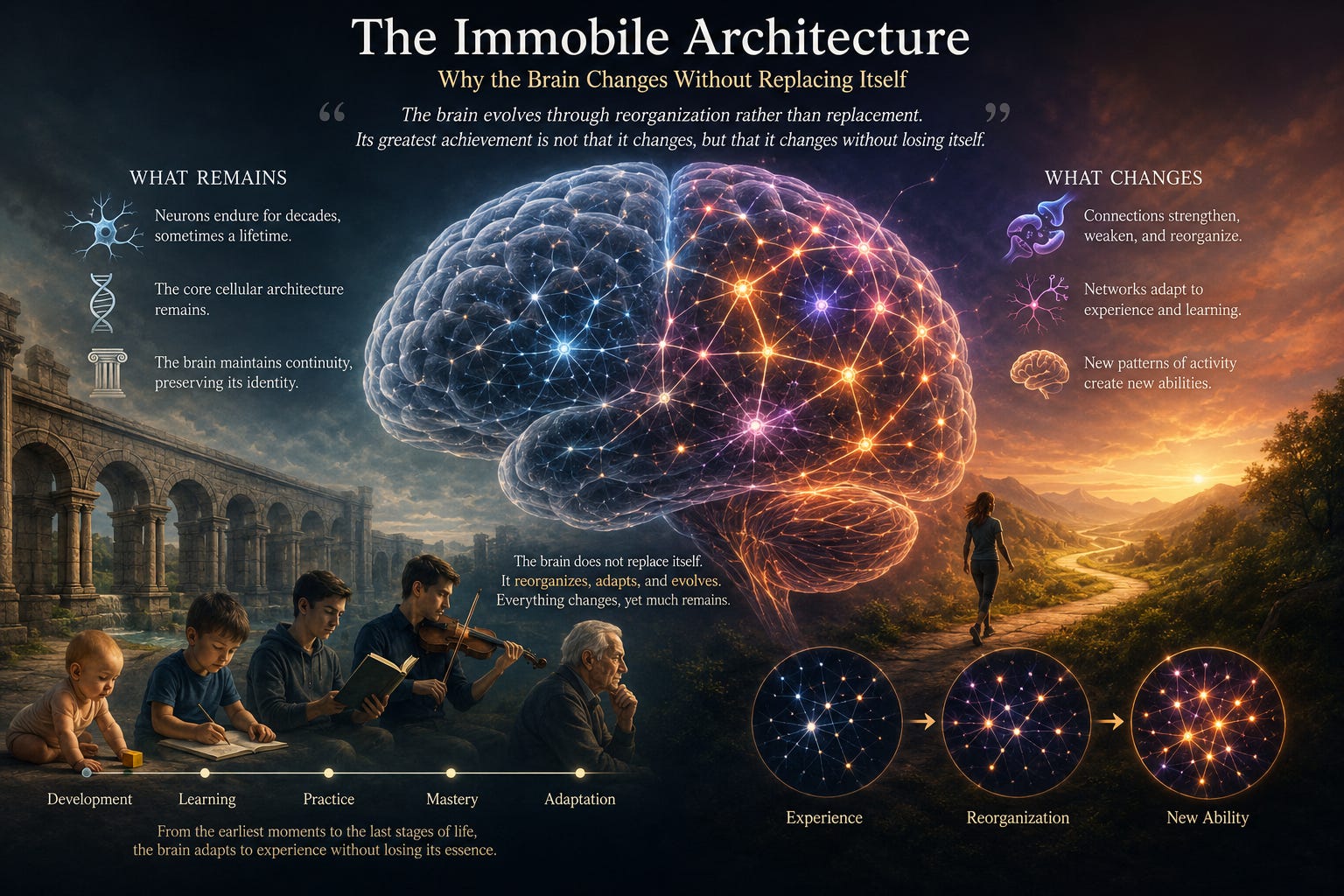
This article examines a central paradox of the human nervous system: the brain remains one of the most adaptable organs in the body while relying on a remarkably persistent cellular architecture. Rather than interpreting neuroplasticity as continual reconstruction or large-scale neuronal replacement, the essay argues that learning, memory, development, and identity depend primarily on the reorganization of existing neural relationships. Synaptic plasticity, network refinement, consolidation, and functional specialization allow the brain to change without abolishing the continuity that makes accumulated experience possible. To describe this complementary principle of persistence, the article introduces the concept of neurotenacity, understood as the structural and organizational continuity that enables plasticity to become cumulative. The brain is therefore presented not as a machine that repeatedly replaces its parts, but as an evolving architecture: a living structure that transforms through rearrangement while remaining connected to its own history. This perspective suggests that future neuroscience must investigate not only how the brain changes, but also how it remains sufficiently stable to preserve memory, identity, and the continuity of the self.
Alexis O. Kaya, MD, PhD, Neuroscientist
Download
