


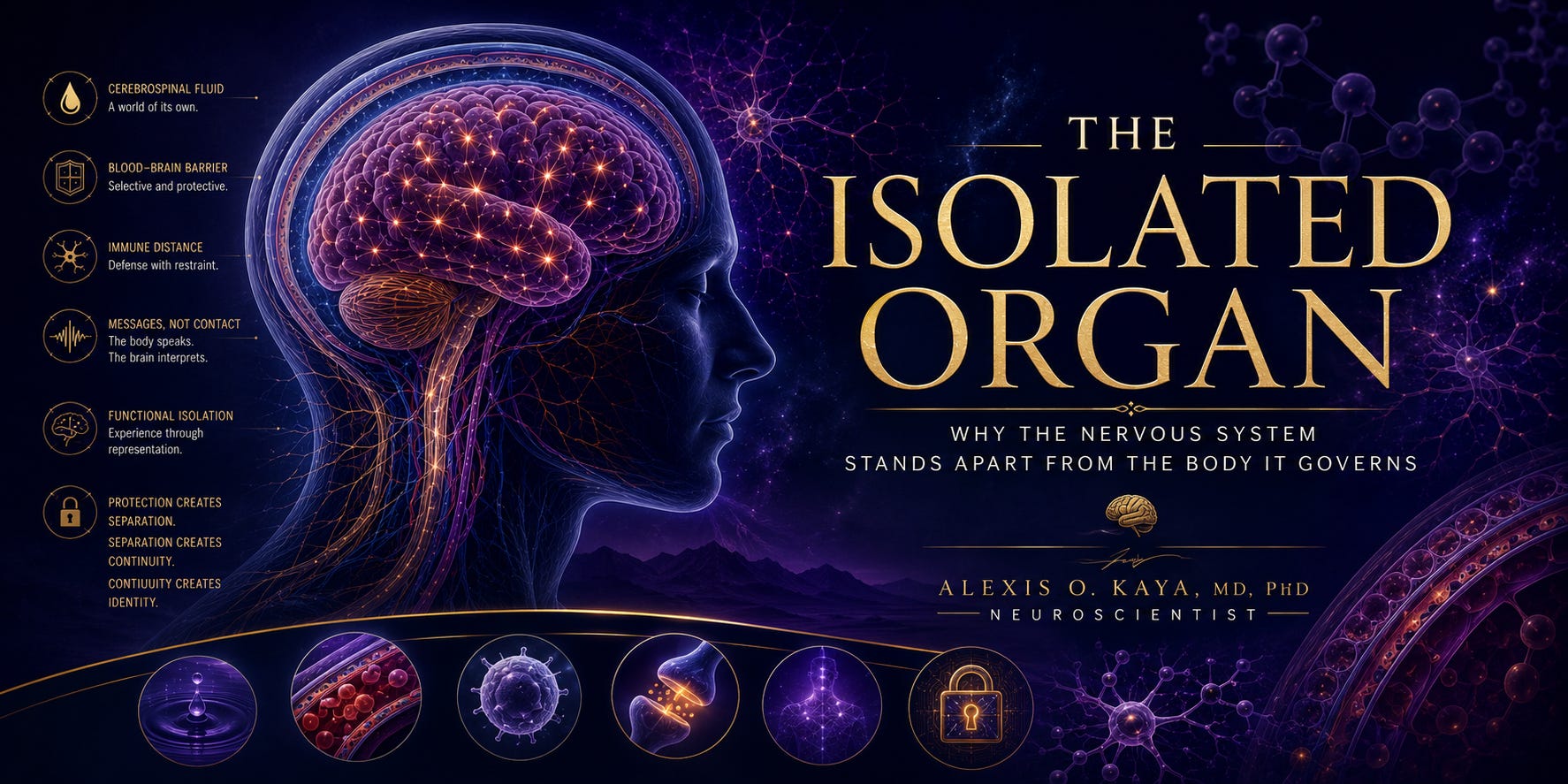
By Alexis O. Kaya, M.D., Ph.D., Neuroscientist.
The nervous system is not merely an organ within the body; it is a protected informational system whose biological power depends upon a paradoxical form of separation. Although the brain governs movement, sensation, homeostasis, immunity, endocrine regulation, memory, cognition, and consciousness, it rarely encounters the organism it regulates through direct contact. Instead, it receives the body through translations: neural signals, endocrine messages, immune mediators, interoceptive maps, and vascularly filtered exchanges. This article proposes that the apparent isolation of the nervous system is not an incidental anatomical arrangement but a fundamental principle of neural organization. Cerebrospinal fluid, meningeal protection, the blood–brain barrier, neuroimmune regulation, and representational processing all converge toward the same biological logic: the preservation of informational continuity. Within this framework, neural isolation is not a withdrawal from the body but a strategy for conserving the architecture through which memory, learning, identity, and consciousness remain possible across time. The concept of Neurotenacity helps clarify this logic. If long-lived neurons and stable neural networks preserve the accumulated history of the organism, then the nervous system must be protected not only as tissue but as an archive of lived experience. The central thesis of this article is therefore that the brain stands apart from the body it governs because what it contains cannot easily be replaced: not merely cells, but continuity; not merely function, but history; not merely regulation, but the biological conditions of personhood.
The article develops this argument across six interlocking dimensions: anatomical separation, cerebrospinal fluid, blood–brain barrier selectivity, neuroimmune regulation, chemical and interoceptive mediation, and functional autonomy. Together, these dimensions suggest that the nervous system is connected to the body through highly regulated channels rather than direct immersion in the body’s physiological flux.
The organ inside the organism
How can the organ that governs the entire body remain so remarkably separated from it?
The question appears paradoxical. The nervous system is often described as the master regulator of the organism: it controls movement, interprets sensation, generates thought, stores memory, shapes emotion, coordinates homeostasis, regulates breathing, influences immunity, and modulates endocrine function.
From birth until death, nearly every major physiological process depends, directly or indirectly, upon neural activity. No organ appears more integrated into the life of the body. The paradox is that few organs are more isolated, and this contradiction is rarely appreciated.
We tend to imagine the brain as the center of the organism, intimately connected to every tissue it governs. In one sense, this is true: the nervous system communicates continuously with muscles, glands, viscera, blood vessels, and sensory organs. Its influence extends throughout the body; yet influence should not be confused with contact.
The brain does not directly touch the tissues it regulates; it does not directly encounter most of the biological events occurring elsewhere in the organism. Instead, it exists within a carefully protected environment: a world separated from the rest of the body by layers of anatomical, physiological, and biochemical mediation.
Unlike most organs, the brain floats within a specialized fluid. It is enclosed within rigid protective structures; its blood supply is filtered through highly selective barriers; its immune interactions are tightly regulated; and its exposure to circulating molecules is carefully controlled. Even the information it receives about the body arrives through specialized pathways and encoded signals.
The nervous system rarely encounters the body directly. It encounters representations of the body: messages about the body; translations of the body’s internal state. This distinction may appear subtle. Yet it carries profound implications.
The heart is immersed in blood; the liver directly processes chemical substances arriving from the digestive system; and the kidneys continuously interact with circulating plasma. Most organs function through immediate contact with the environments they regulate.
The brain does not. Its relationship with the body is fundamentally different. It is connected to everything while remaining separated from almost everything. The paradox becomes even more striking when viewed from an evolutionary perspective: Why would evolution isolate the organ upon which survival most depends? Why protect the nervous system so extensively? Why surround it with barriers, compartments, filters, and specialized fluids? Why create distance between the brain and the organism it governs?
The answer cannot simply be protection. Many organs require protection. Yet none display the degree of isolation found within the nervous system. Something more may be occurring; perhaps the brain’s isolation reflects the extraordinary value of what it contains.
The nervous system does not merely regulate physiology; it stores experience and accumulates biological history.
It preserves memory, maintains continuity, and supports consciousness. The information embedded within neural architecture may be among the most valuable biological structures evolution has ever produced. Such information cannot be replaced as easily as tissue; it cannot be regenerated as easily as cells; it must be preserved: and preservation may require separation.
This possibility invites a different way of thinking about the nervous system. The brain should not be understood simply as another organ among organs, but as a protected domain within the organism: dependent upon the body, continuously communicating with it, yet partially insulated from its fluctuations. It is simultaneously embedded and distinct, integrated and separated, biologically dependent and functionally autonomous. The most connected organ may therefore also be the most isolated, and this isolation may represent one of the deepest evolutionary conditions for neural continuity.
The evolution of protection
The remarkable isolation of the nervous system immediately raises an evolutionary question: Why would biology devote so many resources to protecting a single organ?
Protection is not unique to the brain. Every organ possesses mechanisms that preserve its function: the skin forms a barrier against the external world; the immune system defends against pathogens; and the skeleton protects vital structures. Throughout biology, protection is a recurring theme; yet the nervous system occupies an exceptional position: no other organ receives such extensive and multilayered protection.
The brain is enclosed within the skull; wrapped in specialized membranes; suspended within cerebrospinal fluid; shielded by highly selective vascular barriers; and subject to tightly regulated immune interactions. Even its chemical environment is carefully controlled. The degree of protection is extraordinary.
Evolution rarely invests in costly biological structures without compelling reasons. The existence of such elaborate protective systems suggests that the nervous system possesses characteristics unlike those of most other tissues. One explanation begins with the nature of neurons themselves: neurons are unusually fragile cells.
Unlike many tissues of the body, mature neurons generally possess limited regenerative capacity. They are highly specialized, highly differentiated, and often incapable of replacement once lost. Damage that would be relatively insignificant in other tissues can produce profound and irreversible consequences within the nervous system: a cut in the skin may heal; a fractured bone may remodel, but a damaged neuron often cannot be restored so easily. This vulnerability alone would justify increased protection. Yet fragility is only part of the explanation.
A second factor may be even more important: neurons are remarkably long-lived. Many persist for decades, and some may remain throughout the entire lifespan of the individual. This persistence lies at the heart of the concept of Neurotenacity, which emphasizes the unusual capacity of the nervous system to preserve its principal cellular and informational architecture across time.
The nervous system appears to preserve its principal cellular components with unusual persistence. From an evolutionary perspective, such longevity creates a new challenge: the longer a structure survives, the more valuable its preservation becomes. A short-lived cell can be replaced, but a long-lived cell accumulates history.
Every year of survival increases the amount of biological investment contained within it. Neurons therefore represent more than tissue; they become repositories of continuity. The importance of this continuity becomes clearer when we consider what neurons actually support.
A neuron is not valuable merely because it exists. Its significance lies in the networks to which it belongs, the pathways it participates in, the information it helps organize, and the experiences embedded within its connections. Memory, learning, behavior, emotion, and identity, all emerge from patterns of organization distributed across neural architecture. The nervous system therefore contains something rare in biology. It contains accumulated information.
Most tissues primarily maintain physiological function; the brain maintains function, but it also preserves history. Every experience modifies neural organization, every memory leaves traces, every learned skill alters connectivity, and every relationship contributes to architecture. Over decades, the nervous system becomes an increasingly rich repository of accumulated information.
This observation suggests a broader evolutionary principle. The value of a structure is not determined solely by its material composition; it is also determined by the information it contains: a damaged liver can regenerate substantial portions of its tissue, but a damaged neural network may lose experiences accumulated over an entire lifetime. The biological cost is fundamentally different.
Evolution may therefore have faced a unique challenge: How can a system preserve information that requires decades to construct? One solution would be regeneration; another would be protection.
The nervous system appears to have favored the second strategy. Rather than relying primarily upon replacement, it relies heavily upon preservation; rather than rebuilding, it protects; and rather than renewing continuously, it isolates.
From this perspective, the extraordinary defenses surrounding the brain begin to make sense: the skull protects tissue, the meninges protect structure, the cerebrospinal fluid protects mechanics, and the blood-brain barrier protects chemistry. Together, these systems preserve something far more valuable than cells alone: they preserve organization, continuity, and accumulated history. And perhaps this is the deepest evolutionary logic underlying neural isolation.
The brain is not protected merely because it is essential; many organs are essential. It is protected because what it contains cannot easily be reconstructed once lost. The nervous system is not simply another biological structure; it is a living archive: a repository of memories, experiences, relationships, skills, and identity. Its value increases with time; its informational richness accumulates throughout life; and the greater the informational value of a system, the greater the evolutionary pressure to preserve it.
This principle may explain why the nervous system became the most protected organ in the body. Its exceptional protection does not arise solely from power or complexity, but from irreplaceability. The more valuable the information contained within a biological system, the stronger the pressure to preserve the conditions that allow that information to endure.
The fluid that separates
Long before we encounter the blood-brain barrier, the meninges, or the complex mechanisms of neuroimmune regulation, another remarkable feature of the nervous system appears: the brain does not directly rest upon the body; it floats. This simple anatomical fact is often overlooked. Yet it reveals something profound about the relationship between the nervous system and the organism that surrounds it.
Unlike most organs, the brain is suspended within a specialized fluid environment known as cerebrospinal fluid (CSF). This fluid occupies the ventricular system, the subarachnoid spaces, and the channels surrounding the brain and spinal cord.
At any given moment, the central nervous system exists within a liquid world of its own. The significance of this arrangement extends far beyond mechanics. Certainly, cerebrospinal fluid provides physical protection. The adult human brain weighs approximately 1.3 to 1.5 kilograms. Suspended within cerebrospinal fluid, however, its effective weight is dramatically reduced. The fluid acts as a buoyant medium, protecting delicate neural tissue from the full effects of gravity and mechanical stress. Without this support, the lower regions of the brain would be subjected to continuous pressure from the mass above them. The consequences could be devastating.
In this sense, cerebrospinal fluid functions as a protective cushion. It absorbs shocks, distributes forces, reduces mechanical strain, and preserves the structural integrity of neural tissue. Yet protection is only the beginning of its role.
The cerebrospinal fluid also contributes to one of the most important requirements of nervous system function: stability. Neurons are extraordinarily sensitive cells. Their electrical activity depends upon precise chemical conditions. Small alterations in ion concentrations, pH, osmolarity, or metabolic composition can significantly affect neural communication. The cerebrospinal fluid helps maintain a carefully regulated environment in which these cells can operate reliably.
While the rest of the body experiences constant fluctuations, the nervous system remains immersed within a comparatively stable biochemical medium. This stability may be essential for preserving the integrity of information processing. The fluid therefore functions not only as protection against physical disturbance but also as protection against chemical instability.
Recent discoveries have revealed yet another important role. Cerebrospinal fluid participates in the clearance of metabolic waste products from the brain. Through mechanisms involving the glymphatic system, cerebrospinal fluid contributes to the removal of proteins, cellular debris, and metabolic by-products that accumulate during neural activity.
Remarkably, many of these clearance processes become particularly active during sleep. The brain appears to use periods of reduced activity to maintain the cleanliness of its internal environment. This function further emphasizes the uniqueness of the nervous system: the organ not only possesses its own fluid environment, it uses that environment to preserve the conditions necessary for long-term survival and function.
The ventricular system itself reinforces this impression. Deep within the brain lies an intricate network of interconnected cavities filled with cerebrospinal fluid: the lateral ventricles, the third ventricle, the cerebral aqueduct, and the fourth ventricle, together they form an internal hydraulic architecture unlike anything found elsewhere in the body.
The nervous system appears to carry its own sea within itself. Evolution could have organized the brain differently: neural tissue might have remained in more direct contact with surrounding structures. Instead, a fluid space was created—a protective interval and a physical separation between neural tissue and the rest of the organism.
The existence of this separation suggests that isolation began at a very fundamental level; before chemical barriers and immune regulation, and before sophisticated neurovascular specialization: there was already distance, and there was already mediation. The brain existed within an environment that was neither entirely itself nor entirely the body.
From the perspective of this essay, cerebrospinal fluid represents more than a physiological necessity; it represents a biological boundary, a transitional world between the nervous system and the organism it governs.
The nervous system is physically located within the body; yet it remains partially insulated from direct bodily contact. The fluid surrounding it makes this reality visible: the brain is not embedded directly within the organism; it is suspended within its own protected environment.
This fact carries symbolic significance. The first layer of neural isolation is not a wall; it is a sea; a sea that cushions, stabilizes, cleanses, and separates. Perhaps this is why the cerebrospinal fluid occupies such a special place in the architecture of the nervous system. It reminds us that the brain’s relationship with the body is unlike that of any other organ.
Before the nervous system communicates with the body, it first inhabits its own world. A world of fluid, stability, and protection. For the brain does not directly rest upon the body; it floats. And in doing so, it reveals one of the earliest signs of its remarkable isolation: the nervous system lives within its own sea.
The blood–brain barrier
If cerebrospinal fluid represents the first sign of neural separation, the blood-brain barrier represents its most sophisticated expression. Few structures illustrate the uniqueness of the nervous system more clearly.
The brain depends entirely upon the body for survival. It requires a continuous supply of oxygen, glucose, and nutrients. Without this support, neural activity rapidly ceases. The nervous system cannot survive independently. Its existence depends upon the circulatory system. Yet despite this profound dependence, the brain refuses unrestricted contact with the blood that sustains it.
This apparent contradiction lies at the heart of the blood-brain barrier. In most tissues, circulating blood interacts relatively freely with the surrounding cellular environment. Molecules move between vascular compartments and tissues, immune cells migrate, and chemical signals diffuse. The exchange is dynamic and extensive. The nervous system follows a different logic.
The vessels supplying the brain possess highly specialized endothelial cells. Unlike the endothelial cells found in many other organs, these cells are linked together by exceptionally tight junctions. The spaces through which substances might ordinarily pass are dramatically reduced. The result is not a complete wall but a highly selective filter; the blood continues to nourish the brain; yet access becomes regulated, controlled, and restricted.
The significance of this arrangement cannot be overstated. Every second, enormous quantities of blood pass through the cerebral circulation. And yet most neurons never directly encounter the contents of that blood. Between the circulation and neural tissue stands a complex biological interface: the bloodstream approaches, the barrier decides, some molecules pass, and others do not. The brain receives support without surrendering control.
This selectivity reflects one of the central principles of nervous system organization: stability. Neurons operate within extremely narrow physiological limits. Electrical signaling depends upon carefully regulated ionic gradients; and synaptic transmission depends upon precise chemical conditions. Small disturbances can alter neural activity dramatically. A sudden influx of circulating substances could disrupt information processing, impair communication, or threaten cellular survival.
The blood-brain barrier therefore functions as a guardian of neural stability. It allows nutrients to enter, it facilitates the removal of waste products, it regulates water balance, and it controls ionic composition. At the same time, it excludes many potentially disruptive substances.
The goal is not separation for its own sake; the goal is preservation. The nervous system remains functional because its environment remains stable. The barrier also performs an important metabolic role: neurons possess enormous energetic demands. Although representing only a small fraction of total body mass, the brain consumes a disproportionate share of the body’s energy resources. Meeting these demands requires constant regulation of glucose transport, oxygen delivery, and metabolic exchange.
The blood-brain barrier actively participates in this process. Rather than permitting unrestricted diffusion, it carefully manages access to critical resources. Nourishment becomes selective rather than indiscriminate. This observation reveals something important: the relationship between the brain and the body is not characterized by direct exposure; it is characterized by mediation. Every interaction is interpreted through biological filters.
The nervous system rarely encounters the organism in its raw form. Instead, it encounters information that has been processed, regulated, and translated. The blood-brain barrier embodies this principle at the molecular level; communication occurs, but communication requires regulation, selection, and boundaries.
The barrier therefore serves a role extending beyond physiology. It symbolizes a broader organizational strategy. The nervous system remains connected to the body while preserving a degree of separation from it: dependence and isolation coexist; integration and autonomy coexist.
The brain belongs to the organism. Yet it maintains conditions distinct from those governing the rest of the organism. This perspective helps explain why the blood-brain barrier occupies such a central position in the architecture of neural isolation. It is not simply a protective structure; it is a mechanism through which the nervous system preserves its own internal world, a world governed by stability, precision, and continuity.
The bloodstream sustains that world, but it does not define it. The blood nourishes the brain without directly touching most neurons. And in doing so, it reveals one of the deepest principles of nervous system organization: the nervous system survives through communication, but communication requires filtration. For communication without filtration would become exposure; and exposure would threaten the very continuity that the nervous system exists to preserve.
The immune distance
Among all the forms of separation that distinguish the nervous system from the rest of the body, none may be more surprising than its relationship with the immune system.
At first glance, this relationship appears paradoxical: the immune system exists to protect the organism; it detects pathogens, removes damaged cells, coordinates repair, and maintains biological integrity. Its activity is essential for survival. One might therefore expect unrestricted immune access to the organ upon which survival most depends. Yet evolution has chosen a different strategy.
For much of modern medical history, the brain was described as an immune-privileged organ. The term suggested that the central nervous system was relatively insulated from ordinary immune surveillance. Contemporary neuroimmunology has revised that view: the brain is not immunologically isolated in any absolute sense, but it is immunologically regulated in ways that differ profoundly from most peripheral tissues.
Although contemporary neuroimmunology has shown that this view is overly simplistic, the underlying observation remains valid. The relationship between the brain and the immune system is fundamentally different from that observed in most tissues: access is restricted, communication is regulated, and responses are carefully controlled.
The nervous system remains immunologically distinct. Part of this distinction emerges from the blood-brain barrier itself. The barrier not only regulates chemical exchange; it also limits the entry of many immune cells and circulating inflammatory molecules. The result is a controlled interface between neural tissue and systemic immunity. The brain receives protection; yet it avoids unrestricted exposure.
The importance of this arrangement becomes clearer when we consider the nature of neural tissue. Inflammation is one of the immune system’s most effective tools. In many organs, inflammation promotes defense and repair; damaged tissues attract immune cells, chemical mediators increase vascular permeability, and protective responses are amplified. The process is often beneficial.
The nervous system, however, presents a unique challenge: neural networks depend upon extraordinary precision. The organization supporting memory, perception, emotion, and consciousness is highly sensitive to disruption. A level of inflammation that might be tolerated elsewhere could produce profound consequences within the brain: neurons are not easily replaced, connections may require decades to establish, and experience becomes embedded within architecture. The cost of collateral damage is therefore unusually high.
From this perspective, unrestricted immune activity represents a potential threat. The same mechanisms that protect the body could inadvertently damage the informational structures the nervous system exists to preserve. Evolution appears to have recognized this danger.
Rather than excluding immunity altogether, the central nervous system developed specialized forms of immune regulation. The most notable example is the microglial cell. Microglia serve as resident immune cells of the brain: they survey neural tissue, remove debris, participate in synaptic remodeling, respond to injury, and contribute to homeostasis, while operating from within the nervous system itself.
The brain possesses its own guardians, its own internal surveillance system, and its own specialized form of immunity. This arrangement is remarkable. Instead of relying exclusively upon external immune intervention, the nervous system maintains a degree of immunological autonomy: protection becomes localized, adapted, and integrated into neural architecture. The brain is defended from within.
Recent advances in neuroimmunology have further complicated this picture. Researchers now recognize extensive communication between the nervous and immune systems. Cytokines influence neural activity; immune signals affect behavior; and inflammation contributes to cognition, mood, and disease. Far from being completely isolated, the brain remains in constant dialogue with the immune system.
Yet the dialogue remains carefully mediated: communication exists; direct access remains limited. The distinction is crucial: the nervous system accepts information from immunity without surrendering complete immunological exposure.
Neuroinflammation provides a powerful illustration of why such regulation matters. When inflammatory processes become excessive or chronic, the consequences can be profound: neural communication may become disrupted, synaptic function may deteriorate, neurodegenerative processes may accelerate, and cognitive function may decline. The same biological forces designed to protect can become sources of injury.
The nervous system therefore faces a unique challenge. It must benefit from immune protection while avoiding immune destruction. This challenge may explain the extraordinary sophistication of neuroimmune regulation: the brain requires defense, but it also requires restraint; it requires surveillance, but it also requires stability, protection without excess, communication without invasion, and defense without disruption. Within the framework of The Isolated Organ, this relationship reveals another layer of neural separation.
The brain is not isolated because it rejects the body. It is isolated because its informational architecture is exceptionally valuable and exceptionally vulnerable. Every memory, learned skill, emotional association, and element of personal history depends upon neural structures that must be preserved with extraordinary care.
The immune system protects biological tissue; the nervous system preserves biological history. These goals usually align, but not always. And when they diverge, evolution appears to favor protection of continuity. Perhaps this is why immune access remains so carefully regulated. The nervous system can survive only if its architecture survives. And architecture survives only when protection is balanced with restraint; for the organ that protects the body must also be protected from the body.
The body speaks through intermediaries
The isolation of the nervous system raises an important question. If the brain is separated from the body by barriers, fluids, filters, and specialized interfaces, how does it know what is happening within the organism it governs? The question appears simple; the answer reveals one of the most remarkable principles of nervous system organization.
The brain rarely interacts directly with the body. Instead, it relies upon intermediaries: messages, signals, and translations. The nervous system exists within a world constructed from information rather than direct contact.
This observation may represent one of the deepest consequences of neural isolation. Every moment of life depends upon communication between the brain and the body. The brain regulates cardiovascular activity, monitors respiration, coordinates digestion, influences immunity, controls movement, and maintains homeostasis.
To perform these functions, it must continuously receive information about the state of the organism. Yet the information it receives is never raw reality. It arrives already encoded, already transformed, and already translated into biological language.
Consider sensation. When we touch an object, the brain never directly encounters the object itself. It does not touch the surface; it does not feel the texture; it does not experience the temperature directly. Instead, specialized receptors convert physical events into electrical signals. These signals travel through sensory pathways toward the central nervous system. What ultimately reaches the brain is not the object; it is information about the object, a translation of reality.
The same principle applies throughout physiology. The brain never directly measures blood pressure: specialized baroreceptors detect vascular stretch and transform it into neural signals. The brain never directly observes oxygen levels: chemoreceptors detect changes in blood chemistry and communicate the results. The brain never directly perceives inflammation: immune molecules signal its presence. Again and again, the same pattern emerges. The nervous system does not encounter physiological events themselves. It encounters messages describing those events.
Hormones provide another striking example. Hormones carry information throughout the body. They communicate nutritional status, stress, reproductive state, metabolic activity, and growth. The brain receives these signals and integrates them into ongoing regulatory processes. Yet hormones are not the physiological events they represent, they are messengers: biological words within an endocrine language.
Cytokines play a similar role. The immune system communicates with the nervous system through chemical mediators that convey information about infection, injury, and inflammation. The brain interprets these signals and adjusts behavior accordingly. Fatigue during illness, loss of appetite, altered mood, and changes in sleep, all emerge from communication between systems. Once again, the nervous system responds not to direct exposure but to transmitted information.
Even the autonomic nervous system follows this logic. Signals continuously travel between organs and brain centers. Information flows upward, commands flow downward: the organism functions through constant dialogue. Yet the dialogue remains mediated; the participants rarely meet directly. Instead, communication depends upon networks of translation.
This observation suggests something profound: the brain’s relationship with the body resembles its relationship with the external world. In both cases, it relies upon representations. The brain never directly experiences reality. It experiences encoded versions of reality. Neural constructions derived from incoming signals. This principle applies equally to the body’s internal environment.
The nervous system does not directly know the organism; it knows models of the organism, representations of physiological states, patterns of information generated by specialized receptors and signaling systems. In this sense, the body speaks to the brain through interpreters.
Every sensory receptor acts as a translator; every hormone acts as a messenger; every cytokine acts as a report; and every autonomic signal carries information across a biological distance. The nervous system exists at the center of an immense communication network whose purpose is to transform physiology into information. The implications are significant.
The isolation of the nervous system does not prevent communication; it makes communication necessary. Because the brain remains separated from the body, it must rely upon messages to understand the body: distance creates mediation, mediation creates representation, and representation becomes the basis of regulation. This may be one of the deepest organizational principles of the nervous system.
The brain governs a body it never directly encounters; it regulates tissues it rarely touches; it controls processes it knows only through signals. The nervous system therefore occupies a unique position within biology: it is simultaneously embedded within the organism and separated from it; dependent upon communication and yet insulated from direct exposure; connected to everything while physically distant from almost everything. From the perspective of The Isolated Organ, this realization is crucial: the nervous system does not merely receive information; its entire relationship with the body is built upon information.
The organism becomes knowable through translation; the body becomes accessible through messages. This may be why neural isolation has been preserved throughout evolution: separation does not prevent communication; it transforms communication into a more sophisticated system of biological languages through which the body continuously reports its condition to the organ that governs it. The nervous system knows the body through translation, and the brain governs the body through messages rather than contact.
Functional isolation
Up to this point, the isolation of the nervous system has appeared primarily as a biological phenomenon. The brain floats within cerebrospinal fluid; it is protected by specialized barriers. Its immune interactions are carefully regulated; its communication with the body occurs through intermediaries. These forms of separation are tangible. They can be observed anatomically, measured physiologically, and studied experimentally.
Yet a deeper form of isolation may exist, one that cannot be seen under a microscope, one that arises not from physical barriers but from the fundamental nature of cognition itself. The nervous system is not merely separated from the body anatomically; it may also be separated from the body functionally.
To understand this possibility, we must consider what the brain actually does. The brain does not simply receive information; it transforms information, organizes it, interprets it, and integrates it. The nervous system continuously constructs models of reality.
These models allow perception, prediction, learning, decision-making, and ultimately consciousness itself. Every moment of experience depends upon this constructive process.
Consider perception. When we look at an object, the brain does not directly encounter the object itself: photons strike the retina, electrical signals travel through visual pathways, and neural networks process patterns of activity. From these signals, the brain constructs a perceptual experience.
What reaches consciousness is not the object; it is a neural representation of the object. The same principle applies to sound, touch, taste, and smell. In every case, the nervous system works not with reality itself but with information about reality.
Perception therefore depends upon models: the brain experiences its own constructions. The same logic extends beyond sensory processing. Memory does not store the past itself; it stores neural representations of the past, which are reconstructed rather than replayed. Every act of remembering involves the reactivation of organized neural patterns, making the past accessible through representation.
Even self-awareness appears to depend upon internal models. Human beings possess a remarkable ability to monitor their own thoughts, emotions, and bodily states. Yet this monitoring does not occur through direct contact. The brain does not observe itself from outside, instead, it constructs representations of its own activity. Self-awareness emerges from recursive modeling; the nervous system generates an image of itself for itself. In this sense, even the self becomes a form of representation.
The preceding analysis has shown that information about physiological states reaches the brain through specialized pathways. Signals concerning temperature, blood pressure, oxygen levels, immune activity, metabolic status, and countless other variables contribute to what neuroscientists call interoception: the perception of the body’s internal condition.
Yet the brain never directly encounters these physiological events; it encounters encoded information generated by receptors; it encounters neural representations of bodily states. The distinction is subtle but profound; the brain does not know the body itself, it knows a model of the body, an internal construction derived from continuous streams of biological information.
This realization invites a fascinating question: Does the brain ever truly encounter the body itself? Or does it encounter only representations of the body?
The question resembles those traditionally asked about perception of the external world. Philosophers have long debated whether human beings experience reality directly or through mental representations.
The nervous system appears to confront an analogous situation internally. The body, like the external world, becomes accessible through translation, signals, models, and interpretation.
The consequences of this perspective are far-reaching. The nervous system governs the organism; yet it governs through representations. It regulates a body it never directly touches, it experiences physiological states through informational intermediaries, and it constructs internal maps of processes occurring beyond its immediate reach. In a profound sense, the brain lives within a universe of models. These models are extraordinarily accurate, adaptive, and useful. Yet they remain models.
The nervous system therefore occupies a unique position: it is physically located within the organism, it depends entirely upon the organism, and yet its experience of that organism remains mediated, filtered through layers of representation.
The brain exists at the center of the body while simultaneously remaining separated from direct access to it. This may represent the deepest level of neural isolation, not anatomical isolation, not vascular isolation, not immunological isolation, but epistemological isolation.
The nervous system knows the body only through information, and information always requires interpretation. The concept of The Isolated Organ therefore extends beyond anatomy and physiology. The brain is isolated not only because it is protected from the body, but because it cannot escape the mediating work of representation. Its relationship with reality is mediated, its relationship with the body is mediated, and even its relationship with itself may be mediated.
The organ that governs the organism does so from within a world of its own constructions. And this leads us to one of the deepest questions in neuroscience: Does the brain ever truly encounter the body itself? Or does it forever inhabit representations of the body it seeks to understand? The answer remains uncertain; yet the question reveals just how profound neural isolation may be.
The isolated organ
The preceding sections have explored a series of observations that, at first glance, appear unrelated: the brain floats within cerebrospinal fluid, it is protected by specialized membranes. Its blood supply is filtered through highly selective barriers; its immune interactions are tightly regulated; its communication with the body occurs through intermediaries; and its knowledge of the body depends upon representations rather than direct contact.
Each of these phenomena is well established within neuroscience. None is controversial; yet when viewed together, they reveal a striking pattern.
The nervous system occupies a biological position unlike that of any other organ. It exists within the organism, yet it remains partially separated from the organism; it governs the body, yet it rarely encounters the body directly; it depends completely upon biological support, and yet it carefully regulates access to itself. The nervous system therefore appears to occupy a unique biological status: an organ embedded within the body while simultaneously maintaining a remarkable degree of isolation from it.
This observation forms the basis of a broader hypothesis. Perhaps the defining characteristic of the nervous system is not merely its complexity, nor its computational capacity, nor even its role in consciousness, perhaps its defining characteristic is its controlled separation from the organism it governs.
The brain is neither fully integrated nor fully isolated. It occupies an intermediate position: a protected domain existing within a larger biological system, a world connected to the organism through carefully regulated channels of communication.
This perspective helps explain many of the distinctive features of nervous system organization. The cerebrospinal fluid creates distance, the blood-brain barrier creates selectivity, neuroimmune regulation creates restraint, and sensory and physiological signaling create mediation. Together, these mechanisms establish boundaries between neural architecture and the rest of the organism.
The result is not disconnection, the result is controlled interaction. The nervous system remains deeply dependent upon the body: without oxygen, it cannot survive; without nutrients, it cannot function; without sensory information, it cannot understand its environment; and without physiological signals, it cannot regulate homeostasis.
The brain requires the body continuously; yet dependence does not eliminate separation. Indeed, the two appear to coexist. The nervous system is both connected and insulated, integrated and distinct, embedded and protected. This duality may not be accidental; it may reflect a fundamental evolutionary strategy.
Throughout the previous articles of this series, we have repeatedly encountered the importance of continuity. Neurotenacity emphasized neuronal persistence, The Persistence Problem explored continuity of identity, The Brain That Refuses Renewal examined the preservation of informational architecture, The Architecture of Forgetting proposed that information may survive even when access becomes difficult, and The Fragility of Continuity revealed how identity changes when neural organization deteriorates.
A common principle emerges from all of these discussions: continuity requires preservation; preservation requires protection; and protection often requires separation. The nervous system may therefore be isolated not despite its functions, but because of them: memory requires stability, identity requires continuity, experience requires preservation.
The architecture supporting these phenomena cannot be exposed indiscriminately to every biological fluctuation occurring elsewhere in the organism. Isolation becomes a mechanism of conservation, a strategy for protecting accumulated information, a strategy for preserving biological history.
Viewed from this perspective, the nervous system resembles a protected archive—not separated from the organism, but safeguarded within it. Its barriers do not reject the body; they preserve the conditions under which memory, learning, continuity, and consciousness become biologically possible.
This idea can be summarized through a simple progression: protection creates separation, separation creates continuity, and continuity creates identity. The sequence is not absolute; it is not the only explanation for personhood. Yet it provides a framework capable of linking anatomy, physiology, cognition, and experience into a coherent narrative.
The brain becomes understandable not merely as a computational organ, but as a protected informational system: a system whose isolation serves the preservation of its architecture, a system whose architecture supports continuity, and a system whose continuity contributes to identity.
The implications extend beyond neuroscience; they touch philosophy, psychology, medicine, and the study of consciousness itself. For if the nervous system derives part of its uniqueness from its separation, then isolation may be more than a biological curiosity. It may be one of the organizing principles through which the nervous system became capable of preserving a lifetime of experience; perhaps this is the deeper meaning of neural isolation.
The brain is not simply protected from the body; it is protected for the sake of continuity; and continuity, in turn, may be one of the foundations of personhood; the nervous system inhabits the body without fully belonging to it.
The price of isolation
Throughout this article, the isolation of the nervous system has appeared largely as an advantage: the brain is protected, its environment is stabilized, its exposure to biological fluctuations is limited, its architecture is preserved, and its continuity is maintained. From this perspective, neural isolation appears to be one of evolution’s most successful strategies. Yet biology rarely offers advantages without costs.
Every adaptation involves trade-offs; every protective mechanism imposes limitations; and every solution creates new vulnerabilities. The nervous system is no exception. Indeed, many of its greatest strengths may arise from the very same mechanisms that generate its greatest weaknesses.
The benefits of isolation are undeniable: protection preserves neural tissue, stability supports reliable signaling, and continuity allows memory to accumulate across decades. The preservation of architecture enables learning, identity, and consciousness. Without these protective mechanisms, the nervous system might never have achieved the extraordinary complexity observed in humans. Yet the price of protection is exposure to unique forms of fragility.
The first example emerges from vascular dependence. The brain carefully regulates access to its internal environment; yet despite its isolation, it remains entirely dependent upon blood flow: neurons require constant delivery of oxygen and glucose; unlike many tissues, they possess limited energy reserves. Even brief interruptions in circulation can produce devastating consequences.
This reality becomes dramatically apparent during stroke. The same organ protected from direct exposure to the bloodstream cannot survive without it. Its isolation creates dependence, its dependence creates vulnerability. The paradox is striking: the blood rarely reaches neurons directly; yet the loss of blood supply can destroy them within minutes.
Neurodegeneration reveals a second consequence. Throughout previous articles, we have explored the concept of Neurotenacity—the remarkable persistence of neurons and neural architecture. This persistence contributes to continuity; yet continuity has a cost.
Structures designed to survive for decades must also endure decades of wear, metabolic stress, protein accumulation, and environmental challenges. The very longevity that preserves identity may increase susceptibility to age-related degeneration. A system built for persistence may eventually confront the burden of persistence.
The problem becomes particularly visible in disorders such as Alzheimer’s disease, Parkinson’s disease, and other neurodegenerative conditions. The architecture survives long enough to accumulate history, but it may also survive long enough to accumulate damage.
Limited regeneration represents another consequence of neural isolation. Many tissues solve injury through replacement, damaged cells are removed, new cells emerge, and function is restored. The nervous system often follows a different strategy, because neural organization contains accumulated information, large-scale replacement becomes problematic.
Replacing a neuron is not equivalent to replacing a skin cell. A neuron exists within a network shaped by years of experience. Its removal may involve the loss of relationships that cannot easily be reconstructed. The result is a system that favors preservation over renewal. This strategy protects continuity, but it also limits repair. The nervous system gains stability at the expense of regenerative capacity.
The challenge extends into modern medicine. The very barriers that protect the brain frequently complicate treatment. Many therapeutic agents struggle to cross the blood-brain barrier, potentially useful drugs fail to reach their targets: gene therapies, antibodies, and neuroprotective compounds often encounter formidable obstacles before reaching neural tissue.
Clinicians and researchers repeatedly confront the same reality. The brain is difficult to heal because it is difficult to access. The mechanisms that preserve its internal environment simultaneously restrict intervention: protection becomes resistance, isolation becomes inaccessibility.
The irony is profound. The nervous system evolved barriers to defend itself against disruption. Those same barriers now challenge our efforts to treat disease: the protected organ becomes the difficult organ, the safest organ becomes one of the least accessible.
Viewed from an evolutionary perspective, these trade-offs may be unavoidable. Evolution does not seek perfection; it seeks viability. The nervous system appears to have accepted certain vulnerabilities in exchange for preserving continuity. The price of regeneration became limited repair, the price of protection became restricted access, the price of longevity became susceptibility to cumulative damage, the price of stability became reduced flexibility.
This observation reinforces one of the central themes of the present work: isolation is not a flaw, nor is it an absolute advantage; it is a compromise, a biological strategy whose benefits and limitations emerge from the same underlying principles.
The nervous system remains separated because separation protects what is valuable. Yet every layer of protection imposes constraints, every barrier creates distance, and every safeguard introduces costs; perhaps this is why the nervous system occupies such a unique position within biology: it is not merely protected, it is protected at a price.
The preservation of continuity requires sacrifices, the preservation of identity requires constraints, and the preservation of history requires vulnerability. And this may be one of the deepest lessons of neural isolation: the mechanisms that make the brain extraordinary are often the same mechanisms that make it fragile. For every protection carries a cost.
The philosophy of separation
Throughout this article, neural isolation has been examined as a biological phenomenon. We have explored protective barriers, specialized fluids, immune regulation, selective communication, and informational mediation. Each of these mechanisms contributes to the remarkable separation of the nervous system from the rest of the organism.
As the discussion progresses, a deeper question emerges: Why does consciousness arise within such an isolated structure?
The question is not merely biological, it is philosophical, perhaps even existential. For among all organs of the body, only one appears capable of generating subjective experience, only one produces perception, memory, thought, and self-awareness. And remarkably, that organ is also the one most carefully separated from the organism it governs. The coincidence is striking. Whether it is meaningful remains unknown; yet it invites reflection.
The nervous system does not directly encounter the external world, it encounters signals; the nervous system does not directly encounter most physiological processes, it encounters representations; the nervous system does not even encounter itself directly, it constructs internal models of its own activity. Consciousness therefore emerges not from immediate contact with reality but from interpretation, from mediation, and from representation.
This observation suggests an intriguing possibility: perhaps consciousness requires a certain degree of separation. Perhaps subjective experience becomes possible only when information is transformed into models, only when reality is represented rather than directly encountered.
The idea remains speculative. Yet it resonates with many contemporary theories of cognition. The brain continuously constructs internal representations of both the external world and the body itself: perception becomes an interpretation, memory becomes a reconstruction, and self-awareness becomes a model of the self. At every level, consciousness appears linked to representation, and representation, in turn, requires distance.
A system cannot model something unless there is some distinction between the observer and the observed. This principle becomes particularly interesting when applied to the body.
The nervous system regulates the organism; yet it does so through signals, through translated information, through internal models of physiological states. The brain does not directly experience the heartbeat, it experiences neural representations of cardiovascular activity; it does not directly encounter blood chemistry, it receives coded information about blood chemistry; it does not directly know the organism, it knows an organized model of the organism.
In this sense, the nervous system occupies a curious position. It is part of the body, yet it also stands apart from the body; embedded within the organism, yet observing the organism; dependent upon it, yet partially insulated from it.
The image is almost paradoxical. The observer exists within the system being observed. And yet some degree of separation remains necessary. Perhaps this is one reason why the concept of self emerges so naturally from neural activity.
The brain continuously distinguishes between self and environment, between internal and external events, and between organism and world. These distinctions allow coherent behavior, and they may also contribute to the emergence of subjective identity.
Selfhood may arise from the brain’s ability to construct an organized perspective upon both the body and the world. The self becomes the center of interpretation, the point from which experience is organized. This idea creates a natural bridge between neuroscience and philosophy.
For centuries, philosophers have debated whether the self is a substance, a process, a narrative, or an illusion. The biological observations explored throughout this article suggest another possibility. The self may emerge from a protected system that continuously models reality while remaining partially separated from it.
Identity becomes possible because continuity becomes possible; continuity becomes possible because organization is preserved; and organization is preserved because the nervous system remains protected from complete immersion in the biological processes it governs.
From this perspective, isolation acquires a meaning extending far beyond anatomy. It becomes an epistemological condition, a condition for observation, and a condition for representation. Perhaps even a condition for consciousness itself.
The nervous system becomes more than an organ. It becomes an observer embedded within the organism, a structure simultaneously participating in reality and interpreting reality, living within the body while maintaining a degree of distance from it. This interpretation does not solve the mystery of consciousness. Far from it.
The origin of subjective experience remains one of the greatest unanswered questions in science. Yet it suggests a fascinating possibility. The isolation of the nervous system may not merely protect consciousness; it may be one of the conditions that make consciousness possible.
For perhaps consciousness requires more than information; perhaps it requires perspective; and perspective may require separation. The observer must, in some sense, stand apart from what is observed.
The nervous system does exactly this. It inhabits the organism; yet it never completely merges with it. It experiences the body through representation, the world through representation, even itself through representation. And perhaps this is why the most isolated organ became the seat of subjective experience. The nervous system may be the body’s most extraordinary creation because it is not merely part of the organism, it is the organism’s observer.
The future of the isolated organ
The concept of neural isolation begins with anatomy. It begins with cerebrospinal fluid, with barriers, with immune regulation, and with specialized forms of communication. At first glance, these mechanisms appear to be technical details of nervous system organization.
Yet throughout this article, a broader possibility has emerged: perhaps neural isolation is not merely a structural characteristic of the brain. Perhaps it represents a fundamental principle of nervous system evolution, a principle whose implications extend far beyond anatomy.
If this possibility is correct, the study of neural isolation may become increasingly important for future neuroscience. Indeed, many of the most significant questions in contemporary brain science appear to converge toward the same underlying problem: How does a biological system preserve continuity while remaining capable of adaptation?
The concept of Neurotenacity provides one example. Previous articles proposed that the unusual persistence of neurons contributes to the preservation of informational architecture across decades. Neural longevity protects continuity, continuity supports memory, and memory contributes to identity.
The present article suggests that isolation may represent another component of the same strategy. Persistence preserves information across time, isolation protects the conditions under which that information can survive. The two concepts may therefore be deeply related: Neurotenacity preserves the archive, isolation protects the archive. Together they contribute to continuity.
Future investigations into brain preservation may also benefit from this perspective. For decades, neuroscience has focused primarily upon preserving neural tissue. Yet tissue alone may not be sufficient. The critical question may concern the preservation of organization, of architecture, and of informational continuity.
If neural isolation evolved to protect these properties, understanding its mechanisms could become increasingly important for neuroprotection, regenerative medicine, and the treatment of neurodegenerative disease.
Connectomics introduces another frontier. Modern neuroscience is increasingly interested in mapping the organizational structure of the nervous system. The emphasis has shifted from individual neurons toward networks and patterns of connectivity. This shift aligns naturally with the ideas developed throughout the present work.
If continuity depends upon architecture, and architecture depends upon protection, then connectomics may provide one of the most powerful tools available for understanding why neural isolation evolved in the first place. The future study of connectivity may become inseparable from the study of continuity.
Neuroimmune science offers another important direction. The traditional image of the brain as completely separated from the immune system has gradually given way to a more nuanced understanding. The nervous system communicates continuously with immune processes. Yet it does so through carefully regulated pathways. Understanding how this balance is maintained may reveal important principles governing both health and disease. The future of neuroimmunology may therefore become, in part, the study of how isolation and communication coexist.
Aging raises equally important questions: the human brain remains functional for decades despite continuous exposure to metabolic stress, environmental change, and biological aging; How does continuity survive for so long? How do neural systems preserve stability while adapting to new experiences?
The answer may involve both persistence and protection. Isolation may represent one of the mechanisms through which the nervous system defends accumulated information against the passage of time. The implications extend even into artificial intelligence: modern AI systems excel at learning, yet many continue to struggle with problems that resemble biological challenges: catastrophic forgetting, instability during learning, and loss of previously acquired knowledge. The brain appears to solve these problems more effectively than many artificial systems.
Perhaps one reason is that biological intelligence evolved mechanisms dedicated not merely to acquiring information, but to protecting it. The study of neural isolation may therefore contribute unexpected insights into the future design of adaptive artificial systems. Yet the most profound implications may concern consciousness itself.
Throughout this article, we have repeatedly encountered a striking observation: the nervous system experiences the body through representation, it encounters the world through representation, it constructs internal models of reality, and it does so from within an environment partially separated from both the body and the external world.
This observation leads naturally to a provocative possibility: neural isolation may not merely coexist with consciousness; it may contribute to some of the biological conditions that make consciousness possible. The claim remains speculative. No current evidence demonstrates that neural isolation generates subjective experience. Nevertheless, consciousness appears to require stable information processing, continuity across time, and the capacity to construct coherent internal models. The mechanisms explored in this article may contribute to each of these requirements.
Protection preserves stability, stability supports continuity, continuity supports representation, and representation supports awareness. Whether this chain ultimately explains consciousness remains unknown. Yet it highlights how closely the problem of consciousness may be linked to the problem of neural isolation.
The future of neuroscience may therefore revisit a question that has remained largely invisible, not because it lacks importance, but because its significance has rarely been recognized: Why did evolution place such extraordinary distance between the nervous system and the body it governs?
The answer may illuminate memory, identity, aging, neurodegeneration, artificial intelligence, and perhaps consciousness itself. For the nervous system may not be isolated despite its importance; it may be isolated because its functions require it.
And if so, one final question emerges, a question that may guide future investigations into mind, brain, and personhood: Could the isolation of the nervous system be one of the conditions that made consciousness possible?
The stranger within
We began this article with a seemingly simple question: How can the organ that governs the entire body remain so remarkably separated from it? At first, the question appeared anatomical, a matter of barriers, membranes, fluids, and protective structures. Yet as our exploration unfolded, it became clear that something deeper was being revealed.
The nervous system is not merely protected, it is organized around protection. Its architecture is shaped by separation, its relationship with the body is mediated rather than direct, its communication is filtered, its environment is regulated, and its interactions are carefully controlled. Again and again, the same principle emerged.
The brain exists within the organism. Yet it remains partially insulated from the organism. This observation is extraordinary. Every major organ depends upon interaction with its surroundings: the heart functions through circulation, the lungs through exchange, the liver through metabolism, and the kidneys through filtration. Most organs operate through direct physiological engagement with the systems around them.
The nervous system follows another path. It floats within its own fluid, it regulates access to its own environment, it controls immune entry, it receives information through specialized intermediaries, and it experiences both the body and the external world through representation.
The more closely we examine the nervous system, the more its uniqueness becomes apparent. The brain belongs to the body, yet it never fully merges with the body. It depends upon the organism, yet it maintains distance from the organism; it governs biological processes while remaining partially removed from them. This duality may be one of the defining characteristics of nervous system organization.
Throughout this article, we have proposed that isolation is not an accident, nor is it merely a protective adaptation, rather, isolation may serve deeper purposes. It preserves stability, protects continuity, safeguards accumulated information, and allows the persistence of neural architecture across decades.
In doing so, it contributes to memory, identity, experience, and perhaps even consciousness itself. The concept of The Isolated Organ emerges from this realization.
The nervous system occupies a biological position unlike that of any other structure in the human body. It is simultaneously participant and observer, dependent and autonomous, embedded and distinct. No other organ appears to maintain such a delicate balance between integration and separation.
This perspective also sheds new light on many of the themes explored throughout the broader series. Neurotenacity revealed the persistence of neurons, The Persistence Problem explored the continuity of identity, The Brain That Refuses Renewal examined the preservation of informational architecture, The Fragility of Continuity demonstrated what happens when that architecture deteriorates. The present article provides another piece of the puzzle: perhaps continuity requires protection, and perhaps protection requires separation.
If so, the isolation of the nervous system may be one of the hidden conditions that allow human experience to persist across time. The implications extend beyond neuroscience. They touch philosophy, medicine, psychology, and the study of consciousness.
For the more we learn about the brain, the more we discover a remarkable paradox. The organ most intimately connected to every aspect of our lives may also be the organ most carefully separated from the biological world it inhabits. This paradox may never be fully resolved; yet it offers a powerful way of understanding the uniqueness of the nervous system.
The brain is neither fully separate from the body nor fully merged with it. It occupies a unique biological position. Its isolation may be one of the deepest principles of nervous system organization, and perhaps this is the ultimate lesson of The Isolated Organ; the nervous system does not simply live within the body, it inhabits the body while remaining partially apart from it: a protected observer, a preserved archive, a mediator between organism and experience, and a world enclosed within another world. Perhaps the most remarkable feature of the nervous system is that it lives inside the body while remaining, in many ways, a world of its own.
Bibliography
Bear, Mark F., Barry W. Connors, and Michael A. Paradiso. Neuroscience: Exploring the Brain. Philadelphia: Wolters Kluwer.
Kandel, Eric R., John D. Koester, Sarah H. Mack, and Steven A. Siegelbaum. Principles of Neural Science. 6th ed. New York: McGraw-Hill, 2021.
Squire, Larry R., et al. Fundamental Neuroscience. 5th ed. Academic Press.
Sporns, Olaf. Networks of the Brain. Cambridge, MA: MIT Press, 2011.
Damasio, Antonio. Self Comes to Mind: Constructing the Conscious Brain. New York: Pantheon Books, 2010.
Chalmers, David J. The Conscious Mind: In Search of a Fundamental Theory. Oxford: Oxford University Press, 1996.
LeDoux, Joseph. Synaptic Self: How Our Brains Become Who We Are. New York: Viking, 2002.
Clark, Andy. Surfing Uncertainty: Prediction, Action, and the Embodied Mind. Oxford: Oxford University Press, 2016.
Goodfellow, Ian, Yoshua Bengio, and Aaron Courville. Deep Learning. Cambridge, MA: MIT Press, 2016.
Kandel, Eric R. In Search of Memory: The Emergence of a New Science of Mind. New York: W. W. Norton & Company, 2006.