


By Alexis O. Kaya, MD, PhD, Neuroscientist.
Summary
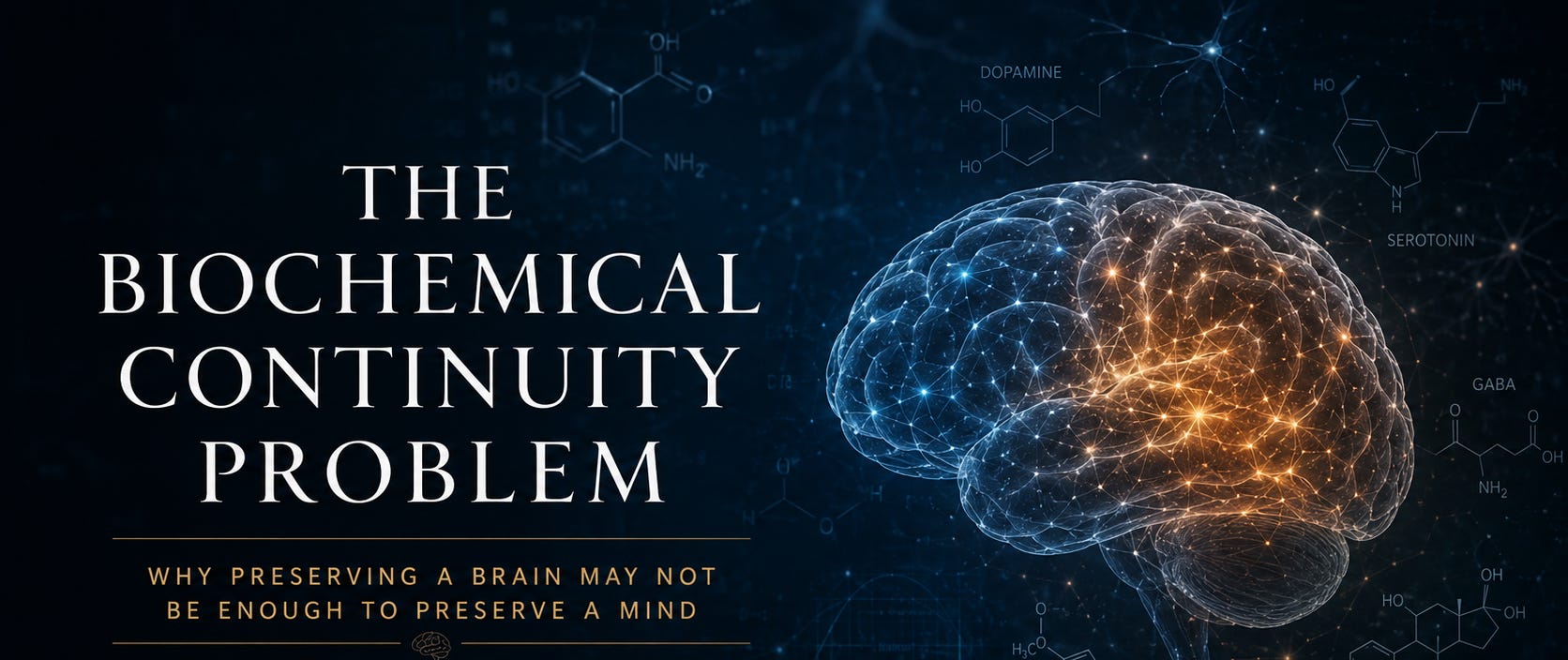
This article argues that preserving the structure of the brain may not be sufficient to preserve consciousness. While neural architecture, connectivity, and the connectome remain essential to memory, identity, and continuity, conscious experience may also depend upon the living biochemical ecology in which that architecture operates. Neurotransmitters, neuromodulators, hormones, immune signals, metabolic processes, and circadian rhythms continuously shape the conditions under which neural networks become active and experiential.
The central concept developed here is the Biochemical Continuity Problem: the possibility that consciousness requires not only structural continuity, but also biochemical and functional continuity. Evidence from anesthesia shows that awareness can disappear while neural structure remains intact. Evidence from psychiatry shows that subjective experience can change profoundly without major destruction of brain architecture. These observations suggest that the preservation of a mind may require more than preserving neurons, synapses, and informational patterns.
The article further proposes that consciousness may emerge from the interaction between brain and body. Hormonal, immune, metabolic, and circadian systems participate in the biological regulation that supports conscious states. Identity itself may therefore be shaped not only by preserved memories and networks, but also by the biochemical conditions through which those memories are experienced. Future efforts in brain preservation, whole-brain emulation, artificial intelligence, and theories of mind may need to confront this deeper question: what must be preserved in order to preserve experience?
The saved brain paradox
The idea that a preserved brain might preserve a person is deeply compelling: memories are encoded in networks, learning modifies connectivity, and identity seems tied to the continuity of neural organization. If the architecture survives, it is tempting to assume that the mind survives with it.
From this perspective, preservation appears almost intuitive: if every neuron remains, the person might remain; if every synapse is intact, memory may remain intact; and if the connectome persists, consciousness might persist as well. The logic is elegant, but it may also conceal a deeper uncertainty: whether preserving the arrangement of the brain is the same as preserving the conditions under which that arrangement becomes conscious.
Modern discussions surrounding brain preservation: connectomics, cryonics, and mind-uploading technologies often begin from a similar assumption; the essential information defining a person may reside within the organization of the nervous system that preserves the individual. The argument appears compelling; yet a fundamental question remains surprisingly difficult to answer: what exactly must be preserved?
Imagine a remarkable technological achievement: every neuron remains intact, every synapse survives, every connection is maintained, every network remains unchanged, and every memory appears preserved within the architecture of the brain; nothing has been lost structurally and the connectome survives in its entirety; would consciousness automatically continue? Would subjective experience necessarily persist? Would the preserved brain still possess awareness? Or would it merely contain the structural possibility of awareness? The distinction may be crucial.
Throughout the previous articles in this series, we explored the importance of continuity: Neurotenacity emphasized neuronal persistence, The Persistence Problem examined the continuity of identity, The Brain that Refuses Renewal proposed that preservation may protect accumulated information, The Isolated Organ suggested that neural architecture exists within carefully maintained conditions designed to preserve continuity; taken together, these ideas naturally lead toward an architectural view of mind.
The self appears inseparable from the organization of the nervous system. Yet architecture alone may not tell the entire story: a building can remain standing while becoming uninhabitable, a musical score can survive even when no orchestra performs it, and a library can preserve knowledge even when no one is reading its books; structure does not always guarantee activity, and organization does not always guarantee function.
The nervous system may present a similar challenge: neurons are not static objects; they are living cells immersed in an extraordinarily dynamic biochemical environment. Their activity depends on neurotransmitters, neuromodulators, ionic gradients, metabolic support, hormonal influences, immune signaling, and thousands of molecular interactions that unfold continuously throughout life. The brain is therefore not simply a network, it is an active biochemical ecosystem.
This observation becomes particularly intriguing when we consider states in which consciousness disappears while neural structure remains largely intact: sleep, anesthesia, coma, and certain pharmacological states. In each case, the architecture may survive, yet subjective experience may change profoundly or disappear entirely; the persistence of structure does not necessarily guarantee the persistence of awareness.
This possibility introduces a problem that may become increasingly important as neuroscience advances: preserving neural architecture may be necessary, but it may not be sufficient, because continuity may require more than structure: the mind may depend not only upon what the brain is, but upon what the brain is doing, and what the brain is doing may depend upon a delicate neurochemical environment that cannot be reduced to anatomy alone.
This idea leads to a question that has received surprisingly little attention: can consciousness survive the loss of its biochemical ecology? The answer remains unknown; yet the question may prove essential for understanding not only consciousness itself, but also the future of brain preservation, artificial intelligence, and the scientific pursuit of human continuity; for the greatest challenge may not be preserving the architecture of the brain, but preserving the conditions that allow that architecture to become a mind. Structure may carry the possibility of consciousness; it may not, by itself, guarantee its continuation.
Before examining this assumption more fully, it is useful to name it clearly. The architectural assumption is the view that the essential features of mind can be preserved by preserving the brain’s structural organization: its neurons, synapses, pathways, and informational relationships. This assumption does not deny the importance of activity or physiology, but it treats structure as the primary carrier of continuity.
The architectural assumption
The preceding articles of this series have progressively developed a common theme: across multiple perspectives, the importance of neural architecture repeatedly emerged as a central principle of continuity; neurons persist, networks endure, information accumulates, experience becomes embedded within organization, and identity appears inseparable from the structures that preserve memory and continuity across time.
This view has guided much of the present exploration. It has also become increasingly influential within contemporary neuroscience.
The idea is intuitively appealing: if experience modifies neural organization, then preserving that organization may preserve the information it contains; if memories are encoded within networks, then preserving networks may preserve memories; and if identity emerges from continuity, then preserving continuity may also preserve identity. The logic appears straightforward: the architecture survives, therefore the person survives.
Many of the concepts introduced throughout this series naturally point in this direction. The concept of Neurotenacity emphasized the remarkable persistence of neurons across the human lifespan. Unlike many other cells of the body, neurons often survive for decades; some may persist from early development until death.
Their longevity contributes to the preservation of accumulated information: experience leaves traces, learning modifies pathways, and memory becomes embedded within architecture. Neurotenacity therefore suggested that continuity depends, at least in part, upon the persistence of neural structures.
The Persistence Problem extended this idea further. Questions of personal identity were explored through the lens of continuity: could a person remain the same individual if neural components were gradually replaced? What aspects of organization must survive for identity to persist?
These discussions repeatedly converged upon a common principle: the self appears less dependent upon individual neurons than upon the continuity of their organization; and identity emerges as an architectural phenomenon, a product of preserved relationships rather than preserved materials.
Subsequent articles strengthened this perspective: The Brain that Refuses Renewal proposed that large-scale neuronal replacement may threaten accumulated informational organization; The Cost of New Neurons suggested that continuity itself may impose constraints upon regeneration; The Architecture of Forgetting argued that information may remain embedded within networks even when access becomes difficult; The Fragility of Continuity demonstrated how neurodegeneration progressively disrupts the architecture supporting memory and identity. Again and again, architecture appeared central; not because neurons themselves were inherently special, but because organization appeared essential.
The precedent article, The Isolated Organ, introduced another dimension of the same argument. The nervous system was shown to possess extraordinary mechanisms of protection: cerebrospinal fluid, the blood-brain barrier, neuroimmune regulation, and specialized communication systems. These mechanisms appeared to serve a common purpose: the preservation of neural architecture; protection preserved continuity, continuity preserved information, and information contributed to identity. Taken together, these ideas encourage what might be called the architectural assumption: the assumption that preserving neural structure is sufficient to preserve the essential properties of mind.
According to this view, the key to continuity lies in organization: protect the architecture, protect the person, preserve the connectome, and preserve the mind. The assumption is powerful; it is supported by substantial evidence.
Modern neuroscience repeatedly demonstrates that cognition depends upon organized networks rather than isolated cells: memories depend upon connectivity, learning depends upon structural modification, and behavior emerges from distributed organization. Few neuroscientists would deny the importance of architecture; yet an important question remains: have we assumed too much? More specifically: have we assumed that structure alone is sufficient? The distinction is subtle but critical.
There is little doubt that neural architecture is necessary: destroy the architecture and cognition disappear, disrupt the organization and continuity collapses; the evidence for this relationship is overwhelming. Necessity, however, is not the same as sufficiency: a condition may be required without being complete, a foundation may support a house without constituting the house itself, a map may describe a city without becoming the city; likewise, neural architecture may provide the framework within which consciousness emerges without fully explaining consciousness itself. The possibility deserves serious consideration.
Across neuroscience, examples repeatedly show that function can change dramatically while structure remains relatively stable: mood fluctuates, attention fluctuates, consciousness fluctuates, and awareness appears and disappears. Yet the underlying architecture often remains largely intact; something beyond anatomy appears to be involved, something dynamic, active, and continuously changing.
This observation does not invalidate the architectural perspective. On the contrary, it clarifies its limits. Architecture may be indispensable, but it is not necessarily the whole story. The persistence of neurons may preserve possibility, the preservation of networks may preserve information, and continuity may preserve identity. Yet consciousness may require an additional ingredient: a dimension of brain function not fully captured by structure alone.
The question therefore becomes unavoidable. If every neuron survives, if every synapse survives, and if every connection survives, would consciousness necessarily survive as well? Or have we mistaken the preservation of architecture for the preservation of experience?
The answer remains unknown. Yet the question opens a new frontier: perhaps the greatest challenge is not to understand the architecture of consciousness alone, but to understand the living processes that allow architecture to become experience. This leads directly to the next step of our investigation: have we assumed too quickly that structure alone is sufficient?
The brain as a chemical organ
The architectural view of the brain is compelling; neurons connect, networks emerge, information becomes organized, memories are embedded within patterns of connectivity, and experience leaves traces within structure. Much of modern neuroscience has been built upon these observations; yet there is a risk hidden within this perspective.
When we focus on architecture, we may begin to imagine the brain as a static object: a map, a network, a connectome, an arrangement of interconnected components. Such representations are useful, but they can also mislead. The brain is not merely an architecture; it is a living chemical system. Every thought, perception, memory, emotion, and conscious experience depends upon a continuous flow of biochemical activity.
The nervous system is not constructed from inert wires; it is composed of living cells whose function depends upon an extraordinarily dynamic molecular environment. At the synapse, information is transmitted through neurotransmitters: glutamate, GABA, dopamine, serotonin, acetylcholine, and norepinephrine, among others. These molecules form an intricate language through which neural networks exchange information. Without them, anatomical connectivity would remain silent; a synapse is therefore not merely a physical connection; it is a biochemical event.
The same principle extends beyond neurotransmission. Neural activity depends upon ionic gradients maintained across cellular membranes: Sodium, Potassium, Calcium, and Chloride. The precise distribution of these ions allows neurons to generate electrical signals. Every action potential depends upon their controlled movement and every synaptic event depends upon their regulation. The electrical activity of the brain is therefore inseparable from its chemistry. Indeed, what we commonly describe as electrical signaling is ultimately generated by chemical gradients.
The distinction between electricity and chemistry therefore becomes difficult to maintain. The two are deeply intertwined, and neuromodulators add another layer of complexity.
While neurotransmitters often transmit specific signals, neuromodulators influence the overall state of neural systems: they alter excitability, adjust responsiveness, modify patterns of communication, shape attention, influence motivation, and regulate mood. In doing so, they help determine how neural architecture functions at any given moment.
The same network may behave differently under different neurochemical conditions: the structure remains unchanged but the function changes. This observation carries profound implications: it suggests that connectivity alone cannot fully explain brain activity.
The meaning of a network depends upon the chemical context within which it operates. The architecture may remain stable, while the behavior emerging from that architecture varies dramatically. Metabolism introduces an equally important dimension: the human brain consumes enormous amounts of energy. Although it represents only a small fraction of total body mass, it requires a disproportionate share of the body’s resources: glucose metabolism, oxygen delivery, mitochondrial function, and cellular energy production continuously sustain neural activity. Without them, architecture survives only briefly: the network remains present, but the mind disappears.
The same principle applies to molecular signaling more broadly. Neurons constantly exchange information through cascades of proteins, receptors, second messengers, growth factors, and intracellular signaling pathways. These processes influence learning, memory consolidation, synaptic plasticity, cell survival, and network adaptation. The brain therefore functions through an immense biochemical dialogue occurring simultaneously across multiple scales of organization.
This realization challenges a common intuition. When we imagine preserving a brain, we often imagine preserving structure: the neurons, the synapses, the connections, and the architecture; yet structure alone may describe only part of the system.
A map of the brain may reveal where information is organized; it may not reveal how that information becomes active. A connectome may describe relationships; it may not fully capture the biochemical conditions that allow those relationships to function. The distinction is crucial: a preserved neural architecture may retain the possibility of cognition, but possibility is not necessarily activity, potential is not necessarily experience.
A musical instrument may remain intact for centuries; yet music exists only when the instrument is played. Likewise, the architecture of the brain may remain preserved while the biochemical processes required for consciousness cease.
The implications extend directly to the question introduced in the previous section: if consciousness depends upon neural organization, then architecture is indispensable. But if consciousness also depends upon neurochemical activity, architecture may not be enough. The brain, then, is not merely a structure, it is a process; and not merely a network, but a continuously active biochemical ecosystem.
This may be one of the most important lessons of modern neurobiology: neurons do not merely connect, they communicate chemically; and perhaps this is why any theory of consciousness that focuses exclusively on architecture risks overlooking a fundamental dimension of brain function. For a connectome without chemistry may resemble a score without musicians (the structure remains and the performance disappears), the connectome is silent without chemistry.
The neurochemical ecology
If the previous section established that the brain is a chemical organ, a deeper realization now emerges: the importance of neurochemistry does not reside merely in the existence of individual molecules; rather, it resides in the relationships among them.
The brain is not governed by a single neurotransmitter, a single signaling pathway, or a single biochemical process. It exists within a vast, continuously changing neurochemical environment: a living ecosystem of molecular interactions.
At every moment of life, billions of neurons operate within this biochemical landscape: neural activity influences chemistry, and chemistry influences neural activity; the relationship is reciprocal, dynamic, continuous, and extraordinarily complex.
This environment includes many of the molecules most familiar to neuroscience: Dopamine contributes to motivation, reward, salience, and learning; Serotonin influences mood, emotional regulation, social behavior, and cognitive flexibility; Acetylcholine participates in attention, memory formation, learning, and cortical activation; Norepinephrine shapes vigilance, arousal, stress responses, and adaptive behavior; Glutamate provides the principal excitatory signaling system of the brain; and GABA supplies the principal inhibitory balance necessary for network stability. Neuropeptides introduce additional layers of regulation affecting emotion, pain, attachment, feeding behavior, and social interaction. Each system performs important functions.
Yet none operates in isolation. The significance of dopamine cannot be understood independently of serotonin; the effects of serotonin depend upon glutamatergic and GABAergic balance; attention depends upon interactions among acetylcholine, norepinephrine, and cortical networks; and emotion emerges from multiple overlapping chemical systems. The brain functions not through isolated molecules but through biochemical relationships.
This observation invites a shift in perspective: perhaps neurotransmitters should not be viewed as isolated actors, but as components of a larger ecological system: one in which stability depends upon balance, every element influences the behavior of others, and the overall organization may be as important as the individual parts.
Biology provides many examples of such systems. A forest is not merely a collection of trees; the trees matter, but so do the soil, the microorganisms, the climate, the water cycle, the insects, and the countless interactions connecting them. Remove enough relationships and the forest changes fundamentally, even if many individual trees remain standing.
The same principle may apply to the brain. A brain is more than neurons; it is more than synapses; and it is more than connectivity. It exists within an intricate molecular environment whose organization continuously shapes neural activity. Neurons do not simply exchange information, they do so under specific neurochemical conditions; and those conditions influence what information is processed, how it is interpreted, and how it contributes to experience.
The implications become particularly important when considering consciousness. Most discussions of consciousness focus upon structure: neural networks, connectivity, information processing, and patterns of activity. These factors are undoubtedly important; yet conscious experience is never observed in the absence of neurochemical regulation.
Every known conscious state exists within a particular biochemical context: wakefulness, attention, emotion, motivation, and even the stability of perception depend upon carefully regulated neurochemical interactions. Architecture remains important, but architecture alone may not explain the phenomenon: a preserved connectome may describe the arrangement of the system; it may not capture the biochemical conditions under which the system becomes conscious.
This possibility introduces a new way of thinking about continuity. Previous articles emphasized structural continuity: the persistence of neurons, networks, and informational architecture. Those forms of continuity remain essential. Yet another form may also exist: biochemical continuity; the continuity of molecular relationships, neurochemical balance, and dynamic regulation.
If consciousness depends upon such conditions, preserving neural structure alone may prove insufficient. One could preserve every neuron while losing the biochemical environment that allows those neurons to function collectively as a conscious system. The distinction is subtle but profound: the architecture may survive; the ecosystem may not. And if the ecosystem disappears, what becomes of consciousness?
At present, neuroscience cannot answer this question with certainty. Yet the question itself may be among the most important raised by contemporary research into consciousness, brain preservation, and identity; for the brain appears increasingly unlike a machine and increasingly like an ecosystem, a system whose properties emerge not merely from its components but from the interactions among those components; a system whose continuity may depend upon both structure and chemistry; and a system whose conscious states arise from a constantly changing yet remarkably stable molecular environment.
This realization leads naturally to the central concept of the present article: consciousness may not emerge from architecture alone. It may emerge from a neurochemical ecology whose complexity rivals that of any natural system found elsewhere in biology: a forest is more than trees; a brain is more than neurons; and consciousness may emerge from an ecosystem rather than a structure alone.
The biochemical continuity problem
The previous sections have led toward a question that may become increasingly important as neuroscience advances. If neural architecture can be preserved, does consciousness necessarily survive?
At first glance, the answer might appear obvious. Much of modern neuroscience emphasizes the importance of structure: neurons, synapses, networks, and connectivity. Information appears to reside within organized architecture: memories depend upon patterns of connections, learning modifies those patterns, and experience becomes embedded within them.
From this perspective, continuity seems fundamentally architectural: preserving the architecture, the information, and the person. Yet the emergence of neurochemical perspectives complicates this assumption. For if consciousness depends not only upon organization but also upon ongoing biochemical activity, a new possibility appears: architecture may survive while consciousness does not.
This possibility introduces what may be called the Biochemical Continuity Problem. The problem can be stated simply: can consciousness survive if architecture remains but chemistry changes fundamentally?
The question appears deceptively straightforward; its implications are profound. To understand the problem, it is useful to distinguish between two forms of continuity.
The first is structural continuity. Structural continuity refers to the persistence of neurons, synapses, pathways, and network organization across time. It is the form of continuity emphasized throughout much of this series: Neurotenacity explored the persistence of neurons, The Persistence Problem examined the continuity of identity through preserved organization, The Isolated Organ described mechanisms that protect neural architecture from disruption; in each case, continuity referred primarily to the survival of structure.
The second form may be called biochemical continuity. It refers to the persistence of the molecular environment within which neural activity occurs: neurotransmitter dynamics, neuromodulatory balance, metabolic regulation, hormonal influences, immune signaling, ionic gradients, and countless molecular interactions that collectively shape brain function. Unlike architecture, this environment is not static; it fluctuates, adapts, reorganizes, and responds to internal and external conditions. Yet despite this dynamism, certain forms of biochemical stability appear necessary for normal cognition.
The distinction between these two forms of continuity is crucial. A preserved connectome could, in principle, maintain structural continuity: the neurons remain, the pathways remain, and the information remains encoded within organization. But would biochemical continuity necessarily survive as well? The answer is far from obvious.
Consider a simple analogy. Imagine a perfectly preserved orchestra: every musician present, every instrument intact, every note of the score preserved; nothing has been lost structurally. Yet the music itself depends upon performance: timing, coordination, interaction, and dynamic relationships among participants. The orchestra may survive physically while the music disappears. The analogy is imperfect, but it captures an important distinction: structure and activity are related, not identical.
The same issue may arise within the nervous system. A connectome describes organization; it does not necessarily describe the biochemical state through which that organization becomes active. Two brains could possess highly similar architectures while existing within different neurochemical conditions. Their experiences might differ profoundly, their perceptions, emotional states, levels of awareness might differ: the structure remains, but the function changes.
Clinical neuroscience provides numerous examples of this phenomenon: mood, attention, motivation, and wakefulness can fluctuate dramatically without major alterations in gross neural architecture. Consciousness can disappear during anesthesia despite the preservation of neuronal structure; the architecture often remains largely intact, while subjective experience changes profoundly.
These observations do not prove that biochemical continuity is necessary for consciousness, but they strongly suggest that architecture alone may not fully explain conscious experience. The possibility becomes particularly important when considering future technologies: brain preservation, cryonics, whole-brain emulation, connectomic reconstruction, and mind uploading. Most such proposals focus primarily upon structural preservation.
The underlying assumption is understandable. If information resides within architecture, architecture becomes the obvious target. Yet the Biochemical Continuity Problem suggests a potential limitation. What if preserving the connectome preserves only the possibility of consciousness? What if conscious experience requires additional forms of continuity that cannot be fully captured by structure alone? What if the molecular environment is part of the phenomenon being preserved? The question remains open.
At present, neuroscience lacks sufficient evidence to answer it definitively. Yet the problem itself deserves attention; for it challenges one of the most influential assumptions in contemporary discussions of mind and identity: the assumption that architecture alone is enough. It may be enough; every relevant aspect of consciousness may ultimately be reducible to organization. But it may not. Continuity may exist at multiple levels simultaneously: architectural continuity, biochemical continuity, and functional continuity. Consciousness may emerge only when these forms of continuity coexist.
This possibility does not diminish the importance of structure; architecture remains indispensable. Without it, information cannot persist; without it, memory cannot survive; and without it, identity becomes difficult to imagine. Yet architecture may represent only part of a larger system: a preserved connectome may preserve the framework. The question is whether it preserves the performance, the experience, and the mind itself.
This uncertainty lies at the center of the Biochemical Continuity Problem; a problem that may become increasingly important as neuroscience moves from understanding the brain toward attempting to preserve it; for a preserved connectome may not guarantee a preserved mind.
Lessons from anesthesia
Few phenomena illustrate the distinction between neural structure and conscious experience more clearly than anesthesia. Every day, millions of patients undergo procedures requiring temporary abolition of consciousness.
Anesthesia provides a clinically familiar example of dissociation between preserved neural structure and altered conscious state. During general anesthesia, awareness and subjective experience can be reversibly abolished while neurons, synapses, and large-scale anatomical organization remain largely intact. Recovery of consciousness demonstrates that structural continuity has been maintained, but the temporary loss of experience indicates that structure alone does not specify the conscious state.
When the patient awakens, memories from before the procedure are often preserved: language returns, identity returns, and personality returns; the individual generally re-emerges as the same person who entered the operating room. The continuity of architecture appears largely preserved; and yet consciousness was absent.
This observation introduces an important distinction. The presence of neural structure does not automatically imply the presence of conscious experience; something else appears necessary: something dynamic, something functional, and something capable of being interrupted without destroying the underlying architecture.
Modern anesthesiology provides valuable clues regarding this phenomenon. Different anesthetic agents act through distinct molecular mechanisms; some enhance inhibitory neurotransmission through GABAergic pathways, others alter glutamatergic signaling. Still others influence thalamocortical communication, neuromodulatory systems, or large-scale network integration.
Despite their differences, these agents share a common outcome: they profoundly alter the biochemical conditions under which neural activity occurs. The result is not widespread neuronal destruction; the result is a reversible alteration of brain function: while the architecture remains, the experience disappears.
If consciousness depended exclusively upon neural structure, anesthesia would be difficult to explain: the connectome, the pathways, and the information remains present; yet awareness is lost. The same neural architecture can support consciousness in one biochemical state and fail to support it in another. Of course, architecture still matters; anesthesia does not occur in the absence of neural organization: the preserved networks provide the substrate through which consciousness can later return. Without structural continuity, recovery would be impossible.
The observations therefore do not invalidate architectural theories of mind. Instead, they reveal their incompleteness: architecture appears necessary, but anesthesia suggests that architecture may not be sufficient. The distinction becomes clearer when we consider what anesthesia actually accomplishes.
The drugs do not erase memories; they do not eliminate neurons, and they do not dismantle cortical organization; rather, they alter the functional conditions under which neural systems operate. The orchestra remains assembled; the instruments remain present; and the score remains available; yet the performance stops. When the biochemical conditions are restored, the performance resumes. The analogy is imperfect but informative: the architecture preserves the possibility of consciousness; the neurochemical state determines whether that possibility becomes reality. This observation resonates directly with the Biochemical Continuity Problem.
Imagine a perfectly preserved brain: every neuron survives, every synapse survives, and every connection survives; would consciousness necessarily survive as well? Anesthesia suggests caution, for clinical experience repeatedly demonstrates that awareness can disappear without significant structural disruption.
The lesson is not that architecture is unimportant; the lesson is that architecture alone may not explain conscious experience. There appears to be a difference between preserving the substrate and preserving the state, a difference between preserving the instrument and preserving the music. Anesthesia therefore provides one of the strongest clinical arguments for distinguishing structural continuity from functional continuity: the brain remains, and the mind temporarily vanishes; and when the mind returns, it does so because the architecture survived the interruption. Yet the interruption itself reveals something profound: consciousness can be suspended without destroying the structures traditionally associated with identity.
This possibility has major implications for neuroscience, for theories of consciousness, for brain preservation, and for future technologies aimed at maintaining or reproducing human experience. If consciousness can disappear while architecture survives, then preserving architecture alone may not be enough. The challenge may involve preserving the conditions under which architecture becomes conscious. Anesthesia does not solve this mystery; it exposes it.
Lessons from psychiatry
Psychiatry offers another perspective on the relationship between neural structure and conscious experience.
Where anesthesia temporarily abolishes awareness, psychiatric disorders often transform it: the individual remains conscious, the architecture of the brain remains largely intact; yet the experience of reality can change dramatically. This observation may be one of the most important clues concerning the role of neurochemistry in consciousness; for psychiatry repeatedly demonstrates that relatively subtle biological alterations can profoundly influence subjective experience: the brain remains, the person remains, and the neurons remain; yet the world may no longer appear the same.
Consider major depressive disorder. Patients frequently describe a profound alteration in the texture of experience itself: pleasure diminishes, motivation declines, hope becomes difficult to sustain, time may appear slowed, and the future may seem inaccessible. Importantly, these changes do not result from large-scale destruction of neural architecture; the individual’s memories often remain, language also remains.
The fundamental organization of the nervous system remains largely preserved. Yet conscious experience becomes profoundly altered; the same world is perceived differently; the same self is experienced differently; and the same architecture produces a different phenomenology.
Bipolar disorder provides another striking example. During depressive phases, experience may become constricted and burdened; during manic phases, it may become expansive, accelerated, and intensely energized: thoughts race, confidence increases, sleep becomes less necessary, and ideas appear abundant. The subjective world changes dramatically; yet the individual remains biologically recognizable as the same person. The architecture persists, but the experiential state shifts. Psychotic disorders reveal an even more profound transformation: hallucinations, delusions, altered salience, and disturbances in self-monitoring.
These experiences challenge conventional distinctions between internal and external reality. Again, the remarkable observation is not the destruction of the nervous system, but the emergence of radically altered conscious experience from brains whose overall architecture remains substantially preserved. The individual continues to think, perceive, and interpret, but the interpretation itself changes. Anxiety disorders provide a further illustration: threat perception becomes amplified, attention becomes biased toward danger, physiological arousal intensifies, and ordinary situations may acquire extraordinary emotional significance. The environment remains unchanged, and the architecture remains largely unchanged. Yet the subjective meaning of experience shifts dramatically.
Across these diverse conditions, a common principle emerges: conscious experience appears extraordinarily sensitive to neurochemical regulation; small alterations in neurotransmitter systems, changes in neuromodulatory balance, variations in network excitability, and disturbances in signaling pathways can all influence mood, perception, motivation, attention, and self-awareness.
These factors can influence mood, perception, motivation, attention, and self-awareness. The resulting changes may be profound despite the absence of major structural disruption. This observation carries important implications for the present discussion: if architecture alone determined conscious experience, such dramatic variations would be difficult to explain.
The persistence of neural structure should produce relative experiential stability; yet clinical reality suggests otherwise. The same architecture can support multiple experiential worlds: different emotional landscapes, different perceptual realities, and different modes of selfhood. Psychiatry therefore highlights a crucial distinction.
The architecture of the brain provides the framework within which experience occurs. The neurochemical state helps determine how that framework is experienced: the structure persists, and the subjective world changes; of course, caution is necessary.
Modern psychiatry no longer supports simplistic notions that complex disorders can be reduced to single neurotransmitter abnormalities. Depression is not merely a deficiency of serotonin, psychosis is not merely an excess of dopamine, anxiety is not merely a chemical imbalance; these conditions emerge from interactions among genetics, development, environment, networks, neurochemistry, and lived experience. Nevertheless, neurochemical influences remain undeniable.
The clinical effectiveness of many psychopharmacological interventions demonstrates that alterations in molecular signaling can modify subjective experience in meaningful ways. This fact is difficult to ignore; for the purposes of the Biochemical Continuity Problem, the lesson is straightforward. Psychiatric disorders reveal that profound changes in conscious experience can occur without profound destruction of neural architecture; the framework remains, the experience changes, the connectome survives, and the phenomenology shifts.
This observation does not prove that consciousness is fundamentally neurochemical, but it strongly suggests that neurochemistry participates in shaping the character of conscious experience; architecture may preserve the possibility of mind; but neurochemical states may help determine the form that mind takes.
Psychiatry therefore offers an important complement to the lessons of anesthesia. Anesthesia demonstrates that consciousness can disappear while structure remains; psychiatry demonstrates that consciousness can change dramatically while structure remains. Together, these observations challenge the assumption that architecture alone is sufficient. They suggest that the living chemistry of the brain may be inseparable from the experience it produces: the architecture remains, while the experience changes.
The body as a chemical partner
The preceding sections suggest that consciousness depends on more than neural architecture alone. Neurons, networks, and connectivity remain indispensable, but neurochemical regulation appears equally central. Anesthesia can abolish consciousness without destroying structure; psychiatric disorders can transform subjective experience while leaving much of the underlying architecture intact. These observations point toward a dynamic biochemical environment. The next question is where that environment begins and ends.
The answer leads us back to a theme developed in The Isolated Organ. The nervous system is often portrayed as an independent center of control: the command structure of the organism, the organ that governs all others. This image contains an important truth, but it can also mislead. The brain never functions in isolation.
Even the most protected organ in the body remains deeply dependent upon the body it governs, the brain is continuously shaped by signals originating beyond itself. The nervous system does not simply create consciousness; it participates in a biological dialogue extending throughout the entire organism.
One of the most important participants in this dialogue is the endocrine system. Hormones continuously communicate information about stress, nutrition, reproduction, energy availability, growth, and metabolic status. These signals reach the brain and influence cognition, emotion, motivation, and behavior. The conscious mind therefore exists within a hormonal landscape that is constantly changing: cortisol can alter attention and memory, thyroid hormones can influence mood and cognition, sex hormones can affect emotion, motivation, and social behavior. The architecture of the brain may remain largely unchanged, yet the subjective experience generated by that architecture can shift significantly.
For many years, the immune system and the nervous system were viewed as largely independent. Modern neuroimmunology has challenged this view. The brain continuously receives information concerning inflammation, infection, tissue injury, and immune activity. Cytokines influence neural function, altering motivation, energy levels, mood, sleep, and social behavior.
Anyone who has experienced illness has felt these effects: fatigue, cognitive slowing, emotional changes, and the desire for social withdrawal. These experiences do not arise from disease alone; they arise from communication between the immune system and the brain.
Conscious states are therefore influenced by signals originating outside the nervous system. Metabolic regulation introduces another dimension. The brain consumes enormous amounts of energy, and normal function requires continuous information about nutritional status and energy availability: glucose levels, insulin signaling, leptin, ghrelin, and countless metabolic messengers participate in this process.
The conscious experience of the world is therefore shaped by physiological conditions throughout the body. The same brain may think differently depending on the metabolic environment in which it operates. Circadian rhythms offer one of the clearest examples. Wakefulness and sleep are not merely decisions; they emerge from interactions among neural circuits, hormonal systems, and molecular clocks distributed throughout the organism. As melatonin, cortisol, body temperature, and metabolic processes shift, consciousness changes as well: alertness rises and falls, attention fluctuates, memory performance varies, and subjective experience is transformed by rhythms extending far beyond the nervous system alone.
These observations suggest a profound conclusion. The neurochemical ecology of consciousness extends beyond the brain. The biochemical environment supporting conscious experience is not produced exclusively within neural tissue. It emerges from interactions among multiple physiological systems. The endocrine system contributes. The immune system contributes. The metabolic system contributes. Circadian biology contributes. The body continuously participates in the conditions that make conscious experience possible.
This realization complicates traditional views of consciousness. If awareness depends partly upon neurochemical conditions, and if those conditions depend partly upon bodily signals, then consciousness may not be entirely generated within the brain itself. The brain remains indispensable. Without neural architecture there is no consciousness. Without neural networks there is no experience. Yet the architecture functions within a larger biological context. The nervous system remains embedded within an organism whose signals continuously shape its activity.
This perspective resonates strongly with the ideas developed in The Isolated Organ. The nervous system is protected, filtered, and partially separated; yet separation is not independence. The brain receives constant reports from the body: hormonal, immune, metabolic, and circadian.
The isolated organ never ceases listening to the organism surrounding it. Indeed, its isolation may make such communication even more important. The brain depends upon these signals to construct an accurate representation of physiological reality. Without them, regulation becomes impossible, adaptation becomes impossible, and perhaps consciousness itself becomes altered. The implications are significant.
Future efforts to preserve or reproduce consciousness may face a challenge greater than preserving neurons; they may need to preserve the biological dialogue between brain and body: a preserved connectome may not be enough, a preserved neurochemical ecology may also be required; and that ecology extends far beyond the boundaries of the nervous system.
The brain never functions alone; it functions as part of an organism, participating in a continuous exchange of information, chemistry, and regulation. Perhaps this is one of the deepest lessons of modern neuroscience: the mind may emerge from the brain, but the conditions that sustain the mind arise throughout the body. Consciousness may therefore be less solitary than we imagine, less confined to neural tissue, and less isolated than the organ that generates it. The brain may be the principal author of experience, but it may not be the only one.
The ecology of the self
The previous sections have explored the possibility that consciousness depends upon a complex neurochemical environment: neurotransmitters shape cognition, hormones influence behavior, immune signals affect mood, metabolic and circadian processes contribute to mental states. Together, these observations suggest that conscious experience emerges within a dynamic biological ecology. A deeper question now follows: if chemistry influences consciousness, does it also influence identity?
The question is not merely scientific; it touches one of the oldest problems in philosophy and neuroscience: what makes a person who they are?
Throughout this series, identity has often been examined through the lens of continuity. Neurotenacity emphasized the persistence of neurons, The Persistence Problem explored the continuity of organization, The Fragility of Continuity examined what occurs when neural architecture deteriorates; a common theme emerged. The self appeared deeply linked to preserved structure: memories accumulate, experiences become embedded within networks, architecture carries history, and identity therefore seemed largely architectural. Yet architecture alone may not explain the lived experience of being oneself.
Human identity is not merely a collection of memories. It is also a perspective: a way of experiencing reality, interpreting the world, and inhabiting a characteristic emotional landscape through which experience acquires meaning. These dimensions appear highly sensitive to neurochemical state.
Consider mood. Mood is often treated as a transient feature of mental life; yet its influence reaches remarkably deep. A positive emotional state may facilitate memory retrieval, increase cognitive flexibility, and promote optimistic interpretations of experience: a depressive state may produce the opposite effects.
The same individual may remember different aspects of the past, notice different features of the present, and imagine different possibilities for the future. The world itself appears transformed. Importantly, the architecture of the brain has not fundamentally changed: the memories remain, and the networks remain. Yet the meaning of those memories and networks may change dramatically: the self experiences itself differently.
Perception provides another example. Human beings do not merely record reality; they interpret it. The significance of events depends partly upon emotional and motivational systems. Neurochemical states influence attention, salience, threat detection, reward processing, and social interpretation. As these processes change, the subjective world changes with them.
The same environment may appear inviting or threatening, hopeful or hopeless, meaningful or empty. Again, architecture remains largely stable while experience becomes profoundly different. Decision-making reveals a similar pattern. Choices emerge not only from information but from valuation: what matters, what feels important, what appears desirable, and what appears dangerous.
These judgments depend heavily upon neurochemical systems regulating motivation, reward, and emotional significance. A person experiencing severe depression may make decisions that seem incomprehensible to their former self. A manic individual may pursue goals that later appear irrational. The architecture remains, but priorities change; the self appears altered. Perhaps most intriguing is the influence of neurochemistry upon self-awareness itself. Human beings continuously construct narratives about who they are.
These narratives integrate memory, emotion, goals, and social experience. Yet the tone and content of these narratives often shift with neurochemical state: a depressed person may experience overwhelming self-criticism; an anxious person may experience persistent self-monitoring; or a manic person may experience exaggerated confidence and grandiosity: the autobiographical narrative changes, the emotional context changes, and the subjective experience of identity changes.
These observations suggest a provocative possibility: identity may not be embedded exclusively within neural architecture; it may also be embedded within the neurochemical conditions that shape how that architecture functions. This does not imply that identity is merely chemical. Such a conclusion would be simplistic: the self cannot be reduced to serotonin, nor to dopamine, nor to any single molecular pathway; identity emerges from interactions among memory, experience, biology, culture, relationships, and personal history.
Yet chemistry appears to participate in this process. It influences how memories are experienced, how events are interpreted, how values are assigned, and how narratives are constructed. The self may therefore exist at the intersection of structure and state. Architecture provides continuity, while chemistry provides modulation; architecture preserves history, while chemistry shapes the lived experience of that history.
From this perspective, identity becomes more complex than previously imagined. The self is not merely a preserved network, nor merely a biochemical condition; it is the product of their interaction: a continuously evolving relationship between structure and physiology, between memory and mood, and between organization and regulation.
This possibility carries important implications for the Biochemical Continuity Problem. If consciousness depends partly upon neurochemical continuity, identity may depend upon it as well.
Future efforts to preserve a mind may therefore confront a challenge extending beyond architecture: preserving memories may not be enough, and preserving networks may also not be enough. One may also need to preserve the biological conditions that allow those memories and networks to be experienced as part of a coherent self.
The question remains open. How much of the self depends upon neurochemical state? Neuroscience cannot yet provide a definitive answer. Yet the evidence suggests that the answer may be greater than traditionally assumed; for identity may be chemically embedded as well as architecturally embedded.
Immortality and the chemical challenge
Few questions have fascinated humanity more than the possibility of overcoming biological death. Across history, myths, religions, philosophies, and scientific movements have explored the hope of preserving the self beyond the limits of ordinary lifespan. In recent decades, advances in neuroscience have brought these ancient aspirations into scientific discussion: brain preservation, cryonics, whole-brain emulation, connectomics, and mind uploading.
Each proposes, in one form or another, that the essential features of a person might be preserved. The underlying logic is often architectural. If memories are encoded within neural networks, preserving those networks may preserve memory. If identity emerges from neural organization, preserving that organization may preserve identity. If consciousness depends upon information processing, preserving the informational structure may preserve the possibility of conscious experience.
The argument is powerful. It has become increasingly influential within discussions of technological immortality. Yet the Biochemical Continuity Problem introduces a profound complication. What if architecture is not enough? What if preserving the structure of the brain preserves only part of the system responsible for conscious experience? The possibility cannot be dismissed lightly.
Throughout this article, evidence from neurochemistry, anesthesia, psychiatry, and systems neuroscience has repeatedly pointed toward the same conclusion. The brain functions within a complex biochemical ecology. Conscious experience emerges within that ecology. Identity may be influenced by that ecology. The self may depend upon it more deeply than traditionally assumed. If this is correct, future preservation technologies may confront a challenge far greater than preserving neural structure.
Consider the goals of many proposed preservation strategies: the neurons must survive, the synapses must survive, the connectome must survive, and the informational architecture must survive; these objectives are already extraordinarily difficult; yet they may represent only the beginning of the problem.
Consciousness unfolds within a dynamic biochemical environment: neurotransmitters fluctuate continuously, neuromodulatory systems interact constantly, hormonal signals influence cognition, immune signals influence behavior, metabolic conditions shape neural function, and circadian rhythms alter conscious states across every day of life. The brain is not simply an object; it is a process, a continuously evolving biological state.
This realization raises an uncomfortable possibility; a preserved connectome may resemble a preserved score: the notes remain, the relationships remain, and the organization survives. Yet the performance itself may depend upon conditions that are far more difficult to preserve: can a preserved brain retain its neurochemical dynamics? Can it retain its hormonal interactions? Can it retain its metabolic ecology? Can it retain the countless molecular processes that continuously influence neural function?
At present, neuroscience cannot answer these questions with confidence. Indeed, we do not yet know which aspects of neurochemistry are essential for consciousness and which are merely supportive. The uncertainty itself is revealing. It suggests that the preservation problem may be deeper than originally imagined.
The challenge may therefore be not merely to preserve neural architecture, but to preserve neural ecology. The implications become even more significant when considering whole-brain emulation.
Suppose future technology succeeds in mapping every neuron, every synapse, every connection, and every structural detail of a human brain; would this information be sufficient to reproduce consciousness? Or would essential aspects of conscious experience depend upon molecular states not captured within the connectome?
The question remains unresolved. Yet it illustrates the importance of distinguishing between informational structure and biological state.
The same concern applies to cryonic preservation. A preserved brain may retain structural information, but does preservation also retain the dynamic biochemical relationships through which conscious experience once emerged? If not, what exactly has been preserved? A person? A blueprint of a person? Or merely the possibility of reconstructing a person?
The distinction may prove decisive. Perhaps the future of immortality research will depend less upon preserving anatomy than upon preserving continuity. And continuity itself may exist at multiple levels: architectural continuity, functional continuity, and biochemical continuity.
The loss of any one of these may alter the outcome profoundly. This perspective does not invalidate the importance of structure. On the contrary, architecture remains indispensable. Without neurons, there is no network; without networks, there is no information; and without information, there is no continuity. Yet architecture alone may not be sufficient.
The living brain appears inseparable from the biochemical environment that sustains it. The future challenge may therefore be greater than preserving a connectome. It may require preserving an entire biological ecosystem: a dynamic ecology whose interactions continuously generate the conditions necessary for conscious experience.
Whether such preservation is ultimately possible remains unknown, but the question itself may become one of the most important in future neuroscience; for every proposal concerning immortality must eventually confront a fundamental uncertainty: can a brain survive without the chemistry that once sustained it? The answer may determine not only the future of brain preservation, but also the future of our understanding of consciousness itself.
The future of the biochemical continuity problem
The Biochemical Continuity Problem does not close a debate. It opens one.
Throughout this article, we have explored the possibility that consciousness depends not only upon neural architecture, but also upon the biochemical ecology within which that architecture functions. This possibility remains speculative, yet it may become increasingly important as neuroscience approaches questions once considered impossible: Can consciousness be preserved? Can a mind be reconstructed? Can identity survive biological interruption? Can experience continue beyond the failure of the body that once sustained it?
These questions cannot be answered by connectomics alone, nor by neurochemistry alone, nor by philosophy alone. They require a new dialogue among multiple fields.
Consciousness studies must ask whether subjective experience depends primarily on structure, activity, integration, biochemical state, or some combination of these. Connectomics must ask whether mapping neural connections is sufficient to describe the living conditions of mind. Neuroendocrinology must examine how hormones shape attention, emotion, memory, motivation, and selfhood. Neuroimmunology must investigate how cytokines, inflammation, microglia, and immune-brain communication influence conscious states. Metabolic neuroscience must clarify how energy availability, mitochondrial function, glucose regulation, and circadian rhythms contribute to awareness.
Artificial intelligence must confront a parallel question: Can intelligence persist without an internal ecology of regulation?
Modern AI systems can store information, process patterns, and learn from experience. Yet biological consciousness may depend on more than information processing alone; it may require dynamic regulation, state dependence, self-maintenance, embodied feedback, and a living architecture. This does not mean that artificial consciousness is impossible; it means that the biological model may be deeper than a static network.
Whole-brain preservation faces the same challenge. If the future can preserve every neuron and every synapse, the question will still remain: What has actually been preserved? A structure? A memory map? A biological archive? A possible mind? Or a conscious subject? The difference matters.
A preserved connectome may contain the history of a person, but consciousness may require the reactivation of that history under the right biochemical conditions; this is the central uncertainty. The future of this problem may therefore require distinguishing several levels of preservation: structural preservation, functional preservation, biochemical preservation, embodied preservation, and experiential preservation. Each level may be necessary. None may be sufficient alone. Perhaps the future of neuroscience will discover that structure contains the information, but chemistry determines whether that information can become lived experience. Perhaps it will reveal that consciousness is not located in a single molecule, pathway, or network, but emerges from the orchestration of all of them.
This is why the Biochemical Continuity Problem matters; it forces neuroscience to move beyond the question: Can the brain be preserved? Toward a more difficult question: What must be preserved to preserve experience?
The orchestra beyond the score
We began this article with a deceptively simple question: if a brain could be perfectly preserved, would a mind necessarily survive? At first glance, the answer seemed straightforward.
Modern neuroscience has repeatedly demonstrated the importance of neural architecture. Memories become embedded within networks, experience modifies connectivity, and identity appears linked to continuity. The connectome emerged as a candidate substrate for the persistence of the self. The logic appeared compelling: preserving the structure, the information, and the person. Yet as our exploration unfolded, the question became more complex.
The brain is not merely an arrangement of neurons, a network of connections, or an archive of information. It is a living biological system immersed within a continuously evolving biochemical environment: neurotransmitters shape communication, neuromodulators alter cognitive states, hormones influence emotion and behavior, immune signals affect motivation and mood, metabolic processes sustain neural activity, and circadian rhythms reorganize the conditions under which consciousness unfolds. Architecture remains indispensable, but architecture alone may not tell the entire story.
The lessons of anesthesia revealed that consciousness can disappear while neural structure survives. The lessons of psychiatry demonstrated that subjective experience can change profoundly while architecture remains largely intact. The body itself emerged as an active participant in the neurochemical conditions supporting awareness. Again and again, the same conclusion appeared: structure matters; yet structure may not be enough.
This realization led to the central concept introduced in this article: the Biochemical Continuity Problem. The problem is not whether neural architecture matters; it unquestionably does. The problem is whether preserving architecture alone is sufficient to preserve consciousness. At present, neuroscience cannot answer this question with certainty. Perhaps future discoveries will show that every aspect of conscious experience can ultimately be reduced to structural organization; and perhaps the connectome contains everything that matters. But perhaps it does not; perhaps consciousness depends upon forms of continuity extending beyond architecture. Perhaps biochemical continuity is one of them.
If this possibility proves correct, the implications are profound. Future efforts to preserve brains may need to preserve more than neurons, more than synapses, and more than networks. They may need to preserve the dynamic biochemical ecology through which those structures become active, adaptive, and conscious.
The challenge would therefore extend beyond anatomy, connectivity, and information. It would become the preservation of a living process: a continuously evolving biological performance.
Throughout this series, we have explored multiple dimensions of continuity. Neurotenacity examined the persistence of neurons, The Persistence Problem explored the continuity of identity, The Isolated Organ investigated the protection of neural architecture, and the present article adds another layer to that framework: the continuity of chemistry, the continuity of regulation, the continuity of biological states that may contribute to experience itself.
Taken together, these ideas suggest a broader principle: the mind may not emerge from structure alone, but from the interaction between structure and process, architecture and activity, organization and ecology. The brain may therefore resemble less a machine than a living ecosystem whose components continuously interact to generate perception, memory, identity, and consciousness.
This perspective does not diminish the importance of neural architecture; it enriches it. The connectome remains essential, but the connectome may represent only part of the story. A score is indispensable to a symphony; yet a score alone does not produce music, musicians must perform it, timing must animate it, and interaction must sustain it.
The same may be true of the brain: the architecture may preserve possibility, and the biochemical ecology may transform that possibility into experience. And this returns us to our original question: if a brain survives, does consciousness survive?
The answer remains unknown. Yet the question itself may reveal one of the deepest challenges facing future neuroscience: perhaps the greatest obstacle is not preserving neural structure, but preserving the conditions that allow neural structure to become a conscious mind.
The brain is not merely a structure. It is a living biochemical ecology. Perhaps the greatest challenge is therefore not preserving the brain itself, but preserving the invisible chemical symphony that allows the brain to become a mind.
References
Neurochemistry and Brain Function
· Brady, Scott, and Monica J. Carson, eds. Basic Neurochemistry: Principles of Molecular, Cellular, and Medical Neurobiology. 9th ed. Academic Press, 2027.
· Kandel, Eric R., John D. Koester, Sarah H. Mack, and Steven A. Siegelbaum, eds. Principles of Neural Science. 6th ed. McGraw Hill, 2021.
Consciousness Studies
· Chalmers, David J. The Conscious Mind: In Search of a Fundamental Theory. Oxford University Press, 1996.
· Dennett, Daniel C. Consciousness Explained. Little, Brown and Company, 1991.
· Damasio, Antonio. The Feeling of What Happens: Body and Emotion in the Making of Consciousness. Harcourt Brace, 1999.
· Damasio, Antonio. Self Comes to Mind: Constructing the Conscious Brain. Pantheon Books, 2010.
Psychiatry and Brain States
· Sadock, Benjamin J., Virginia A. Sadock, and Pedro Ruiz, eds. Kaplan & Sadock’s Comprehensive Textbook of Psychiatry. 10th ed. Wolters Kluwer, 2017.
· LeDoux, Joseph. The Emotional Brain: The Mysterious Underpinnings of Emotional Life. Simon & Schuster, 1996.
· Damasio, Antonio. Descartes’ Error: Emotion, Reason, and the Human Brain. G. P. Putnam’s Sons, 1994.
Connectomics
· Seung, Sebastian. Connectome: How the Brain’s Wiring Makes Us Who We Are. Houghton Mifflin Harcourt, 2012.
· Sporns, Olaf. Networks of the Brain. MIT Press, 2011.
Neuroendocrinology and Neuroimmunology
· Melmed, Shlomo, Kenneth S. Polonsky, P. Reed Larsen, and Henry M. Kronenberg, eds. Williams Textbook of Endocrinology. 14th ed. Elsevier, 2019.
· Ikezu, Tsuneya, and Howard E. Gendelman, eds. Neuroimmune Pharmacology. Springer, 2008.
Brain Preservation and Future Neuroscience
· Marcus, Gary, and Jeremy Freeman, eds. The Future of the Brain: Essays by the World’s Leading Neuroscientists. Princeton University Press, 2015.
· Merkle, Ralph, Robert Freitas, and Linda Chamberlain. Cryostasis. Alcor Life Extension Foundation, n.d.
· Best, Benjamin, and Ralph Merkle, eds. The Scientific Conquest of Death: Essays on Infinite Lifespans. LibrosEnRed, 2004.