


Alexis O. Kaya, M.D., Ph.D., Neuroscientist.
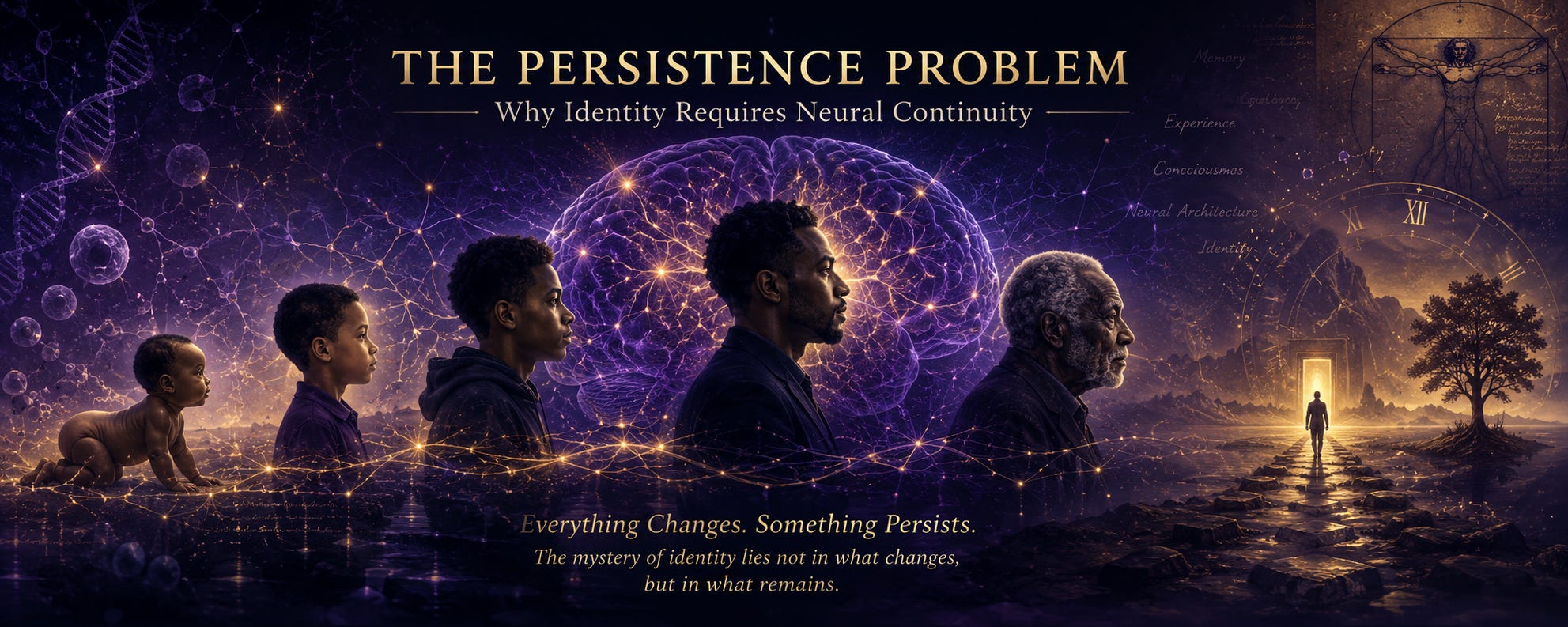
The persistence of identity may depend on the persistence of neural architecture.
WHO IS THE SAME PERSON?
In this essay, neural continuity refers not to the immobility of the nervous system, but to the persistence of an organized architecture through change. The brain may modify its connections, encode new experiences, and reorganize its networks; nevertheless, identity may depend on the fact that these transformations occur within a continuous structure rather than through total replacement or discontinuous reconstruction.
To answer this question, we must first address a more fundamental one: how can a human being remain the same person across an entire lifetime?
At first glance, the question appears deceptively simple. Most people answer it without hesitation: the child they once were, the adolescent they became, the adult they are today, and the older person they may one day become are all understood as the same individual. Despite the passage of time, the accumulation of experience, and the transformation of body and mind, a deeply rooted intuition persists: a continuous self endures across the lifespan. We rarely question this assumption, although it forms one of the most fundamental certainties of human existence.
When we remember our childhood, we do not speak of another person. When we recall our first friendship, our first failure, our first achievement, or our first loss, we experience those memories as belonging to us. The individual who lived those moments may appear physically different, emotionally different, intellectually different, and biologically different. Yet we instinctively recognize that individual as ourselves.
From a biological perspective, however, this apparent certainty becomes difficult to explain. The child, the adolescent, the adult, and the elderly person are not biologically identical beings. The body undergoes continuous transformation throughout life: cells die and are replaced, tissues renew themselves, bones remodel, hormonal systems fluctuate, the immune system evolves, and the brain develops, reorganizes, and adapts to experience. Each stage of life introduces change; each year adds transformation; each experience leaves traces. If one compares the organism of a newborn with that of an elderly individual, the differences are profound. Anatomy has matured, physiology has evolved, knowledge has expanded, memories have accumulated, and entire worlds of experience have been added. Yet something remarkable persists: the child and the elder answer to the same name, claim the same history, and recognize themselves as participants in the same life. If change is the rule of biology, continuity becomes the mystery. How can a human being remain the same person while continuously changing? What exactly survives the passage of time: memory, consciousness, neural architecture, or something more fundamental than either memory or biology?
Philosophers have wrestled with these questions for centuries. From John Locke’s reflections on personal identity to contemporary debates in philosophy of mind, the persistence of the self remains one of the most enduring problems of human thought. Neuroscience has approached the question from another direction. Rather than asking what the self is, it seeks to understand how continuity is maintained within a biological system that never entirely ceases to change. Memory, neural organization, and cognitive architecture have all become candidates in the search for an explanation. Yet the problem remains unresolved.
The more we learn about the dynamic nature of the brain, the more remarkable continuity appears. The nervous system is not static: it learns, adapts, reorganizes, and evolves. Yet the self persists. This paradox lies at the heart of the present essay. Cells change, experiences change, beliefs change, memories evolve, and the brain itself changes. Nevertheless, human beings continue to experience a profound sense of personal continuity. Somehow, amid the perpetual movement of biological life, a coherent identity survives.
The challenge, therefore, is not merely to explain change; it is to explain persistence. The deepest mystery of personal identity may not be that human beings transform throughout life, but that they continue to recognize themselves while doing so. Before we can understand why identity persists, we must confront a more fundamental question: what exactly remains when everything else changes?
THE BIOLOGICAL PARADOX OF IDENTITY
The question of personal identity is often approached through philosophy, psychology, or introspection. We ask who we are, what defines us, and what remains constant throughout the unfolding of a life. Yet before identity becomes a philosophical problem, it presents itself as a biological paradox: the human body is not a fixed entity but a process.
From the first moments of life until its final stages, the organism exists in a state of continuous transformation. Cells die. Cells are replaced. Tissues regenerate. Organs adapt to changing demands. Physiological systems evolve across development, maturity, and aging: life is movement, change, and renewal. The skin that covers the body today is not entirely the same skin that existed years ago. Blood cells are continuously produced and removed. The intestinal epithelium renews itself with remarkable speed. Bone tissue undergoes constant remodeling. The immune system continuously adapts to new challenges. Even organs that appear stable are engaged in ongoing processes of maintenance, repair, and replacement.
Biology does not preserve itself through immobility. Biology survives through change. This principle appears throughout the living world. Renewal is one of nature’s most fundamental strategies. To remain alive, organisms must continuously replace, repair, and reorganize themselves. And yet, amid this perpetual transformation, a remarkable fact persists: identity appears astonishingly stable.
A person who recalls a childhood memory does not experience it as belonging to a different organism. The adult recognizes the child. The elderly person recognizes the adolescent. Across decades of biological change, there remains a persistent sense of ownership over one’s life: the body changes and the self remains. At least, it appears to remain.
This observation introduces one of the most intriguing paradoxes in neuroscience and philosophy alike.
How can psychological continuity survive biological discontinuity?
If the organism is continuously renewing itself, what allows an individual to experience life as a single unfolding story rather than a succession of disconnected biological states? Why does memory accumulate rather than fragment? Why does personal history remain coherent? Why does the individual who awakens today feel connected to the individual who existed ten, twenty, or fifty years ago? These questions become even more striking when we consider the magnitude of change that occurs throughout a lifetime.
The infant possesses neither the knowledge nor the abilities of the adult. The adolescent experiences emotions differently from the elderly person. Entire systems of beliefs, relationships, values, and aspirations may evolve across the decades. A human life is not merely a continuation. It is a transformation. And yet transformation does not seem to abolish identity. Something persists through change and remains connected to its own history.
For centuries, philosophers attempted to explain this continuity through concepts such as memory, consciousness, soul, or personal narrative. Modern neuroscience approaches the problem differently. Rather than beginning with abstract definitions of the self, it examines the biological structures that may preserve continuity across time. This shift leads to a critical realization: identity may not depend equally on every component of the body. The loss of skin cells does not alter personal identity; the replacement of blood cells does not erase autobiographical memory; bone remodeling does not transform one individual into another. Most biological renewal remains compatible with the persistence of the self. This suggests that continuity may depend on a more specific architecture: one capable of preserving experience, integrating memory, connecting past and present, and carrying a life through time. That architecture is the nervous system. If identity survives biological change, then the key to continuity may lie not in the body as a whole, but in the structure that remembers the body’s history.
MEMORY AS THE FOUNDATION OF SELF
If identity persists across time, then one question immediately emerges: What allows the present self to remain connected to its past?
Among the answers proposed throughout history, one appears with remarkable consistency: memory. At first glance, the relationship seems obvious. When we think about who we are, we naturally think about what we remember. Childhood experiences, relationships, achievements, failures, fears, aspirations, and decisive moments all contribute to the story we call a life. We do not simply exist in the present; we carry the past within us.
Indeed, it is difficult to imagine identity without memory. Suppose that every autobiographical memory were suddenly erased while language, perception, intelligence, and motor abilities remained intact. There would be no remembered childhood, no family history, no remembered friendships, no remembered accomplishments, and no remembered suffering. Would that individual still be the same person? The question is unsettling precisely because memory appears so intimately connected to identity. Much of what we call the self consists of continuity across time, and continuity requires some form of remembrance. Without memory, experience would become fragmented; life would cease to appear as a coherent narrative and would instead become a succession of disconnected events.
Memory transforms existence into history: it allows individuals to recognize a past as their own. It provides the thread that connects childhood, adolescence, adulthood, and old age into a single unfolding life. This idea has fascinated philosophers for centuries. John Locke famously proposed that personal identity depends fundamentally on memory. According to this view, continuity of consciousness links different moments of life together. A person remains the same individual because past experiences can be recognized as belonging to the same self. Whether or not Locke’s theory is sufficient, it captures an intuition that remains powerful today: memory creates continuity.
Modern neuroscience approaches the question from a biological perspective. Rather than asking what memory means philosophically, it examines how memory becomes possible within the nervous system. This research has shown that memory is not a single faculty but a collection of systems. Procedural memory supports the acquisition of skills; working memory sustains ongoing cognition; semantic memory stores factual knowledge; and episodic memory preserves events situated in time and place. Among these systems, autobiographical memory occupies a particularly important position in the construction of identity. It allows individuals to remember their own lives, to access personal history, and to mentally travel through time toward events that shaped who they are. Without autobiographical memory, the continuity of the self becomes fragile.
The nervous system contains specialized structures that contribute to this remarkable capacity. Among the most important is the hippocampus, a structure located within the medial temporal lobe. The hippocampus plays a critical role in the formation and consolidation of new memories. Experiences initially encoded in transient forms can gradually become integrated into broader cortical networks, where they may persist for years or even decades. This process is known as memory consolidation.
Consolidation transforms experience into history: a moment becomes a memory, a memory becomes part of a life, and a life becomes part of an identity. The significance of this process extends beyond simple recollection: memory does not merely preserve information, it preserves continuity. Each remembered experience remains connected to previous experiences. The nervous system does not store isolated fragments, it organizes relationships.
A childhood memory acquires meaning because it remains linked to later events. A personal failure influences future decisions because it becomes integrated into a larger narrative. Experiences accumulate and interact, gradually forming an autobiographical architecture unique to each individual. This suggests that identity may emerge not despite memory, but through memory. The self may not be a fixed object hidden somewhere inside the brain; it may be the ongoing integration of remembered experience. The nervous system continuously connects past, present, and anticipated future into a coherent whole. Through memory, life becomes more than a sequence of moments: it becomes a story, and stories require continuity. Yet memory also presents a challenge, because memories are not stored like documents in an archive. They are dynamic, reconstructed, and transformed by new experiences. Despite this fluidity, they continue to provide one of the foundations upon which identity rests.
We do not merely possess memories; we inhabit them. They shape our understanding of who we were, who we are, and who we believe we may become. Without memory, consciousness, perception, and biological life may remain, but the bridge connecting one moment of existence to another begins to disappear. With that bridge, the continuity upon which identity depends also becomes fragile. Memory therefore emerges as the first major candidate in the search for the persistence of the self. It may not explain identity completely, but it is difficult to imagine identity without it.
THE ARCHITECTURE OF PERSONAL HISTORY
If memory provides continuity, another question naturally follows: Where does continuity reside?
At first glance, the answer seems obvious: it resides in memories themselves.
We remember our childhood, people we have loved, places we have visited, successes, failures, discoveries, and losses. Memory appears to preserve the history of a life. Yet modern neuroscience suggests a more profound possibility. Perhaps the continuity of personal identity is not contained merely within individual memories. Perhaps it resides within the architecture that memories gradually create.
Experiences do not simply pass through the brain; they leave traces. Every perception, conversation, lesson, attachment, fear, and act of learning contributes, however subtly, to the organization of the nervous system. Life does not merely happen to the brain; life shapes the brain.
This shaping begins from the earliest moments of existence. The newborn enters the world possessing a nervous system of extraordinary potential but limited experience. Over time, interactions with the environment begin to sculpt neural organization. Sensory experiences establish pathways. Relationships influence emotional circuits. Language reorganizes cognition. Education modifies networks. Repetition stabilizes patterns. The architecture becomes progressively individualized. The nervous system carries the imprint of experience. In this sense, learning is not simply the acquisition of information, it is biological inscription: every significant experience leaves traces within neural organization. Some traces are subtle, others become foundational. Together, they contribute to the construction of a unique neural landscape.
No two lives produce identical architectures. Even genetically identical individuals encounter different experiences, form different memories, establish different relationships, and develop different trajectories of learning. Consequently, every nervous system becomes a singular historical structure: a living record of accumulated experience. This observation introduces an important shift in perspective. We often imagine memory as a collection of stored events, a mental archive, or a library of experiences. Although this image contains some truth, it remains incomplete. Experiences do more than populate the library; they help construct the library itself. Every memory participates in the organization of future memories. Every learning experience influences subsequent learning. Every relationship alters the networks through which future relationships are interpreted. The history of a life becomes woven into the structure that supports future experience. Identity may therefore emerge not from isolated memories, but from accumulated neural organization.
The self may depend less on what is remembered individually than on how a lifetime of experiences has collectively shaped the nervous system. This perspective helps explain why identity often survives even when particular memories fade. Many childhood experiences become inaccessible to conscious recollection: specific details disappear, names are forgotten, events become fragmented, and yet the individual remains influenced by those experiences. Relationships continue to shape personality; early attachments continue to influence emotional life; past learning continues to guide behavior. The architecture remains even when specific recollections become difficult to retrieve.
The nervous system remembers more than consciousness remembers. This insight has important implications. It suggests that personal history may not exist solely as a narrative we can consciously recount. It may also exist as an organization we continuously inhabit.
The pathways shaped by experience continue to influence perception. Networks shaped by learning continue to guide interpretation. Emotional architectures established through relationships continue to affect behavior. The past remains active within the structure of the present. A life is therefore more than a sequence of remembered events: it is an accumulated architecture. Each experience contributes a stone, each relationship contributes a corridor, each lesson contributes a pathway, and each memory contributes a connection. Over time, these elements become integrated into a coherent whole. The result is not merely memory; the result is identity.
Seen from this perspective, the self resembles an evolving city more than a static monument. New districts emerge, old pathways remain, some structures become central, and others lose importance. Yet the city preserves continuity because its history remains embedded within its organization. The same may be true of the nervous system.
The history of a life is not merely stored; it is organized and incorporated. It becomes part of the architecture itself. This possibility leads directly to the central thesis of the present essay: identity may emerge from accumulated neural organization. Not because memories alone persist, but because the architecture shaped by those memories persists. For a life is not merely remembered; a life is architecturally embedded.
THE PERSISTENCE PROBLEM
The questions explored so far lead inevitably toward a deeper and more unsettling problem. If memory contributes to identity, and if experience gradually shapes a unique neural architecture, what happens when continuity itself is disrupted?
To understand the Persistence Problem, we must distinguish transformation from replacement, continuity from reconstruction, and persistence from duplication. A human life changes continuously: memories are acquired and lost, beliefs evolve, bodies age, and neural networks reorganize. These transformations do not necessarily threaten identity, because they occur within an ongoing structure. Replacement raises a different problem. If the architecture that carries personal history were reconstructed rather than continuously transformed, would the same person persist, or would only an indistinguishable successor remain?
Consider a simple thought experiment. Imagine a brain whose neurons are progressively replaced—not damaged, destroyed, or suddenly removed, but gradually and perfectly substituted one after another. The overall structure appears preserved. Behavior remains unchanged. Memories seem accessible. Language survives. Personality appears intact. From the outside, nothing seems different. Yet a profound question emerges: is the resulting individual still the same person, or has continuity been silently interrupted?
The difficulty of this question arises because identity is rarely defined in purely biological terms. Most individuals do not experience themselves as collections of cells. They experience themselves as continuous beings. What matters is not merely what exists at a particular moment, but what remains connected across time: continuity appears essential.
A person awakening each morning does not feel newly created. The self experienced today appears linked to the self-experienced yesterday. This connection is so immediate that it is usually taken for granted. Yet the thought experiment challenges precisely this assumption.
If every component were eventually replaced, what exactly would persist? Would continuity survive complete reconstruction, or would reconstruction merely produce an indistinguishable successor? The question recalls one of the oldest puzzles in philosophy: the Ship of Theseus. If every plank of a ship is gradually replaced, is it still the same ship?
For centuries, philosophers have debated the answer. The persistence problem brings this classical dilemma into neuroscience. The question is no longer about ships; it is about minds. And unlike ships, minds possess memory; they possess experience and identity. This makes the problem considerably more complex.
One possible answer is that identity depends only on function. As long as behavior remains unchanged, continuity survives. According to this view, replacement poses no threat: the system continues to operate. Therefore, the self continues to exist. Yet another possibility deserves consideration. Perhaps identity depends not merely on function, but on continuity itself. Perhaps there is a meaningful difference between an architecture that persists and an architecture that is reconstructed.
Consider a city. A city may evolve for centuries. Buildings are renovated, roads are expanded, neighborhoods emerge, and others disappear. Yet the city retains continuity because its transformation remains connected to its own history.
Now imagine destroying the city entirely and rebuilding a perfect replica elsewhere. The replica may be indistinguishable. It may reproduce every street and every building. Yet many would hesitate before calling it the same city. Something about continuity appears significant. The same intuition may apply to the nervous system: the self may not emerge solely from organization; it may emerge from organized continuity. Identity may depend not only upon what the architecture is, but upon how that architecture persists through time.
This distinction becomes particularly important when considering memory. Memories are not isolated data points; they are integrated into a continuously evolving structure. Each experience modifies an architecture that already possesses a history. Each new memory becomes connected to previous memories, and each learning event becomes part of an existing network. The self emerges within this ongoing accumulation. Continuity is not an accessory; it is the medium through which personal history unfolds. From this perspective, the persistence problem may be stated simply: can identity survive the loss of continuity, or is continuity one of the essential conditions of identity itself?
The answer remains uncertain. Neuroscience has not yet resolved this question. Philosophy continues to debate it. Perhaps it will remain open for generations. Yet the problem possesses extraordinary importance. For hidden within it are some of the deepest questions human beings can ask: What makes a person the same person? What allows a life to remain connected to itself? What exactly persists through the passage of time? And perhaps most importantly: If continuity disappears, does the self disappear with it?
The present essay does not claim to provide a definitive answer. It proposes instead a hypothesis that emerges from the concepts developed thus far. If memory depends on organized neural architecture, and if identity depends in part on memory, then the persistence of the self may depend on the persistence of that architecture. In other words, continuity may not merely accompany identity; it may be one of the conditions that makes identity possible.
PHILOSOPHERS OF CONTINUITY
Long before neuroscience began mapping neural circuits, philosophers were already struggling with a question that remains surprisingly modern: What allows a human being to remain the same person through time?
The persistence of identity is not merely a scientific problem; it is one of the oldest questions in intellectual history. Every generation has confronted it in its own language. Some have approached it through memory, others through consciousness, and others through existence itself. Although their conclusions differ, they share a common intuition: identity cannot be understood without continuity.
Among the many thinkers who explored this problem, three figures remain particularly influential: John Locke, David Hume and Martin Heidegger. Together, they offer three profoundly different ways of thinking about the self.
John Locke: Memory and personal identity. For John Locke, continuity begins with memory. Writing in the seventeenth century, Locke proposed one of the most influential theories of personal identity. According to Locke, a person remains the same individual because consciousness can extend backward through remembered experience. Identity is not fundamentally a matter of substance: it is not determined by the body alone, nor by the persistence of biological matter. Rather, identity depends on the continuity of consciousness. A person is connected to his past because he remembers it as his own. This idea remains remarkably intuitive. Much of what we call the self appears inseparable from autobiographical memory: the experiences we remember become part of our personal history, and the continuity of memory becomes one form of continuity of identity.
Locke’s insight continues to influence contemporary discussions in psychology, philosophy, and neuroscience. Yet his theory raises difficult questions: What happens when memories disappear? What happens in amnesia? What happens in dementia? Do we cease to be ourselves when memory becomes fragmented? These challenges suggest that memory may be necessary for identity, but perhaps not sufficient. The search must therefore continue.
David Hume: The self as a bundle. David Hume approached the problem from a radically different direction. Whereas Locke sought continuity, Hume questioned whether a stable self exists at all.
When we look inward, Hume argued, we never encounter a permanent self, we encounter perceptions: thoughts, sensations, emotions, memories, and desires. But never an unchanging entity that exists beneath them. The self, according to Hume, is not a fixed substance, it is a bundle of perceptions linked together by habit and association. The feeling of continuity may therefore be, at least partially, an illusion created by the mind itself. This perspective remains deeply provocative: modern neuroscience has revealed that the brain is indeed composed of countless interacting processes rather than a single controlling center. No specific region appears to contain a miniature observer watching the world from within. The self may be distributed rather than localized, emergent rather than fundamental. Yet even if Hume was correct that the self is not a substance, a question remains: Why does the bundle remain coherent? Why does experience preserve continuity rather than dissolve into fragmentation? The Persistence Problem survives even if the traditional self disappears.
Martin Heidegger: identity through time. If Locke focused on memory and Hume on perception, Heidegger approached the problem through existence itself. For Heidegger, human beings are not static objects; they are beings unfolding through time. Existence is not something possessed but something lived. Human life is fundamentally temporal. We are always situated between a remembered past and an anticipated future, and the self emerges through this movement. What matters is not merely what we are at a particular instant, but how our existence remains connected across time. Identity therefore becomes inseparable from temporality. We do not simply occupy time; we are historical beings. Our lives acquire meaning through continuity. Experiences accumulate, possibilities evolve, and the past remains active within the present. From this perspective, identity resembles an unfolding architecture rather than a fixed object.
A human life is not a completed structure; it is a construction continuously in progress. This vision resonates strongly with contemporary neuroscience. The brain is neither static nor chaotic: it changes, reorganizes, and develops, while preserving enough continuity to maintain a coherent life history. The nervous system appears to embody, at the biological level, the tension between change and persistence that Heidegger described at the existential level.
These three philosophers illuminate different dimensions of the same mystery. Locke teaches us that memory contributes to continuity; Hume reminds us that the self may not be a fixed substance; and Heidegger reveals that identity unfolds through time. Yet none of these perspectives entirely resolves the problem. For even if memory contributes to identity, another question remains: Why does memory itself remain connected? Even if the self is a dynamic process rather than a substance, why does that process preserve continuity? And even if existence unfolds through time, what allows that unfolding to remain coherent? These questions lead us back toward neuroscience. Perhaps continuity depends upon something deeper than memory alone. Perhaps beneath remembered experience lies an enduring neural organization that allows experience itself to remain connected across decades.
If so, memory may not be the ultimate foundation of identity; memory may itself depend upon a more fundamental continuity, a continuity embedded within the architecture of the nervous system. The persistence of memory may explain part of the self, but perhaps the persistence of neural architecture explains why memory can persist at all.
THE CLINICAL CHALLENGE
Philosophy asks what identity is; neuroscience asks how continuity is maintained. Clinical medicine encounters what happens when continuity begins to fail. Nowhere does the persistence problem become more tangible than at the bedside.
For clinicians who care for patients affected by neurological disease, questions of identity are not merely theoretical, they emerge in hospital rooms. They arise during consultations, they appear in conversations between physicians and families, they unfold within the lives of individuals whose relationship with their own history is gradually transformed. The persistence of the self becomes a clinical question, and often, a deeply painful one. Many neurological disorders reveal a striking distinction between biological survival and psychological continuity.
A patient may remain alive: the heart continues to beat, the lungs continue to breathe, and the body remains present. Yet something essential may appear altered. The individual who once occupied that body no longer seems fully accessible. This phenomenon is particularly evident in Alzheimer’s disease. The disease does not immediately destroy the organism; it progressively disrupts memory. Names disappear, faces become unfamiliar, and personal histories become fragmented. Entire decades of experience may become inaccessible. The disease attacks one of the foundations upon which continuity depends. Families frequently describe the experience in remarkably similar terms. They do not usually say, “My mother has forgotten information.” Instead, they say, “She is no longer the person she used to be.” This observation is profoundly significant. It suggests that identity is experienced not merely as biological existence, but as continuity across time.
When continuity becomes disrupted, the sense of personhood itself appears threatened. The same challenge emerges in frontotemporal dementia. Unlike Alzheimer’s disease, frontotemporal disorders often affect personality, judgment, emotional regulation, and social behavior at relatively early stages: the patient may retain many memories, and language may remain partially intact. Yet profound alterations in character can occur. Individuals who were once empathetic may become indifferent, and reserved individuals may become impulsive. Patterns of behavior that remained stable for decades may suddenly change.
Families again confront a disturbing question: if personality changes profoundly, does the same person remain? The persistence problem appears once more. Not because biological life has ended, but because continuity has become uncertain. Amnesia presents a different but equally illuminating perspective. Some individuals lose access to large portions of their autobiographical history while preserving many other cognitive abilities: they can perceive, reason, speak, and learn certain new skills. Yet they may no longer recognize large segments of their own past, the bridge connecting present and history becomes fractured. The question naturally emerges: How much memory can disappear before identity itself is altered?
Clinical reality provides no simple answer. Yet it consistently reveals the intimate relationship between memory and personhood. Traumatic brain injury introduces another dimension to the problem. Following severe injury, patients may survive physically while experiencing dramatic changes in cognition, emotional regulation, behavior, or self-awareness. In some cases, families describe a sensation that is difficult to articulate. The individual appears both present and absent, familiar and unfamiliar; the same body remains. Yet continuity seems partially disrupted. These experiences reveal something important: identity cannot be reduced to biological survival alone.
If survival were sufficient, these questions would never arise. Yet clinicians encounter them every day.
Indeed, one of the most common questions asked by families confronting severe neurological illness is neither scientific nor technical; it is existential: “Is he still the same person?” This question has extraordinary depth. It reflects an intuitive understanding that identity depends on more than physiology. Families may not speak of neural networks, memory systems, or cortical organization, yet they instinctively recognize the significance of continuity. What they mourn is often not only the loss of function, but also the loss of connection: the gradual disappearance of a life story that once remained accessible and the disruption of a continuity that previously united past and present.
Clinical neurology therefore occupies a unique position in the study of identity. It observes what happens when the mechanisms that sustain continuity become compromised: disease becomes an unintentional experiment. Through degeneration, injury, and memory disorders, medicine gains insight into the structures that normally preserve the self. This perspective carries profound implications: if identity becomes fragile when continuity is disrupted, then continuity itself may be more fundamental than we often assume. Perhaps the self depends not merely upon consciousness at a particular moment. Perhaps it depends upon the capacity of consciousness to remain connected to its own history. This possibility returns us to the central hypothesis of the present essay.
If memory contributes to identity, and if memory depends upon neural architecture, then disturbances of that architecture may alter continuity itself. The clinic does not provide a definitive answer. But it provides an indispensable observation. Again and again, neurological disease reveals the same lesson: biological life can persist even when continuity begins to fracture. And when continuity fractures, identity becomes uncertain. For this reason, clinical neurology confronts the persistence problem every day. Not as an abstract philosophical puzzle, but as one of the most human questions medicine can ask. What remains of a person when the continuity of a life begins to disappear?
THE SHIP OF THESEUS AND THE BRAIN
Among the oldest thought experiments in philosophy, few have proven as enduring as the Ship of Theseus. The question appears deceptively simple: imagine a ship preserved for centuries. As time passes, individual planks begin to deteriorate. One by one, they are replaced. A damaged plank is exchanged for a new one. Later, another is replaced, then another. Eventually, every original component has been removed and substituted. The ship remains visually identical. Its structure appears unchanged; its function remains intact. Yet a profound question emerges: Is it still the same ship?
For more than two thousand years, philosophers have debated this problem. The puzzle survives because it touches a fundamental aspect of identity. At what point does replacement become transformation? At what point does transformation become something entirely new?
The Ship of Theseus is not ultimately a question about ships, it is a question about continuity. And nowhere does this question become more fascinating than when applied to the human brain. The nervous system presents a remarkable challenge to traditional notions of identity. Unlike a ship, it is alive; unlike a machine, it learns; unlike a static object, it continuously reorganizes itself. And yet, like the Ship of Theseus, it confronts us with the problem of persistence.
To approach this question, it is useful to distinguish three forms of continuity: biological, psychological, and neural.
Biological continuity. At the most basic level, a living organism persists through biological continuity: the body remains alive, metabolism continues, and physiological processes sustain existence. From this perspective, identity appears linked to the ongoing survival of the organism. Yet this explanation quickly encounters difficulties. The body changes continuously throughout life. Cells die; cells are replaced; tissues regenerate; organs age. Despite these transformations, identity appears remarkably stable. Biological continuity alone therefore seems insufficient, something more is required.
Psychological continuity. Psychological continuity provides a second possibility. According to this view, identity survives because memories, beliefs, intentions, relationships, and personal narratives remain connected through time. A person recognizes his past. He remembers his experiences. He anticipates his future. His life forms a coherent story. This perspective aligns closely with Locke’s theory of personal identity. And indeed, memory appears indispensable to continuity; yet psychological continuity raises new questions: How much memory can disappear before identity is altered? What happens in dementia? What happens in severe amnesia? What happens when personality itself changes? Psychological continuity clearly matters, but perhaps it depends upon something deeper: neural continuity.
Neural continuity. Neuroscience introduces a third possibility. Perhaps continuity depends upon the persistence of neural architecture itself. Experiences become embedded within networks. Learning modifies pathways, relationships shape organization, and memory emerges from accumulated connectivity. The self may therefore depend upon the continued existence of a living architecture capable of preserving its own history. This perspective shifts the problem in a significant way. The question is no longer merely whether memories survive, the question becomes whether the architecture that supports those memories survives. For memories do not exist independently, they are embedded within organized neural systems. Continuity may therefore depend not simply upon information, but upon the persistence of the architecture carrying that information.
This brings us back to the Ship of Theseus. Imagine, once again, a brain whose neurons are progressively replaced, not damaged, not destroyed, and perfectly replaced. Suppose every function remains intact, every memory remains accessible, every behavior remains unchanged, and every aspect of personality appears preserved. Would the resulting individual still be the same person?
Many would answer yes. If continuity of function survives, continuity of identity survives. Others hesitate, for perhaps perfect reconstruction is not equivalent to persistence. Perhaps continuity requires more than similarity, and perhaps it requires an uninterrupted history.
This distinction becomes even more striking when considered from another angle. Imagine two brains: the original and a perfect duplicate. Both possess identical memories, identical personalities, identical beliefs, and identical histories. Which one is the original person? The question immediately exposes the limitations of simple functional explanations; identity may involve more than information; it may involve continuity itself.
The nervous system therefore occupies a unique position within the Ship of Theseus problem. Unlike the ship, the brain is not merely an object, it is the medium through which experience becomes history, it is the architecture through which memory accumulates. It is the structure through which continuity becomes possible. This realization brings us to one of the deepest questions raised by contemporary neuroscience: Can a person survive perfect replacement?
The answer remains uncertain. Perhaps future science will provide greater clarity; perhaps philosophy will continue debating the issue for centuries. Yet the question remains profoundly important. For hidden within it lies the fate of every theory of identity, memory, consciousness, and survival. If continuity proves essential, then persistence becomes one of the most important properties of the nervous system. If continuity proves unnecessary, then identity may be far more transferable than we currently imagine. The persistence problem therefore reaches beyond neuroscience. It touches the very definition of what it means to remain oneself. And perhaps the most important lesson of the Ship of Theseus is not that replacement creates uncertainty, it is that continuity may matter far more than we once believed.
IDENTITY AS AN EMERGENT ARCHITECTURE
The questions explored throughout this essay converge toward a single possibility. Perhaps we have been looking for identity in the wrong places.
For centuries, philosophers and scientists have searched for the location of the self. Some have sought it in consciousness, others in memory, others in reason, and others in particular regions of the brain. This search often assumes that identity must reside somewhere: that there must be a structure, substance, or center capable of containing the self. Yet modern neuroscience suggests a different perspective. The brain contains no obvious seat of identity. There is no single neuron that can be called the self, and there is no isolated cortical region where personhood resides. No anatomical structure has been found to contain an individual’s entire identity. The nervous system appears to operate according to a different logic. Its most important properties emerge from organization: perception emerges from networks, memory emerges from networks, and language emerges from networks. Consciousness itself appears to depend on the coordinated activity of distributed systems. Why should identity be different? Perhaps identity does not reside in a particular component of the nervous system. Perhaps it emerges from the continuity of organization.
This possibility invites a fundamental shift in perspective. The self may not be a substance, it may be an architecture; not a static architecture, not a completed structure, but a living architecture continuously shaped by experience while preserving enough continuity to remain connected to its own history.
Such a view helps explain many of the observations explored throughout this essay. Memory becomes meaningful because experiences remain integrated within an organized framework. Learning becomes possible because new information modifies an existing architecture rather than replacing it. Development becomes intelligible because the nervous system transforms while preserving continuity. Even the persistence of identity across decades becomes less mysterious. The self survives not because it is fixed, it survives because the architecture remains sufficiently continuous through change. This perspective also helps reconcile two seemingly contradictory realities. Human beings clearly change, no one remains psychologically identical throughout life; experiences accumulate, beliefs evolve, relationships transform us, knowledge expands, and personality itself may mature. And yet despite these changes, continuity remains. The self evolves without becoming entirely disconnected from itself.
A purely static model of identity cannot explain this, nor can a model based solely upon constant replacement. An architectural model offers another possibility. Architectures can evolve while preserving continuity.
A city may expand for centuries while remaining recognizably the same city; a cathedral may undergo generations of renovation while preserving its identity; a language may evolve while maintaining continuity with its origins. The same principle may apply to the nervous system.
The self persists because change occurs within an organized continuity. Identity therefore becomes less a thing than a process, less an object than a relationship, and less a substance than a structure unfolding through time. This interpretation resonates with both philosophy and neuroscience. It echoes Locke’s emphasis on continuity, accommodates Hume’s rejection of a permanent substance, and reflects Heidegger’s vision of existence as an unfolding temporal reality. It also remains compatible with contemporary understandings of neural organization. Yet it introduces a further possibility: identity may be neither a soul-like entity nor a mere collection of psychological states. It may be an emergent architecture constructed through memory, shaped by experience, modified through learning, preserved through continuity, and sustained by the remarkable persistence of the nervous system.
This perspective carries important implications. If identity emerges from organized continuity, then the persistence of neural architecture becomes far more than a biological curiosity, it becomes a foundational condition of personhood. The self depends not merely upon what the nervous system contains, it depends upon the continued existence of the architecture through which experiences remain connected. This does not imply that identity is reducible to neurons, quite the contrary.
A single neuron explains almost nothing about a person. Even millions of neurons considered independently reveal little about a life. What matters is organization; what matters is continuity; what matters is the history embedded within that organization.
The self may therefore be understood as the living expression of an accumulated architecture. A structure that remembers, a structure that learns, a structure that transforms, a structure that remains connected to itself through time. And perhaps this is why the search for identity has often proven so difficult. We have searched for a location, what we may need to understand instead is a pattern.
Identity may therefore not reside somewhere within the brain; it may emerge from the enduring continuity of the brain’s organization. The self may be less a substance than a persistent architecture. If this is true, one conclusion follows naturally: we are not our neurons individually; we are the continuity of their organization.
THE FUTURE OF THE PERSISTENCE PROBLEM
Every meaningful scientific question eventually reveals horizons larger than itself. The persistence problem is no exception. What began as an inquiry into identity has gradually expanded into something far broader. The question of continuity does not concern the self alone. It touches memory, disease, development, consciousness, intelligence, and perhaps even the future limits of human existence.
Throughout this essay, we have explored a central possibility: identity may emerge not from isolated biological components, but from the continuity of an organized neural architecture. If this hypothesis contains even part of the truth, its implications extend beyond philosophy. It becomes a problem for neuroscience, medicine, technology, and perhaps one day for civilization itself. The first horizon is memory.
Memory has traditionally been studied as a mechanism of storage and retrieval. Neuroscience has made extraordinary progress in understanding how experiences are encoded, consolidated, and recalled. Yet the persistence problem suggests another perspective. Perhaps memory cannot be understood solely as information, perhaps memory is also continuity.
A memory survives because it remains connected to a living architecture capable of preserving its history. Understanding memory may therefore require understanding persistence. Future research may need to ask not only how memories are formed, but how they remain connected to the evolving self.
The second horizon concerns neurodegeneration. Diseases such as Alzheimer’s disease, frontotemporal dementia, and other neurodegenerative disorders confront us with one of the most painful manifestations of disrupted continuity.
When memory fragments, identity often appears to fragment with it. When neural architectures deteriorate, personal histories become increasingly difficult to access. The question then becomes urgent: How much continuity can be lost before the self is altered? Clinical medicine encounters this mystery every day. And the future understanding of neurodegeneration may depend as much upon understanding persistence as understanding pathology.
A third horizon concerns development. The infant and the elderly person possess profoundly different nervous systems. Yet continuity remains. The same life unfolds across radically different stages of biological existence. How does continuity survive such transformation?
Developmental neuroscience may ultimately reveal that the emergence of identity depends not merely upon growth, but upon the preservation of coherent neural organization throughout growth. The persistence problem therefore extends backward to the beginning of life as much as it extends forward toward aging.
A fourth horizon emerges in the study of artificial intelligence. Modern artificial systems can learn. They can adapt; they can modify internal parameters. Some can even improve their performance through experience. Yet a deeper question remains unresolved: Can an artificial system possess continuity? Can it accumulate a history that remains genuinely its own? Can it develop something analogous to personal identity? Or does identity require forms of persistence unique to biological architectures?
The future dialogue between neuroscience and artificial intelligence may increasingly revolve around these questions. Intelligence alone may not be sufficient; continuity may matter as well. Beyond intelligence lies an even deeper mystery: consciousness. Neuroscience has made considerable progress in identifying neural correlates of conscious experience, yet one of the most fundamental questions remains unanswered. Why does a conscious self feel continuous?
Every moment of awareness appears linked to previous moments. Experience unfolds as a coherent stream rather than a collection of disconnected events. The persistence problem suggests that continuity itself may be one of the central features requiring explanation. Perhaps consciousness is not merely awareness. Perhaps consciousness is awareness connected to its own history. And beyond all these horizons lies a final possibility: a possibility that remains speculative.
A possibility that must be approached with humility. Yet it cannot be ignored. If identity depends upon continuity rather than merely biological matter, then questions concerning preservation inevitably emerge: What exactly must persist for a person to remain himself? Can continuity survive radical biological transformation? Can continuity survive advanced technological intervention? Can continuity survive forms of preservation not yet imagined?
These questions currently belong more to hypothesis than to established science.
Yet history repeatedly demonstrates that today’s speculation can become tomorrow’s investigation.
For centuries, many realities remained unimaginable until science developed the tools required to explore them.
The persistence problem therefore reaches toward a future that remains largely unknown. Its ultimate implications have not yet been measured. Its consequences have not yet been fully explored. Its questions remain open. Yet perhaps that openness is precisely what makes the problem so important. For every field touched by continuity ultimately converges upon the same question: memory asks it, neurology asks it, development asks it, artificial intelligence asks it, and consciousness asks it. And perhaps one day, the future of human survival itself may ask it.
The question remains remarkably simple; yet it may prove to be one of the deepest questions neurosciences will ever confront: Can identity survive the loss of biological continuity? The future of the persistence problem may ultimately depend upon the answer. And perhaps so might the future of our understanding of what it means to remain human.
THE ARCHITECTURE THAT REMAINS
We began with a simple question: How does a human being remain the same person throughout an entire lifetime? At first, the answer appeared obvious. We remain ourselves because we remember, because we recognize our past, because we carry our history within us. Yet the deeper we explored the question, the more complex it became.
The body changes continuously, cells are replaced, tissues renew themselves, and organs age. Biology unfolds as a process of perpetual transformation. And yet identity persists. Somehow, amid the movement of life, continuity survives.
This essay has proposed that the answer may not reside in any single component of the nervous system. Not in a particular neuron, not in a specific brain region, not even in memory considered as an isolated function. Rather, the persistence of identity may depend upon something broader: a continuity of organization, a continuity of architecture. Experiences accumulate, memories become integrated, relationships leave traces, and learning reshapes pathways. A lifetime gradually sculpts a unique neural landscape. The self emerges within this architecture, not as a fixed object, not as an immutable substance, but as an organized continuity unfolding through time. The body changes, the architecture evolves, yet enough remains connected for a life to remain its own. This possibility helps illuminate one of the most remarkable features of human existence: change and continuity are not opposites, they are partners.
Without change, there would be no learning, no development, no growth, and no history. Without continuity, there would be no memory, no identity, no enduring self. Human life exists precisely at the intersection of both. We are transformed by time. Yet we remain connected to the person we once were. Perhaps this is why neurological disease affects us so profoundly.
When continuity begins to fracture, we sense that something fundamental is at stake: not merely cognition, not merely memory, but the coherence of a life, the persistence of a person, and the continuity of a self. This may also explain why the nervous system remains so fascinating. Among all the structures of the human body, it appears uniquely devoted to preserving continuity amid change. It carries the history of a life while adapting to new experience. It remembers while transforming. It persists while evolving.
Bibliography
Neuroscience & Biological Foundations of Mind
Bear, Mark F., Barry W. Connors, and Michael A. Paradiso. Neuroscience: Exploring the Brain. 4th ed. Philadelphia: Wolters Kluwer, 2016.
Damasio, Antonio. Self Comes to Mind: Constructing the Conscious Brain. New York: Pantheon Books, 2010.
Kandel, Eric R. In Search of Memory: The Emergence of a New Science of Mind. New York: W. W. Norton, 2006.
Kandel, Eric R., James H. Schwartz, Thomas M. Jessell, Steven A. Siegelbaum, and A. J. Hudspeth. Principles of Neural Science. 5th ed. New York: McGraw-Hill Education, 2013.
LeDoux, Joseph. Synaptic Self: How Our Brains Become Who We Are. New York: Viking, 2002.
Squire, Larry R., and Eric R. Kandel. Memory: From Mind to Molecules. 2nd ed. Greenwood Village, CO: Roberts and Company Publishers, 2009.
Sporns, Olaf. Networks of the Brain. Cambridge, MA: MIT Press, 2011.
Philosophy of Personal Identity & Continuity
Heidegger, Martin. Being and Time. Translated by Joan Stambaugh. Revised and edited by Dennis J. Schmidt. Albany: State University of New York Press, 2010.
Hume, David. A Treatise of Human Nature. Edited by David Fate Norton and Mary J. Norton. Oxford: Oxford University Press, 2000.
Locke, John. An Essay Concerning Human Understanding. Edited by Peter H. Nidditch. Oxford: Clarendon Press, 1975.
Parfit, Derek. Reasons and Persons. Oxford: Oxford University Press, 1984.
Consciousness, Selfhood, & Cognitive Architecture
Damasio, Antonio. The Feeling of What Happens: Body and Emotion in the Making of Consciousness. New York: Harcourt Brace, 1999.
Metzinger, Thomas. Being No One: The Self-Model Theory of Subjectivity. Cambridge, MA: MIT Press, 2003.
Metzinger, Thomas. The Ego Tunnel: The Science of the Mind and the Myth of the Self. New York: Basic Books, 2009.
Schacter, Daniel L. The Seven Sins of Memory: How the Mind Forgets and Remembers. Boston: Houghton Mifflin, 2001.
Learning, Development, & Neural Plasticity
Doidge, Norman. The Brain That Changes Itself. New York: Viking, 2007.
Hebb, Donald O. The Organization of Behavior: A Neuropsychological Theory. New York: Wiley, 1949.
Siegel, Daniel J. The Developing Mind: How Relationships and the Brain Interact to Shape Who We Are. 3rd ed. New York: Guilford Press, 2020.
Varela, Francisco J., Evan Thompson, and Eleanor Rosch. The Embodied Mind: Cognitive Science and Human Experience. Revised ed. Cambridge, MA: MIT Press, 2017.
Clinical Neurology & Disorders of Identity
Corkin, Suzanne. Permanent Present Tense: The Unforgettable Life of the Amnesic Patient H. M. New York: Basic Books, 2013.
Sacks, Oliver. Awakenings. Revised ed. New York: Vintage Books, 1999.
Sacks, Oliver. The Man Who Mistook His Wife for a Hat and Other Clinical Tales. New York: Summit Books, 1985.
Artificial Intelligence & the Future of Mind
Bostrom, Nick. Superintelligence: Paths, Dangers, Strategies. Oxford: Oxford University Press, 2014.
Tegmark, Max. Life 3.0: Being Human in the Age of Artificial Intelligence. New York: Alfred A. Knopf, 2017.
About the author
Alexis O. Kaya is a physician, published author, and researcher in the neurosciences of learning, memory, and human development at the Université de Montréal. His work lies at the intersection of medicine, neuroscience, philosophy, and developmental science, with a particular interest in the principles that govern cognitive maturation, memory formation, identity, and the continuity of human experience across the lifespan.
Drawing from both scientific inquiry and philosophical reflection, he explores the hidden architectures through which the brain organizes knowledge, preserves experience, and transforms development into cognition. His research seeks to bridge biological mechanisms with broader questions concerning consciousness, learning, behavior, and the emergence of the human self.
He is the originator of the concept of Neurotenacity, a theoretical framework proposing that the persistence of neural architecture may constitute a fundamental biological condition for memory, identity, and cognitive continuity. Through this and related works, he advocates for a renewed examination of continuity, organization, and temporal structure as central themes in contemporary neuroscience.
His current research focuses on large-scale principles of neurodevelopmental organization, including the temporal dynamics of neural activation, the hierarchical emergence of cognitive networks, and the mechanisms through which neural architectures mature across development.