


Essay No. 04
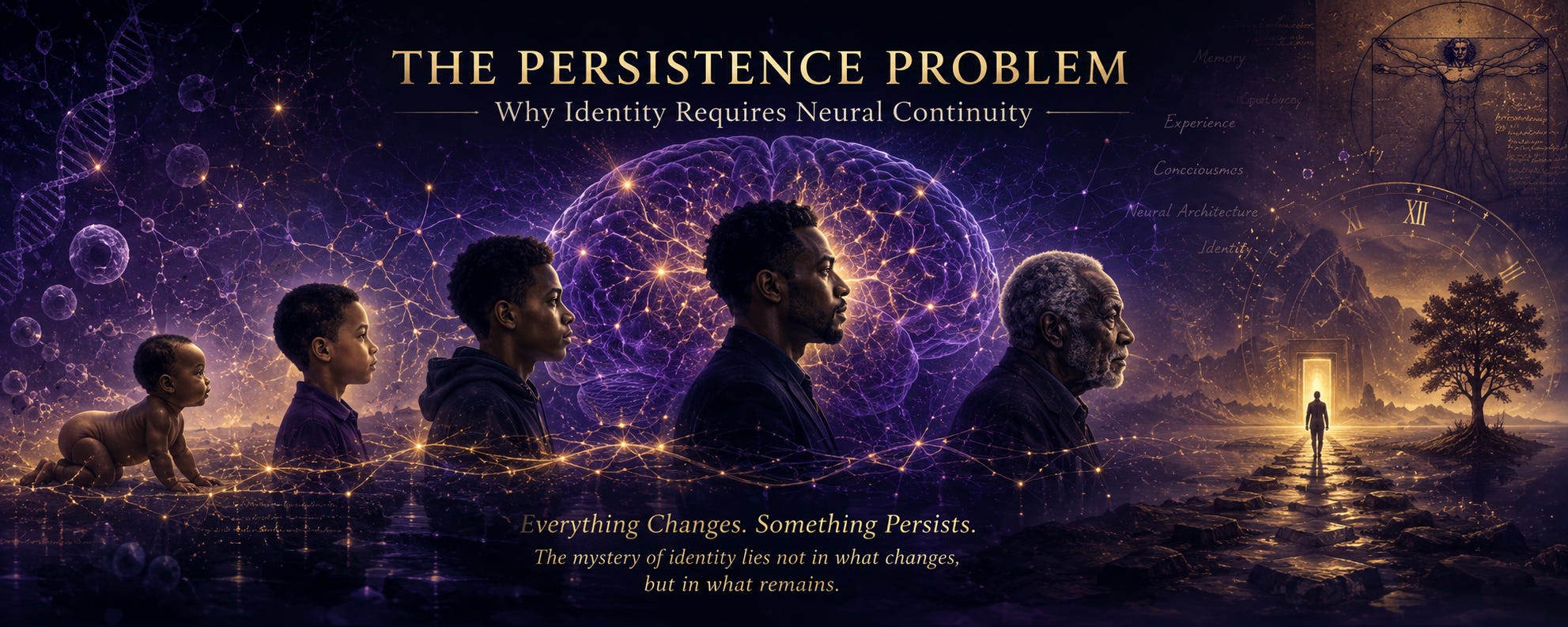
The Persistence Problem

This essay explores one of the most enduring questions in philosophy and neuroscience: what allows a human being to remain the same person throughout life despite continuous biological and psychological change? Drawing upon contemporary neuroscience, classical theories of personal identity, and clinical observations, it develops the hypothesis that personal identity may depend not merely on memory or psychological continuity, but on the persistence of an organized neural architecture through time. While the human body undergoes constant renewal and the brain continuously adapts through learning and plasticity, individuals generally experience themselves as enduring selves connected to their own histories. The essay examines the role of memory, autobiographical continuity, neural organization, and the gradual accumulation of experience in sustaining this sense of persistence. It also analyzes challenges posed by amnesia, neurodegenerative diseases, and the philosophical thought experiment of the Ship of Theseus, highlighting the distinction between continuous transformation and complete reconstruction. The central argument is that identity may emerge from a living architecture that preserves continuity across change rather than from any isolated biological component or static substance. If this view is correct, neural continuity may constitute a necessary condition for the persistence of the self. The implications of this hypothesis extend beyond philosophy to neuroscience, clinical medicine, consciousness studies, artificial intelligence, and future debates concerning the preservation and survival of personal identity.
Alexis O. Kaya, MD, PhD, Neuroscientist
Download
