



By Alexis O. Kaya, MD, PhD, Neuroscientist.
The contemporary idea of overpopulation is not merely a demographic claim about the number of human beings on Earth. It is a civilizational framework through which modern societies interpret scarcity, technology, productivity, recognition, and the future of humanity itself. This essay argues that before asking whether humanity has become too numerous, philosophy must first examine how this question became intellectually legitimate, historically transferable, and morally persuasive. Many of the limits attributed to humanity may reveal not the natural limits of the Earth alone, but the historical, political, economic, technological, and organizational limits of the civilizations through which human life is interpreted and governed.
When Did Humanity Become a Problem?
Every civilization inherits not only its monuments, its institutions, and its technologies. It also inherits the questions through which it learns to interpret the world. Some of these questions become so familiar that they cease to appear as questions at all. They become assumptions—silent frameworks through which reality itself is perceived.
There was a time when the growth of a people was almost universally understood as a sign of vitality. A flourishing population testified to the continuity of generations, the transmission of knowledge, the expansion of cultures, and the endurance of civilizations. To increase in number was not merely to occupy more land or to produce more wealth; it was to affirm the persistence of human life across time. The future of a civilization was inseparable from the future of the human beings who composed it.
Today, however, a striking inversion has emerged. Across political debates, economic forecasts, environmental discussions, and technological projections, humanity increasingly appears not only as the subject of civilization but also as one of its perceived constraints. Population growth is frequently presented as a source of pressure upon resources, ecological systems, public infrastructures, and even the long-term stability of the planet. In many contemporary discussions, the presence of more human beings is no longer interpreted primarily as a sign of continuity, but as a problem requiring management.
Whether such concerns are justified is not the question that concerns us first.
Before evaluating any answer, philosophy must examine the question itself. How did humanity become thinkable as a problem?
This inquiry does not seek to deny the existence of environmental challenges, demographic transitions, or economic constraints. Nor does it attempt to replace scientific analysis with philosophical speculation. Rather, it asks something more fundamental: what intellectual transformation made it possible for an idea that once symbolized the strength of civilizations to become associated with the limits of civilization itself?
The purpose of this essay is therefore not to argue for or against the theory of overpopulation. Such a debate, important as it may be, already presupposes a particular way of framing the issue. The deeper philosophical task is to investigate the origin of that framework. Every civilization interprets reality through inherited concepts, inherited distinctions, and inherited questions. Yet history reminds us that the questions societies consider self-evident are themselves historical constructions. They emerge under specific circumstances, respond to particular conditions, and often outlive the contexts that first gave them meaning.
To examine those questions is not to reject them. It is to recover the intellectual freedom necessary to determine whether they still illuminate the world we inhabit.
This methodological shift constitutes the guiding principle of the present reflection. Rather than asking whether the Earth can sustain humanity, we shall first ask why contemporary civilization has learned to formulate the future of humanity through the language of demographic limits. Perhaps the first philosophical responsibility is not to produce better answers, but to ensure that we have inherited the right questions.
The question that gives this essay its title should therefore not be understood as a rhetorical provocation. It is an invitation to suspend what appears obvious and to recover the philosophical distance from which genuine inquiry becomes possible: who decided that we are too many?
For before civilizations are transformed by the answers they embrace, they are first transformed by the questions they no longer think to examine.
Why Some Questions Become Self-Evident
If civilizations inherit languages, they also inherit the intellectual structures through which those languages make the world intelligible. Every generation receives not only institutions, laws, scientific knowledge, and technologies, but also a repertoire of questions that appear so natural they seldom require justification. These questions define what is considered worthy of investigation, what counts as a legitimate problem, and ultimately what kinds of answers can be imagined.
This observation leads to a principle that will guide the present essay and, more broadly, the philosophical project developed throughout The Human Value Question: The Principle of Civilizational Questions: Every civilization inherits not only institutions and technologies, but also the questions through which it learns to interpret reality.
This principle proposes a simple yet far-reaching idea. Human beings rarely begin their reflections from an entirely neutral position. Long before they formulate answers, they inherit conceptual frameworks that silently organize their perception of reality. These frameworks are so deeply embedded within a civilization that they gradually lose the appearance of historical constructions. They become common sense.
This transformation is one of the least visible yet most influential processes in intellectual history. A question initially formulated in response to particular historical circumstances may, over time, acquire the status of an unquestioned intellectual necessity. What once emerged as a provisional interpretation gradually becomes the natural lens through which subsequent generations perceive the world.
Philosophy, however, has never confined itself to producing better answers. At its most fundamental level, philosophy examines the conditions under which questions themselves become possible. It asks why certain problems emerge at specific moments in history, why particular distinctions become meaningful, and why some forms of inquiry appear obvious while others remain unthinkable.
For this reason, genuine philosophical progress does not always consist in discovering new solutions. It often begins earlier, when inherited questions themselves become objects of reflection.
A civilization reaches intellectual maturity not when it possesses definitive answers, but when it acquires the capacity to examine the assumptions hidden within its own questions. Every question already contains a way of organizing reality. It identifies what deserves attention, determines which variables appear relevant, and silently excludes alternative perspectives before any argument has even begun.
This insight has profound methodological consequences. Debates frequently oppose competing answers while leaving untouched the question that generated those answers in the first place. As a result, disagreement may occur within a shared conceptual framework whose historical origins remain invisible. Entire intellectual traditions can thus develop around assumptions that are rarely subjected to philosophical examination.
History repeatedly illustrates this phenomenon. Concepts such as progress, development, civilization, race, productivity, security, or sustainability have all functioned, at different moments, as organizing principles through which societies interpreted themselves. None of these notions emerged outside history. Each arose under particular conditions, addressed specific concerns, and reflected the intellectual horizons of its time. Yet once institutionalized, they often came to appear universal and self-evident. The same may be true of overpopulation.
Before asking whether humanity has become too numerous, philosophy must first investigate how this question itself acquired the status of an obvious problem. What historical transformations allowed demographic growth to be interpreted primarily through the language of limits? What assumptions concerning resources, productivity, technology, and civilization were already embedded within the very formulation of the question?
These are not merely historical curiosities. They determine the horizon within which contemporary societies imagine their future.
To examine inherited questions is therefore not an exercise in skepticism for its own sake. It is an act of intellectual responsibility. Every civilization possesses the right—and perhaps the obligation—to reconsider the conceptual instruments through which it interprets its own existence.
Only then can philosophy recover one of its oldest responsibilities: not simply to answer the questions of its age, but to determine whether those questions still deserve to be asked in the same way.
The Genealogy of a Modern Idea: Overpopulation
Ideas rarely emerge in isolation. They are born within particular historical circumstances, shaped by the problems of their time, and gradually incorporated into the intellectual traditions that succeed them. Once established, they often lose the appearance of historical responses and begin to function as universal descriptions of reality. The idea of overpopulation is no exception.
Contrary to common perception, overpopulation is not a self-evident demographic fact. It is an interpretation—one among several possible ways of understanding the relationship between humanity, nature, technology, and civilization. Its persuasive force does not arise solely from numerical observations, but from a succession of conceptual frameworks that have progressively shaped how modern societies imagine the future of human existence.
The purpose of the present section is therefore neither to defend nor to refute the idea of overpopulation. Such a debate would already presuppose the conceptual framework we seek to examine. Our objective is more fundamental: to understand how this framework came into being and why it acquired such intellectual authority.
Rather than reconstructing an exhaustive history, we shall identify six major models that have progressively contributed to making overpopulation appear as a legitimate civilizational concern. Each of these models emerged under different historical conditions, responded to distinct intellectual challenges, and emphasized different aspects of the relationship between humanity and its environment. None of them should be understood as entirely replacing the previous one. Instead, they accumulated, interacted, and sometimes reinforced one another, gradually constructing a new way of asking the question itself.
The first is the Malthusian Model, which introduced the concern that population growth might eventually outpace the production of essential resources. Whatever its historical limitations, its enduring significance lies less in its demographic calculations than in the intellectual possibility it introduced: that human reproduction itself could become an object of systematic concern.
The second is the Ecological Model, which shifted attention toward the relationship between human activity and the natural environment. As scientific knowledge of ecosystems expanded, questions concerning biodiversity, pollution, climate, and resource management increasingly influenced discussions about humanity’s future. Here, demographic growth came to be interpreted within broader ecological systems rather than solely through agricultural production.
The third is the Economic Model, in which population is primarily understood through the organization and distribution of material resources. In this perspective, debates concerning labor markets, public expenditures, inequality, housing, and productivity frequently intersect with demographic considerations. Population becomes not merely a biological reality but an economic variable integrated into broader models of growth and development.
The fourth is the Technocratic Model, which reflects the growing tendency of contemporary societies to approach complex human questions through technological optimization. As automation, digital infrastructures, and computational systems increasingly organize economic life, discussions about demographic change become intertwined with questions of efficiency, productivity, and technological management.
The fifth is the Transhumanist Model, perhaps the most future-oriented of these frameworks. Rather than focusing exclusively on present demographic conditions, it asks how humanity should prepare for long-term existential risks and technological transformations. Questions concerning artificial intelligence, biotechnology, space exploration, and human enhancement introduce entirely new ways of imagining both the future of civilization and the future of the human species itself.
Finally, we arrive at what this essay proposes as the Civilizational Model. Unlike the preceding frameworks, this perspective does not begin by asking how many human beings the Earth can sustain. It asks a prior question: what conception of civilization makes such a question appear necessary in the first place? It therefore shifts the focus from demographic quantities to the philosophical assumptions that organize our interpretation of demographic phenomena.
These six models should not be understood as competing ideologies from which one must choose. Each captures genuine aspects of reality. Each emerged in response to concrete historical conditions. Each contributed valuable insights to humanity’s understanding of itself. Yet none is entirely neutral. Every model illuminates certain dimensions of reality while simultaneously leaving others in the background. Every framework reveals—but it also selects.
For this reason, the philosophical task is not to determine which model should simply replace the others. It is to understand the conditions under which each became persuasive. Ideas become influential not only because they are logically coherent, but because they resonate with the historical experiences, institutional structures, scientific knowledge, and collective anxieties of their time.
The genealogy of overpopulation is therefore not merely the history of a demographic theory. It is the history of a civilization progressively transforming one of the oldest signs of its vitality—the growth of humanity—into one of its most debated uncertainties.
The question before us is thus no longer whether overpopulation exists. The deeper question is how an entire civilization learned to perceive the future of humanity through this particular conceptual lens, and what other possibilities may have remained outside its field of vision.
Every Theory Has a Geography
Every theory begins somewhere. No philosophical system, scientific model, political doctrine, or economic framework emerges independently of the historical conditions within which it is conceived. Ideas do not arise in abstraction from the world; they arise because particular societies encounter particular problems requiring particular forms of explanation.
To recognize this is not to weaken the authority of theory. On the contrary, it is to understand theory more rigorously. Every intellectual construction carries within it the traces of the circumstances that made its emergence possible.
Theories therefore possess what might be called an intellectual geography. They belong, before anything else, to a landscape of experience.
This observation may appear self-evident. Yet many of the concepts that structure contemporary public debate are frequently detached from the environments that originally produced them. Once detached, they often acquire the status of universal explanations, capable of interpreting realities far removed from those in which they first emerged. The difficulty rarely lies in the original theory. It lies in forgetting where the theory came from.
Thomas Robert Malthus offers a revealing illustration of this phenomenon. Writing at the end of the eighteenth century, he observed a rapidly changing England marked by agricultural constraints, demographic growth, industrial transformation, and limited productive capacity relative to the technologies available at the time. Within that historical context, the relationship between population growth and available resources appeared to raise genuine concerns.
Whether one ultimately accepts or rejects Malthus’s conclusions is not the central issue here. The important point is that his theory was formulated in response to a particular historical environment. It was not originally intended to describe every civilization across all periods of history. Like every major theory, it was situated.
Yet ideas possess a remarkable capacity to travel. As they circulate across cultures, languages, institutions, and generations, they often lose the memory of the conditions that once limited their scope. Gradually, a historically situated interpretation can become an apparently self-evident description of reality itself.
This transformation deserves careful philosophical attention. For it is one thing to acknowledge that a theory successfully explains a local historical situation. It is quite another to assume that the same theory necessarily explains every society, every economy, every ecology, and every future.
The universalization of local experience represents one of the most persistent mechanisms through which civilizations misunderstand both themselves and others.
The history of ideas contains numerous examples of this phenomenon. Economic models developed within industrial Europe have frequently been exported to societies organized according to entirely different productive systems. Political institutions shaped by particular constitutional traditions have often been presented as universally applicable forms of governance. Social categories originating within specific historical experiences have sometimes become the preferred vocabulary through which humanity attempts to understand itself as a whole. None of these intellectual transfers is necessarily illegitimate. The problem emerges when the transfer becomes invisible.
Once the historical origin of an idea disappears from collective memory, the idea itself begins to appear natural rather than historical. Its assumptions cease to be questioned. Its limits cease to be examined.
Its geographical origin becomes philosophically invisible. This observation extends far beyond demographic theory.
Every civilization inherits intellectual frameworks from previous generations. Some of these frameworks continue to illuminate reality. Others persist long after the circumstances that justified them have profoundly changed. The task of philosophy is therefore not merely to inherit concepts, but to ask whether the world that produced them still exists.
For this reason, the present article does not seek to demonstrate that theories of overpopulation are simply false. Such an objective would be both intellectually insufficient and philosophically uninteresting. The more fundamental question is another: to what extent does the contemporary idea of overpopulation describe a natural limit of humanity, and to what extent does it continue to reflect historical conditions that have gradually been mistaken for universal truths?
The answer cannot be given before another question has first been examined: What happens when an entire civilization forgets that its theories also have a geography?
Rethinking Scarcity
Every civilization eventually encounters limits. No ecosystem is infinite. No technological system is without constraints. No political order can organize itself independently of material realities. To recognize the existence of limits is therefore neither pessimistic nor controversial. It is one of the fundamental conditions of human existence. The philosophical question is not whether limits exist. The philosophical question is which limits we are actually observing when we claim to have reached them. This distinction is essential.
Throughout history, societies have often attributed to nature what was, in reality, produced by their own institutions, their technologies, or their forms of organization. Conversely, they have sometimes imagined that technological progress could indefinitely postpone constraints that ultimately belong to the natural world.
The confusion between different categories of limits has accompanied civilization from its earliest beginnings. A clearer distinction therefore becomes necessary.
The first are natural limits. These arise from the physical characteristics of the Earth itself: finite land, finite ecosystems, finite energy transformations, biological processes, climatic dynamics, and the irreversible laws governing the material universe. These constraints exist independently of political institutions or economic systems. Humanity cannot abolish them; it can only learn to understand and respect them.
The second are technological limits. These concern the level of scientific knowledge and technical capability available at a particular historical moment. Throughout history, many situations once interpreted as absolute limitations later disappeared through innovation. Agricultural productivity, transportation, medicine, communication, and energy production have repeatedly demonstrated that what appears impossible in one century may become ordinary in the next. Technological limits are therefore historical rather than permanent.
The third are political limits. These emerge from the ways societies distribute power, construct institutions, establish legal systems, and define collective priorities. Wars, administrative failures, corruption, exclusion, and institutional instability frequently generate forms of scarcity that cannot be explained by natural conditions alone. Political organization determines not only how resources are governed, but also who is permitted to benefit from them.
The fourth are economic limits. These concern the production, distribution, valuation, and circulation of resources. Scarcity often reflects not merely the quantity of available goods but the structures through which access to those goods is organized. Markets, property systems, financial institutions, and global trade profoundly influence whether abundance becomes widely shared or remains concentrated within particular sectors of society. An economy can generate scarcity even amidst considerable material wealth.
Finally, there are organizational limits. These are perhaps the least visible and yet among the most decisive. They concern the capacity of a civilization to coordinate its knowledge, technologies, institutions, infrastructures, and collective action. Two societies possessing similar natural resources may experience profoundly different outcomes depending upon how effectively they organize production, education, transportation, scientific cooperation, public health, and social trust. Organization itself becomes a civilizational resource.
Once these distinctions are recognized, the debate concerning overpopulation acquires a different character. The question can no longer be reduced to the relationship between the number of human beings and the quantity of available resources. It becomes necessary to ask another question: Which category of limits are we actually observing? When food fails to reach populations capable of producing it, are we witnessing a natural limit or an organizational one? When technological innovation dramatically increases productive capacity, should previous demographic assumptions remain unchanged? When economic systems produce unprecedented concentrations of wealth alongside persistent poverty, does scarcity describe nature or distribution? When political institutions fail to coordinate collective action, have the limits of humanity truly been reached—or only the limits of governance?
These questions do not deny the existence of genuine natural constraints. Rather, they refuse to attribute every observed difficulty to nature before examining the structures through which civilization itself operates.
This distinction has important philosophical consequences. Civilizations often experience their own institutions as though they were natural phenomena. Economic arrangements become treated as immutable laws. Administrative structures appear inevitable. Historical choices gradually acquire the appearance of biological necessity.
Yet institutions are not mountains. Markets are not climates. Political systems are not ecosystems. They are historical constructions. And historical constructions can be transformed.
Perhaps one of the greatest intellectual mistakes of every civilization is to confuse the boundaries of its present organization with the boundaries of reality itself. This confusion becomes especially consequential when discussing humanity’s future.
For if organizational limits are mistaken for natural limits, civilizations may begin to regulate human existence in response to constraints that are neither permanent nor inevitable. Policies, demographic strategies, and collective fears may then emerge from assumptions whose apparent necessity conceals their historical contingency.
The debate over overpopulation therefore cannot be resolved by demographic calculations alone. Before asking how many human beings the Earth can sustain, we must first ask a more fundamental question: At what point do civilizations mistake the limits of their own organization for the limits of humanity itself?
Perhaps the future of civilization will depend less on discovering new resources than on learning to distinguish, with greater philosophical precision, between the limits imposed by nature and those created by civilization itself.
When Price Replaces Recognition
One of the most remarkable achievements of modern civilization has been its capacity to assign measurable value to almost everything. Goods possess prices. Services possess costs. Labour possesses wages. Capital possesses returns. Markets continuously transform countless forms of activity into numerical expressions capable of comparison, exchange, and accumulation.
This capacity has undoubtedly contributed to extraordinary economic development. Yet the very success of economic quantification has also produced a subtle philosophical consequence. Modern societies increasingly employ the language of economic valuation to describe realities that are not themselves economic.
Among these realities, none is more significant than the human being. This confusion rarely appears openly. Very few contemporary societies explicitly declare that certain human beings possess less intrinsic worth than others. On the contrary, nearly all modern constitutional orders formally affirm the equal dignity of every person.
The transformation occurs elsewhere. It takes place through the gradual substitution of recognition by evaluation. Little by little, individuals come to be perceived less according to what they are than according to what they produce. The distinction may appear slight. Philosophically, it is enormous. To understand this transformation, three concepts must be carefully distinguished.
The first is value. Within the Theory of Reflective Human Value, value designates the stable structure of recognition that belongs to every human being by virtue of participating in our common humanity. It is neither earned nor purchased. It is not created by society, although society may either recognize or neglect it. Human value precedes every economic system because every economy ultimately depends upon human existence.
The second concept is price. Price expresses the terms under which goods or services may be exchanged within a particular economic system. Prices fluctuate. They respond to markets, scarcity, technological innovation, institutional arrangements, and countless historical contingencies. Price therefore measures exchange. It does not measure human worth.
The third concept is productivity. Productivity concerns the capacity to contribute to the production of goods, services, knowledge, or other forms of collective benefit. Like price, productivity may vary across time, occupations, health conditions, education, age, or technological development. It describes function. It does not describe personhood.
Once these distinctions become clear, an important philosophical observation emerges. Human value, price, and productivity may occasionally intersect. They should never be confused. Yet contemporary societies frequently blur these boundaries. Individuals whose productivity declines are often perceived as though their value itself had diminished. Those unable to participate fully in economic activity may gradually experience forms of social invisibility.
Children possess little measurable productivity. Older adults may cease to generate economic output. Persons living with severe disabilities may contribute in ways that cannot easily be quantified. Periods of illness, unemployment, or social exclusion often interrupt productive activity altogether. None of these conditions alters the intrinsic value of the person. Yet societies sometimes behave as though they did.
The reduction rarely takes the form of explicit discrimination. It operates more quietly. Recognition slowly follows productivity. Visibility follows income. Social esteem follows economic success. The person gradually becomes identified with function.
This process represents one of the most significant anthropological transformations of modern civilization. The danger is not that economies measure productivity. Every society must evaluate work, organize exchange, and distribute resources. The danger appears when economic categories become the primary vocabulary through which civilizations understand human beings themselves.
At that moment, the invisible economy of human value begins to emerge. People no longer ask first: Who is this person? They ask: What does this person contribute? The shift may appear insignificant. In reality, it reorganizes the moral architecture of society. Recognition gradually becomes conditional. Human presence becomes interpreted through economic participation.
Those whose functions diminish increasingly risk becoming socially peripheral—not because their humanity has changed, but because the criteria through which society perceives them have changed. It is precisely here that the Theory of Reflective Human Value offers a different framework.
Human value does not fluctuate with income. It is not indexed to productivity. It is not determined by market demand. Nor is it suspended whenever economic participation becomes impossible.
Human value remains a stable structure of recognition. Economic systems may organize labour. They cannot define humanity. This distinction becomes increasingly important as artificial intelligence and automation transform the relationship between human beings and productive work.
If civilizations continue to identify recognition with economic usefulness, every technological advance capable of replacing human labour will inevitably generate new forms of social invisibility. The question will no longer concern employment alone. It will concern recognition itself.
The challenge of the twenty-first century is therefore not merely to reorganize work. It is to ensure that civilizations remain capable of recognizing human beings independently of the economic functions they happen to perform. For civilizations rarely begin by denying human value. They begin by forgetting the difference between value, price, and productivity.
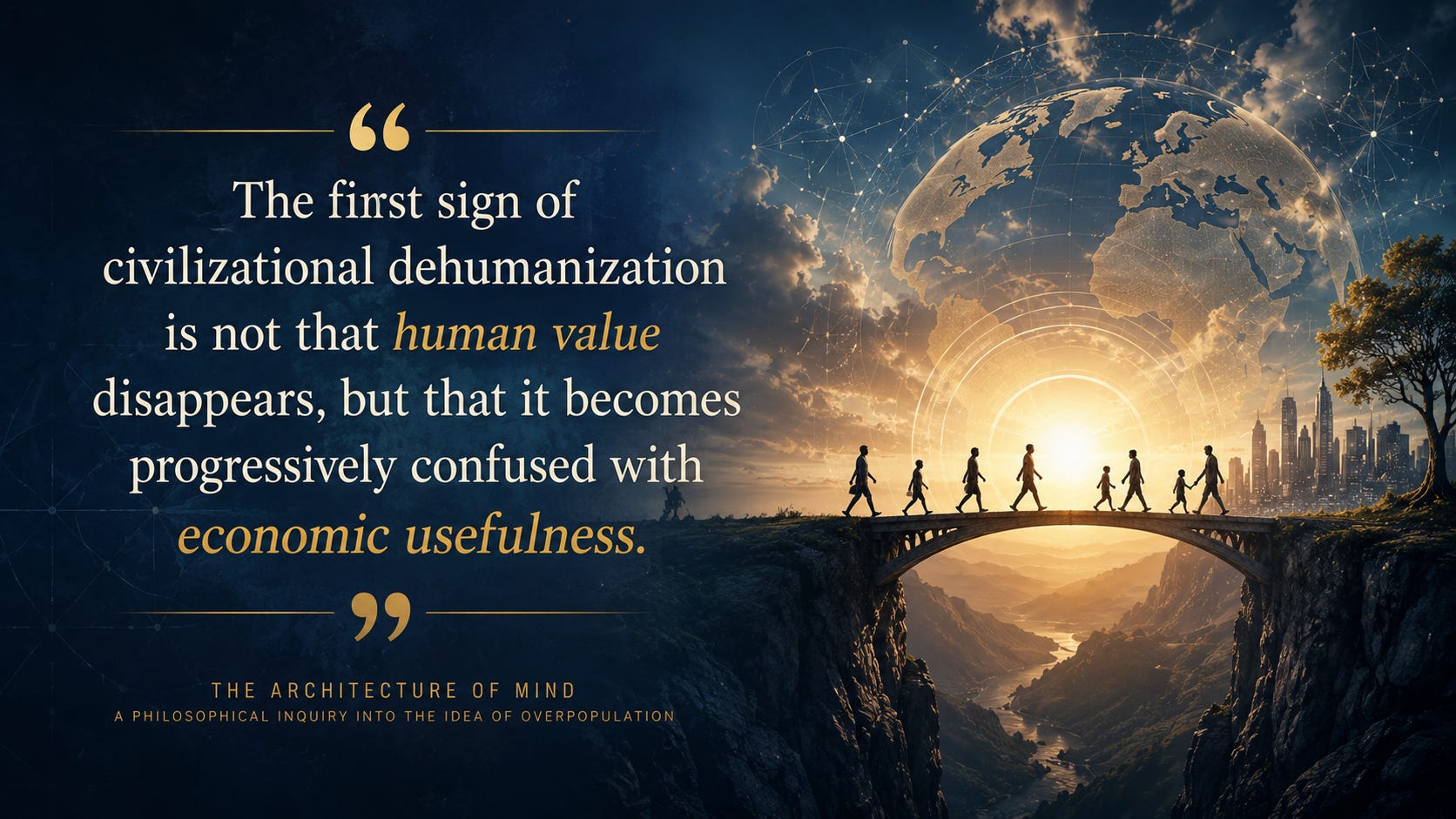
And once these distinctions disappear, dehumanization no longer requires hostility. It can emerge simply through ordinary habits of evaluation. Perhaps this is the most discreet transformation of all: The greatest reduction of human value does not occur when societies openly reject human dignity, but when they quietly replace recognition with economic usefulness.
Artificial Intelligence Beyond Automation
Public discussions surrounding artificial intelligence are often dominated by a single concern. Will intelligent machines replace human workers?
This question is understandable. Automation has already transformed manufacturing, logistics, communication, finance, transportation, and an increasing number of cognitive professions. Advances in machine learning now extend this transformation into domains once considered uniquely human: language, diagnosis, education, creativity, legal reasoning, scientific research, and artistic production.
From an economic perspective, these developments naturally provoke concern regarding employment, productivity, and the future organization of labour. Yet this question, important though it is, remains incomplete. It assumes that the principal consequence of artificial intelligence concerns work.
The present essay proposes a different perspective. The most profound transformation introduced by artificial intelligence may not concern employment itself. It may concern the criteria through which civilizations recognize human value. This distinction is subtle, and its consequences are immense.
Throughout history, societies have rarely recognized human beings in purely abstract terms. Recognition has almost always been mediated through visible forms of contribution. In different civilizations, these mediations have taken different forms: physical strength, agricultural production, military service, craftsmanship, property, religious authority, scientific knowledge, political responsibility, professional expertise, and economic success. These activities never created human value; they made human value socially visible. Recognition has therefore always followed pathways established by civilization itself. Artificial intelligence alters these pathways.
When machines progressively assume functions once regarded as uniquely human, they do more than replace specific forms of labour; they modify the symbolic relationship between contribution and recognition. This transformation deserves careful philosophical attention.
A civilization that has long associated recognition with productive participation may gradually discover that productivity itself has become increasingly independent of human participation. The consequences extend beyond economics; they reach into the structure of social identity.
For many individuals, occupation represents more than a source of income. It provides meaning, belonging, responsibility, competence, recognition by others, and participation in a shared world.
If automation progressively assumes growing portions of productive activity, civilizations will eventually confront a question that cannot be answered by economic policy alone. How should societies recognize persons whose humanity no longer coincides with economically indispensable functions?
This question concerns neither unemployment nor technology alone. It concerns civilization itself. Artificial intelligence therefore introduces a paradox. The more efficiently technology performs human functions, the less obvious the traditional foundations of social recognition may become.
Civilizations may respond in different ways. They may continue identifying recognition primarily with economic productivity, thereby increasing the social invisibility of those whose functions have become technologically replaceable. Or they may gradually rediscover forms of recognition that were never fundamentally dependent upon economic usefulness.
This distinction recalls one of the central insights of the Theory of Reflective Human Value. Human value is not produced by function. Function merely provides one historical avenue through which societies have chosen to recognize persons. When the avenue changes, human value does not disappear. Only the civilization’s habits of recognition require transformation.
In this sense, artificial intelligence does not create the philosophical problem. It reveals one that has existed for centuries. The increasing autonomy of intelligent systems simply exposes an assumption modern societies have rarely examined: that economic participation and human recognition have become almost inseparable. Artificial intelligence compels civilization to decide whether this assumption should continue.
Perhaps the greatest challenge of artificial intelligence is therefore not technological adaptation. It is civilizational imagination. Can societies learn to recognize human beings independently of the productive functions through which they have historically become visible?
This question extends beyond employment. It concerns education, healthcare, citizenship, family life, old age, disability, childhood, scientific research, art, and political participation. Every institution through which societies organize recognition will eventually confront the same challenge.
The future of artificial intelligence will therefore depend not only upon algorithms. It will depend upon the philosophical principles through which civilizations choose to recognize themselves. Technological revolutions do not merely transform what human beings do. They transform the social pathways through which human value becomes visible. Whether this transformation ultimately strengthens or weakens our common humanity will depend less upon the intelligence of machines than upon the wisdom with which civilization redefines recognition itself.
For this reason, the greatest question raised by artificial intelligence is not whether machines will become more capable. It is whether civilizations will remain capable of recognizing the human being beyond the functions that machines can perform.
Why Civilization Must Preserve Humanity
Every civilization inherits more than territory, institutions, technologies, and knowledge. It also inherits humanity itself. Long before any political system, economic order, or scientific achievement becomes possible, there already exists a continuous chain of human generations through which every civilization receives its language, memory, culture, and accumulated experience. Civilization is therefore not simply an organization of people living at a particular moment. It is the historical continuity of humanity across time.
This continuity should never be taken for granted. Every generation receives it without having created it. Every generation modifies it through its own choices. Every generation ultimately transmits it to those who will come after. Civilizational responsibility therefore extends beyond the present. It necessarily includes the future conditions under which humanity itself will continue to exist.
For this reason, the present essay proposes what may be called The Principle of Human Continuity. Every civilization worthy of its name must organize not only the recognition of every human being, but also the conditions through which humanity itself can endure across generations.
This principle follows naturally from the Theory of Reflective Human Value. If every human being possesses intrinsic value independently of economic usefulness, then humanity as a continuous historical community cannot itself become merely an instrument of economic calculation.
The preservation of humanity is therefore not primarily a demographic objective. It is a civilizational responsibility. This distinction deserves careful clarification.
The Principle of Human Continuity is neither natalist nor anti-natalist: it does not prescribe an ideal population size; it does not encourage unrestricted demographic growth; nor does it advocate demographic reduction. Questions concerning fertility, public health, family policy, environmental sustainability, migration, and economic planning remain legitimate subjects of democratic deliberation and scientific inquiry.
The present principle seeks something more fundamental. It establishes a philosophical boundary. Humanity itself must never be treated merely as an adjustable variable within broader economic, political, technological, or administrative calculations. Whenever civilizations begin to approach human existence primarily through optimization models, they risk forgetting that every model ultimately exists for humanity—not humanity for the model.
This distinction transforms the entire debate. The central question is no longer: How many human beings should civilization permit? The more fundamental question becomes: How should civilization organize itself so that humanity may continue with dignity across generations? The difference between these questions is profound. The first begins by treating humanity as the object to be managed. The second begins by treating civilization as the structure that must justify itself before humanity.
Throughout history, civilizations have repeatedly reorganized agriculture, commerce, education, medicine, transportation, communication, and political institutions in response to changing historical circumstances. These transformations demonstrate that civilization itself possesses remarkable adaptive capacity. Humanity should therefore not automatically be regarded as the primary variable requiring adjustment whenever new challenges emerge. Sometimes the institutions require transformation. Sometimes the economy. Sometimes technology. Sometimes political organization. Sometimes collective priorities.
The Principle of Human Continuity simply reminds us that before asking humanity to adapt itself to civilization, civilization should first examine whether it has exhausted its own capacity for adaptation. This observation acquires particular importance in an era increasingly shaped by artificial intelligence.
Automation, demographic transitions, ecological concerns, and technological acceleration will undoubtedly require profound institutional change during the coming decades.
Yet these transformations should never lead civilizations to regard humanity itself as a problem requiring technical optimization. Civilization exists because humanity exists. Its institutions derive their legitimacy from serving human beings, not from replacing them. Human continuity is therefore not merely a biological process. It is the uninterrupted transmission of memory, language, culture, knowledge, responsibility, and recognition from one generation to the next.
Without this continuity, civilization loses the very subject whose existence justifies its institutions. Perhaps this is the deepest implication of the Principle of Human Continuity. A civilization worthy of its name does not begin by asking how many human beings can be sustained. It begins by asking how humanity itself can be sustained with dignity. For civilization is not measured by the efficiency with which it manages populations. It is measured by the wisdom with which it preserves the continuous adventure of being human.
The Real Question beyond overpopulation
Throughout this essay, one central intuition has gradually emerged. The debate surrounding overpopulation is not fundamentally a debate about numbers. It is a debate about civilization. For more than two centuries, discussions concerning demographic growth have largely been framed as questions of capacity. Can the Earth sustain an increasing number of human beings? Can economies provide sufficient resources? Can ecosystems absorb expanding patterns of consumption? Can technological innovation compensate for growing demands?
These questions remain important. Yet they all presuppose something that is rarely examined. They assume that civilization itself already provides the appropriate framework within which such questions should be asked. The present essay has proposed a different approach.
Before asking whether humanity has reached its limits, we should first ask whether our inherited models of civilization have reached theirs. This distinction changes everything. Perhaps the central challenge of the twenty-first century is not demographic expansion. Perhaps it is the growing difficulty of imagining forms of civilization capable of preserving human recognition under entirely new historical conditions.
If this is true, then overpopulation appears in a different light. It becomes less a description of objective reality than an interpretation produced within particular civilizational assumptions. The question therefore shifts. No longer: How many human beings can the Earth sustain? But rather: What kind of civilization are we trying to sustain?
This question reaches deeper than demography. It reaches the philosophical foundations through which societies understand themselves.
Every civilization organizes production. Every civilization develops institutions. Every civilization distributes responsibilities. Every civilization defines justice. Every civilization creates technologies. Yet beneath all these visible structures lies a more fundamental activity. Every civilization decides—implicitly or explicitly—how human beings will recognize one another.
This observation brings us back to the central definition proposed in the previous interlude. A civilization is the way a society organizes the recognition of human value. Once this definition is accepted, demographic debates acquire an entirely different meaning. Population itself no longer appears as an isolated variable. Its interpretation depends upon the conception of civilization from which it is observed.
A civilization that primarily values economic productivity will naturally interpret demographic change through the language of labour markets, fiscal sustainability, and productive efficiency. A civilization organized around technological optimization may increasingly evaluate humanity according to measurable performance.
Another civilization may place greater emphasis upon social cohesion. Another upon political participation. Another upon ecological balance. Another upon cultural continuity. Each will formulate the demographic question differently because each begins from a different conception of what civilization exists to preserve.
This insight reveals why disagreements concerning population often prove so difficult to resolve. Participants frequently believe they are debating demographic facts. In reality, they are often defending different philosophies of civilization. The disagreement therefore lies at a deeper level than statistics alone can resolve. Numbers describe populations; they do not determine the meaning civilizations assign to those populations.
For this reason, the most important question of our century may not concern population growth at all. It may concern the principles according to which civilization itself chooses to organize recognition, dignity, responsibility, and coexistence.
Artificial intelligence, demographic transitions, ecological pressures, economic restructuring, and geopolitical instability all converge toward the same underlying challenge. Not simply how to manage increasingly complex societies; but how to preserve the humanity that gives those societies their legitimacy.
The Theory of Reflective Human Value offers one possible response. If human value remains intrinsic rather than conditional, if recognition remains the foundation of civilization, and if human continuity constitutes a civilizational responsibility, then demographic questions can no longer be treated independently of the philosophical principles through which civilization understands the human person.
The future therefore depends less upon determining how many human beings should inhabit the Earth than upon determining what conception of humanity our civilizations choose to cultivate. Perhaps this is the real question of the twenty-first century: not whether humanity has become too numerous, but whether civilization has remained sufficiently human to recognize the value of humanity itself. For civilizations are ultimately judged neither by the magnitude of their economies nor by the sophistication of their technologies. They are judged by the image of humanity they choose to preserve.
The Future We Have Not Yet Learned to Ask
Every age believes that it understands the questions defining its own future. History suggests otherwise.
Looking backward, civilizations often appear surprisingly confident in the permanence of the assumptions through which they interpreted their world. Economic systems seemed immutable, political institutions appeared self-evident, scientific paradigms were taken as definitive descriptions of reality, even the questions themselves appeared so natural that few imagined they might one day be reformulated.
Yet history rarely unfolds according to inherited expectations. Civilizations seldom disappear because they fail to answer the great questions of their time. More often, they decline because they continue answering questions whose underlying assumptions have quietly become obsolete. The questions survive, but the world beneath them has already changed. Perhaps this is the deepest lesson offered by the present reflection.
The debate over overpopulation is not merely a demographic discussion. It reveals something more fundamental. It invites us to examine the intellectual frameworks through which civilization has learned to interpret humanity itself.
Throughout this essay, we have not attempted to prove that concerns regarding population, ecology, technological change, or economic organization are illegitimate. On the contrary. Each of these concerns raises genuine and often urgent questions. But genuine questions deserve an equally genuine philosophical examination. They deserve to be situated within the historical, conceptual, and civilizational contexts that gave them meaning.
For no question is ever entirely innocent. Every question already contains an image of reality. Every question privileges certain possibilities while rendering others almost invisible. Every question reflects a conception of what civilization believes itself to be. To examine our questions is therefore not an intellectual luxury. It is one of the deepest responsibilities of civilization.
Perhaps the future will not judge our generation primarily by the technologies we created, the wealth we accumulated, or even the environmental challenges we confronted. Perhaps it will judge us by something more subtle. By whether we remained capable of questioning the assumptions that seemed too obvious to question.
The Theory of Reflective Human Value was born from one such effort. It began with a simple intuition: that the value of one human being cannot be denied without ultimately weakening the foundations upon which every other human being seeks recognition.
From that intuition emerged a broader reflection on civilization itself. If civilization is indeed the way a society organizes the recognition of human value, then every debate concerning economics, technology, demography, ecology, or political organization ultimately returns to the same philosophical responsibility: not simply to preserve institutions, but to preserve the humanity for whose sake institutions exist.
This responsibility has no final formula. Every generation must rediscover it under historical conditions unlike those faced by any previous generation.
Artificial intelligence will present questions unknown to earlier civilizations. Climate change will reshape political and economic choices in unprecedented ways. Scientific discoveries will continue expanding the horizons of what humanity can accomplish. None of these transformations relieves civilization of its oldest responsibility: to recognize the human being, to preserve the continuity of humanity, and to remain worthy of the civilization it claims to embody.
Perhaps, then, the most important question facing our century is not whether the Earth can sustain humanity. Nor whether artificial intelligence will surpass human intelligence. Nor even how civilization should organize its economies. Perhaps the question we have not yet fully learned to ask is this: What kind of civilization allows humanity to remain fully human, even as everything else changes?
We do not yet possess a definitive answer. Perhaps no civilization ever will; but philosophy has never advanced by preserving inherited certainties. It has advanced by returning, generation after generation, to the questions that seemed already settled. For every civilization inherits answers. Only the greatest civilizations remain capable of re-examining the questions themselves. And perhaps the future of humanity will depend less upon the certainty of our answers than upon the courage to ask better questions.
Perhaps the first mistake is not to ask whether the Earth can sustain humanity, but whether our civilization has mistaken the limits of its own organization for the limits of the human species.
The future of civilization will not depend solely on the answers we give to the questions we inherit. It will depend, above all, on our courage to examine whether those questions still deserve to be asked in the same way.
Perhaps the question is not how many human beings the Earth can sustain, but how much of the architecture through which we organize human existence we have actually understood. A population does not experience the Earth directly. It experiences an architecture of access: institutions, technologies, economies, infrastructures, ecological systems, political arrangements, and cultural assumptions. What appears as a natural limit may therefore sometimes be the visible consequence of an invisible organization.
The deepest civilizational challenge may therefore be neither to increase nor to reduce humanity, but to understand the architecture within which humanity is asked to live.
Bibliography
Arendt, Hannah. The Human Condition. 2nd ed. University of Chicago Press, 1998.
Bostrom, Nick. Superintelligence: Paths, Dangers, Strategies. Oxford University Press, 2014.
Diamond, Jared. Collapse: How Societies Choose to Fail or Succeed. Viking, 2005.
Harari, Yuval Noah. Homo Deus: A Brief History of Tomorrow. Harper, 2017.
Heidegger, Martin. The Question Concerning Technology and Other Essays. Translated by William Lovitt. Harper & Row, 1977.
Jonas, Hans. The Imperative of Responsibility: In Search of an Ethics for the Technological Age. University of Chicago Press, 1984.
Keynes, John Maynard. “Economic Possibilities for Our Grandchildren.” In Essays in Persuasion, 321–332. Macmillan, 1931.
Malthus, Thomas Robert. An Essay on the Principle of Population. Edited by Geoffrey Gilbert. Oxford University Press, 1999. First published 1798.
Marx, Karl. Capital: A Critique of Political Economy. Vol. 1. Translated by Ben Fowkes. Penguin Classics, 1976.
Meadows, Donella H., Dennis L. Meadows, Jørgen Randers, and William W. Behrens III. The Limits to Growth. Universe Books, 1972.
Nussbaum, Martha C. Creating Capabilities: The Human Development Approach. Harvard University Press, 2011.
Polanyi, Karl. The Great Transformation: The Political and Economic Origins of Our Time. Beacon Press, 2001.
Rawls, John. A Theory of Justice. Rev. ed. Harvard University Press, 1999.
Sen, Amartya. Development as Freedom. Alfred A. Knopf, 1999.
United Nations Development Programme. Human Development Report 2023/2024. United Nations Development Programme, 2024.
About The Author
Alexis O. Kaya is a physician, neuroscientist, philosopher, and author whose work explores the fundamental principles that organize human existence across biology, cognition, and civilization. Trained in medicine and engaged in research in the neurosciences of learning, memory, and human development at the Université de Montréal, his scholarship seeks to bridge empirical science with philosophical inquiry in order to uncover the structural foundations of human experience.
His research investigates the architectures through which neural systems develop, memories endure, identities emerge, and civilizations organize the recognition of human value. Rather than studying isolated phenomena, he is interested in the organizing principles that govern continuity, development, and transformation across multiple levels of reality—from neural networks to human societies.
His current work brings together neuroscience, philosophy, developmental science, and ethics to examine how minds, institutions, and civilizations evolve over time. Across these fields, he pursues a common question: What are the underlying structures that make continuity possible—within the brain, within the self, and within humanity itself?
Through The Architecture of Mind, he develops an interdisciplinary body of work that seeks not merely to answer contemporary questions, but to examine the deeper assumptions from which those questions arise. His writings advocate a philosophy grounded in scientific rigor, conceptual clarity, and the conviction that lasting intellectual progress begins by learning to ask better questions.