

By Alexis O. Kaya, MD, PhD, Neuroscientist.
The idea that we must choose our own path is so familiar that we rarely stop to question it. We are encouraged, explicitly or implicitly, to decide what we want to become, set objectives and priorities, make plans, seize opportunities, and overcome whatever stands between us and the future we envision. If a plan succeeds, we call it an achievement; if it fails, we look for what went wrong—a decision, a missed opportunity, insufficient effort, an unforeseen obstacle, or an unfortunate circumstance. In either case, we tend to take one assumption for granted: our lives are fundamentally ours to design.
Yet this assumption may be only partly true. Are we confusing the ability to choose a direction with the ability to choose the path itself? Perhaps freedom consists less in determining what will happen than in remaining capable of becoming when events no longer correspond to our expectations.
It is this question that has increasingly occupied me, though I do not regard my own experience as a universal model of human existence. A single life cannot constitute a statistical law, but it can bring into view something that abstraction leaves obscure: within a particular experience, we may recognize structures that extend beyond it.
I have repeatedly found that I can plan with considerable care, choose a direction, invest time in it, and believe I know where I am going, only for something to happen that I did not choose. It may be significant or almost trivial: a financial constraint, a delayed journey, a forgotten document, an unexpected obligation, a change in circumstances, or a failure. An opportunity disappears or arises unexpectedly, or the circumstances change through another person’s actions or the physical world itself.
When these circumstances alter the plan, success or failure is no longer the only question: what does freedom mean when the path itself changes? Perhaps we have not considered this carefully enough. Before asking people to choose their own paths, we might ask who decided that a human life should unfold along a path that could be chosen in advance.
I. The fiction of the chosen path
We do not begin our lives by choosing; we arrive in a world that already surrounds us. Before we possess language or understand institutions, money, property, work, family, law, education, geography, culture, and social expectation already have consequences for our existence.
We inherit this world before acquiring the capacity to question it, and inheritance does not necessarily imply consent. Yet what we inherit can become so familiar that we cease to distinguish the natural from the constructed, the necessary from the contingent, or what we have chosen from what was simply there when we arrived.
A child does not decide that land must be owned, food purchased, or shelter paid for, nor choose the language that will first organize thought. The economic system, governing institutions, and historical moment into which the child is born are likewise given. As the child becomes an adult, however, these structures may come to appear not merely as circumstances, but as reality itself.
Here lies one of civilization’s quiet powers: a sufficiently old construction can become indistinguishable from nature. We forget that many of the conditions under which we live were made by people who preceded us, with different knowledge, under different circumstances, and within different limitations.
Remembering how these conditions came into being does not necessarily make them wrong. It does, however, acknowledge that what human beings have made remains, at least in principle, open to examination.
Such examination becomes difficult, however, when familiarity renders an architecture invisible. We ordinarily question the direction in which we walk, not the floor on which we stand. Perhaps philosophy sometimes needs to reverse that perspective and ask what the floor is made of.
II. Who built the world we were given?
Once we begin to see this architecture, it becomes harder to imagine freedom as an individual facing an open field of possibilities, ready to choose, decide, act, and become. The field is never entirely open: every life begins under conditions that precede individual choice. These may be biological, geographical, historical, social, economic, institutional, or accidental. Some are made by human beings; others emerge from interactions among all of these.
These conditions belong to several architectures that we inhabit at once. Nature has laws we did not create, and the organism has a fundamental design we did not choose. Much of society was constructed before our arrival, while the economy organizes resources, labour, exchange, and value, and knowledge makes some possibilities visible while leaving others obscure. The architecture of the self also changes continuously: experience becomes memory, memory becomes interpretation, and interpretation contributes to identity. None of these architectures lies entirely within individual control.
To acknowledge these limits is not to resign ourselves to helplessness. It may be how we arrive at a more realistic understanding of freedom, since pretending that constraints do not exist cannot free us from them. We need to see where the walls are: which belong to nature and which were built by human beings, which can be moved or crossed, and which must, for now, be accepted. Others may only seem to be permanent features of reality. Before choosing, then, we may first need to see.
III. Nature does not negotiate
Planning makes this difficulty especially apparent. As a plan becomes more detailed, the future can seem to acquire solidity: we give shape to what has not yet happened. Yet careful consideration does not oblige the future to respect our plans. Nature does not negotiate with intention.
Meanwhile, the body changes, time passes, other people act, resources disappear, and circumstances shift.
Within this changing world, a road closes or a journey is delayed; an opportunity vanishes while another appears. Such unexpected events can suddenly change the architecture of possibility.
I have experienced this in circumstances that might look insignificant to someone else. A day may begin with a clear plan, then one event disrupts it and another follows, until what seemed possible that morning is no longer possible a few hours later.
These events need not announce how much they will matter. One obstacle may have been enough to change the plan, and then a second arrives that would have changed it anyway. It is tempting to become angry, ask who is responsible, and look immediately for what went wrong. Yet perhaps we need to observe what has happened before deciding what it means.
Taking that time is not the same as remaining passive; it means not mistaking an interrupted plan for a destroyed life. We know that the plan has changed, but what this change will ultimately mean is still unknown.
IV. There may be no wrong path
The more I reflect on this uncertainty, the less comfortable I become with dividing life’s paths into good and bad ones. This does not make suffering unreal, injustice acceptable, or every outcome desirable. Pain can be pain, loss can be loss, and failure can be failure. Still, we can recognize what an experience is at a particular moment without claiming to know what it will mean within the whole of a life.
An obstacle that delays a project, for example, may leave time for revision, during which a weakness becomes visible and can be corrected. The project may then become something different from what it would have been had the obstacle never occurred.
The obstacle was not necessarily good or bad; it belonged to the architecture through which the project took its eventual form. Yet we are often tempted to judge events before giving ourselves time to understand them.
When we do so, an interruption becomes a failure in our eyes, a delay becomes misfortune, and a lost opportunity seems to close the path. Perhaps we are assigning meaning to events before they have finished acting upon us.
Life remains unfinished in time, and its meaning remains unfinished too. Years later, an event that once seemed decisive may hardly matter, while something we scarcely noticed may have changed the direction of our life. This calls for humility: what hurts is not always harmful, and what pleases is not always beneficial. A delay need not set us back, just as an apparent advance need not take us forward. We come to understand the path gradually, even as we ourselves change.
V. The freedom to adapt
Where does this leave freedom? If it meant complete control, none of us could be free, since no human being controls all the conditions of their existence. Perhaps a more modest definition would also be a more profound one.
Freedom may be the capacity to remain an author when the path changes: although we do not author everything that happens to us, we participate in authoring what we become through those events.
Such authorship is no fantasy of omnipotence: the free human being does not command reality, but can encounter it without immediately surrendering the authorship of the self.
An unexpected event may alter what we can do without necessarily determining who we must become; a limitation may close one possibility while leaving another open. Even when circumstances require adaptation, adapting need not mean submitting. To be forced to change one’s circumstances is not the same as being reduced to the identity they appear to impose.
This is why I increasingly think of freedom not as an absence of constraints, but as a capacity for adaptive authorship within the changing relationship between the individual and the world. Patience may matter for the same reason. Instead of simply waiting for something to happen, we can refrain from interpreting too soon, giving reality time to reveal enough of itself to be understood. We listen, observe, adapt, and continue. Sometimes the wisest action is not to force the path open, but to understand why it has changed.
VI. The time we need to become
Patience draws our attention to another condition of human freedom that rarely receives sufficiently serious consideration: time.
We need it not merely to act, but to understand. An answer rarely ends a question; more often, it raises another, which changes the earlier answer and reveals a further possibility. Understanding unfolds through this movement, over time.
Here the difference between information and the human experience of knowledge becomes clear. Contemporary technological systems can return information almost immediately, but we cannot acquire understanding at the same speed.
For an idea to change the organization of what we already know, we need time. An interruption sometimes provides it: outwardly, little seems to be happening, yet inwardly the pause may be productive. A limitation may thus allow something to emerge that abundance does not.
In my own work, I have sometimes found that an interruption allows ideas to become explicit, while the mind continues working even though external activity has stopped. We are not processors merely waiting for another input. We need intervals and repetition, time to forget and return, to reconsider what remains uncertain, and to reconstruct after failure. A question needs room to become another question. Perhaps this helps explain why an excessively accelerated civilization can become difficult to inhabit.
If delays are treated as inefficiency, pauses as lost productivity, and hours measured by their economic output, we risk losing sight of the time in which a human being becomes a human being.
VII. When time becomes a commodity
To recognize this risk is not to make money the enemy of human existence, work the enemy of freedom, or economic organization inherently opposed to dignity. We need material resources; civilizations need organization, and work creates goods and services. Money can facilitate exchange, while institutions allow people to cooperate on a scale they could not otherwise achieve.
The difficulty begins when one measure of value becomes so dominant that others are hard to perceive. An hour can become a unit of income, a day a unit of productivity, and a life a sequence of economic outputs. Yet that same hour might be spent studying, thinking, being with a child, or developing an idea whose economic value is not yet visible. It may be time in which a person becomes someone they were not before—existentially productive, even if not immediately productive in economic terms.
It is with these other forms of value in mind that I question whether maximizing income necessarily maximizes the value of one’s life. There are moments when preserving time for education, research, creation, family, or personal development may reasonably matter more than earning additional money.
Choosing this need not mean abandoning economic responsibility; it may be another way of assuming it. The decision concerns how much of our finite existence we exchange for financial security, and how much we preserve for becoming. Alongside “How much can I earn?” we might ask a further question: “What am I giving my time to become?”
VIII. The space in which a human being can become
Time alone, however, is not enough: we also need space. By this I mean not simply geographical space, but a sufficiently secure field of possibility from which to begin constructing a life—existential space.
This need brings us back to a strangely simple question: why should a human being have to purchase the right to occupy a place in the world into which they were born?
Asking this is not to argue against property, which can provide stability, responsibility, autonomy, continuity, and protection. Property and freedom are nevertheless not identical.
Owning property does not prevent someone from depending profoundly on systems beyond their control. Conversely, a person with very little individual property may still have meaningful access to what existence requires. The question is not simply whether to favour absolute individual ownership or absolute collective provision, but whether people have access to the foundations from which autonomy can emerge.
Such foundations give a person somewhere to begin, with some security, access to fundamental necessities, and opportunities to learn, live with others, and construct a life they can call their own. What matters is not that everyone receive an identical form of property, but that existence should not have to be economically justified before autonomy can begin.
Civilizations can organize property, exchange, and labour in many ways. Whatever architecture they adopt, we should still be able to ask whether it preserves the possibility for a human being to become.
IX. Identity is not an inheritance
Becoming also has a more intimate dimension: identity. We no more choose our initial identity than the world into which we are born. Before we can examine it, we receive a name, a language, a family, a culture, a history, and a social position, along with expectations, descriptions, and categories—sometimes beliefs, obligations, or wounds as well. Some of these inheritances become deeply valuable.
Other inheritances may become harder to live with, though they need not determine our destiny. Dignity may then involve more than being recognized by others: it may also involve becoming the author of who we are. We do not thereby become sovereign authors of reality or creators of every circumstance, but we can author the self that emerges through them.
Identity, then, cannot be reduced to choice when choice itself takes place within conditions. We become who we are through what is given and what happens, through what we understand, resist, accept, and transform. Rather than creating ourselves from nothing, we work with what we inherit. Perhaps this is where responsibility reaches deepest: we need not earn the right to exist, but we are responsible for the dignity with which we inhabit the existence we have received.
X. A civilization that must learn again
If human beings remain unfinished, perhaps the same must be true of the civilizations they construct. Far from being a weakness, this incompleteness may be a condition of intelligence.
Science offers an instructive comparison. A discovery may seem to provide an adequate explanation until a later observation reveals its limits, leading us to extend, refine, correct, or replace our earlier understanding. Progress does not require us to dismiss every previous understanding as worthless, but to keep each open to questioning. Why should civilization be different?
Because institutions are made by people who are themselves limited, we should expect them to have limits too. A rule may solve one problem while creating another, just as an institution may protect some people while unintentionally excluding others. Economic abundance may bring previously invisible dependencies, and a social structure that functions in one historical period may become inadequate in another. None of this means that every institution should be dismantled; it means they should remain open to examination. A civilization that considers its architecture complete may be the least capable of seeing its own walls.
XI. The human question
What should we ask when we examine these institutions? Perhaps the most important thing is not to find a perfect arrangement, but to keep the right question alive. Whenever we make important decisions, transform institutions, advance technology, reform economies, or devise new ways of organizing life, we might ask: does this continue to place human value at the centre?
The question asks neither for a perfect guarantee of freedom nor for the satisfaction of every desire, and it does not require every social structure to serve individual preference. We live together: our freedoms intersect, our responsibilities conflict, our needs and capacities differ, and our decisions affect one another. No final architecture can be expected to resolve every tension.
Our task, then, is not to eliminate the complexity of human existence, but to remain capable of recognizing the human being within the systems we construct.
Doing so requires us to accept that we may be wrong. Our institutions may be incomplete, and an assumption we believe we have examined may simply be one we inherited. A solution may have consequences we never anticipated; even our understanding of freedom may prove insufficient as our sense of human value deepens. The answer cannot be a final system, but must remain a question we are willing to pursue.
XII. The architecture we have not yet learned to see
This brings us back to the beginning of freedom. We often place it at the moment of choice, but perhaps it begins before that, when we first see the architecture within which we choose.
Without that awareness, constraint can look like fate, habit like necessity, and an institution like nature. We may take an inherited identity for destiny, an interruption for failure, or a delay for loss; speed may pass for progress, and accumulation for freedom. An entire life can be spent responding to structures we never learned to see. Once they become visible, another possibility emerges—not necessarily escape or revolution, but sometimes simply understanding.
With this awareness, we may discover that one constraint can be negotiated even if another cannot, or that leaving one path leaves another open. We may change an institution, refuse an expectation, re-examine an identity, or use a delay as time to think. Seeing the architecture does not give us power over everything; it makes us less blind. Perhaps freedom can realistically mean this: not escaping reality, but no longer confusing it with everything we have been told about it.
An unfinished path
Perhaps we were never meant to choose the whole path; it may be beyond any human being’s capacity. We choose directions, make plans, build expectations, and imagine futures, but reality responds in ways we cannot always foresee. Sometimes a door opens or closes; we are slowed or forced to turn, given something unexpected or deprived of something we had. We cannot always know, as it happens, what any of this will mean.
This uncertainty need not oppose freedom; it may help make freedom meaningful. If everything were known, all paths determined, and every consequence visible in advance, little would remain to discover: the path would be a calculation. Yet human existence is not a completed calculation, but an unfolding. In a world we did not choose, under conditions we did not create, we encounter events we cannot fully control and respond by adapting, learning, questioning, reconstructing, and becoming. Identity emerges through this movement, not as an object fixed at the outset, but as the evolving expression of how we have inhabited what life placed before us.
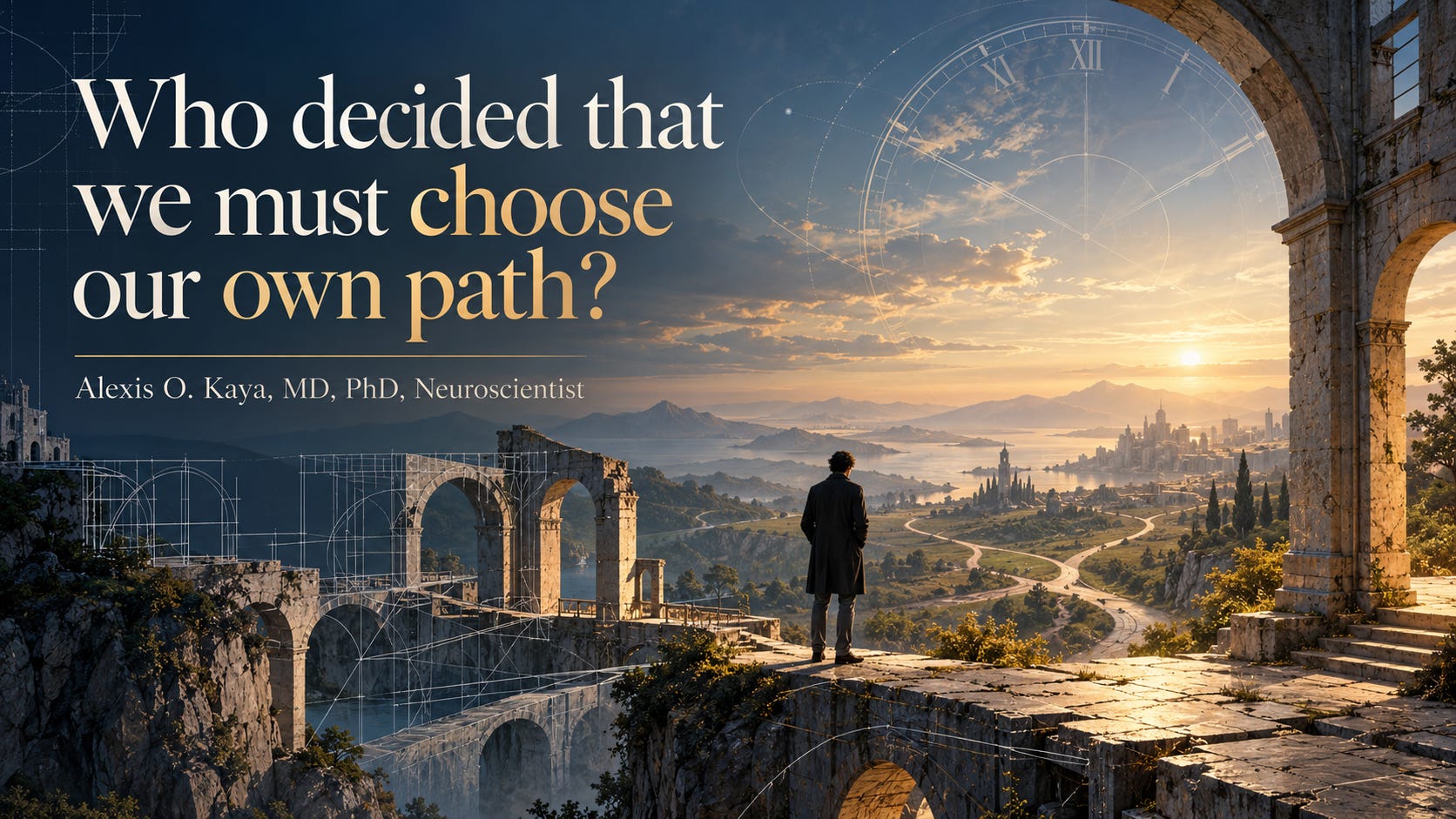
Perhaps the question “Who decided that we must choose our own path?” leaves a deeper one unanswered: who told us that freedom required us to control the path at all?
Freedom may lie less in determining everything that happens than in remaining awake when the path changes: listening before judging, adapting without disappearing, and giving thought time before surrendering to urgency. We may need to preserve time for understanding and learn to recognize the structures around us without taking them for the whole of reality. We may become authors of our identities without imagining ourselves authors of the world. Perhaps living within an unfinished architecture means precisely this—not knowing exactly where the path will lead, yet remaining capable of becoming as we walk it.
The path remains unfinished, as do we. Perhaps that is precisely why something remains to be discovered—not necessarily a new world, but the world already there, waiting to be seen.
Related philosophical and sociological perspectives: suggested further reading
The following works are suggested as further reading on themes adjacent to this independently developed reflection. They were not consulted in its composition and are not presented as sources of its argument, evidence of influence, or endorsements of its conclusions. The connections noted below indicate possible avenues for comparison, not equivalence between the authors’ positions and the present argument.
Berger, P. L., & Luckmann, T. (1967). The social construction of reality: A treatise in the sociology of knowledge. Anchor Books. Suggested connection: the institutional and social processes through which everyday reality becomes familiar and taken for granted, particularly in relation to the inherited architectures discussed in sections I and II.
Ricoeur, P. (1992). Oneself as another (K. Blamey, Trans.). University of Chicago Press. Suggested connection: personal and narrative identity, selfhood, and agency, offering a comparative perspective on the distinction between inherited identity and the authorship of the self in sections V and IX.
Rosa, H. (2013). Social acceleration: A new theory of modernity (J. Trejo-Mathys, Trans.). Columbia University Press. Suggested connection: technological acceleration, social change, and the pace of life, particularly alongside the discussion of time, understanding, and economic measurement in sections VI and VII.
Sen, A. (1999). Development as freedom. Alfred A. Knopf. Suggested connection: substantive freedom, social opportunities, and the relationship between economic resources and the ability to live a valued life, particularly in relation to autonomy and its foundational conditions in sections VII and VIII.
Author : Alexis O. Kaya
Alexis O. Kaya is a physician, neuroscientist, philosopher, and author whose work explores the structures underlying mind, memory, identity, human development, and civilization. His research and philosophical writing examine how biological, cognitive, and social architectures shape the conditions through which human beings become, remember, act, and recognize one another.
His broader work includes the concepts of “Neurotenacity”, “Functional Accessibility”, and the “Theory of Reflective Human Value” (TRHV). Across these projects, a recurring question emerges: what are the underlying structures that make continuity possible—within the brain, within the self, and within humanity itself?
His writing is not intended to persuade, but to explore.