
What truly gives a human being value? This episode explores that question at a moment when artificial intelligence, automation, migration, and global economic change are transforming the foundations of contemporary civilization.
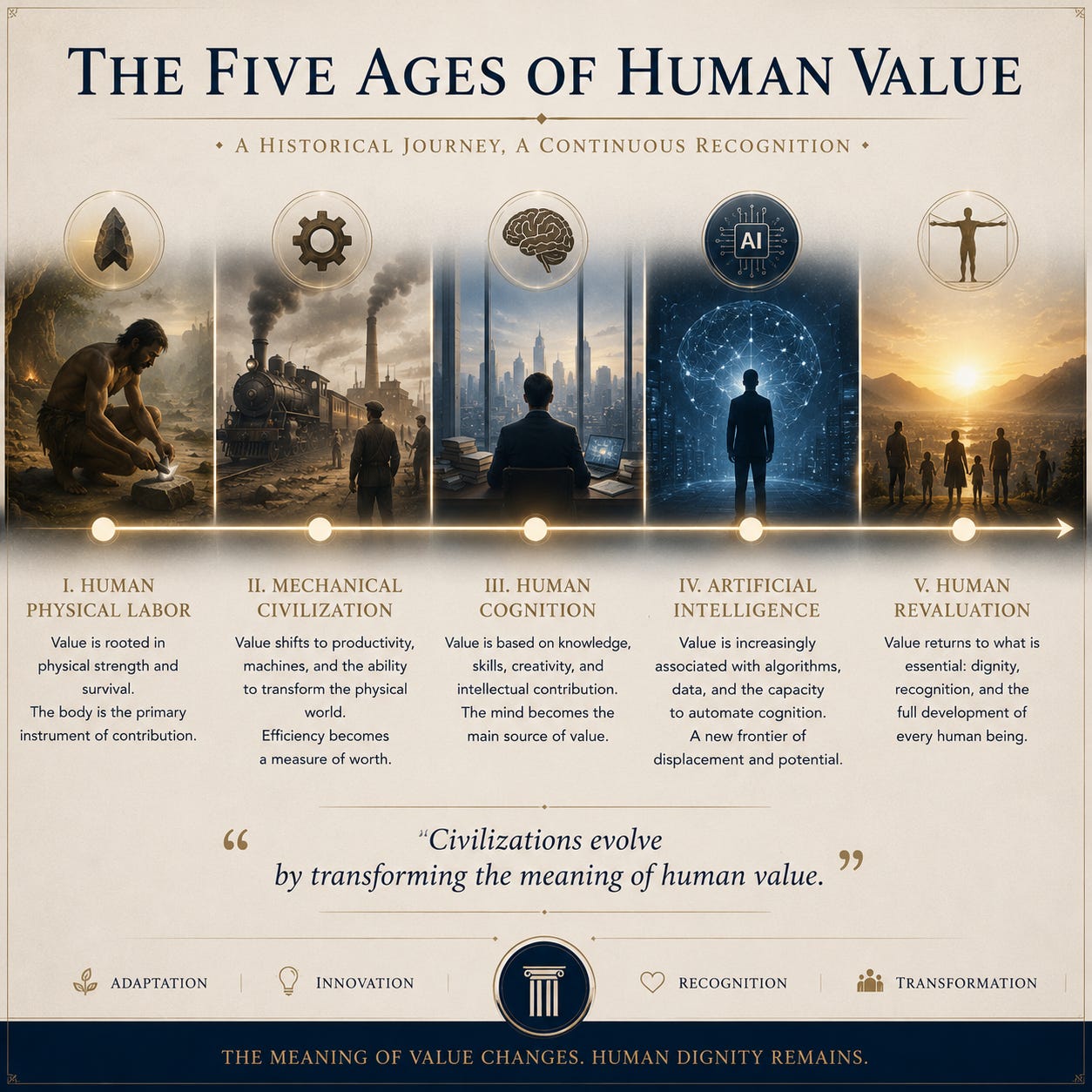
Rather than asking only what societies produce, build, or invent, the episode proposes a deeper question: what does a civilization recognize? Through a long historical perspective, it examines how human value has been associated with physical labor, mechanical production, cognitive ability, and now the challenges introduced by artificial intelligence.
At the center of the reflection is the Theory of Reflective Human Value, which argues that human worth is not created by usefulness, productivity, intelligence, or social status. Human value is sustained through recognition, and the denial of another person’s value ultimately weakens the very foundation upon which our own value depends.
The episode also introduces the Diamond Structure of Human Value, built around four dimensions: ontological value, moral value, social value, and economic value. A civilization becomes truly mature when it preserves all four dimensions and refuses to reduce human beings to their function, origin, performance, or market utility.
The central message is clear: the future will not be judged only by the intelligence of our machines, but by the humanity our civilization is still able to recognize, protect, and affirm.
Alexis O. Kaya, MD, PhD, Neuroscientist.