

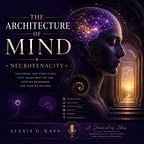

Modern neuroscience has revealed a remarkable paradox: the human brain is one of the most adaptable structures in nature, yet many of its neurons persist for decades, often for a lifetime. In The Immobile Architecture, Alexis O. Kaya explores how the brain learns, develops, and transforms without continuously replacing its fundamental cellular framework. Rather than rebuilding itself, the brain evolves through the reorganization of connections, strengthening some pathways, weakening others, and refining networks through experience.
Drawing on the concepts of neuroplasticity and the proposed principle of Neurotenacity, this essay argues that adaptation and continuity are not opposing forces but complementary necessities. Learning requires change, but memory, identity, and personal history require stability. The brain’s greatest achievement may therefore be its ability to remain itself while continuously transforming.
Through examples from development, memory, learning, and neural architecture, this reflection invites us to reconsider how cognition emerges from the delicate balance between persistence and change. More than a discussion of neuroscience, it is an exploration of one of the deepest questions about mind and identity: How can a system continuously change and yet remain the same? The answer may hold the key not only to understanding the brain, but also to understanding ourselves.
Alexis O. Kaya, M.D., Ph.D., Neuroscientist.


